



Build Your Custom Market Intelligence Report
Customize Your ReportNorth America Synthetic Engine Oils Market Key Highlights
By Product Type:
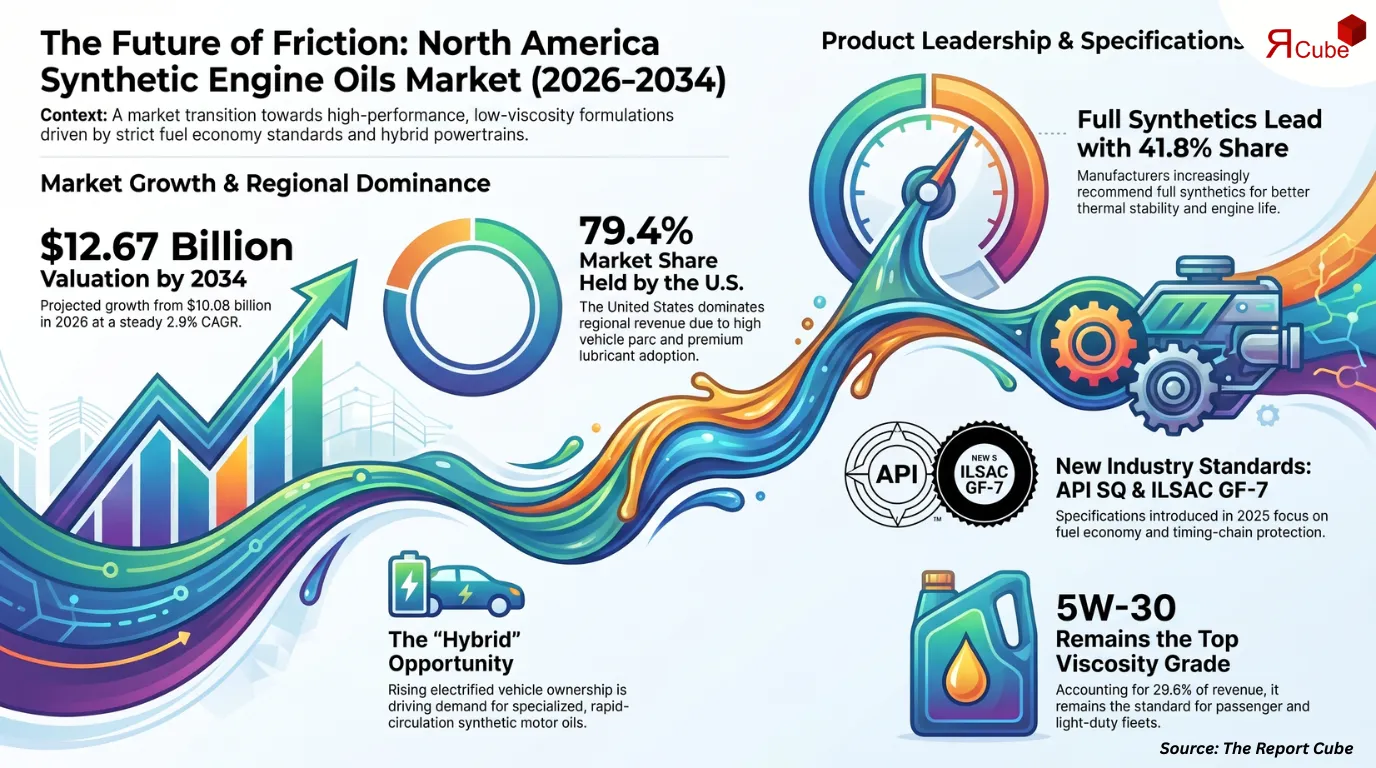
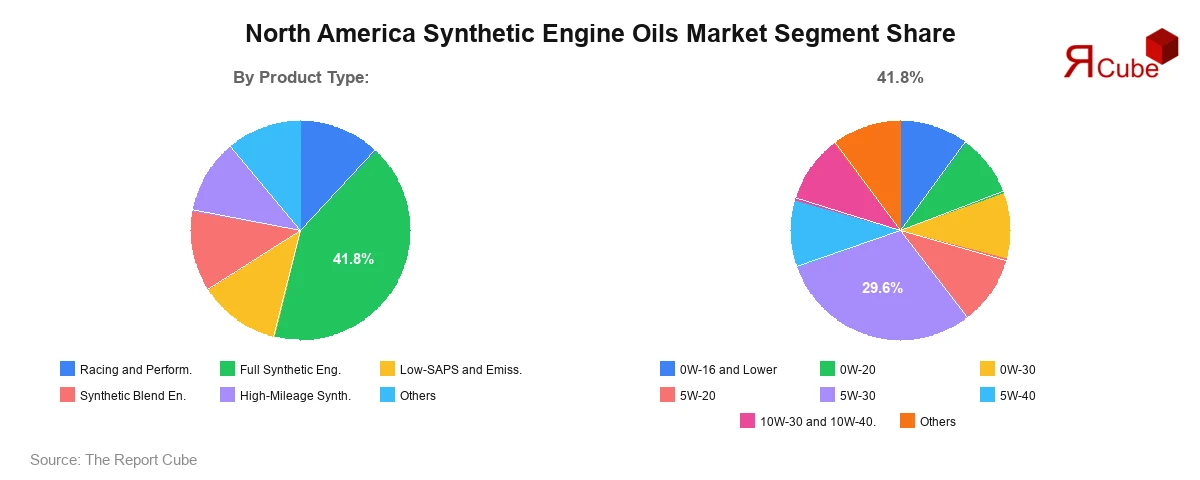
Full Synthetic Engine Oils segment leads the market with approximately 41.8% share.
By Viscosity Grade:
5W-30 segment dominates the market with nearly 29.6% of total revenue owing to its broad compatibility with passenger vehicles and light-duty commercial fleets.
Regional Outlook:
The United States dominates the North America Synthetic Engine Oils Market with an estimated 79.4% share, supported by a large vehicle parc, premium lubricant adoption, and stringent fuel economy regulations.
North America Synthetic Engine Oils Market Insights & Analysis
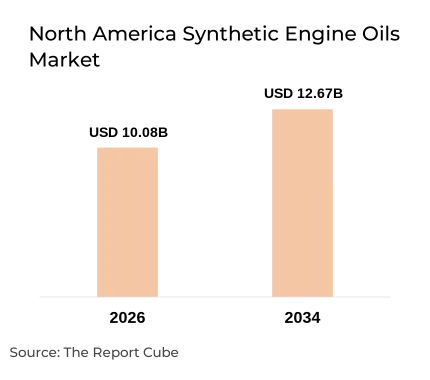
The North America Synthetic Engine Oils Market is anticipated to register a CAGR of around 2.9% during the forecast period of 2026-2034. The market size is valued at USD 10.08 billion in 2026 and is projected to reach USD 12.67 billion by 2034. Demand for premium lubricants continues to rise as vehicle manufacturers introduce engines that operate under higher temperatures, tighter tolerances, and lower-viscosity lubrication requirements. Modern gasoline, diesel, and hybrid powertrains increasingly depend on synthetic engine oils to minimize friction, improve thermal stability, and extend engine life. Passenger vehicles account for the largest share of lubricant consumption, while commercial fleets are steadily adopting synthetic products to reduce maintenance costs and improve vehicle uptime. These factors continue to strengthen the long-term outlook for Synthetic Engine Oils in North America.
Industry participants are investing in advanced base oil technologies, additive chemistry, and product formulations that comply with the latest API SQ and ILSAC GF-7 standards introduced across North America in 2025. These updated specifications support better fuel economy, enhanced timing-chain protection, reduced low-speed pre-ignition risk, and improved engine cleanliness for modern gasoline-powered vehicles. Lubricant manufacturers are also expanding hybrid-specific product portfolios as electrified vehicle ownership continues to increase across the region. At the same time, growth in professional service centers, dealership maintenance programs, and digital lubricant distribution channels is improving product accessibility. These developments are expected to sustain steady revenue growth and reinforce the competitive position of the North America Synthetic Engine Oils Market throughout the forecast period.
North America Synthetic Engine Oils Market Impact Analysis
| Factor | Type | Specific Impact on Market | Magnitude | Business Implication |
|---|---|---|---|---|
| Growth in Light Vehicle Parc | Market | More cars on road sustain demand for high grade oils | High | Supports volume growth for synthetic lubricant brands |
| OEM Shift to Low Viscosity Oils | Technological | Factory fill uses synthetics to enhance fuel efficiency | High | Encourages premium product positioning with OEM ties |
| Extended Drain Interval Adoption | Consumer | Drivers prefer oils that allow longer service intervals | Medium | Raises share of long life synthetic lubricant ranges |
| Stricter Emission and Fuel Norms | Regulatory | Standards require advanced formulations for cleaner burn | High | Pushes R&D spend toward compliant additive packages |
| Performance Brand Differentiation | Competitive | Global majors promote superior wear and thermal control | High | Demands clear benefit messaging and motorsport tie ups |
| Electrification of Vehicle Fleet | Environmental | EV share growth gradually softens long term engine oil use | Medium | Requires diversification into hybrid and EV fluid products |
| Digital Retail and Service Platforms | Technological | Online channels simplify access to premium oil brands | Medium | Enables direct consumer marketing and subscription offers |
North America Synthetic Engine Oils Market Dynamics
Key Driver: Rising Adoption of High-Efficiency Engines Requiring Advanced Lubrication
Automotive manufacturers across North America continue to develop engines with smaller displacement, turbocharging, direct fuel injection, and hybrid technologies to improve fuel efficiency while maintaining vehicle performance. These advanced engine designs require synthetic lubricants capable of maintaining viscosity under severe operating conditions and providing reliable protection against oxidation, deposits, and wear. Compared with conventional lubricants, synthetic engine oils offer greater thermal stability and improved low-temperature performance, helping engines operate efficiently across diverse climatic conditions. These technical advantages continue to increase the adoption of premium lubricants throughout the automotive sector.
Fleet operators, commercial vehicle owners, and individual consumers are also recognizing the operational benefits of synthetic lubricants, including longer service intervals, reduced maintenance frequency, and improved engine durability. Automotive manufacturers increasingly specify full synthetic oils as factory-fill and recommended service products for newer vehicle platforms. As the average age of vehicles remains relatively high across North America, demand for high-performance lubricants capable of protecting aging engines while supporting modern emission systems is expected to remain stable throughout the forecast period.
Industry Trend: Transition Toward Lower-Viscosity Synthetic Engine Oils
Vehicle manufacturers are steadily recommending lower-viscosity grades such as 0W-16 and 0W-20 to improve fuel economy and reduce greenhouse gas emissions without compromising engine protection. This transition is encouraging lubricant producers to develop advanced formulations that maintain excellent wear resistance, oxidation stability, and deposit control while meeting increasingly stringent industry specifications. As more newly manufactured vehicles require these grades, product portfolios across the North America Synthetic Engine Oils Market continue to evolve toward premium low-viscosity solutions.
Hybrid vehicles are creating additional opportunities for specialized synthetic lubricants because their engines experience frequent start-stop operation and varying thermal conditions. Manufacturers have responded by introducing dedicated hybrid motor oils formulated to deliver rapid lubrication during repeated engine restarts and consistent performance under mixed driving cycles. Continuous innovation in additive technology, combined with evolving original equipment manufacturer requirements, is expected to accelerate the replacement of conventional lubricants with premium synthetic alternatives across North America.
Book your FREE 30-minute expert consultation today
Contact UsMajor Challenge: Extended Oil Drain Intervals Reduce Replacement Volume
The superior durability of synthetic engine oils has improved customer value but has also moderated replacement demand across the aftermarket. Premium formulations are engineered to maintain performance over significantly longer service intervals than conventional lubricants, allowing vehicle owners to reduce the frequency of scheduled oil changes. Although higher product value supports revenue generation, lower replacement volume creates a gradual shift in overall lubricant consumption patterns across mature automotive markets.
Manufacturers also continue to manage fluctuations in the cost of Group III and Group IV base oils, specialty additives, packaging materials, and transportation. Maintaining competitive pricing while investing in research, product testing, and compliance with evolving performance standards requires continuous operational efficiency. These cost pressures remain an important consideration for lubricant suppliers seeking to preserve profitability while expanding premium product offerings throughout North America.
Opportunity: Expanding Hybrid Vehicle Fleet and Premium Aftermarket Services
The growing population of hybrid passenger vehicles across the United States, Canada, and Mexico is creating long-term opportunities for manufacturers of advanced synthetic lubricants. Hybrid engines require engine oils that provide rapid circulation during cold starts, maintain oxidation resistance during intermittent engine operation, and support compatibility with advanced emission-control systems. These technical requirements are encouraging lubricant companies to broaden their portfolios with hybrid-specific synthetic engine oils that deliver measurable performance advantages.
Growth in organized vehicle maintenance networks is also supporting market expansion. Dealership service centers, quick-lube chains, and independent workshops increasingly recommend manufacturer-approved synthetic lubricants that comply with current engine specifications. In parallel, digital retail platforms are making premium lubricants more accessible to individual vehicle owners, while commercial fleet operators continue to prioritize predictive maintenance programs that improve operational efficiency. These structural developments are expected to create sustainable opportunities for the North America Synthetic Engine Oils Market through 2034.
North America Synthetic Engine Oils Market Segment-wise Analysis
By Product Type:
- Racing and Performance Synthetic Engine Oils
- Full Synthetic Engine Oils
- Low-SAPS and Emission-Compatible Synthetic Engine Oils
- Synthetic Blend Engine Oils
- High-Mileage Synthetic Engine Oils
- Others
Full Synthetic Engine Oils held the leading position in the North America Synthetic Engine Oils Market, accounting for approximately 41.8% of total revenue in 2026. The segment continues to benefit from increasing adoption across passenger cars, light commercial vehicles, sport utility vehicles, and pickup trucks that require advanced lubrication for modern engine technologies. Vehicle manufacturers are increasingly recommending full synthetic formulations because they provide excellent thermal stability, superior oxidation resistance, improved sludge control, and enhanced wear protection compared with mineral-based lubricants. Their ability to maintain viscosity across a wide operating temperature range also supports longer drain intervals and improved fuel economy, making them the preferred choice for both original equipment manufacturers and aftermarket service providers.
Growing production of turbocharged gasoline engines, direct fuel injection systems, and hybrid powertrains continues to strengthen demand for full synthetic engine oils throughout North America. Lubricant manufacturers are expanding premium product portfolios by introducing formulations that comply with the latest API SQ and ILSAC GF-7 specifications while addressing stricter engine performance and emissions requirements. Rising consumer awareness regarding preventive maintenance, combined with increasing recommendations from dealership service centers and professional workshops, is expected to support sustained demand for full synthetic engine oils. These factors position the segment to maintain its market leadership throughout the forecast period.
By Viscosity Grade:
- 0W-16 and Lower
- 0W-20
- 0W-30
- 5W-20
- 5W-30
- 5W-40
- 10W-30 and 10W-40
- 15W-40 and Above
- Others
The 5W-30 viscosity grade accounted for nearly 29.6% of the North America Synthetic Engine Oils Market in 2026, making it the largest revenue-generating viscosity segment. Its popularity stems from broad compatibility with gasoline-powered passenger vehicles and light-duty commercial fleets operating under varying climate conditions. The grade offers an effective balance between cold-start protection, fuel efficiency, and high-temperature engine performance, making it suitable for a large portion of the existing vehicle fleet across the region. Its widespread approval by original equipment manufacturers has further strengthened its position within dealership and independent service networks.
Although demand for ultra-low-viscosity grades such as 0W-16 and 0W-20 is increasing with the introduction of newer vehicle models, 5W-30 continues to dominate replacement demand because millions of vehicles currently operating across the United States, Canada, and Mexico are designed for this specification. Stable aftermarket consumption, strong retail availability, and continued use in mixed driving conditions support long-term volume sales. Ongoing improvements in additive technology and synthetic base oils are also enhancing the performance of 5W-30 formulations, ensuring continued relevance as engine efficiency standards evolve across North America.
Regional Projection of North America Synthetic Engine Oils Industry
- United States
- Canada
- Mexico
The United States dominated the North America Synthetic Engine Oils Market with an estimated 79.4% revenue share in 2026. The country's leadership is supported by one of the largest vehicle fleets globally, a mature automotive aftermarket, and widespread consumer adoption of premium lubricants. Strong demand from passenger vehicles, commercial transportation fleets, and performance vehicles continues to generate consistent lubricant consumption. In addition, the presence of leading lubricant manufacturers, advanced refining capacity, and an extensive distribution network enables efficient supply across retail outlets, dealerships, quick-lube centers, and independent automotive service providers.
Demand for Synthetic Engine Oils in North America remains particularly strong in the United States due to continuous improvements in fuel economy regulations, increasing hybrid vehicle ownership, and growing acceptance of manufacturer-recommended full synthetic lubricants. Canada contributes significantly through consistent demand for synthetic oils formulated for extreme cold-weather performance, where low-temperature fluidity is essential for engine protection. Mexico is experiencing steady market expansion as automotive manufacturing investments, vehicle ownership, and organized vehicle servicing continue to increase. Together, these country-level developments are expected to support stable regional market growth through 2034 while encouraging continued investment in premium lubricant technologies and specification-compliant synthetic engine oil products.
Need insights for a specific region within this market?
Request Regional DataNorth America Synthetic Engine Oils Market – Country Analysis
The North America synthetic engine oils market shows distinct country-level patterns due to vehicle mix, climate, regulation, and industrial intensity.
| Country | Demand Level | Key Areas | System Dominance | Core Demand Logic | Growth Nature |
|---|---|---|---|---|---|
| United States | Very High | Midwest, Texas, California | Fully synthetic & low-viscosity | Strict fuel norms & advanced engines | Value-led, EV drag on volumes |
| Canada | High | Ontario, Alberta, Quebec | Synthetics for fleets & cold starts | Harsh climate & heavy-duty uptime | Moderate growth, mix premiumizing |
| Mexico | Medium | Bajío, Nuevo León, Estado de México | Semi & fully synthetic blends | OEM factory-fill & export platforms | Volume growth from OEM output |
Government Initiatives & Policies
- United States Fuel Economy Standards: The U.S. government continues implementing updated Corporate Average Fuel Economy (CAFE) standards that encourage automakers to improve vehicle efficiency. These requirements support increased adoption of advanced low-viscosity synthetic engine oils that help reduce friction and improve fuel economy.
- Latest API SQ and ILSAC GF-7 Implementation (2025): The North American lubricant industry adopted the new API SQ and ILSAC GF-7 engine oil specifications beginning March 31, 2025. The updated standards improve engine protection, fuel efficiency, timing-chain wear resistance, and emissions-system compatibility for modern gasoline-powered vehicles, accelerating demand for next-generation synthetic engine oils.
North America Synthetic Engine Oils Industry Recent Developments
- 2025: Valvoline Cummins Private Limited announced that its complete motor oil portfolio in Canada became fully compatible with the new ILSAC GF-7 and API SQ lubricant standards that came into effect on March 31, 2025. The transition enables workshops, distributors, and retailers to upgrade inventories with low-viscosity, specification-compliant synthetic engine oils that improve engine protection, fuel efficiency, and compatibility with the latest gasoline-powered vehicles.
- 2025: AMSOIL INC. strengthened its premium synthetic lubricant portfolio by introducing updated formulations, including 100% Synthetic Hybrid Motor Oil and OE 100% Synthetic Motor Oil that meet or exceed the latest ILSAC GF-7 and API SQ specifications. The expanded product range supports hybrid vehicles, passenger cars, and original equipment service requirements while addressing growing aftermarket demand for advanced synthetic engine oils across North America.
Why Choose This Report?
- Provides a comprehensive overview of the overall market analysis, encompassing key trends, consumer behavior analysis, and risk assessment to support strategic decision-making.
- Provides accurate, up-to-date insights into market size, segmentation, and emerging opportunities, helping to minimize risk while capitalizing on growth opportunities.
- Gives a deep understanding of target audience preferences, investment habits, and communication channels for enhanced product development and marketing effectiveness.
- Delivers competitive analysis and benchmarking, uncovering the strengths and weaknesses of market competitors to guide strategic planning.
- Consolidates comprehensive market intelligence, reducing research efforts while improving business efficiency.
- Facilitates customized market segmentation and risk mitigation strategies that align with business objectives.
- Aids in identifying both market challenges and untapped opportunities within the industry to support long-term business growth.
- Provides valuable information based on actual customer data, industry developments, and evolving search trends.
Table of Contents
- Introduction
- Objective of the Study
- Product and Category Definition
- Market Segmentation
- Study Variables
- Research Methodology
- Secondary Data Points
- Breakdown of Secondary Sources
- Primary Data Points
- Breakdown of Primary Interviews
- Secondary Data Points
- Executive Summary
- Market Dynamics
- Emerging Opportunities
- Adoption Trends
- Demand Drivers
- Disruption Analysis (Challenges)
- Industry Analysis & Strategic Insights
- Supply/Value Chain Analysis
- Pricing Analysis
- Go-To-Market (GTM) Strategy
- BCG Matrix
- Recent Trends and Developments
- Import and Export Analysis
- Regulatory and Policy Landscape
- Country-wise policies
- Government Initiatives
- North America Synthetic Engine Oils Market Overview and Forecast Analysis (2021-2034)
- Market Size, By Value, By Growth Rate (CAGR/USD Billion)
- Market Share, By Product Type
- Racing and Performance Synthetic Engine Oils
- Full Synthetic Engine Oils
- Low-SAPS and Emission-Compatible Synthetic Engine Oils
- Synthetic Blend Engine Oils
- High-Mileage Synthetic Engine Oils
- Others
- Market Share, By Base Oil Type
- Group IV PAO Synthetic Base Oils
- Blended Synthetic Base Oil Formulations
- GTL-Derived Synthetic Base Oils
- Group V Ester Synthetic Base Oils
- Group III and Group III+ Synthetic Base Oils
- Others
- Market Share, By Viscosity Grade
- 0W-16 and Lower
- 0W-20
- 0W-30
- 5W-20
- 5W-30
- 5W-40
- 10W-30 and 10W-40
- 15W-40 and Above
- Others
- Market Share, By Engine Type
- Hybrid Vehicle Engines
- Gasoline Engines
- Heavy-Duty Diesel Engines
- CNG and LPG Engines
- Diesel Engines
- Others
- Market Share, By End-Use Vehicle and Equipment Type
- Marine Engines
- Passenger Cars
- Off-Highway and Construction Equipment
- Two-Wheelers and Motorcycles
- Heavy-Duty Trucks
- Agricultural Equipment
- Buses and Coaches
- Stationary Engines and Power Generation
- Light Commercial Vehicles
- Others
- Market Share, By Sales Channel
- Aftermarket
- OEM and Factory Fill
- Market Share, By Country
- United States
- Canada
- Mexico
- Market Share, By Company
- Revenue Shares & Analysis
- Competitive Landscape
- United States Synthetic Engine Oils Market Overview and Forecast Analysis (2021-2034)
- Market Size, By Value, By Growth Rate (CAGR/USD Billion/Million)
- Market Share, By Product Type
- Market Share, By Base Oil Type
- Market Share, By Viscosity Grade
- Market Share, By Engine Type
- Market Share, By End-Use Vehicle and Equipment Type
- Market Share, By Sales Channel
- Canada Synthetic Engine Oils Market Overview and Forecast Analysis (2021-2034)
- Market Size, By Value, By Growth Rate (CAGR/USD Billion/Million)
- Market Share, By Product Type
- Market Share, By Base Oil Type
- Market Share, By Viscosity Grade
- Market Share, By Engine Type
- Market Share, By End-Use Vehicle and Equipment Type
- Market Share, By Sales Channel
- Mexico Synthetic Engine Oils Market Overview and Forecast Analysis (2021-2034)
- Market Size, By Value, By Growth Rate (CAGR/USD Billion/Million)
- Market Share, By Product Type
- Market Share, By Base Oil Type
- Market Share, By Viscosity Grade
- Market Share, By Engine Type
- Market Share, By End-Use Vehicle and Equipment Type
- Market Share, By Sales Channel
- Competitive Analysis, 2026
- Market Share of Key Players
- Competitive Mapping for Each Segment and Companies Operating Regionally
- United States Synthetic Engine Oils Companies Share & Competitive Analysis, 2026
- Canada Synthetic Engine Oils Companies Share & Competitive Analysis, 2026
- Mexico Synthetic Engine Oils Companies Share & Competitive Analysis, 2026
- Company Profile (Partial List)
- Safety-Kleen Systems Inc.
- Company Overview
- Product Portfolio
- Strategic Alliances/Partnerships
- Recent Developments
- Lucas Oil Products Inc.
- Company Overview
- Product Portfolio
- Strategic Alliances/Partnerships
- Recent Developments
- Castrol Ltd
- Company Overview
- Product Portfolio
- Strategic Alliances/Partnerships
- Recent Developments
- Old World Industries LLC
- Company Overview
- Product Portfolio
- Strategic Alliances/Partnerships
- Recent Developments
- Phillips 66 Company
- Company Overview
- Product Portfolio
- Strategic Alliances/Partnerships
- Recent Developments
- AMSOIL INC.
- Company Overview
- Product Portfolio
- Strategic Alliances/Partnerships
- Recent Developments
- Chevron Corporation
- Company Overview
- Product Portfolio
- Strategic Alliances/Partnerships
- Recent Developments
- Valvoline Cummins Private Limited
- Company Overview
- Product Portfolio
- Strategic Alliances/Partnerships
- Recent Developments
- Shell plc
- Company Overview
- Product Portfolio
- Strategic Alliances/Partnerships
- Recent Developments
- Exxon Mobil Corporation
- Company Overview
- Product Portfolio
- Strategic Alliances/Partnerships
- Recent Developments
- Calumet Inc.
- Company Overview
- Product Portfolio
- Strategic Alliances/Partnerships
- Recent Developments
- Highline Warren LLC
- Company Overview
- Product Portfolio
- Strategic Alliances/Partnerships
- Recent Developments
- Others (Partial List)
- Safety-Kleen Systems Inc.
- Contact Us and Disclaimer
Top Key Players & Market Share Outlook
- Safety-Kleen Systems Inc.
- Lucas Oil Products Inc.
- Castrol Ltd
- Old World Industries LLC
- Phillips 66 Company
- AMSOIL INC.
- Chevron Corporation
- Valvoline Cummins Private Limited
- Shell plc
- Exxon Mobil Corporation
- Calumet Inc.
- Highline Warren LLC
- Others
Frequently Asked Questions






