




Build Your Custom Market Intelligence Report
Customize Your ReportUnited States Industrial Lubricants Market Insights & Analysis
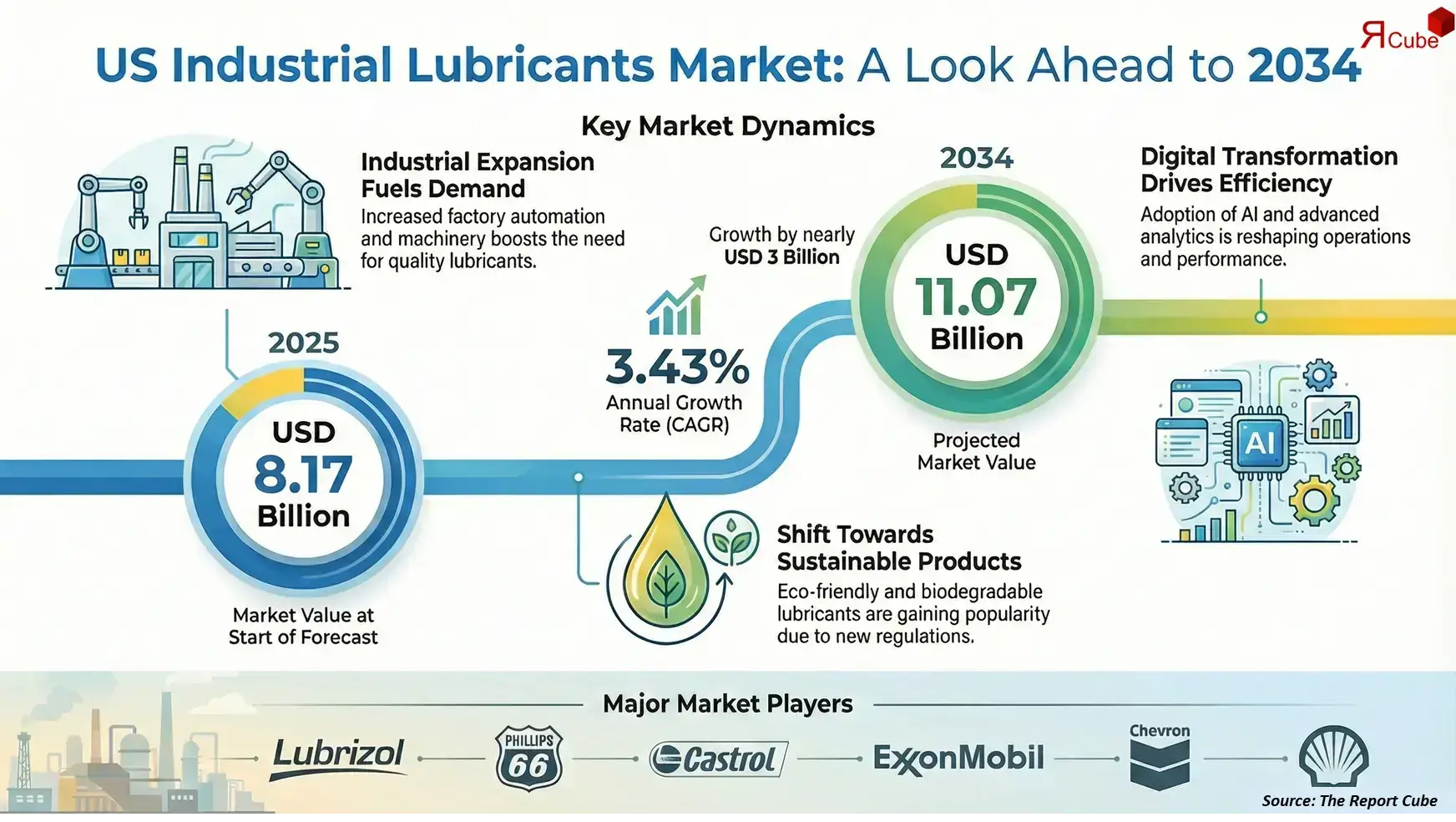
The United States Industrial Lubricants Market is anticipated to register a CAGR of 3.43% during 2026-2034. The market size was valued at USD 8,173.18 million in 2025 and is projected to reach USD 11,071.58 million by 2034. The market plays a critical role in supporting the country’s industrial backbone, including manufacturing, energy, automotive, construction, and heavy machinery operations. Industrial lubricants are essential for reducing friction, improving equipment efficiency, and extending machinery lifespan, making them indispensable across production-intensive industries.
Market growth is closely tied to steady industrial output, modernization of manufacturing facilities, and the gradual shift toward high-performance and specialty lubricants. The United States continues to invest heavily in advanced manufacturing, automation, and infrastructure upgrades, all of which increase lubricant consumption. Additionally, strict regulations on equipment efficiency and emissions are pushing industries to adopt premium lubricants that offer longer drain intervals and better thermal stability.
Furthermore, sustainability considerations are influencing product innovation, with increasing demand for synthetic and environmentally acceptable lubricants. While volume growth remains moderate, value growth is supported by higher adoption of advanced formulations. As a result, the United States Industrial Lubricants Market is expected to maintain stable, long-term growth through 2034.
US Industrial Lubricants Market Recent Developments
- 2025: ExxonMobil approved Baytown reconfiguration to boost Group III base stocks for advanced industrial lubricants demand.
- 2025: FUCHS Lubricants acquired IRMCO to expand sustainable metal-forming lubricant technologies across U.S. industrial customers.
Government Initiatives & Policies
- Advanced Manufacturing National Program: Supports efficiency improvements and advanced materials across U.S. industries.
- U.S. Department of Energy Industrial Efficiency Program: Promotes energy-efficient industrial processes and equipment.
United States Industrial Lubricants Market Dynamics
Key Driver: Consistent Demand from Manufacturing and Heavy Industries
Consistent demand from manufacturing and heavy industries remains the primary driver of the United States Industrial Lubricants Market. The U.S. manufacturing sector contributes over 11% to national GDP, creating sustained lubricant demand across metal fabrication, automotive production, machinery, and chemical processing. Industrial lubricants are vital for maintaining operational continuity, minimizing downtime, and reducing maintenance costs. As production facilities increasingly rely on high-speed, automated equipment, lubricant performance requirements continue to rise. This drives demand for advanced formulations capable of operating under extreme pressure and temperature conditions, reinforcing long-term market stability.
Book your FREE 30-minute expert consultation today
Contact UsIndustry Trends: Shift Toward Synthetic and High-Performance Lubricants
A key trend shaping the market is the growing shift toward synthetic and high-performance lubricants. These products offer superior oxidation resistance, longer service life, and improved energy efficiency compared to conventional mineral oils. Nearly 40% of large U.S. industrial facilities have adopted synthetic lubricants in critical applications to reduce total cost of ownership. This trend is supported by rising labor costs, as extended oil change intervals reduce maintenance frequency. Additionally, industries are prioritizing operational efficiency and sustainability, accelerating the adoption of premium lubricant solutions.
Major Challenge: Volatility in Raw Material Prices
Volatility in raw material prices poses a significant challenge to the United States Industrial Lubricants Market. Base oils and additive components are closely linked to crude oil price fluctuations, which directly impact production costs. Sudden price changes create margin pressure for manufacturers and complicate long-term pricing strategies. Smaller lubricant producers are particularly vulnerable, as they have limited ability to absorb cost increases. This challenge is further intensified by supply chain disruptions and geopolitical uncertainties affecting global energy markets.
Opportunity: Growth in Energy, Infrastructure, and Automation Investments
Rising investments in energy infrastructure, renewable power generation, and industrial automation present strong growth opportunities. Turbine oils, hydraulic fluids, and gear oils are increasingly required for wind farms, power plants, and automated manufacturing lines. Federal infrastructure spending and private sector investments are expected to stimulate demand for reliable, high-performance lubricants. Manufacturers that focus on application-specific solutions and technical support services are well-positioned to capitalize on these opportunities through 2034.
United States Industrial Lubricants Market Segment-wise Analysis
By Product:
- Hydraulic Fluids
- Metalworking Fluids
- Gear Oils
- Compressor Oils
- Greases
- Turbine Oils
- Process Oils
- Other Products
Among product segments, Hydraulic Fluids lead the market, accounting for approximately 28% of total revenue in 2025. Their dominance is driven by widespread usage in construction equipment, manufacturing machinery, and material handling systems. Hydraulic fluids are critical for power transmission and equipment reliability, resulting in steady replacement demand. Metalworking fluids also hold a significant share due to extensive machining and fabrication activities across U.S. industries.
By Application:
- Metalworking Fluids
- Process Oils
- Hydraulic Fluids
- Gear Oils
- General Industrial Lubricants
- Others
By application, Metalworking Fluids represent the leading segment with an estimated 26% market share in 2025. Strong demand from automotive, aerospace, and industrial equipment manufacturing drives this segment. Precision machining and surface finishing processes rely heavily on high-quality metalworking fluids to improve tool life and product quality, supporting consistent consumption across production cycles.
Regional Projection of United States Industrial Lubricants Industry
- Northeast
- Midwest
- South
- West
The Midwest leads the United States Industrial Lubricants Market, contributing approximately 34% of total market revenue in 2025. The region’s dominance is supported by its strong concentration of automotive manufacturing, heavy machinery production, and metal processing industries. States within the Midwest host extensive industrial infrastructure, resulting in high and consistent lubricant consumption. The South follows closely, driven by energy production and expanding manufacturing capacity.
Need insights for a specific region within this market?
Request Regional DataWhy Choose This Report?
- Provides a comprehensive overview of the overall market analysis, encompassing key trends, consumer behavior analysis, and risk assessment to support strategic decision-making.
- Provides accurate, up-to-date insights into market size, segmentation, and emerging opportunities, helping to minimize risk & capitalizing on growth.
- Gives deep understanding of target audience preferences, investment habits, and communication channels for enhanced product development & marketing effectiveness.
- Delivers competitive analysis & benchmarking, uncovering the strengths & weaknesses of market competitors to guide strategies.
- Consolidate comprehensive market intelligence, reducing reasoning & streamlining research efforts.
- Facilitates customized market segmentation & risk mitigation strategies, fine-tuned to the business objectives.
- Aids in identifying both market challenges & untapped opportunities within the industry to drive long-term business growth.
- Provides valuable information based on actual customer data & search trends.
Table of Contents
- Introduction
- Objective of the Study
- Product and Category Definition
- Market Segmentation
- Study Variables
- Research Methodology
- Secondary Data Points
- Breakdown of Secondary Sources
- Primary Data Points
- Breakdown of Primary Interviews
- Secondary Data Points
- Executive Summary
- Market Dynamics
- Drivers
- Challenges
- Opportunity Assessment
- Recent Trends and Developments
- Regulatory and Policy Landscape
- United States Industrial Lubricants Market Overview (2020-2034)
- Market Size, By Value (USD Billion)
- Market Share, By Product
- Hydraulic Fluids
- Metalworking Fluids
- Gear Oils
- Compressor Oils
- Greases
- Turbine Oils
- Process Oils
- Other Products
- Market Share, By Application
- Metalworking Fluids
- Process Oils
- Hydraulic Fluids
- Gear Oils
- General Industrial Lubricants
- Others
- Market Share, By Base Oil
- Mineral Oil
- Synthetic Oil
- Bio-based Oil
- Other Base Oils
- Market Share, By End-use
- Construction
- Metal Mining
- Cement Production
- Power Generation
- Automotive
- Chemical Production
- Oil Gas
- Textile Manufacturing
- Food Processing
- Pulp Paper
- Others
- Market Share, By Sales Channel
- Direct Sales
- Distributor Sales
- Online Channels
- Other Channels
- Market Share, By Region
- Northeast
- Midwest
- South
- West
- Market Share, By Company
- Competition Characteristics
- Revenue Shares & Analysis
- Northeast Industrial Lubricants Market
- Market Size, By Value (USD Billion)
- Market Share, By Product
- Market Share, By Application
- Market Share, By Base Oil
- Market Share, By End-use
- Market Share, By Sales Channel
- Midwest Industrial Lubricants Market
- Market Size, By Value (USD Billion)
- Market Share, By Product
- Market Share, By Application
- Market Share, By Base Oil
- Market Share, By End-use
- Market Share, By Sales Channel
- South Industrial Lubricants Market
- Market Size, By Value (USD Billion)
- Market Share, By Product
- Market Share, By Application
- Market Share, By Base Oil
- Market Share, By End-use
- Market Share, By Sales Channel
- West Industrial Lubricants Market
- Market Size, By Value (USD Billion)
- Market Share, By Product
- Market Share, By Application
- Market Share, By Base Oil
- Market Share, By End-use
- Market Share, By Sales Channel
- Competitive Outlook and Company Profiles
- ExxonMobil Corporation
- Company Overview
- Product Portfolio
- Strategic Alliances/Partnerships
- Recent Developments
- Chevron Corporation
- Company Overview
- Product Portfolio
- Strategic Alliances/Partnerships
- Recent Developments
- Shell USA Inc.
- Company Overview
- Product Portfolio
- Strategic Alliances/Partnerships
- Recent Developments
- BP America Inc.
- Company Overview
- Product Portfolio
- Strategic Alliances/Partnerships
- Recent Developments
- TotalEnergies Marketing USA Inc.
- Company Overview
- Product Portfolio
- Strategic Alliances/Partnerships
- Recent Developments
- Fuchs Lubricants Co.
- Company Overview
- Product Portfolio
- Strategic Alliances/Partnerships
- Recent Developments
- Valvoline Inc.
- Company Overview
- Product Portfolio
- Strategic Alliances/Partnerships
- Recent Developments
- Phillips 66 Company
- Company Overview
- Product Portfolio
- Strategic Alliances/Partnerships
- Recent Developments
- AMSOIL Inc.
- Company Overview
- Product Portfolio
- Strategic Alliances/Partnerships
- Recent Developments
- Kluber Lubrication NA LP
- Company Overview
- Product Portfolio
- Strategic Alliances/Partnerships
- Recent Developments
- Others
- ExxonMobil Corporation
- Contact Us and Disclaimer
Top Key Players & Market Share Outlook
- ExxonMobil Corporation
- Chevron Corporation
- Shell USA Inc.
- BP America Inc.
- TotalEnergies Marketing USA Inc.
- Fuchs Lubricants Co.
- Valvoline Inc.
- Phillips 66 Company
- AMSOIL Inc.
- Kluber Lubrication NA LP
- Others
Frequently Asked Questions