



Build Your Custom Market Intelligence Report
Customize Your ReportUS Automotive Semiconductor Market Key Highlights
By Component:
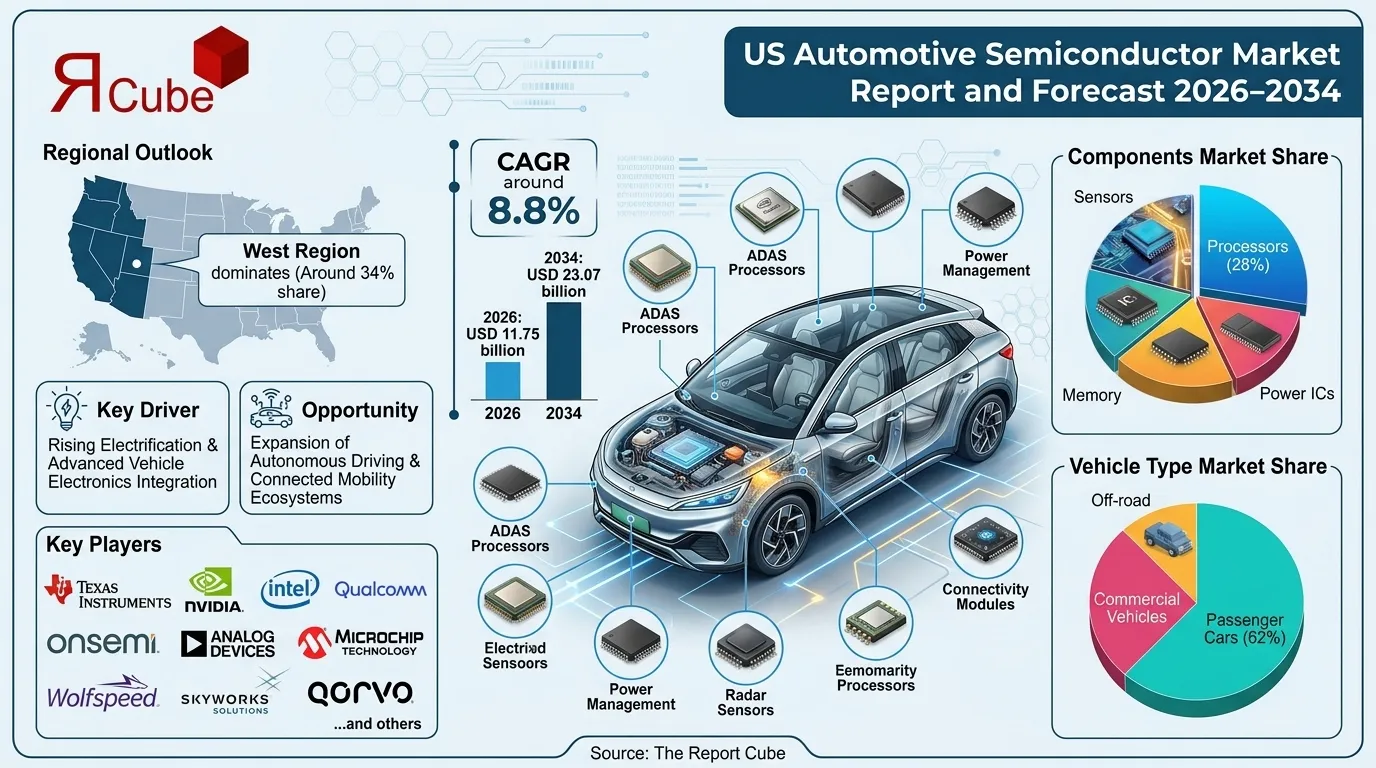
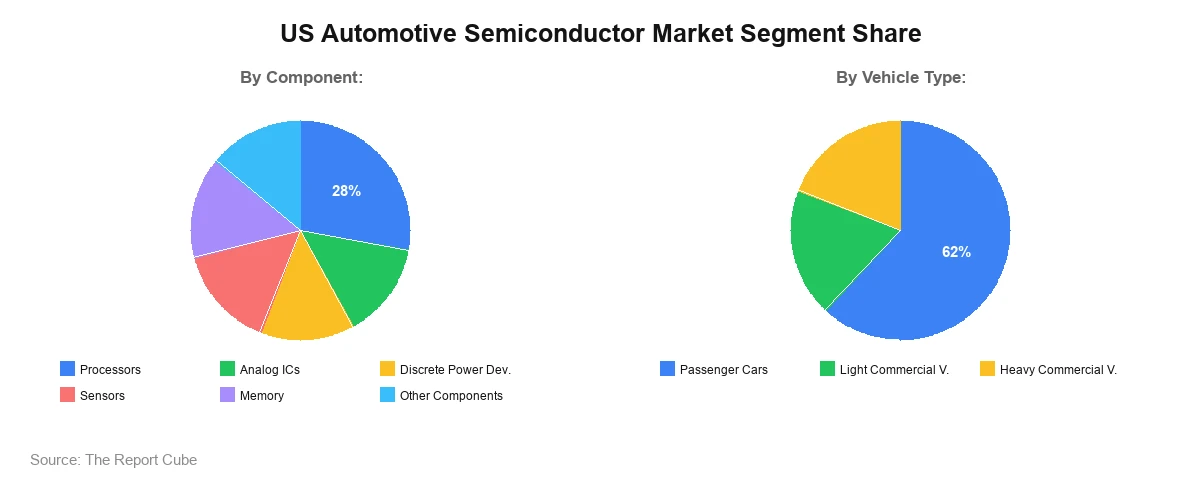
Processors segment leads the market with around 28% market share.
By Vehicle Type:
Passenger Cars segment dominates the market with nearly 62% of revenue.
Regional Outlook:
West region dominates the US Automotive Semiconductor market with around 34% share.
US Automotive Semiconductor Market Insights & Analysis
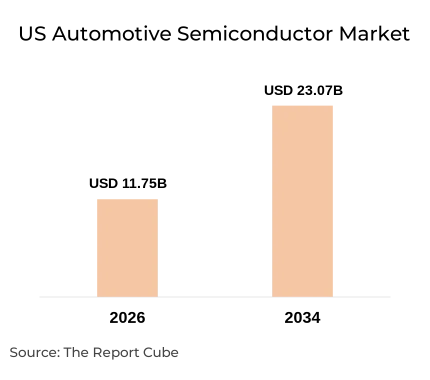
The US Automotive Semiconductor Market is anticipated to register a CAGR of around 8.8% during the forecast period 2026-2034. The market size is valued at USD 11.75 billion in 2026 and is projected to reach USD 23.07 billion by 2034. The market is witnessing strong momentum due to the rapid transformation of vehicles into software-defined, electronics-intensive systems. Increasing adoption of electric vehicles, advanced driver assistance systems, and connected car technologies is significantly boosting semiconductor demand across the automotive value chain.
Investment activity across the U.S. semiconductor ecosystem is accelerating, driven by government-backed funding and private sector expansion plans. Leading companies are strengthening domestic fabrication capacity while focusing on high-performance chips such as silicon carbide and gallium nitride. In addition, automotive OEMs are entering long-term supply agreements with semiconductor manufacturers to mitigate supply chain disruptions experienced in recent years. The integration of high-speed processors, memory, and sensor technologies is reshaping vehicle architecture, enabling real-time data processing, enhanced safety systems, and improved energy efficiency, which collectively support sustained market growth.
US Automotive Semiconductor Market Dynamics
Key Driver: Rising Electrification and Advanced Vehicle Electronics Integration
The rapid shift toward electric vehicles in the U.S. is a primary growth driver for the automotive semiconductor market. Electric vehicles require nearly twice the semiconductor content compared to traditional internal combustion engine vehicles. Power electronics, battery management systems, and inverter technologies heavily rely on advanced semiconductors such as silicon carbide. With EV sales in the U.S. expected to surpass 40% of total vehicle sales by 2030, semiconductor demand is expanding significantly.
Additionally, modern vehicles are increasingly equipped with advanced features such as infotainment systems, connectivity modules, and ADAS functionalities. These features depend on high-performance processors and sensors, driving the need for complex semiconductor architectures. As automakers continue to enhance vehicle intelligence and safety, semiconductor integration is becoming central to automotive design.
Book your FREE 30-minute expert consultation today
Contact UsIndustry Trends: Transition Toward Software-Defined Vehicles and AI Integration
The automotive industry is evolving toward software-defined vehicles, where hardware and software integration plays a key role in delivering enhanced functionality. Semiconductor companies are developing high-performance computing platforms capable of handling real-time data processing for autonomous driving and connectivity applications. This shift is increasing the demand for advanced processors and memory chips.
Another notable trend is the integration of artificial intelligence within vehicles. AI-enabled chips are supporting features such as predictive maintenance, driver monitoring systems, and autonomous navigation. Automotive manufacturers are collaborating with semiconductor firms to co-develop customized chipsets, enabling optimized performance and improved energy efficiency across vehicle platforms.
Major Challenge: Supply Chain Volatility and High Manufacturing Complexity
The automotive semiconductor market continues to face challenges related to supply chain disruptions and manufacturing complexity. Semiconductor fabrication requires significant capital investment and long production cycles, making it difficult to quickly respond to fluctuations in demand. Past shortages have highlighted vulnerabilities in global supply chains, especially for automotive-grade chips.
In addition, the transition to advanced materials such as silicon carbide and gallium nitride introduces technical complexities and higher production costs. Automotive-grade semiconductors must meet strict reliability and safety standards, increasing development timelines. These factors can limit scalability and pose challenges for manufacturers aiming to meet growing demand.
Opportunity: Expansion of Autonomous Driving and Connected Mobility Ecosystems
The increasing focus on autonomous driving technologies presents a major opportunity for the automotive semiconductor market. Autonomous vehicles require a wide array of sensors, processors, and connectivity modules to operate efficiently. This creates strong demand for high-performance semiconductors capable of processing large volumes of data in real time.
Furthermore, the expansion of connected mobility ecosystems is opening new revenue streams for semiconductor companies. Vehicle-to-everything communication, smart infrastructure integration, and cloud-based vehicle management systems are gaining traction. These advancements are driving the need for innovative semiconductor solutions, positioning the market for long-term growth.
US Automotive Semiconductor Market Segment-wise Analysis
By Component:
- Processors
- Analog ICs
- Discrete Power Devices
- Sensors
- Memory
- Other Components
The processors segment holds the leading position in the US automotive semiconductor market, accounting for approximately 28% share. This dominance is driven by the increasing need for high-performance computing in modern vehicles. Advanced processors are essential for enabling functionalities such as ADAS, infotainment systems, and real-time vehicle diagnostics. The growing adoption of software-defined vehicle architectures further strengthens demand for processors, as they act as the central computing units managing complex automotive operations.
By Vehicle Type:
- Passenger Cars
- Light Commercial Vehicles
- Heavy Commercial Vehicles
Passenger cars dominate the market with nearly 62% revenue share, supported by high production volumes and rising consumer demand for advanced vehicle features. Increasing penetration of electric passenger vehicles and connected car technologies is significantly boosting semiconductor usage in this segment. Automakers are focusing on enhancing in-car experience, safety, and efficiency, which drives the integration of multiple semiconductor components across passenger vehicles.
Regional Projection of US Automotive Semiconductor Industry
- West
- Midwest
- South
- East
- Others
The West region leads the US automotive semiconductor market with an estimated 34% share, driven by its strong technology ecosystem and presence of major semiconductor companies and innovation hubs. States such as California play a significant role due to their concentration of electric vehicle manufacturers, research institutions, and advanced chip design firms. The region benefits from high investment in research and development, as well as strong collaboration between automotive and technology companies.
Government Initiatives & Policies
- CHIPS and Science Act Implementation (2025): The U.S. government expanded semiconductor funding to strengthen domestic automotive chip manufacturing, reducing reliance on imports and supporting EV and ADAS innovation.
- DOE EV Grid Integration Program (2025): U.S. Department of Energy launched initiatives to enhance EV infrastructure and semiconductor-powered vehicle systems, boosting demand for power electronics and advanced automotive chips.
US Automotive Semiconductor Industry Recent Developments
- 2025: Texas Instruments introduced a 60 GHz millimeter-wave radar sensor and advanced automotive audio chips at CES 2025, enhancing in-cabin safety, connectivity, and ADAS capabilities.
Need insights for a specific region within this market?
Request Regional DataWhy Choose This Report?
- Provides a comprehensive overview of the overall market analysis, encompassing key trends, consumer behavior analysis, and risk assessment to support strategic decision-making.
- Provides accurate, up-to-date insights into market size, segmentation, and emerging opportunities, helping to minimize risk & capitalizing on growth.
- Gives deep understanding of target audience preferences, investment habits, and communication channels for enhanced product development & marketing effectiveness.
- Delivers competitive analysis & benchmarking, uncovering the strengths & weaknesses of market competitors to guide strategies.
- Consolidate comprehensive market intelligence, reducing reasoning & streamlining research efforts.
- Facilitates customized market segmentation & risk mitigation strategies, fine-tuned to the business objectives.
- Aids in identifying both market challenges & untapped opportunities within the industry to drive long-term business growth.
- Provides valuable information based on actual customer data & search trends.
Table of Contents
- Introduction
- Objective of the Study
- Product and Category Definition
- Market Segmentation
- Study Variables
- Research Methodology
- Secondary Data Points
- Breakdown of Secondary Sources
- Primary Data Points
- Breakdown of Primary Interviews
- Secondary Data Points
- Executive Summary
- Market Dynamics
- Drivers
- Challenges
- Opportunity Assessment
- Recent Trends and Developments
- Regulatory and Policy Landscape
- US Automotive Semiconductor Market Overview (2021-2034)
- Market Size, By Value (USD Billion)
- Market Share, By Component
- Processors
- Analog ICs
- Discrete Power Devices
- Sensors
- Memory
- Other Components
- Market Share, By Vehicle Type
- Passenger Cars
- Light Commercial Vehicles
- Heavy Commercial Vehicles
- Market Share, By Propulsion Type
- Internal Combustion Engine
- Electric
- Market Share, By Material
- Silicon
- Silicon Carbide
- Gallium Nitride
- Other Materials
- Market Share, By Application
- Powertrain
- Safety
- Body Electronics
- Chassis
- Telematics & Infotainment
- ADAS & Autonomous Driving
- Market Share, By Region
- West
- Midwest
- South
- East
- Others
- Market Share, By Company
- Revenue Shares & Analysis
- Competitive Landscape
- US Automotive Semiconductor Market, By Component
- Processors
- Microprocessor Units (MPUs)
- Microcontroller Units (MCUs)
- Digital Signal Processors (DSPs)
- Graphic Processing Units (GPUs)
- Analog ICs
- Amplifiers
- Interfaces
- Converters
- Comparators
- Application-Specific ICs
- Logic ICs
- Infotainment, Telematics & Connectivity ICs
- Discrete Power Devices
- Small-Signal Transistors
- Power Transistors
- Thyristors
- Rectifiers and Diodes
- Sensors
- Image Sensors
- CMOS Image Sensors
- CCD Sensors
- Pressure Sensors
- Inertial Sensors
- Accelerometers
- Gyroscopes
- Temperature Sensors
- Radar Sensors
- Memory
- Dynamic Random-Access Memory (DRAM)
- Static Random-Access Memory (SRAM)
- Other Components
- Processors
- US Automotive Semiconductor Market, By Vehicle Type
- Passenger Cars
- Hatchbacks
- Sedans
- SUVs and Crossovers
- Light Commercial Vehicles
- Vans
- Pickups
- Heavy Commercial Vehicles
- Trucks
- Buses
- Passenger Cars
- US Automotive Semiconductor Market, By Propulsion Type
- Internal Combustion Engine
- Gasoline
- Diesel
- Other Internal Combustion Engines
- Electric
- Hybrid Electric Vehicles (HEVs)
- Plug-in Hybrid Electric Vehicles (PHEVs)
- Battery Electric Vehicles (BEVs)
- Internal Combustion Engine
- US Automotive Semiconductor Market, By Material
- Silicon
- Silicon Carbide
- Gallium Nitride
- Other Materials
- US Automotive Semiconductor Market, By Application
- Powertrain
- Engine Controls
- HEV and EV Motors
- Transmission Controls
- Safety
- Airbags
- Electronic Stability Controls
- Tire Pressure Monitoring Systems
- Body Electronics
- Body Control Modules
- Seat Electronics
- Door Electronics
- Mirror and Window Controls
- HVAC Systems
- Chassis
- Braking
- Steering
- Traction Control
- Vehicle Dynamics Management
- Telematics & Infotainment
- Instrument Clusters and Dashboards
- Navigation Systems
- Connectivity Devices
- Audio-Video Systems
- ADAS & Autonomous Driving
- Adaptive Cruise Control
- Lane Departure Warning
- Lane Keep Assist
- Blind Spot Detection
- Automatic Emergency Braking
- Traffic Sign Recognition
- Parking Assistance
- Night Vision
- Driver Monitoring Systems
- Fully Autonomous Driving Systems
- Powertrain
- US Automotive Semiconductor Market, By Region
- West
- Midwest
- South
- East
- Others
- Competitive Outlook and Company Profiles
- Texas Instruments
- Company Overview
- Product Portfolio
- Strategic Alliances/Partnerships
- Recent Developments
- NVIDIA
- Company Overview
- Product Portfolio
- Strategic Alliances/Partnerships
- Recent Developments
- Intel
- Company Overview
- Product Portfolio
- Strategic Alliances/Partnerships
- Recent Developments
- Qualcomm
- Company Overview
- Product Portfolio
- Strategic Alliances/Partnerships
- Recent Developments
- onsemi
- Company Overview
- Product Portfolio
- Strategic Alliances/Partnerships
- Recent Developments
- Analog Devices
- Company Overview
- Product Portfolio
- Strategic Alliances/Partnerships
- Recent Developments
- Microchip Technology
- Company Overview
- Product Portfolio
- Strategic Alliances/Partnerships
- Recent Developments
- Wolfspeed
- Company Overview
- Product Portfolio
- Strategic Alliances/Partnerships
- Recent Developments
- Skyworks Solutions
- Company Overview
- Product Portfolio
- Strategic Alliances/Partnerships
- Recent Developments
- Qorvo
- Company Overview
- Product Portfolio
- Strategic Alliances/Partnerships
- Recent Developments
- Allegro MicroSystems
- Company Overview
- Product Portfolio
- Strategic Alliances/Partnerships
- Recent Developments
- Monolithic Power Systems
- Company Overview
- Product Portfolio
- Strategic Alliances/Partnerships
- Recent Developments
- Lattice Semiconductor
- Company Overview
- Product Portfolio
- Strategic Alliances/Partnerships
- Recent Developments
- Diodes Incorporated
- Company Overview
- Product Portfolio
- Strategic Alliances/Partnerships
- Recent Developments
- Amkor Technology
- Company Overview
- Product Portfolio
- Strategic Alliances/Partnerships
- Recent Developments
- Marvell Technology
- Company Overview
- Product Portfolio
- Strategic Alliances/Partnerships
- Recent Developments
- Others
- Texas Instruments
- Contact Us and Disclaimer
Top Key Players & Market Share Outlook
- Texas Instruments
- NVIDIA
- Intel
- Qualcomm
- onsemi
- Analog Devices
- Microchip Technology
- Wolfspeed
- Skyworks Solutions
- Qorvo
- Allegro MicroSystems
- Monolithic Power Systems
- Lattice Semiconductor
- Diodes Incorporated
- Amkor Technology
- Marvell Technology
Frequently Asked Questions






