



Build Your Custom Market Intelligence Report
Customize Your ReportUnited States Automotive Instrument Cluster Market Key Highlights
By Display Type:
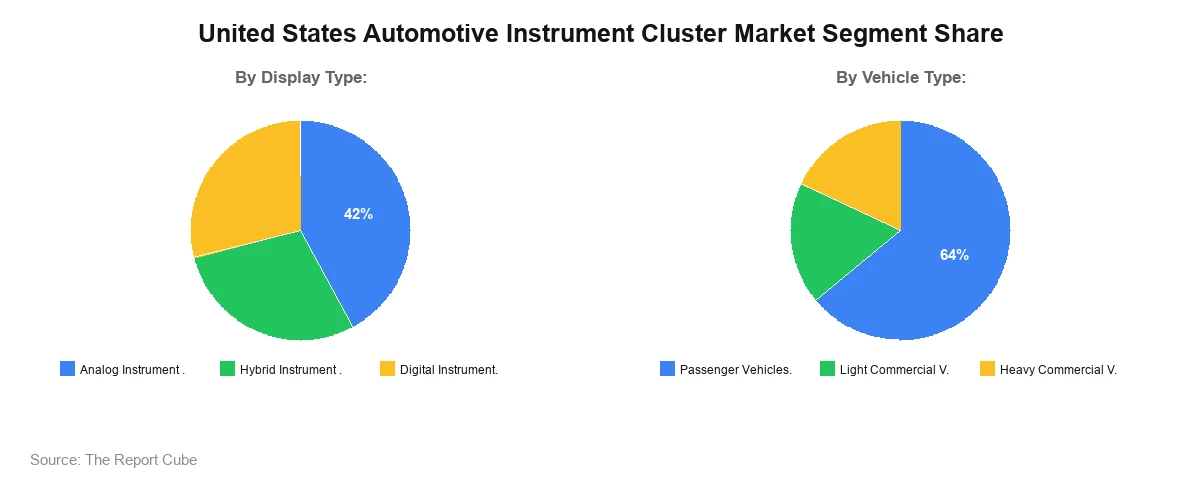
Digital Instrument Cluster segment leads the market with around 42% share.
By Vehicle Type:
Passenger Vehicles segment dominates the market with nearly 64% of revenue.
Regional Outlook:
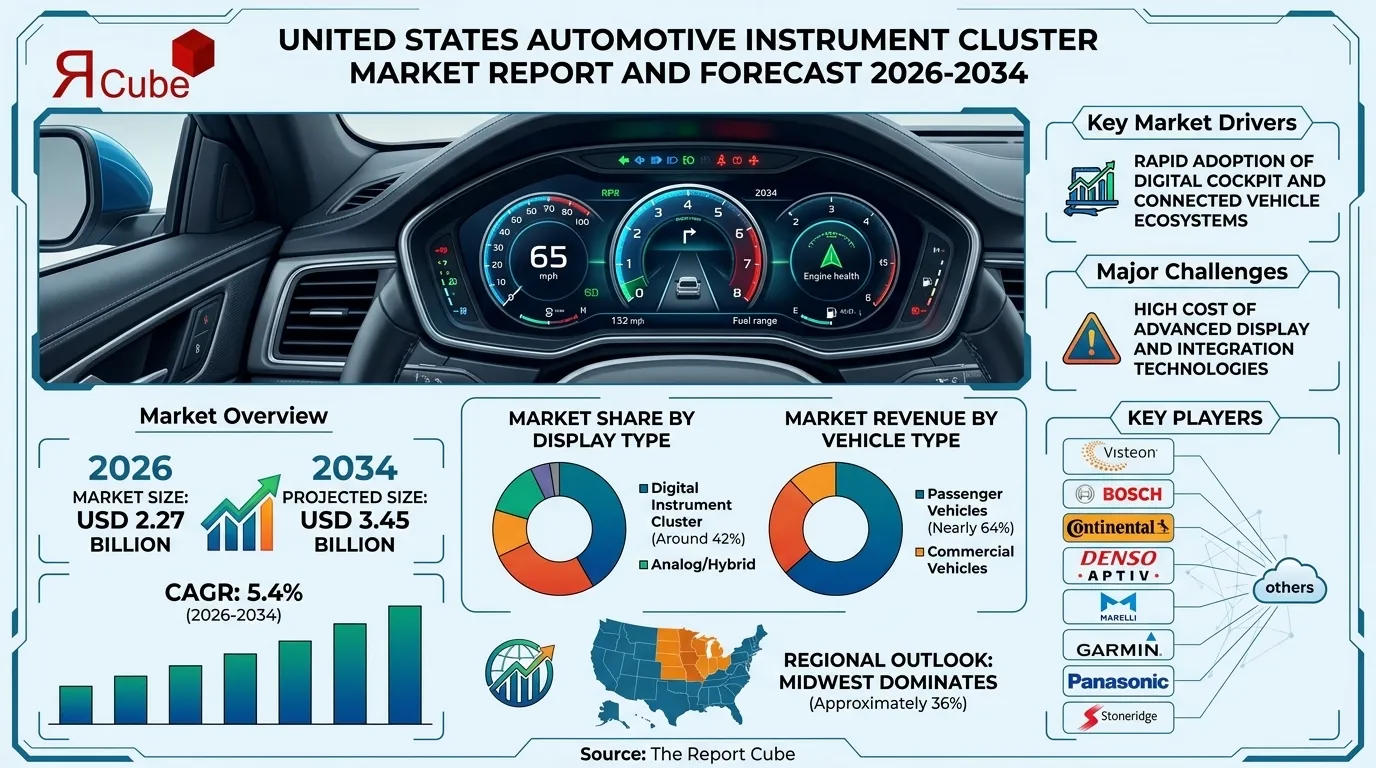
Midwest region dominates the United States Automotive Instrument Cluster market with approximately 36% share.
United States Automotive Instrument Cluster Market Insights & Analysis
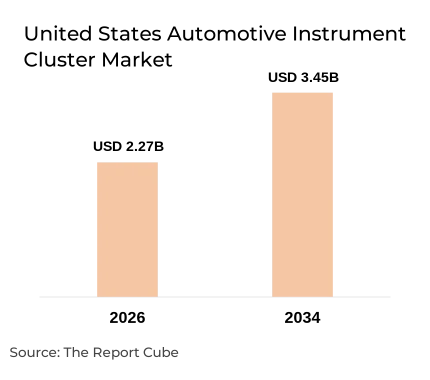
The United States Automotive Instrument Cluster Market is anticipated to register a CAGR of around 5.4% during the forecast period 2026-2034. The market size is valued at USD 2.27 Billion in 2026 and is projected to reach USD 3.45 Billion by 2034. Growth in this market is strongly influenced by the increasing penetration of digital cockpit technologies and connected vehicle ecosystems across the U.S. automotive industry. Automakers are rapidly transitioning from analog to fully digital clusters to enhance user experience, safety, and infotainment integration. By 2025, more than 68% of newly manufactured passenger vehicles in the U.S. were equipped with at least partially digital instrument clusters, reflecting a steady shift toward advanced visualization technologies.
Investment trends indicate strong collaboration between automotive OEMs and semiconductor companies to develop high-resolution displays, AI-enabled interfaces, and augmented reality systems. The rise of electric vehicles and autonomous driving technologies further strengthens demand for advanced clusters capable of displaying real-time diagnostics, navigation, and safety alerts. Companies are increasingly integrating OLED and TFT-LCD technologies, improving display clarity and reducing energy consumption by nearly 18% compared to traditional systems. Additionally, regulatory focus on driver safety and human-machine interface (HMI) design is encouraging continuous innovation, positioning instrument clusters as a core component of next-generation vehicle architecture.
United States Automotive Instrument Cluster Market Dynamics
Key Driver: Rapid Adoption of Digital Cockpit and Connected Vehicle Ecosystems
The transition toward connected vehicles is a primary driver of the automotive instrument cluster market in the United States. Automakers are increasingly integrating infotainment, navigation, and vehicle diagnostics into unified digital interfaces, making instrument clusters a central communication hub. By 2025, over 72% of mid-size and luxury vehicles in the U.S. featured connected cluster systems capable of real-time updates and cloud integration. This shift is supported by growing consumer expectations for seamless digital experiences similar to smartphones.
Additionally, the expansion of electric vehicles has accelerated demand for advanced clusters that display battery health, range prediction, and energy efficiency metrics. Automotive manufacturers are investing heavily in human-machine interface technologies, ensuring drivers receive intuitive and distraction-free information. These advancements improve safety outcomes and enhance user satisfaction, making digital clusters a critical differentiator in vehicle design and performance.
Book your FREE 30-minute expert consultation today
Contact UsIndustry Trends: Integration of Augmented Reality and AI-Driven Interfaces
The market is witnessing a strong trend toward augmented reality (AR) and artificial intelligence integration within instrument clusters. AR-enabled head-up displays are becoming increasingly popular, projecting navigation and hazard information directly onto the windshield. By 2025, adoption of AR clusters in premium vehicles grew by over 28% year-over-year, highlighting a significant shift toward immersive driving experiences.
AI-powered systems are also transforming instrument clusters by enabling predictive analytics and personalized interfaces. These systems analyze driving behavior, environmental conditions, and vehicle performance to deliver customized alerts and recommendations. This evolution is enhancing driver engagement and safety, while also paving the way for autonomous vehicle integration, where clusters will serve as critical monitoring and interaction platforms.
Major Challenge: High Cost of Advanced Display and Integration Technologies
The adoption of advanced instrument cluster technologies involves significant cost implications, particularly due to high-end components such as OLED displays, microcontrollers, and sensors. Manufacturing these systems requires precision engineering, advanced materials, and specialized software development, increasing overall production costs by approximately 22% compared to conventional clusters. These expenses often translate into higher vehicle prices, limiting adoption in entry-level segments.
Moreover, integrating multiple functionalities into a single cluster system demands extensive testing and validation to meet safety and regulatory standards. This process can extend development timelines and increase R&D expenditure. Smaller automotive manufacturers and aftermarket players may face challenges in keeping pace with rapid technological advancements, potentially restricting market expansion.
Opportunity: Expansion of Electric Vehicles and Autonomous Driving Technologies
The rapid growth of electric and autonomous vehicles presents a significant opportunity for the automotive instrument cluster market. EV adoption in the U.S. is projected to exceed 35% of total vehicle sales by 2030, creating demand for advanced clusters that provide detailed energy management insights. These vehicles require highly interactive displays capable of delivering real-time performance data, enhancing driver awareness and efficiency.
Autonomous driving technologies further expand opportunities, as instrument clusters evolve into comprehensive information systems for monitoring vehicle operations and passenger interaction. Integration with smart ecosystems, including mobile apps and cloud platforms, will enable seamless connectivity and remote diagnostics. This transformation positions instrument clusters as a vital component in the future of mobility, offering substantial growth potential for market players.
United States Automotive Instrument Cluster Market Segment-wise Analysis
By Display Type:
- Analog Instrument Cluster
- Hybrid Instrument Cluster
- Digital Instrument Cluster
The digital instrument cluster segment leads the market, accounting for approximately 42% share in 2026. This dominance is driven by the increasing demand for customizable and high-resolution displays in modern vehicles. Digital clusters offer superior flexibility, enabling automakers to integrate navigation, infotainment, and safety alerts into a single interface.
Adoption has been particularly strong in luxury and mid-size vehicles, where over 78% of models now feature fully digital displays. Additionally, advancements in display technologies such as OLED and TFT-LCD have improved visual clarity and reduced power consumption, further accelerating adoption across various vehicle categories.
By Vehicle Type:
- Passenger Vehicles
- Compact Cars
- Mid-size Cars
- Luxury Cars
- SUVs
- MPVs
- Light Commercial Vehicles
- Heavy Commercial Vehicles (Trucks, Buses & Coaches)
Passenger vehicles dominate the market with nearly 64% revenue share, primarily due to high production volumes and increasing consumer demand for advanced in-vehicle technologies. The integration of digital clusters in compact and mid-size vehicles has grown significantly, driven by competitive pricing and enhanced user experience.
SUVs and luxury vehicles continue to lead adoption, with digital cluster penetration exceeding 85% in premium segments. Additionally, the growing preference for connected and smart vehicles among U.S. consumers is further supporting segment growth, making passenger vehicles the primary revenue contributor.
Regional Projection of United States Automotive Instrument Cluster Industry
- West
- East
- South
- Midwest
- Others
The Midwest region leads the United States Automotive Instrument Cluster Market, holding approximately 36% market share. This dominance is attributed to the strong presence of automotive manufacturing hubs and major OEM facilities in states such as Michigan and Ohio. The region accounts for a significant portion of vehicle production in the U.S., driving demand for instrument clusters across both passenger and commercial vehicle segments. Additionally, the Midwest benefits from a well-established supply chain network, including component manufacturers and technology providers, enabling efficient production and innovation.
Furthermore, increased investments in automotive R&D and the presence of leading industry players contribute to the region’s leadership. The adoption of advanced manufacturing technologies and digital systems is particularly high in this region, supporting the development of next-generation instrument clusters. This strong industrial base ensures continued growth and technological advancement in the market.
Government Initiatives & Policies
- U.S. DOT Vehicle Safety Modernization (2025): Focuses on advanced driver display integration and digital cockpit safety standards for connected vehicles.
- NHTSA Advanced Driver Assistance Systems Policy (2025): Promotes integration of real-time vehicle data visualization systems to enhance driver awareness and reduce road accidents.
United States Automotive Instrument Cluster Industry Recent Developments
- 2025: Nippon Seiki announced EDT-India joint venture expansion, strengthening global instrument cluster manufacturing capabilities and supporting rising demand from automakers with advanced display production.
- 2025: Marelli USA partnered with Infineon to introduce laser beam scanning display technology, enabling flexible cockpit designs and next-generation immersive instrument cluster experiences.
Need insights for a specific region within this market?
Request Regional DataWhy Choose This Report?
- Provides a comprehensive overview of the overall market analysis, encompassing key trends, consumer behavior analysis, and risk assessment to support strategic decision-making.
- Provides accurate, up-to-date insights into market size, segmentation, and emerging opportunities, helping to minimize risk & capitalizing on growth.
- Gives deep understanding of target audience preferences, investment habits, and communication channels for enhanced product development & marketing effectiveness.
- Delivers competitive analysis & benchmarking, uncovering the strengths & weaknesses of market competitors to guide strategies.
- Consolidate comprehensive market intelligence, reducing reasoning & streamlining research efforts.
- Facilitates customized market segmentation & risk mitigation strategies, fine-tuned to the business objectives.
- Aids in identifying both market challenges & untapped opportunities within the industry to drive long-term business growth.
- Provides valuable information based on actual customer data & search trends.
Table of Contents
- Introduction
- Objective of the Study
- Product and Category Definition
- Market Segmentation
- Study Variables
- Research Methodology
- Secondary Data Points
- Breakdown of Secondary Sources
- Primary Data Points
- Breakdown of Primary Interviews
- Secondary Data Points
- Executive Summary
- Market Dynamics
- Drivers
- Challenges
- Opportunity Assessment
- Recent Trends and Developments
- Regulatory and Policy Landscape
- United States Automotive Instrument Cluster Market Overview (2021-2034)
- Market Size, By Value (USD Million)
- Market Share, By Display Type
- Analog Instrument Cluster
- Hybrid Instrument Cluster
- Digital Instrument Cluster
- Market Share, By Component
- Display Unit
- LCD Display
- TFT-LCD Display
- OLED Display
- Electronic Control Unit
- Microcontroller
- Printed Circuit Board
- Sensors & Actuators
- Backlighting Module
- Housings & Bezels
- Others
- Display Unit
- Market Share, By Vehicle Type
- Passenger Vehicles
- Compact Cars
- Mid-size Cars
- Luxury Cars
- Sport Utility Vehicles (SUVs)
- Multi-purpose Vehicles (MPVs)
- Light Commercial Vehicles
- Heavy Commercial Vehicles
- Trucks
- Buses & Coaches
- Passenger Vehicles
- Market Share, By Propulsion
- Internal Combustion Engine Vehicles
- Hybrid Electric Vehicles
- Battery Electric Vehicles
- Plug-in Hybrid Electric Vehicles
- Market Share, By Cluster Functionality
- Basic Instrument Cluster
- Advanced Driver Information Cluster
- Head-up Display Integrated Cluster
- Market Share, By Technology
- Conventional Embedded Systems
- Connected Instrument Cluster
- Augmented Reality Cluster
- Market Share, By Sales Channel
- OEM
- Aftermarket
- Market Share, By Region
- West
- East
- South
- Midwest
- Others
- Market Share, By Company
- Revenue Shares & Analysis
- Competitive Landscape
- West United States Automotive Instrument Cluster Market
- Market Size, By Value (USD Million)
- Market Share, By Display Type
- Market Share, By Component
- Market Share, By Vehicle Type
- Market Share, By Propulsion
- Market Share, By Cluster Functionality
- Market Share, By Technology
- Market Share, By Sales Channel
- East United States Automotive Instrument Cluster Market
- Market Size, By Value (USD Million)
- Market Share, By Display Type
- Market Share, By Component
- Market Share, By Vehicle Type
- Market Share, By Propulsion
- Market Share, By Cluster Functionality
- Market Share, By Technology
- Market Share, By Sales Channel
- South United States Automotive Instrument Cluster Market
- Market Size, By Value (USD Million)
- Market Share, By Display Type
- Market Share, By Component
- Market Share, By Vehicle Type
- Market Share, By Propulsion
- Market Share, By Cluster Functionality
- Market Share, By Technology
- Market Share, By Sales Channel
- Midwest United States Automotive Instrument Cluster Market
- Market Size, By Value (USD Million)
- Market Share, By Display Type
- Market Share, By Component
- Market Share, By Vehicle Type
- Market Share, By Propulsion
- Market Share, By Cluster Functionality
- Market Share, By Technology
- Market Share, By Sales Channel
- Competitive Outlook and Company Profiles
- Visteon Corporation
- Company Overview
- Product Portfolio
- Strategic Alliances/Partnerships
- Recent Developments
- Stoneridge, Inc.
- Company Overview
- Product Portfolio
- Strategic Alliances/Partnerships
- Recent Developments
- Robert Bosch LLC
- Company Overview
- Product Portfolio
- Strategic Alliances/Partnerships
- Recent Developments
- Continental Automotive
- Company Overview
- Product Portfolio
- Strategic Alliances/Partnerships
- Recent Developments
- DENSO International America
- Company Overview
- Product Portfolio
- Strategic Alliances/Partnerships
- Recent Developments
- Aptiv PLC
- Company Overview
- Product Portfolio
- Strategic Alliances/Partnerships
- Recent Developments
- Marelli USA
- Company Overview
- Product Portfolio
- Strategic Alliances/Partnerships
- Recent Developments
- Garmin Ltd.
- Company Overview
- Product Portfolio
- Strategic Alliances/Partnerships
- Recent Developments
- Panasonic Automotive
- Company Overview
- Product Portfolio
- Strategic Alliances/Partnerships
- Recent Developments
- Nippon Seiki (NS International)
- Company Overview
- Product Portfolio
- Strategic Alliances/Partnerships
- Recent Developments
- Yazaki North America
- Company Overview
- Product Portfolio
- Strategic Alliances/Partnerships
- Recent Developments
- Mitsubishi Electric
- Company Overview
- Product Portfolio
- Strategic Alliances/Partnerships
- Recent Developments
- FORVIA (Faurecia)
- Company Overview
- Product Portfolio
- Strategic Alliances/Partnerships
- Recent Developments
- Magna Electronics
- Company Overview
- Product Portfolio
- Strategic Alliances/Partnerships
- Recent Developments
- Lear Corporation
- Company Overview
- Product Portfolio
- Strategic Alliances/Partnerships
- Recent Developments
- Qualcomm Automotive
- Company Overview
- Product Portfolio
- Strategic Alliances/Partnerships
- Recent Developments
- Texas Instruments
- Company Overview
- Product Portfolio
- Strategic Alliances/Partnerships
- Recent Developments
- Others
- Visteon Corporation
- Contact Us and Disclaimer
Top Key Players & Market Share Outlook
- Visteon Corporation
- Stoneridge, Inc.
- Robert Bosch LLC
- Continental Automotive
- DENSO International America
- Aptiv PLC
- Marelli USA
- Garmin Ltd.
- Panasonic Automotive
- Nippon Seiki (NS International)
- Yazaki North America
- Mitsubishi Electric
- FORVIA (Faurecia)
- Magna Electronics
- Lear Corporation
- Qualcomm Automotive
- Texas Instruments
- Others
Frequently Asked Questions






