



Build Your Custom Market Intelligence Report
Customize Your ReportEurope Biofungicides Market Key Highlights
By Source:
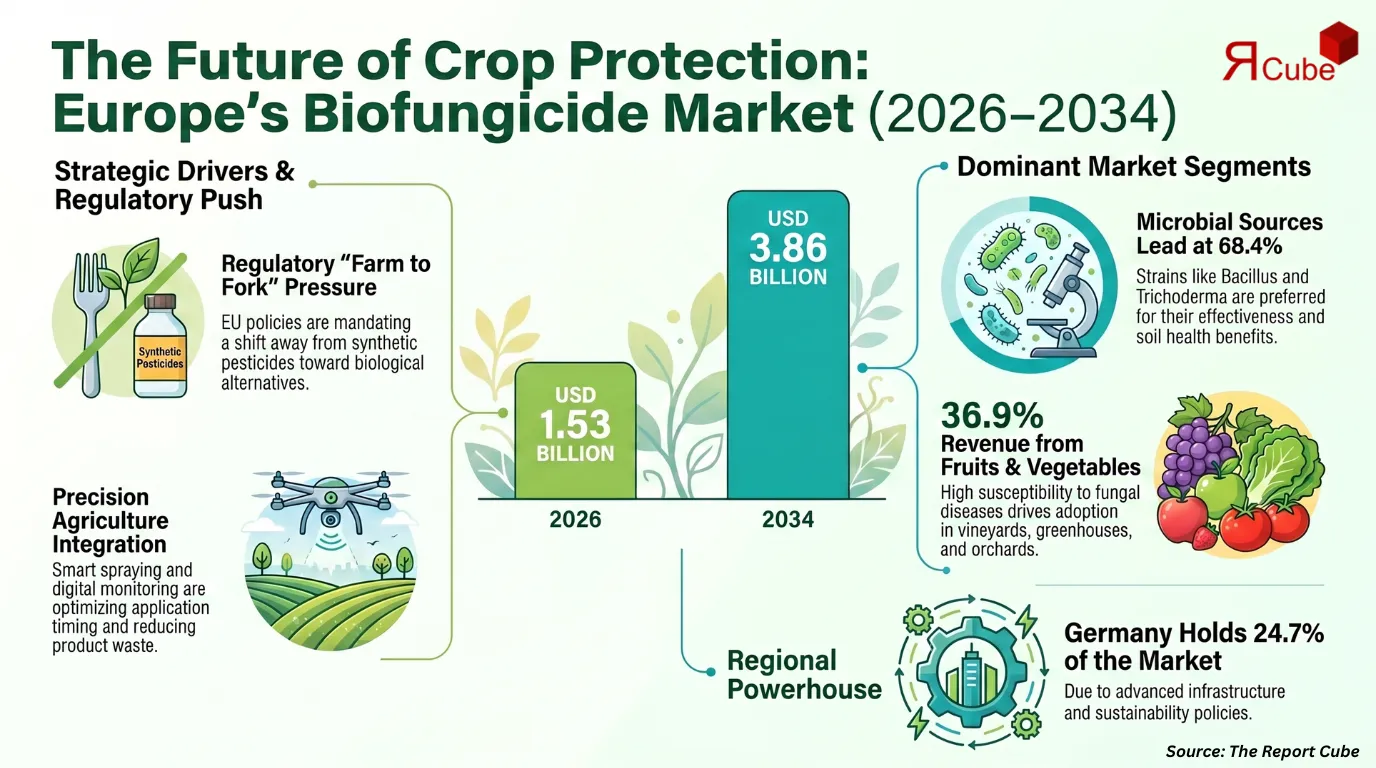
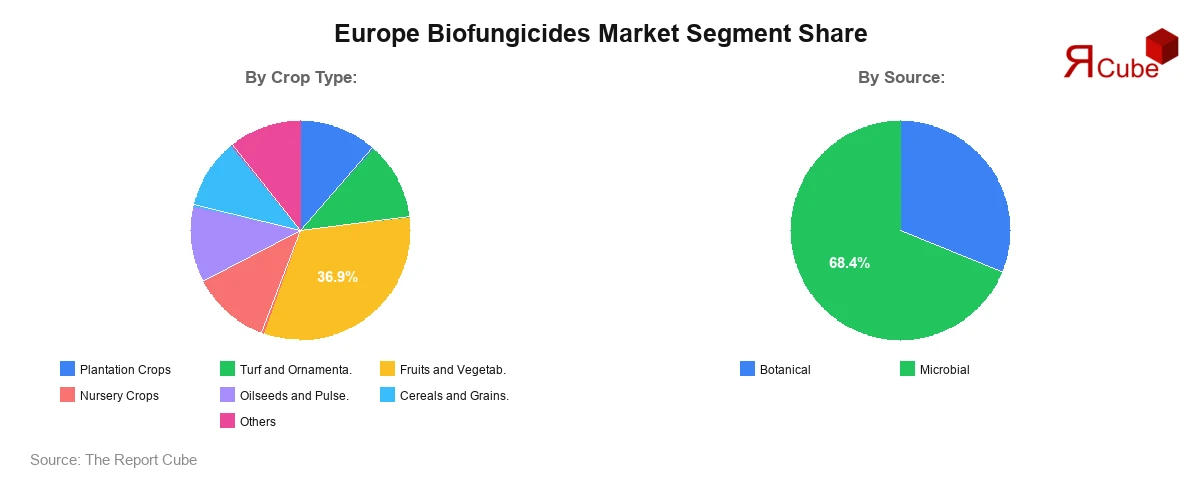
Microbial segment leads the market with nearly 68.4% share.
By Crop Type:
Fruits and Vegetables segment dominates the market with around 36.9% of total revenue.
Regional Outlook:
Germany dominates the Europe Biofungicides Market with approximately 24.7% share.
Europe Biofungicides Market Insights & Analysis
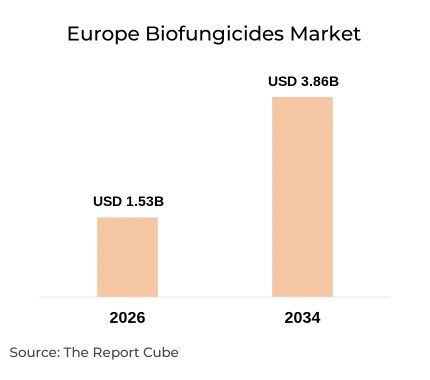
The Europe Biofungicides Market is anticipated to register a CAGR of around 12.28% during the forecast period 2026-2034. The market size is valued at USD 1.53 billion in 2026 and is projected to reach USD 3.86 billion by 2034. Rising pressure to reduce synthetic fungicide residues across European agriculture is creating strong demand for biological crop protection solutions. Commercial growers are increasingly adopting microbial and botanical biofungicides to comply with evolving food safety standards and environmental sustainability targets. Demand remains particularly high in fruits, vegetables, vineyards, and greenhouse cultivation where fungal diseases continue to impact crop quality and export value.
Government-backed sustainable farming initiatives across Germany, France, Spain, and the Netherlands are accelerating the transition toward biological inputs. Companies are investing in advanced microbial formulations with longer shelf life and improved field performance under varying climatic conditions. Strategic collaborations between agricultural biotechnology firms and crop protection distributors are also expanding product accessibility across Europe. In addition, precision agriculture technologies and integrated pest management programs are improving the commercial adoption of biofungicides in high-value crops. Growing consumer preference for organic produce and reduced chemical dependency is expected to support long-term Europe biofungicides market growth during the forecast period.
Europe Biofungicides Market Impact Analysis
| Factor | Type | Specific Impact on Market | Magnitude | Business Implication |
|---|---|---|---|---|
| Stringent EU Chemical Rules | Regulatory | Restrictions on synthetic fungicides accelerate bioproduct use | High | Expands addressable market for compliant biofungicide solutions |
| Growth in Organic Farming | Market | Organic acreage increases demand for residue free fungicides | High | Supports premium pricing and portfolio focus on organic crops |
| Sustainability Focus in Retail | Consumer | Retailers favor suppliers using lower residue plant inputs | Medium | Encourages growers to adopt biofungicides for market access |
| Technological Advances in Strains | Technological | Improved microbial strains enhance field performance reliability | Medium | Drives adoption through better efficacy and broader crop fit |
| Integrated Pest Management Uptake | Market | IPM programs embed biofungicides alongside reduced chemicals | High | Positions biofungicides as core tools in disease programs |
| Farmer Awareness and Training Gaps | Consumer | Limited know how slows correct dosage and timing adoption | Medium | Requires extension support and demos to unlock repeat demand |
| Competitive Pressure from Biocontrols | Competitive | Many players and substitutes intensify price and margin pressure | Medium | Needs differentiation via support services and tailored blends |
Europe Biofungicides Market Dynamics
Key Driver: Regulatory Shift Toward Sustainable Crop Protection Practices
European agricultural regulations are increasingly encouraging the use of biological crop protection products as authorities tighten restrictions on synthetic pesticide residues and environmental emissions. Farmers across Germany, France, Italy, and Spain are adopting biofungicides to align with evolving sustainability standards while maintaining crop productivity. The transition toward integrated pest management practices is accelerating the use of microbial-based fungicides in commercial farming systems, particularly within fruits, vegetables, and vineyard cultivation.
Demand for residue-free agricultural produce among retailers and food processors is further strengthening biofungicide adoption across Europe. Products based on Trichoderma, Bacillus, and Pseudomonas species are gaining wider commercial acceptance due to their ability to suppress fungal pathogens while supporting soil health. Agricultural cooperatives and sustainability-focused farming programs are also increasing awareness regarding biological disease management solutions, supporting steady market expansion across both conventional and organic farming sectors.
Industry Trends: Expansion of Microbial Innovation and Precision Farming Integration
The Europe biofungicides industry is witnessing continuous innovation in microbial technology as manufacturers focus on improving formulation performance and shelf stability. Companies are developing advanced liquid and wettable powder formulations designed to deliver better adhesion, crop coverage, and disease resistance management. Bacillus- and Streptomyces-based products are increasingly preferred for greenhouse crops and horticultural applications due to their broad-spectrum fungal control capabilities.
Precision agriculture technologies are also influencing biofungicide adoption across Europe. Smart spraying systems, digital farm monitoring tools, and weather-based disease prediction platforms are helping growers optimize application timing and reduce product wastage. Agricultural biotechnology firms are strengthening partnerships with distributors and farming organizations to expand biological product accessibility across regional agricultural markets. This ongoing technological integration continues to enhance operational efficiency and long-term market competitiveness.
Book your FREE 30-minute expert consultation today
Contact UsMajor Challenge: Performance Variability Under Diverse Environmental Conditions
One of the primary challenges affecting the Europe biofungicides market is the inconsistent performance of certain biological products under changing climatic and soil conditions. Factors such as temperature shifts, humidity fluctuations, and soil composition can influence microbial activity and disease-control effectiveness. Large-scale commercial growers often require highly predictable crop protection performance, which may create hesitation in fully replacing conventional fungicides.
Storage sensitivity and shorter shelf life of microbial formulations also create logistical concerns across extended agricultural supply chains. Some biofungicides require precise storage temperatures and application timing to maintain efficacy during cultivation cycles. In addition, registration procedures for biological crop protection products can vary across European countries, increasing compliance costs and commercialization timelines for manufacturers. These operational complexities may limit faster penetration in certain crop categories and regional markets.
Opportunity: Rising Demand for Sustainable Horticulture and Export-Oriented Farming
The growing emphasis on sustainable horticulture production across Europe is creating strong commercial opportunities for biofungicide manufacturers. Export-oriented growers are increasingly adopting biological disease-control products to meet strict food safety standards and retailer requirements related to chemical residue limits. This trend remains particularly strong in fruits, vegetables, vineyards, and ornamental crop production where product quality directly impacts export competitiveness and pricing.
Greenhouse farming expansion across the Netherlands and Spain is also generating additional demand for foliar spray and drip-irrigation compatible biofungicides. Companies are introducing crop-specific microbial formulations targeting diseases such as powdery mildew, downy mildew, and root rot in high-value crops. Rising investments in regenerative agriculture and climate-resilient farming systems are expected to support broader adoption of sustainable crop protection technologies across Europe during the forecast period.
Europe Biofungicides Market Segment-wise Analysis
By Source:
- Botanical
- Microbial
The microbial segment continues to dominate the Europe biofungicides market, accounting for nearly 68.4% of total revenue in 2026. Strong adoption of microbial fungicides is primarily linked to their effectiveness against a broad range of fungal pathogens and their compatibility with sustainable farming systems. Products developed from Bacillus, Trichoderma, and Streptomyces species are widely utilized across greenhouse cultivation, cereals, horticulture crops, and vineyards due to their ability to improve plant resilience while reducing chemical fungicide dependency.
Commercial growers are increasingly selecting microbial formulations because they support integrated disease management strategies and align with strict European environmental standards. Advancements in liquid and aqueous microbial formulations are improving product shelf life and field stability, making them more practical for large-scale agricultural applications. Research collaborations between agricultural institutes and biological crop protection companies are also contributing to product innovation and wider regional adoption.
By Crop Type:
- Plantation Crops
- Turf and Ornamentals
- Fruits and Vegetables
- Nursery Crops
- Oilseeds and Pulses
- Cereals and Grains
- Others
The fruits and vegetables segment holds the largest share in the Europe biofungicides market with approximately 36.9% revenue contribution. European producers are increasingly implementing biological crop protection programs to address fungal diseases while maintaining compliance with strict food safety standards. Crops such as tomatoes, grapes, berries, cucumbers, and peppers require frequent disease management due to their high susceptibility to mildew, blight, and soil-borne fungal infections.
The expansion of organic farming and greenhouse cultivation across Spain, Italy, and the Netherlands continues to strengthen segment growth. Retail chains and food exporters are demanding produce with lower chemical residues, encouraging growers to integrate biofungicides into routine crop management practices. Bio-based foliar sprays and drip-irrigation compatible products are witnessing increasing preference because they support efficient disease prevention without affecting crop quality or shelf life.
Regional Projection of Europe Biofungicides Industry
- Germany
- The UK
- France
- Italy
- Spain
- The Netherlands
- Rest of Europe
Germany maintains the leading position in the Europe biofungicides market with nearly 24.7% share due to strong environmental regulations, advanced agricultural infrastructure, and widespread adoption of sustainable farming technologies. The country has established a strong presence in organic agriculture and biological crop protection research, creating favorable conditions for microbial and botanical fungicide adoption across commercial farming operations.
German growers are increasingly using biofungicides in cereals, horticulture crops, vineyards, and greenhouse farming to reduce chemical pesticide dependency and comply with sustainability targets. Government-backed agricultural innovation programs and collaborations between research institutions and crop protection manufacturers continue to support product development and field-level adoption. Strong consumer demand for organic and residue-free food products across Germany is also encouraging retailers and producers to expand the use of biological disease-control solutions throughout the agricultural value chain.
Need insights for a specific region within this market?
Request Regional DataEurope Biofungicides Market Country Analysis
The Europe biofungicides market varies significantly across countries due to agricultural intensity, regulatory frameworks, and organic farming adoption.
| Country | Demand Level | Key Agricultural Focus | Product Dominance | Core Demand Logic | Growth Nature |
|---|---|---|---|---|---|
| Germany | Very High | High-value crops & IPM systems | Microbial biofungicides | Sustainability policies & research ecosystem | Market leadership position |
| The UK | High | Organic produce & cereals | Biochemical fungicides | Stringent eco-friendly regulations | Regulatory-driven growth |
| France | Very High | Grapes, fruits & vegetables | Liquid formulations | Intensive horticulture & wine production | Premium crop protection |
| Italy | Very High | Greenhouse & horticultural crops | Soil treatment biofungicides | High fungal disease pressure & residue limits | Greenhouse intensification |
| Spain | Extremely High | Fruits, vegetables & ornamentals | Foliar & soil biofungicides | Largest EU pesticide user, chemical phase-out | Fastest-growing segment |
| The Netherlands | Very High | Advanced greenhouse cultivation | IPM-compatible biofungicides | Intensive horticulture & export orientation | Technology-led adoption |
| Rest of Europe | Medium | Cereals, grains & oilseeds | Cost-effective formulations | Emerging organic farming & EU compliance | Gradual market expansion |
Government Initiatives & Policies
- European Union Farm to Fork Strategy: The European Commission continues promoting reduced chemical pesticide usage and sustainable farming practices under the Farm to Fork strategy, supporting biological crop protection adoption across member countries.
- EU Common Agricultural Policy 2025-2027: The updated Common Agricultural Policy supports eco-friendly agricultural inputs and integrated pest management programs, encouraging farmers to adopt biological fungicides and sustainable crop production methods.
Europe Biofungicides Industry Recent Developments
- 2026: Eden Research plc announced a Mevalone label extension in France in January 2026. The approval expanded Mevalone applications on grapes for downy and powdery mildew management, strengthening biological disease-control availability within France’s commercial vineyard sector.
Why Choose This Report?
- Provides a comprehensive overview of the overall market analysis, encompassing key trends, consumer behavior analysis, and risk assessment to support strategic decision-making.
- Provides accurate, up-to-date insights into market size, segmentation, and emerging opportunities, helping to minimize risk & capitalizing on growth.
- Gives deep understanding of target audience preferences, investment habits, and communication channels for enhanced product development & marketing effectiveness.
- Delivers competitive analysis & benchmarking, uncovering the strengths & weaknesses of market competitors to guide strategies.
- Consolidate comprehensive market intelligence, reducing reasoning & streamlining research efforts.
- Facilitates customized market segmentation & risk mitigation strategies, fine-tuned to the business objectives.
- Aids in identifying both market challenges & untapped opportunities within the industry to drive long-term business growth.
- Provides valuable information based on actual customer data & search trends.
Table of Contents
- Introduction
- Objective of the Study
- Product and Category Definition
- Market Segmentation
- Study Variables
- Research Methodology
- Secondary Data Points
- Breakdown of Secondary Sources
- Primary Data Points
- Breakdown of Primary Interviews
- Secondary Data Points
- Executive Summary
- Market Dynamics
- Emerging Opportunities
- Adoption Trends
- Demand Drivers
- Disruption Analysis (Challenges)
- Industry Analysis & Strategic Insights
- Supply/Value Chain Analysis
- Pricing Analysis
- Go-To-Market (GTM) Strategy
- BCG Matrix
- Recent Trends and Developments
- Import and Export Analysis
- Regulatory and Policy Landscape
- Region-wise policies
- Government Initiatives
- Europe Biofungicides Market Overview and Forecast Analysis (2021-2034)
- Market Size, By Value, By Growth Rate (CAGR/USD Billion)
- Market Share, By Source
- Botanical
- Microbial
- Market Share, By Species
- Trichoderma
- Saccharomyces
- Bacillus
- Coniothyrium
- Aureobasidium
- Pseudomonas
- Streptomyces
- Others
- Market Share, By Form
- Liquid
- Granules
- Wettable Powder
- Powder
- Aqueous Solution
- Market Share, By Mode of Application
- Seed Treatment
- Foliar Spray
- Drip Irrigation
- Root Dipping
- Soil Treatment
- Sprinkler Irrigation
- Post-Harvest Treatment
- Others
- Market Share, By Crop Type
- Plantation Crops
- Turf and Ornamentals
- Fruits and Vegetables
- Nursery Crops
- Oilseeds and Pulses
- Cereals and Grains
- Others
- Market Share, By Country
- Germany
- United Kingdom
- France
- Italy
- Spain
- Netherlands
- Rest of Europe
- Market Share, By Company
- Revenue Shares & Analysis
- Competitive Landscape
- Germany Biofungicides Market Overview and Forecast Analysis (2021-2034)
- Market Size, By Value, By Growth Rate (CAGR/USD Billion/Million)
- Market Share, By Source
- Market Share, By Species
- Market Share, By Form
- Market Share, By Mode of Application
- Market Share, By Crop Type
- United Kingdom Biofungicides Market Overview and Forecast Analysis (2021-2034)
- Market Size, By Value, By Growth Rate (CAGR/USD Billion/Million)
- Market Share, By Source
- Market Share, By Species
- Market Share, By Form
- Market Share, By Mode of Application
- Market Share, By Crop Type
- France Biofungicides Market Overview and Forecast Analysis (2021-2034)
- Market Size, By Value, By Growth Rate (CAGR/USD Billion/Million)
- Market Share, By Source
- Market Share, By Species
- Market Share, By Form
- Market Share, By Mode of Application
- Market Share, By Crop Type
- Italy Biofungicides Market Overview and Forecast Analysis (2021-2034)
- Market Size, By Value, By Growth Rate (CAGR/USD Billion/Million)
- Market Share, By Source
- Market Share, By Species
- Market Share, By Form
- Market Share, By Mode of Application
- Market Share, By Crop Type
- Spain Biofungicides Market Overview and Forecast Analysis (2021-2034)
- Market Size, By Value, By Growth Rate (CAGR/USD Billion/Million)
- Market Share, By Source
- Market Share, By Species
- Market Share, By Form
- Market Share, By Mode of Application
- Market Share, By Crop Type
- Netherlands Biofungicides Market Overview and Forecast Analysis (2021-2034)
- Market Size, By Value, By Growth Rate (CAGR/USD Billion/Million)
- Market Share, By Source
- Market Share, By Species
- Market Share, By Form
- Market Share, By Mode of Application
- Market Share, By Crop Type
- Rest of Europe Biofungicides Market Overview and Forecast Analysis (2021-2034)
- Market Size, By Value, By Growth Rate (CAGR/USD Billion/Million)
- Market Share, By Source
- Market Share, By Species
- Market Share, By Form
- Market Share, By Mode of Application
- Market Share, By Crop Type
- Competitive Analysis, 2026
- Market Share of Key Players
- Competitive Mapping for Each Segment and Companies Operating Regionally
- Germany Biofungicides Companies Share & Competitive Analysis, 2026
- The UK Biofungicides Companies Share & Competitive Analysis, 2026
- France Biofungicides Companies Share & Competitive Analysis, 2026
- Italy Biofungicides Companies Share & Competitive Analysis, 2026
- Spain Biofungicides Companies Share & Competitive Analysis, 2026
- Netherlands Biofungicides Companies Share & Competitive Analysis, 2026
- Company Profile (Partial List)
- Andermatt Group AG
- Company Overview
- Product Portfolio
- Strategic Alliances/Partnerships
- Recent Developments
- BASF SE (BASF Agricultural Solutions)
- Company Overview
- Product Portfolio
- Strategic Alliances/Partnerships
- Recent Developments
- UPL Europe Ltd
- Company Overview
- Product Portfolio
- Strategic Alliances/Partnerships
- Recent Developments
- Koppert B.V.
- Company Overview
- Product Portfolio
- Strategic Alliances/Partnerships
- Recent Developments
- Lallemand Plant Care
- Company Overview
- Product Portfolio
- Strategic Alliances/Partnerships
- Recent Developments
- Eden Research plc
- Company Overview
- Product Portfolio
- Strategic Alliances/Partnerships
- Recent Developments
- Certis Belchim B.V.
- Company Overview
- Product Portfolio
- Strategic Alliances/Partnerships
- Recent Developments
- De Sangosse S.A.S.
- Company Overview
- Product Portfolio
- Strategic Alliances/Partnerships
- Recent Developments
- Bayer AG (Bayer CropScience)
- Company Overview
- Product Portfolio
- Strategic Alliances/Partnerships
- Recent Developments
- CBC (Europe) Srl
- Company Overview
- Product Portfolio
- Strategic Alliances/Partnerships
- Recent Developments
- Gowan Company L.L.C.
- Company Overview
- Product Portfolio
- Strategic Alliances/Partnerships
- Recent Developments
- Syngenta Crop Protection AG
- Company Overview
- Product Portfolio
- Strategic Alliances/Partnerships
- Recent Developments
- Others (Partial List)
- Andermatt Group AG
- Contact Us and Disclaimer
Top Key Players & Market Share Outlook
- Andermatt Group AG
- BASF SE (BASF Agricultural Solutions)
- UPL Europe Ltd
- Koppert B.V.
- Lallemand Plant Care
- Eden Research plc
- Certis Belchim B.V.
- De Sangosse S.A.S.
- Bayer AG (Bayer CropScience)
- CBC (Europe) Srl
- Gowan Company L.L.C.
- Syngenta Crop Protection AG
- Others
Frequently Asked Questions