



Build Your Custom Market Intelligence Report
Customize Your ReportGlobal Biomethanol Market Insights & Analysis
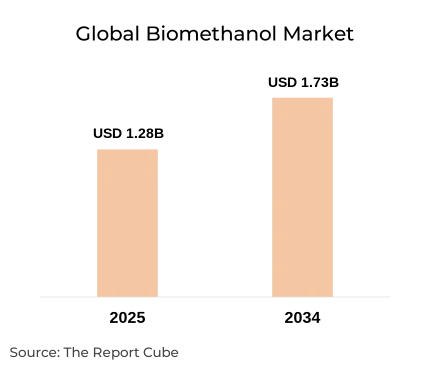
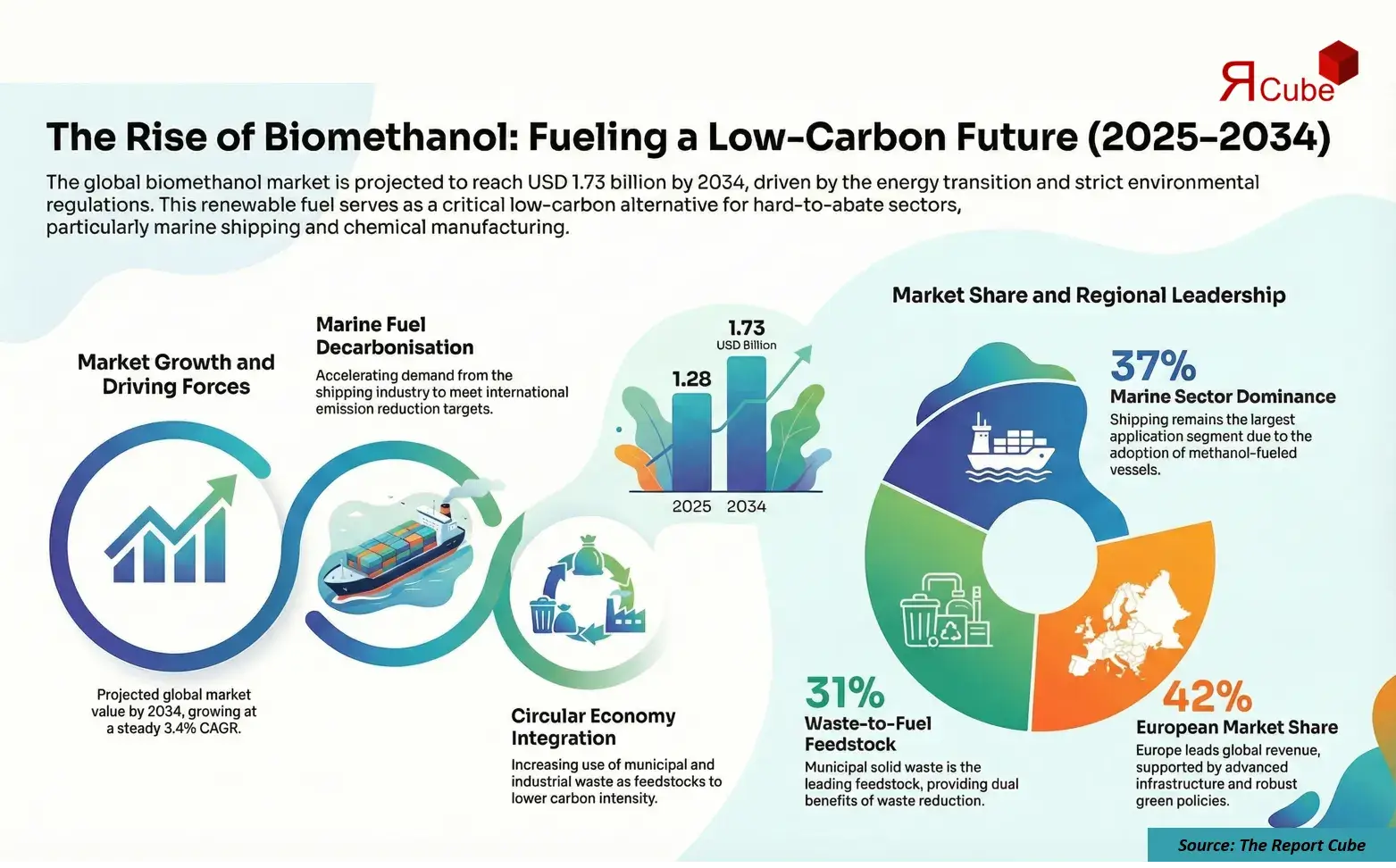
The Global Biomethanol Market is anticipated to register a CAGR of 3.4% during the forecast period 2026-2034. The market size was valued at USD 1.28 Billion in 2025 and is projected to reach USD 1.73 Billion by 2034. This measured yet resilient growth reflects the increasing role of biomethanol as a low-carbon alternative to conventional methanol in energy, chemicals, and transportation applications. Biomethanol, produced from renewable biomass and waste feedstocks, supports decarbonization goals by reducing lifecycle greenhouse gas emissions while utilizing existing methanol infrastructure.
The global energy transition and tightening environmental regulations are driving interest in renewable fuels and sustainable chemical feedstocks. Biomethanol offers a versatile pathway to reduce fossil fuel dependence, particularly in hard-to-abate sectors such as marine shipping, industrial chemicals, and heavy transport. Its compatibility with existing methanol engines, storage, and distribution systems makes it an attractive near-term solution compared to alternative fuels requiring extensive infrastructure upgrades. As governments and industries prioritize circular economy models, the utilization of waste-derived feedstocks for biomethanol production is strengthening its long-term strategic relevance.
Global Biomethanol Market Recent Developments
- 2025: BioMCN expanded renewable methanol capacity in Europe to support marine fuel decarbonization initiatives.
- 2025: Carbon Recycling International advanced commercial-scale biomethanol projects using captured CO₂ and renewable hydrogen.
Government Initiatives & Policies
- EU Renewable Energy Directive (RED III): Promotes renewable fuels of non-biological origin and bio-based fuels for transport and industry.
- IMO GHG Strategy: Targets reduction of shipping emissions, accelerating adoption of low-carbon marine fuels including biomethanol.
Global Biomethanol Market Dynamics
Key Driver: Decarbonization of Marine and Industrial Fuel Consumption
The primary driver of the global biomethanol market is the accelerating push to decarbonize marine transportation and industrial fuel usage. International shipping alone accounts for nearly 3% of global greenhouse gas emissions, prompting regulators and vessel operators to seek scalable low-carbon fuel alternatives. Biomethanol is gaining traction as a preferred option due to its lower carbon intensity, ease of handling, and compatibility with dual-fuel engines. In parallel, industrial users are adopting biomethanol as a sustainable feedstock for formaldehyde, acetic acid, and other derivatives. These combined demand streams are creating stable offtake opportunities, supporting long-term market growth.
Major Challenge: Limited Production Capacity and Feedstock Availability
A major challenge constraining biomethanol market expansion is limited global production capacity and competition for sustainable biomass feedstocks. Biomethanol production requires consistent access to agricultural residues, forestry waste, municipal solid waste, or industrial by-products, which can be geographically constrained. Feedstock logistics, collection costs, and seasonal variability impact supply reliability and production economics. Additionally, biomethanol currently represents a small fraction of total methanol production, limiting economies of scale. Overcoming these challenges will require coordinated investment in feedstock supply chains, waste management infrastructure, and advanced conversion technologies.
Industry Trends: Integration with Circular Economy and Waste-to-Fuel Models
An important trend shaping the biomethanol market is its integration with circular economy and waste-to-fuel strategies. Producers are increasingly utilizing municipal solid waste, industrial off-gases, and forestry residues to generate renewable methanol, reducing landfill use and emissions simultaneously. This approach aligns biomethanol production with broader sustainability objectives, including waste reduction and resource efficiency. Technological advances in gasification, syngas cleanup, and carbon recycling are improving conversion efficiency and lowering production costs. As circular economy policies expand globally, biomethanol is expected to benefit from preferential regulatory treatment and public support.
Opportunity Ahead: Growth in Green Shipping and Chemical Demand
The expansion of green shipping corridors and low-carbon chemical supply chains presents a significant opportunity for biomethanol producers. Major shipping companies are investing in methanol-fueled vessels, creating long-term demand for renewable methanol blends. At the same time, chemical manufacturers are under pressure to decarbonize Scope 3 emissions, driving interest in bio-based methanol derivatives. Biomethanol’s ability to serve both energy and chemical markets enhances its value proposition and revenue diversification, positioning it as a strategic transition fuel over the forecast period.
Global Biomethanol Market Segment-wise Analysis
By Feedstock Type:
- Agricultural Residues
- Forestry Residues
- Municipal Solid Waste
- Industrial Waste and By-products
- Other Biomass Feedstocks
Municipal solid waste represents the leading feedstock segment, accounting for approximately 31% of biomethanol production in 2025. Waste-based feedstocks offer dual environmental benefits by reducing landfill volumes while generating renewable fuel. Industrial waste gases and forestry residues also contribute significantly, particularly in regions with established pulp, paper, and steel industries. Agricultural residues show steady growth potential, supported by rural biomass availability and waste valorization initiatives.
By Application:
- Transportation Fuels (Blends and Neat Use)
- Marine Fuel and Shipping
- Chemicals and Derivatives (Formaldehyde, Acetic Acid, MTBE, DME, etc.)
- Power Generation and Heat
- Other Industrial Applications
Marine fuel and shipping applications dominate the biomethanol market, contributing nearly 37% of total demand in 2025. The segment’s leadership is driven by rapid adoption of methanol-fueled vessels and compliance with maritime emission regulations. Chemical and derivative applications follow closely, supported by demand for low-carbon feedstocks in formaldehyde and acetic acid production. Transportation fuel blending represents a growing segment as policymakers encourage renewable fuel integration.
Regional Projection of Global Biomethanol Industry
- North America
- Europe
- Asia Pacific
- Middle East and Africa
- South America
Europe leads the global biomethanol market, accounting for approximately 42% of total revenue in 2025. The region benefits from strong renewable energy policies, advanced waste management infrastructure, and early adoption of green marine fuels. North America follows, supported by industrial decarbonization initiatives and growing interest in carbon recycling technologies. Asia Pacific represents an emerging growth region due to expanding shipping activity, industrial demand, and increasing investments in sustainable fuels. The Middle East and Africa and South America show long-term potential driven by biomass availability and industrial diversification.
Why Choose This Report?
- Provides a comprehensive overview of the overall market analysis, encompassing key trends, policy drivers, and risk assessment to support strategic decision-making.
- Provides accurate, up-to-date insights into market size, segmentation, and emerging opportunities, helping to minimize risk & capitalizing on growth.
- Gives deep understanding of feedstock dynamics, application trends, and renewable fuel economics.
- Delivers competitive analysis & benchmarking, uncovering the strengths & weaknesses of market participants.
- Consolidates comprehensive market intelligence, reducing reasoning & streamlining research efforts.
- Facilitates customized market segmentation & risk mitigation strategies, fine-tuned to the business objectives.
- Aids in identifying both market challenges & untapped opportunities within low-carbon fuels.
- Provides valuable information based on deployment trends, regulatory evolution, and real-world project data.
Table of Contents
- Introduction
- Objective of the Study
- Product and Category Definition
- Market Segmentation
- Study Variables
- Research Methodology
- Secondary Data Points
- Breakdown of Secondary Sources
- Primary Data Points
- Breakdown of Primary Interviews
- Secondary Data Points
- Executive Summary
- Market Dynamics
- Drivers
- Challenges
- Opportunity Assessment
- Recent Trends and Developments
- Regulatory and Policy Landscape
- Global Biomethanol Market Overview (2020-2034)
- Market Size, By Value (USD Billion)
- Market Share, By Feedstock Type
- Agricultural Residues
- Forestry Residues
- Municipal Solid Waste
- Industrial Waste and By‑products
- Other Biomass Feedstocks
- Market Share, By Application
- Transportation Fuels (Blends and Neat Use)
- Marine Fuel and Shipping
- Chemicals and Derivatives (Formaldehyde, Acetic Acid, MTBE, DME, etc.)
- Power Generation and Heat
- Other Industrial Applications
- Market Share, By Production Route
- Biomass Gasification‑based Biomethanol
- Anaerobic Digestion and Biogas‑based Biomethanol
- Waste‑to‑Biomethanol
- Other Emerging Production Routes
- Market Share, By End Use Sector
- Transportation
- Chemicals and Petrochemicals
- Power and Utilities
- Industrial and Commercial
- Other End Use Sectors
- Market Share, By Region
- North America
- Europe
- Asia Pacific
- Middle East and Africa
- South America
- Market Share, By Company
- Revenue Shares
- Competitive Landscape
- North America Biomethanol Market
- Market Size, By Value (USD Billion)
- Market Share, By Feedstock Type
- Market Share, By Application
- Market Share, By Production Route
- Market Share, By End Use Sector
- Market Share, By Country
- United States
- Canada
- Mexico
- Europe Biomethanol Market
- Market Size, By Value (USD Billion)
- Market Share, By Feedstock Type
- Market Share, By Application
- Market Share, By Production Route
- Market Share, By End Use Sector
- Market Share, By Country
- Germany
- Netherlands
- United Kingdom
- France
- Nordic Countries
- Rest of Europe
- Asia Pacific Biomethanol Market
- Market Size, By Value (USD Billion)
- Market Share, By Feedstock Type
- Market Share, By Application
- Market Share, By Production Route
- Market Share, By End Use Sector
- Market Share, By Country
- China
- Japan
- South Korea
- India
- Rest of Asia Pacific
- Middle East and Africa Biomethanol Market
- Market Size, By Value (USD Billion)
- Market Share, By Feedstock Type
- Market Share, By Application
- Market Share, By Production Route
- Market Share, By End Use Sector
- Market Share, By Country
- Saudi Arabia
- United Arab Emirates
- South Africa
- Rest of Middle East and Africa
- South America Biomethanol Market
- Market Size, By Value (USD Billion)
- Market Share, By Feedstock Type
- Market Share, By Application
- Market Share, By Production Route
- Market Share, By End Use Sector
- Market Share, By Country
- Brazil
- Argentina
- Chile
- Rest of South America
- Competitive Outlook and Company Profiles
- OCI / BioMCN
- Company Overview
- Biomethanol Production and Project Portfolio
- Strategic Alliances and Partnerships
- Recent Developments
- Methanex Corporation
- Company Overview
- Low‑carbon Methanol and Biomethanol Portfolio
- Strategic Alliances and Partnerships
- Recent Developments
- Enerkem
- Company Overview
- Waste‑to‑Biomethanol Technology and Projects
- Strategic Alliances and Partnerships
- Recent Developments
- Södra
- Company Overview
- Biomass‑based Biomethanol Portfolio
- Strategic Alliances and Partnerships
- Recent Developments
- Alberta Pacific (Al-Pac)
- Company Overview
- Pulp Industry‑linked Biomethanol Production
- Strategic Alliances and Partnerships
- Recent Developments
- BASF
- Company Overview
- Methanol and Low‑carbon/Green Methanol Activities
- Strategic Alliances and Partnerships
- Recent Developments
- Carbon Recycling International (CRI)
- Company Overview
- CO2-to‑Methanol and Biomethanol Projects
- Strategic Alliances and Partnerships
- Recent Developments
- Atlantic Methanol / Related Green Methanol Initiatives
- Company Overview
- Methanol and Biomethanol Project Portfolio
- Strategic Alliances and Partnerships
- Recent Developments
- Proman
- Company Overview
- Methanol, Green Methanol and Biomethanol Projects
- Strategic Alliances and Partnerships
- Recent Developments
- Shanghai Baichuan or Other Regional Biomethanol Producers
- Company Overview
- Biomethanol and Green Methanol Portfolio
- Strategic Alliances and Partnerships
- Recent Developments
- Others
- OCI / BioMCN
- Contact Us and Disclaimer
Top Key Players & Market Share Outlook
- OCI / BioMCN
- Methanex Corporation
- Enerkem
- Södra
- Alberta Pacific (Al-Pac)
- BASF
- Carbon Recycling International (CRI)
- Atlantic Methanol / Related Green Methanol Initiatives
- Proman
- Shanghai Baichuan or Other Regional Biomethanol Producers
- Others
Frequently Asked Questions






