




Build Your Custom Market Intelligence Report
Customize Your ReportBrazil Industrial Lubricants Market Insights & Analysis
The Brazil Industrial Lubricants Market is anticipated to register a CAGR of 3.60% during 2026-2034. The market size was valued at USD 3.8 billion in 2025 and is projected to reach USD 5.22 billion by 2034. The market plays a critical role in supporting Brazil’s industrial backbone, including manufacturing, mining, energy, and heavy equipment operations. Industrial lubricants are essential for reducing friction, minimizing equipment wear, improving operational efficiency, and extending machinery lifespan across diverse industrial environments.
Brazil’s steady industrial recovery, supported by investments in infrastructure modernization and domestic manufacturing, continues to underpin lubricant demand. The resurgence of metal processing, automotive components, and industrial equipment production has directly increased consumption of hydraulic fluids, gear oils, and metalworking fluids. At the same time, industries are increasingly prioritizing operational efficiency and equipment reliability, driving demand for high-performance and specialty lubricants that deliver longer service intervals and improved thermal stability.
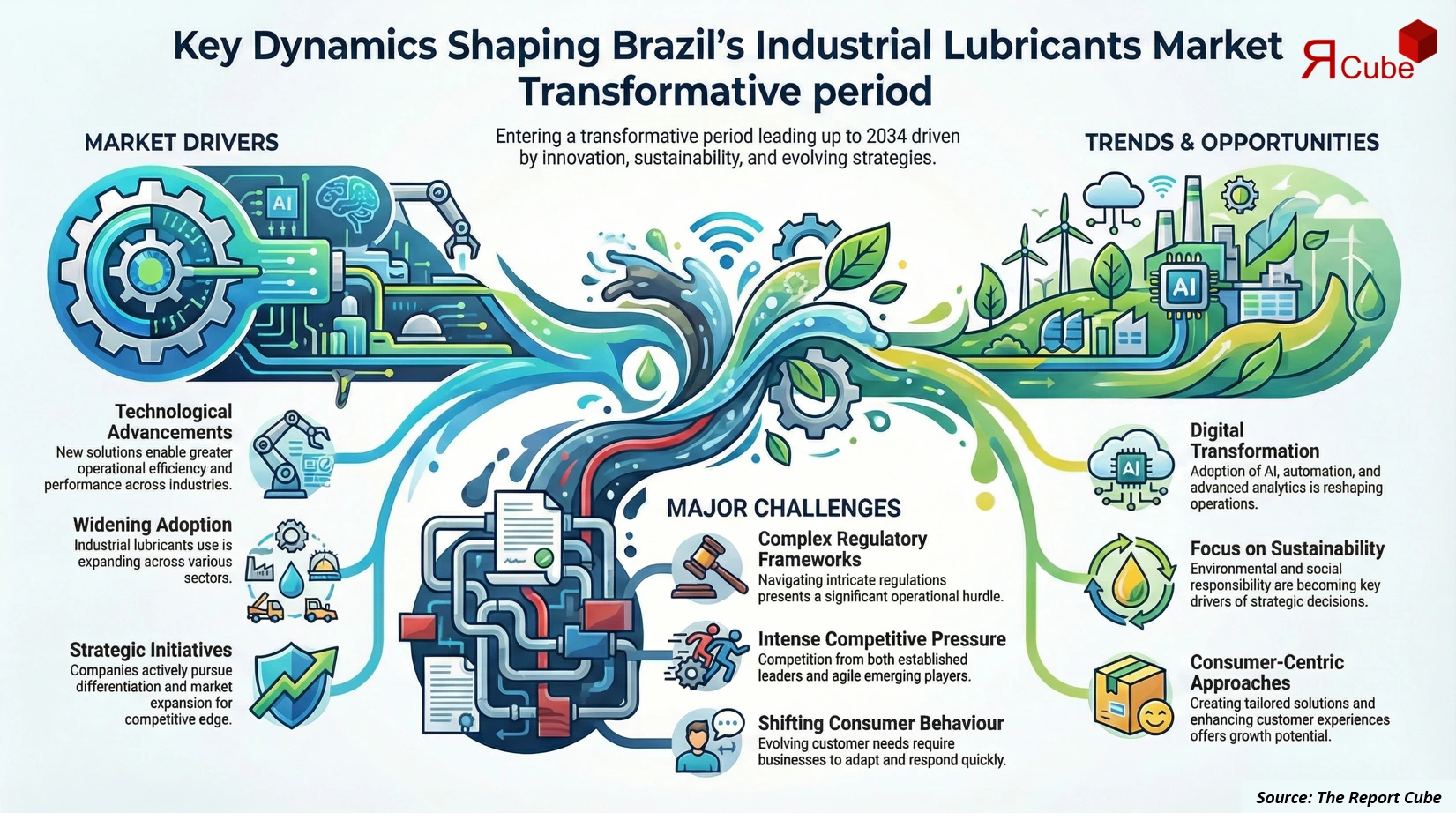
Additionally, sustainability considerations are shaping purchasing behavior across industrial sectors. Brazilian manufacturers are gradually shifting toward lubricants with improved biodegradability, lower emissions, and enhanced energy efficiency. This transition is reinforcing innovation among lubricant suppliers and strengthening long-term growth prospects for the Brazil Industrial Lubricants Market through 2034.
Brazil Industrial Lubricants Market Recent Developments
- 2025: Fuchs do Brasil began initial operations at new Sorocaba lubricant plant serving industrial customers nationwide.
- 2025: Petrobras advanced investments to expand high-performance industrial lubricant capacity aligned with 2026–2030 business plan.
Government Initiatives & Policies
- Brazil National Industry Development Program: Supports modernization of manufacturing and industrial efficiency improvements.
- Brazil Energy Efficiency Plan: Encourages reduced energy losses and improved machinery efficiency across industrial sectors.
Brazil Industrial Lubricants Market Dynamics
Key Driver: Expansion of Industrial Manufacturing and Heavy Equipment Usage
The continued expansion of Brazil’s industrial manufacturing base is a primary driver of the industrial lubricants market. Growth in sectors such as metal fabrication, mining, construction materials, and energy production has led to higher utilization of heavy machinery and complex mechanical systems. These operations rely heavily on hydraulic fluids, gear oils, and compressor oils to maintain operational stability and minimize downtime. Approximately 65% of industrial facilities in Brazil report increased focus on preventive maintenance, directly boosting lubricant consumption. As machinery complexity rises, demand is shifting toward higher-quality lubricants capable of withstanding extreme temperatures, pressure, and continuous operation, reinforcing consistent market growth.
Book your FREE 30-minute expert consultation today
Contact UsIndustry Trends: Rising Adoption of High-Performance and Synthetic Lubricants
A key trend reshaping the Brazil Industrial Lubricants Market is the gradual adoption of high-performance and synthetic lubricant formulations. Industrial operators are increasingly prioritizing longer drain intervals, reduced maintenance frequency, and improved energy efficiency. Synthetic and semi-synthetic lubricants offer superior oxidation resistance and thermal stability, making them attractive for critical applications such as turbines, compressors, and high-load gear systems. Nearly 30% of large industrial facilities in Brazil have transitioned part of their lubricant portfolio toward advanced formulations. This trend is also supported by digital monitoring tools that optimize lubricant usage and predict maintenance needs.
Major Challenge: Price Sensitivity and Volatility in Raw Material Costs
Despite steady demand, price sensitivity remains a significant challenge within the Brazil Industrial Lubricants Market. Industrial buyers often prioritize cost efficiency, particularly during periods of economic uncertainty. Fluctuations in crude oil prices directly impact base oil costs, creating pricing volatility for lubricant manufacturers and distributors. Additionally, competition from low-cost alternatives places pressure on premium product adoption, especially among small and mid-sized industrial operators. These factors constrain margin expansion and require suppliers to balance cost competitiveness with performance differentiation.
Opportunity: Integration of Digital Industrial Solutions and Predictive Maintenance
The integration of digital industrial solutions presents a compelling opportunity for lubricant suppliers in Brazil. Predictive maintenance platforms, industrial IoT systems, and data analytics tools enable real-time monitoring of lubricant condition and equipment health. This approach reduces unplanned downtime and optimizes lubricant consumption. By aligning lubricant products with digital service offerings, suppliers can strengthen customer relationships and move toward value-added service models. As Brazilian industries modernize operations, demand for digitally enabled lubrication solutions is expected to rise steadily through the forecast period.
Brazil Industrial Lubricants Market Segment-wise Analysis
By Product:
- Hydraulic Fluids
- Metalworking Fluids
- Gear Oils
- Compressor Oils
- Greases
- Turbine Oils
- Process Oils
- Other Products
Hydraulic Fluids represent the leading product segment, accounting for approximately 32% of the Brazil Industrial Lubricants Market in 2025. Their dominance is driven by widespread use in construction equipment, manufacturing machinery, and material handling systems. Hydraulic systems require consistent lubrication to ensure precise control and operational efficiency, leading to high replacement and refill rates. Growth in infrastructure projects and industrial automation further supports demand, while improved formulations with higher viscosity stability enhance performance across varied operating conditions.
By Application:
- Metalworking Fluids
- Process Oils
- Hydraulic Fluids
- Gear Oils
- General Industrial Lubricants
- Others
Hydraulic Fluids also lead by application, holding nearly 29% market share due to their critical role in industrial machinery operations. Continuous usage across manufacturing, mining, and energy sectors ensures stable demand. Meanwhile, metalworking fluids are gaining traction as Brazil’s metal fabrication and automotive component industries recover. Process oils and gear oils maintain steady growth, supported by chemical processing and heavy equipment usage across the country.
Regional Projection of Brazil Industrial Lubricants Industry
- North
- Northeast
- Central-West
- Southeast
- South
The Southeast region leads the Brazil Industrial Lubricants Market, contributing approximately 45% of total revenue in 2025. This dominance is attributed to the region’s concentration of manufacturing hubs, automotive plants, mining activities, and energy infrastructure. States such as São Paulo and Minas Gerais host extensive industrial operations that require consistent lubricant supply. Strong logistics networks and access to skilled labor further reinforce regional leadership. The South region follows, supported by machinery manufacturing and agribusiness-related industrial activity.
Need insights for a specific region within this market?
Request Regional DataWhy Choose This Report?
- Provides a comprehensive overview of the overall market analysis, encompassing key trends, consumer behavior analysis, and risk assessment to support strategic decision-making.
- Provides accurate, up-to-date insights into market size, segmentation, and emerging opportunities, helping to minimize risk & capitalizing on growth.
- Gives deep understanding of target audience preferences, investment habits, and communication channels for enhanced product development & marketing effectiveness.
- Delivers competitive analysis & benchmarking, uncovering the strengths & weaknesses of market competitors to guide strategies.
- Consolidate comprehensive market intelligence, reducing reasoning & streamlining research efforts.
- Facilitates customized market segmentation & risk mitigation strategies, fine-tuned to the business objectives.
- Aids in identifying both market challenges & untapped opportunities within the industry to drive long-term business growth.
- Provides valuable information based on actual customer data & search trends.
Table of Contents
- Introduction
- Objective of the Study
- Product and Category Definition
- Market Segmentation
- Study Variables
- Research Methodology
- Secondary Data Points
- Breakdown of Secondary Sources
- Primary Data Points
- Breakdown of Primary Interviews
- Secondary Data Points
- Executive Summary
- Market Dynamics
- Drivers
- Challenges
- Opportunity Assessment
- Recent Trends and Developments
- Regulatory and Policy Landscape
- Brazil Industrial Lubricants Market Overview (2020-2034)
- Market Size, By Value (USD Billion)
- Market Share, By Product
- Hydraulic Fluids
- Metalworking Fluids
- Gear Oils
- Compressor Oils
- Greases
- Turbine Oils
- Process Oils
- Other Products
- Market Share, By Application
- Metalworking Fluids
- Process Oils
- Hydraulic Fluids
- Gear Oils
- General Industrial Lubricants
- Others
- Market Share, By Base Oil
- Mineral Oil
- Synthetic Oil
- Bio-based Oil
- Other Base Oils
- Market Share, By End-use
- Construction
- Metal Mining
- Cement Production
- Power Generation
- Automotive
- Chemical Production
- Oil Gas
- Textile Manufacturing
- Food Processing
- Pulp Paper
- Others
- Market Share, By Sales Channel
- Direct Sales
- Distributor Sales
- Online Channels
- Other Channels
- Market Share, By Region
- North
- Northeast
- Central-West
- Southeast
- South
- Market Share, By Company
- Competition Characteristics
- Revenue Shares & Analysis
- North Region Industrial Lubricants Market
- Market Size, By Value (USD Billion)
- Market Share, By Product
- Market Share, By Application
- Market Share, By Base Oil
- Market Share, By End-use
- Market Share, By Sales Channel
- Northeast Region Industrial Lubricants Market
- Market Size, By Value (USD Billion)
- Market Share, By Product
- Market Share, By Application
- Market Share, By Base Oil
- Market Share, By End-use
- Market Share, By Sales Channel
- Central-West Region Industrial Lubricants Market
- Market Size, By Value (USD Billion)
- Market Share, By Product
- Market Share, By Application
- Market Share, By Base Oil
- Market Share, By End-use
- Market Share, By Sales Channel
- Southeast Region Industrial Lubricants Market
- Market Size, By Value (USD Billion)
- Market Share, By Product
- Market Share, By Application
- Market Share, By Base Oil
- Market Share, By End-use
- Market Share, By Sales Channel
- South Region Industrial Lubricants Market
- Market Size, By Value (USD Billion)
- Market Share, By Product
- Market Share, By Application
- Market Share, By Base Oil
- Market Share, By End-use
- Market Share, By Sales Channel
- Competitive Outlook and Company Profiles
- Petrobras
- Company Overview
- Product Portfolio
- Strategic Alliances/Partnerships
- Recent Developments
- Shell Brasil
- Company Overview
- Product Portfolio
- Strategic Alliances/Partnerships
- Recent Developments
- ExxonMobil Brasil
- Company Overview
- Product Portfolio
- Strategic Alliances/Partnerships
- Recent Developments
- Chevron Brazil
- Company Overview
- Product Portfolio
- Strategic Alliances/Partnerships
- Recent Developments
- TotalEnergies Brazil
- Company Overview
- Product Portfolio
- Strategic Alliances/Partnerships
- Recent Developments
- Iconic Lubrificantes
- Company Overview
- Product Portfolio
- Strategic Alliances/Partnerships
- Recent Developments
- Castrol Brasil
- Company Overview
- Product Portfolio
- Strategic Alliances/Partnerships
- Recent Developments
- Ipiranga Lubrificantes
- Company Overview
- Product Portfolio
- Strategic Alliances/Partnerships
- Recent Developments
- Petronas Brazil
- Company Overview
- Product Portfolio
- Strategic Alliances/Partnerships
- Recent Developments
- Fuchs do Brasil
- Company Overview
- Product Portfolio
- Strategic Alliances/Partnerships
- Recent Developments
- Others
- Petrobras
- Contact Us and Disclaimer
Top Key Players & Market Share Outlook
- Petrobras
- Shell Brasil
- ExxonMobil Brasil
- Chevron Brazil
- TotalEnergies Brazil
- Iconic Lubrificantes
- Castrol Brasil
- Ipiranga Lubrificantes
- Petronas Brazil
- Fuchs do Brasil
- Others
Frequently Asked Questions






