




Build Your Custom Market Intelligence Report
Customize Your ReportBrazil Flex-Fuel Vehicle Market Insights & Analysis
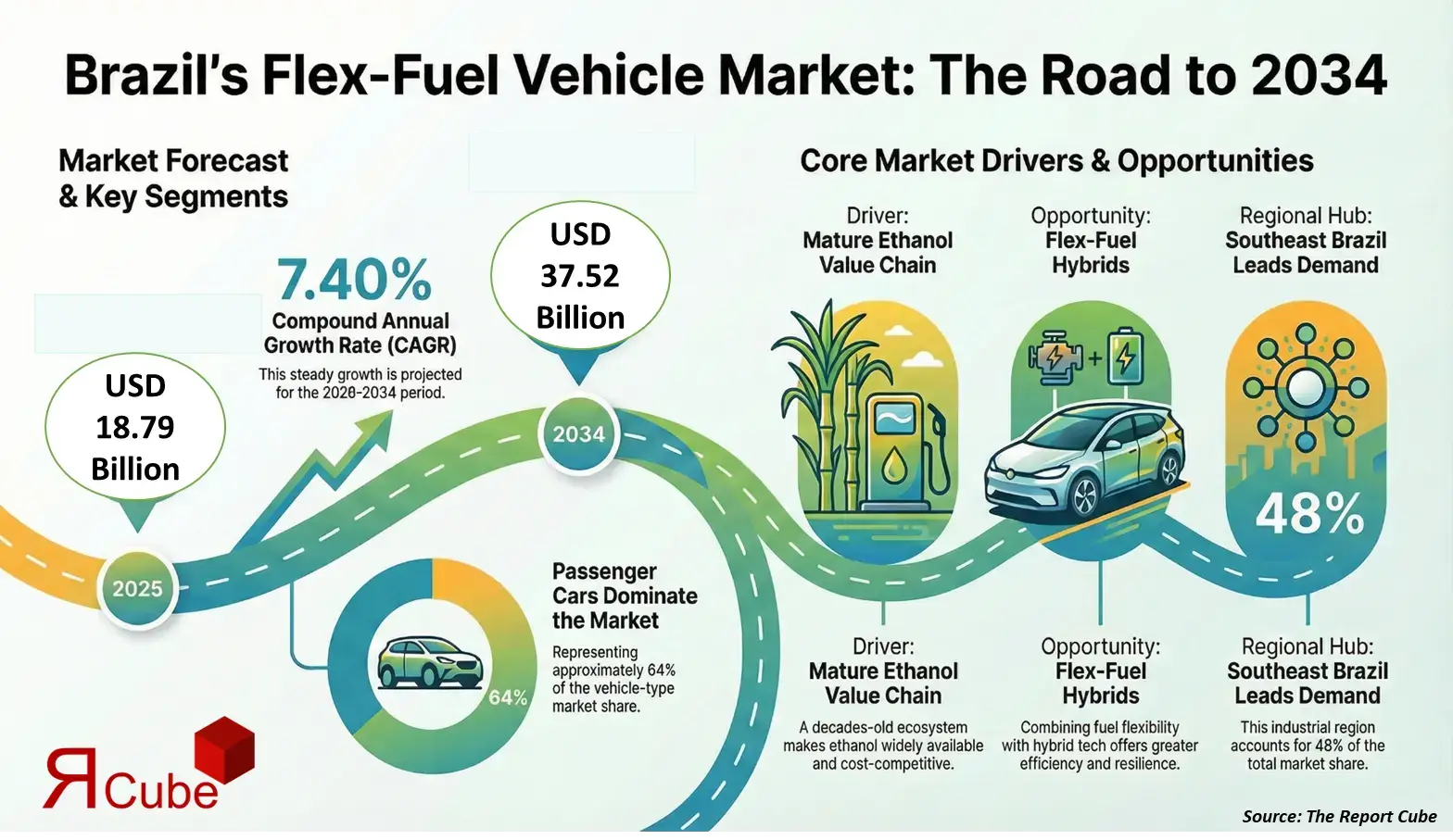
The Brazil Flex-Fuel Vehicle Market is projected to grow at a 7.40% CAGR during 2026-2034. The market stood at USD 18.79 billion in 2025 and is expected to reach USD 35.72 billion by 2034. Growth is driven by Brazil’s long-standing biofuel ecosystem, extensive ethanol supply chain, and strong consumer preference for vehicles that accept multiple fuel types. OEMs continue to introduce flexible powertrains across mainstream segments, while local manufacturing, favorable taxation, and fuel-station coverage for hydrous ethanol and blended gasoline sustain broad fleet adoption. As vehicle electrification advances globally, flex-fuel powertrains remain strategically important in Brazil, providing low-cost, resilient mobility solutions for urban and rural markets alike. Government support for renewable fuels and broad aftermarket capabilities also underpin demand for new vehicle sales and retrofit programs.
Market expansion is complemented by product diversification and technology evolution: automakers are launching improved engine calibration, optimized fuel-management systems, and hybridized flex-fuel variants that boost efficiency and reduce emissions. Distribution networks and dealer aftersales channels are adapting to support multiple-fuel maintenance and warranty systems, and financing options are increasingly tailored for flex-fuel models. Fleet operators in logistics and ride-hailing segments value the fuel flexibility that mitigates price volatility between ethanol and gasoline, improving operating economics. Combined urbanization trends, vehicle replacement cycles, and incremental uptake of flex-fuel hybrid powertrains create a durable growth corridor for Brazil’s auto industry through 2034.
Brazil Flex-Fuel Vehicle Market Recent Developments
- 2025: Major OEMs expanded local assembly lines for flex-fuel models and introduced new flex-hybrid variants targeting fuel-efficiency gains and lower fleet emissions.
- 2025: Fuel-station networks in key states increased ethanol storage capacity and upgraded dispensing infrastructure to support higher E100 and blended fuel throughput.
Government Initiatives & Policies
- Renewable Fuels & Industrial Policy Support: Federal incentives and local tax benefits continue to favour ethanol production, distribution, and fleet adoption to sustain rural employment and energy security.
- Vehicle Efficiency & Emissions Programs: National targets and state-level programs encourage modernized flex-fuel engines, emission testing, and incentives for low-emission commercial fleets.
Brazil Flex-Fuel Vehicle Market Dynamics
Driver: Mature Ethanol Value Chain & Resilient Fuel Infrastructure
Brazil’s decades-old ethanol industry from sugarcane cultivation to fuel refining and retail distribution remains the single most important structural driver for flex-fuel vehicles. The country benefits from an integrated supply chain that keeps ethanol widely available and cost-competitive versus imported fossil fuels. This infrastructure lowers barrier-to-entry for flex-fuel vehicle adoption and supports fleet operators who optimize fuel choice by price and availability. Local engineering expertise and OEM familiarity with flex-fuel calibration also speed model introduction. For consumers, the combination of competitive ethanol pricing, high station coverage in both urban and rural areas, and cultural familiarity with ethanol fuels translates into strong and sustained demand for new flex-capable models across passenger and commercial segments.
Challenge: Fuel-Price Volatility & Macroeconomic Sensitivity
Although the ethanol ecosystem is a market strength, price volatility between hydrous ethanol and gasoline can influence total cost of ownership and short-term consumer purchase decisions. Macroeconomic instability, currency swings, and agricultural yield variability affect feedstock costs and ethanol availability in certain years. Moreover, fiscal policy changes or shifts in taxation can rapidly alter relative fuel economics, creating uncertainty for fleet planners and private buyers. Infrastructure gaps persist in remote northern regions where ethanol station density is lower, potentially constraining nationwide uniform adoption. Addressing these vulnerabilities through stabilizing fiscal measures and targeted infrastructure investments—will reduce adoption friction and support more predictable market growth.
Opportunity: Flex-Fuel Hybrids & Commercial Fleet Conversion
There is a meaningful opportunity to combine flexible fuel capability with hybrid drivetrains to deliver both lower fuel consumption and the resilience of multiple fuel options. Flex-hybrid models enable urban fuel savings while retaining ethanol capability for rural refuelling networks, creating a compelling total-cost-of-ownership proposition for ride-hailing, delivery, and commercial fleets. Large fleet conversion programs logistics operators, municipal buses, and corporate vehicle fleetsoffer scale to OEMs and retrofit specialists. These programs also open recurring service and telematics revenue streams. OEMs that lead with efficient flex-hybrid platforms and integrated fleet-service offerings can capture significant market share as operators look to hedge against fuel-price risk and meet tightening emissions expectations.
Book your FREE 30-minute expert consultation today
Contact UsTrend: Localisation, Aftermarket Services & Digital Fuel Optimization
Manufacturers and suppliers are localizing components, calibration services, and training to reduce costs and shorten lead times. The aftermarket ecosystem—service networks, fuel-advisory apps, and telematics providers—enables real-time fuel-choice optimization and predictive maintenance for flex fleets. Digital services that advise drivers on the most economical fuel option, combined with dealer programs that offer bundled maintenance for flex-fuel systems, increase owner confidence and retention. This trend toward integration of vehicle, fuel, and digital services supports higher utilization rates and improved lifecycle economics, helping to sustain mid-term growth even as broader powertrain electrification trends emerge globally.
Brazil Flex-Fuel Vehicle Market Segment-wise Analysis
By Vehicle Type:
- Passenger Cars
- Light Commercial Vehicles (LCVs)
- Heavy Commercial Vehicles (HCVs)
- Two-Wheelers
- Others
Passenger Cars represent the largest vehicle-type segment with an estimated around 64% share. Passenger cars are the primary channel through which flex-fuel technology reaches mainstream consumers, from compact city models to mid-size sedans and SUVs. OEMs concentrate model launches and marketing efforts on passenger vehicles because of high replacement cycles, broad retail financing availability, and strong urban demand. Passenger-car dominance is reinforced by the popularity of flex-fuel family cars and compact fleet vehicles used in ride-hailing, which together drive volume and normalize flex-technology for everyday users across metropolitan regions.
By Fuel Type:
- Hydrous Ethanol – E100
- E27 Gasoline – 27% Ethanol Blend
- Flex-Fuel Hybrids
- Others
Flex-capable vehicles (E100/E27) lead the fuel-type segment with an estimated about 71% share, reflecting the dominance of multi-fuel powertrains in Brazil’s vehicle fleet. The ability to run on both hydrous ethanol and blended gasoline provides operational flexibility and resilience to price swings, making flex-capability the default configuration for many locally sold models. High market penetration of flex-fuel technology means most new vehicles offer factory-calibrated multi-fuel systems, ensuring consumers can choose the most economical or available fuel at the pump without mechanical modifications.
Regional Projection of Brazil Flex-Fuel Vehicle Industry
By Region:
- Southeast Brazil
- South Brazil
- Northeast Brazil
- Central-West Brazil
- North Brazil
Southeast Brazil leads the market with an estimated approximately 48% share. This region—anchored by São Paulo, Rio de Janeiro, and major industrial and commercial centres—combines highest vehicle sales, dense dealership networks, and abundant ethanol and gasoline retail infrastructure. Southeast Brazil’s concentration of urban consumers, corporate fleets, and logistics hubs creates disproportionate demand for flex-fuel passenger cars and commercial vehicles. As a result, OEM launches, fleet conversion pilots, and charging/refuelling infrastructure investments are typically concentrated in this region before scaling nationwide.
Need insights for a specific region within this market?
Request Regional DataWhat Does Our Brazil Flex-Fuel Vehicle Market Research Study Entail?
- Provides comprehensive market sizing and forecasting from 2026–2034, showing growth from USD 18.79 billion to USD 35.72 billion at a 7.40% CAGR, with scenario analysis by fuel-price dynamics and policy shifts.
- Delivers detailed segmentation across Vehicle Types and Fuel Types to identify high-opportunity categories such as passenger cars and flex-capable platforms.
- Offers regional insights covering Southeast, South, Northeast, Central-West, and North Brazil to prioritise dealer networks, fleet pilots, and infrastructure investments.
- Presents competitive profiling of leading automakers including FCA Brazil, Volkswagen do Brasil, General Motors do Brasil, Ford Brasil, Renault Nissan Alliance Brazil, Stellantis, Honda, Toyota, Hyundai Motor Brasil, and Mercedes-Benz do Brasil.
- Reviews regulatory environment, ethanol supply-chain resilience, fleet-conversion economics, and go-to-market recommendations for OEMs, fleet operators, fuel suppliers, and finance partners.
Brazil Flex-Fuel Vehicle Industry Companies,
Market Share - (2026-2034)
Top Key Players
Fiat Chrysler Automobiles (FCA) Brazil, Volkswagen do Brasil, General Motors do Brasil, Ford Brasil, Renault Nissan Alliance Brazil, Stellantis (Peugeot/Citroën Brazil), Honda Automóveis do Brasil, Toyota do Brasil, Hyundai Motor Brasil, Mercedes-Benz do Brasil, and Others.
Table of Contents
- Introduction
- Objective of the Study
- Product/Technology Definition
- Market Segmentation
- Study Variables
- Research Methodology
- Secondary Data Points
- Breakdown of Secondary Sources
- Primary Data Points
- Breakdown of Primary Interviews
- Secondary Data Points
- Executive Summary
- Market Dynamics
- Drivers
- Challenges
- Opportunity Assessment
- Recent Trends and Developments
- Policy and Regulatory Landscape
- Brazil Flex-Fuel Vehicle Market Overview (2020–2034)
- Market Size, By Volume (Units) & Value (USD Million)
- Market Share, By Vehicle Type
- Passenger Cars
- Light Commercial Vehicles (LCVs)
- Heavy Commercial Vehicles (HCVs)
- Two-Wheelers
- Others
- Market Share, By Fuel Type
- Hydrous Ethanol (E100)
- E27 Gasoline (27% Ethanol Blend)
- Flex-Fuel Hybrids
- Others
- Market Share, By Powertrain
- Internal Combustion Engine (ICE)
- Hybrid Electric Vehicles (HEV)
- Plug-in Hybrid Electric Vehicles (PHEV)
- Others
- Market Share, By Region
- Southeast Brazil
- South Brazil
- Northeast Brazil
- Central-West Brazil
- North Brazil
- Market Share, By Company
- Revenue Shares
- Competitive Landscape
- Segment-wise & Industry-wise Market Forecast (2026–2034)
- By Vehicle Type
- By Fuel Type
- By Powertrain
- By Region
- Regional Analysis (2020–2034)
- Southeast Brazil Flex-Fuel Vehicle Market
- Market Size, By Volume & Value (USD Million)
- Market Share, By Vehicle Type
- Market Share, By Fuel Type
- Market Share, By Key States
- South Brazil Flex-Fuel Vehicle Market
- Market Size, By Volume & Value (USD Million)
- Market Share, By Vehicle Type
- Market Share, By Fuel Type
- Market Share, By Key States
- Northeast Brazil Flex-Fuel Vehicle Market
- Market Size, By Volume & Value (USD Million)
- Market Share, By Vehicle Type
- Market Share, By Fuel Type
- Market Share, By Key States
- Central-West Brazil Flex-Fuel Vehicle Market
- Market Size, By Volume & Value (USD Million)
- Market Share, By Vehicle Type
- Market Share, By Fuel Type
- Market Share, By Key States
- North Brazil Flex-Fuel Vehicle Market
- Market Size, By Volume & Value (USD Million)
- Market Share, By Vehicle Type
- Market Share, By Fuel Type
- Market Share, By Key States
- Competitive Outlook & Company Profiles
- Fiat Chrysler Automobiles (FCA) Brazil
- Company Overview
- Business Segments
- Strategic Alliances/Partnerships
- Recent Developments
- Volkswagen do Brasil
- Company Overview
- Business Segments
- Strategic Alliances/Partnerships
- Recent Developments
- General Motors do Brasil
- Company Overview
- Business Segments
- Strategic Alliances/Partnerships
- Recent Developments
- Ford Brasil
- Company Overview
- Business Segments
- Strategic Alliances/Partnerships
- Recent Developments
- Renault Nissan Alliance Brazil
- Company Overview
- Business Segments
- Strategic Alliances/Partnerships
- Recent Developments
- Stellantis (Peugeot/Citroën Brazil)
- Company Overview
- Business Segments
- Strategic Alliances/Partnerships
- Recent Developments
- Honda Automóveis do Brasil
- Company Overview
- Business Segments
- Strategic Alliances/Partnerships
- Recent Developments
- Toyota do Brasil
- Company Overview
- Business Segments
- Strategic Alliances/Partnerships
- Recent Developments
- Hyundai Motor Brasil
- Company Overview
- Business Segments
- Strategic Alliances/Partnerships
- Recent Developments
- Mercedes-Benz do Brasil
- Company Overview
- Business Segments
- Strategic Alliances/Partnerships
- Recent Developments
- Fiat Chrysler Automobiles (FCA) Brazil
- Contact Us / Disclaimer
Top Key Players & Market Share Outlook
- Fiat Chrysler Automobiles (FCA) Brazil
- Volkswagen do Brasil
- General Motors do Brasil
- Ford Brasil
- Renault Nissan Alliance Brazil
- Stellantis (Peugeot/Citroën Brazil)
- Honda Automóveis do Brasil
- Toyota do Brasil
- Hyundai Motor Brasil
- Mercedes-Benz do Brasil
Frequently Asked Questions






