



Build Your Custom Market Intelligence Report
Customize Your ReportUAE Car Lubricants Market Key Highlights
By Product Type:
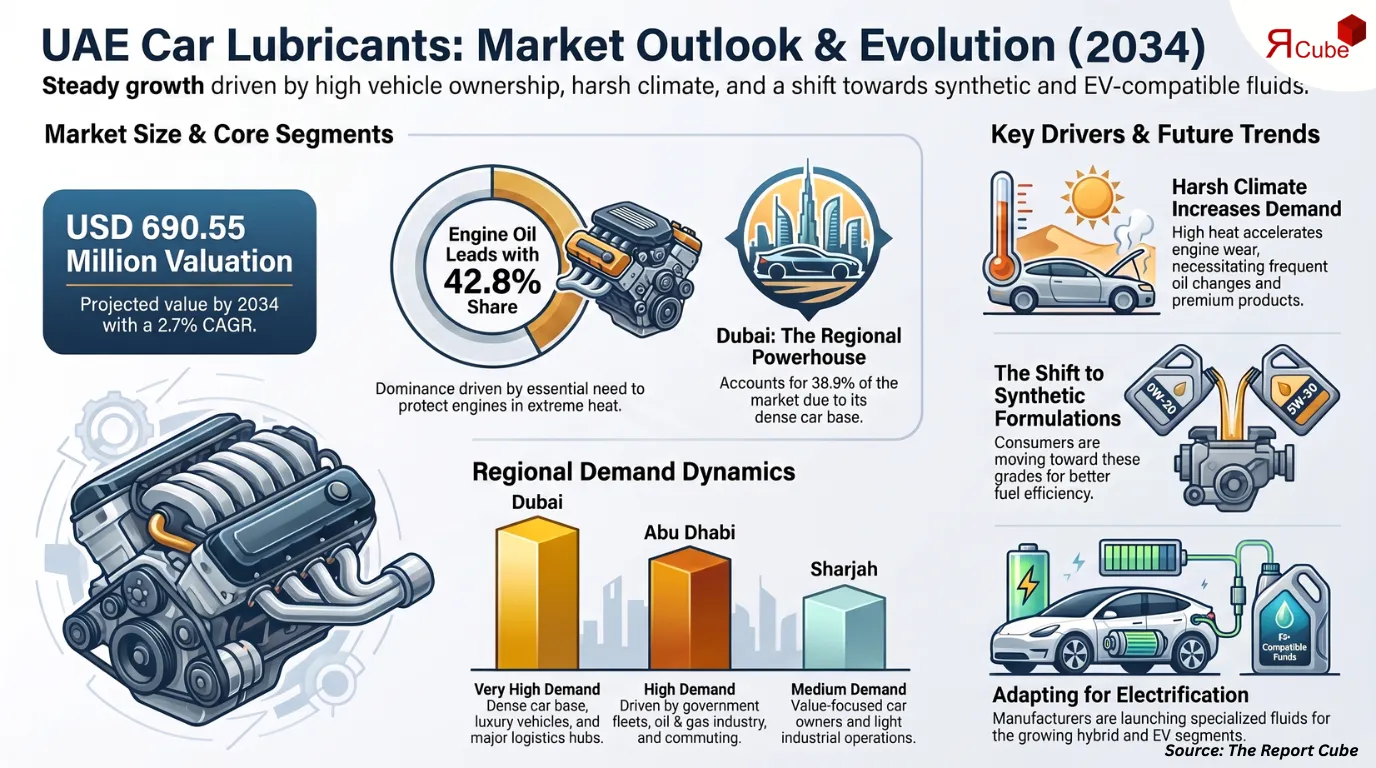
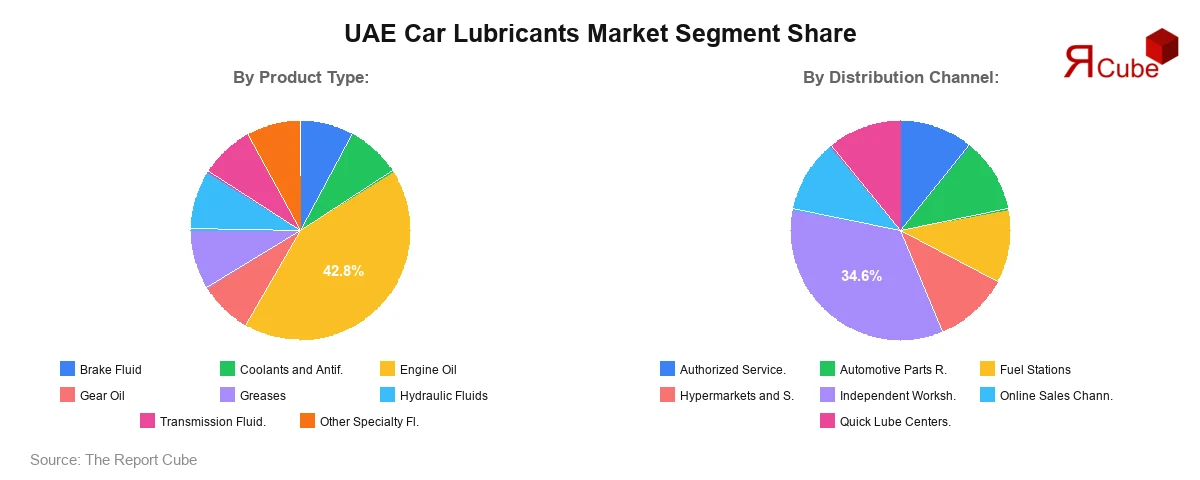
Engine Oil segment leads the market with approximately 42.8% share.
By Distribution Channel:
Independent Workshops and Garages dominate the market with nearly 34.6% of total revenue.
Regional Outlook:
Dubai dominates the UAE Car Lubricants Market with an estimated 38.9% market share.
UAE Car Lubricants Market Insights & Analysis
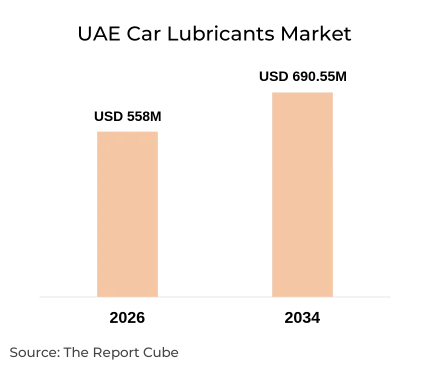
The UAE Car Lubricants Market is anticipated to register a CAGR of around 2.7% during the forecast period from 2026 to 2034. The market size is valued at USD 558 million in 2026 and is projected to reach USD 690.55 million by 2034. The growth of the market is driven by the country's high passenger vehicle ownership, continuous growth in premium automobiles, and increasing vehicle servicing frequency. Rising demand for synthetic and semi-synthetic lubricants is encouraging manufacturers to introduce advanced formulations that improve engine durability, fuel efficiency, and extended drain intervals. Consumers are increasingly selecting OEM-approved lubricants that comply with modern engine specifications, particularly for turbocharged gasoline engines and hybrid vehicles. Alongside passenger vehicle growth, expanding rental fleets and corporate transportation services continue to generate stable demand for engine oils, transmission fluids, brake fluids, coolants, and specialty lubricants across the UAE automotive aftermarket.
Ongoing investments by domestic energy companies and international lubricant manufacturers continue to strengthen the competitive landscape. Major suppliers are expanding blending facilities, introducing higher-performance formulations, and strengthening nationwide distribution networks to improve product availability. Government investments in transportation infrastructure, smart mobility projects, and sustainable mobility initiatives are also creating favorable conditions for the automotive service industry. Although electric vehicle adoption is gradually increasing, internal combustion engine vehicles remain the dominant vehicle category across the UAE, ensuring consistent lubricant consumption throughout the forecast period. Product innovation is increasingly centered on low-viscosity engine oils, enhanced thermal stability, oxidation resistance, and formulations compatible with stricter international API and OEM specifications. These developments are expected to support steady market growth while improving customer retention through higher-value premium lubricant products.
UAE Car Lubricants Market Impact Analysis
| Factor | Type | Specific Impact on Market | Magnitude | Business Implication |
|---|---|---|---|---|
| Growing Vehicle Parc | Market | Larger passenger and fleet base raises lubricant demand volumes | High | Supports expansion of branded car engine oil and service reach |
| Harsh Climate Operating Conditions | Environmental | High heat accelerates wear and shortens lubricant drain cycles | High | Drives need for premium high performance oils and frequent changes |
| Shift Toward Synthetic Formulations | Technological | Users adopt synthetics for better protection and fuel efficiency | Medium | Enables upselling higher margin synthetic and semi synthetic ranges |
| Consolidated Brand Competition | Competitive | Few large suppliers dominate volumes and control pricing power | High | Requires strong channel programs and brand led workshop loyalty |
| OEM Service Network Influence | Market | Dealer workshops guide product choice for newer car owners | Medium | Partnerships with OEMs secure recommended fill and refill business |
| Regulatory Focus on Emissions | Regulatory | Efficiency norms favor low friction lubricants for modern engines | Medium | Supports development of compliant formulations aligned to standards |
| Growth in Ride Hailing Fleets | Consumer | High mileage cars require regular lubricant replacement cycles | High | Opens bulk contract sales with taxi and app based fleet operators |
UAE Car Lubricants Market Dynamics
Key Driver: Rising Vehicle Ownership and Increasing Preference for Premium Maintenance Products
Growing passenger vehicle ownership remains a fundamental growth driver for the UAE Car Lubricants Market. Population growth, expanding urban communities, and increasing disposable income continue to support new vehicle registrations across Dubai, Abu Dhabi, and other emirates. At the same time, consumers are retaining vehicles for longer periods, resulting in higher demand for routine servicing and quality automotive lubricants. Regular replacement of engine oil, gear oil, brake fluid and coolants, transmission fluids, and automotive greases has become a standard maintenance practice as vehicle owners prioritize engine durability, fuel efficiency, and reduced repair costs. Premium vehicle ownership, particularly among luxury sedans and sport utility vehicles, further supports demand for synthetic engine oil that performs reliably under extreme operating temperatures.
Commercial mobility also contributes significantly to lubricant consumption. Rental companies, corporate fleets, government transportation departments, and mobility service providers maintain preventive maintenance schedules to maximize fleet availability and reduce operational downtime. Fleet managers increasingly select OEM-approved motor oil and transmission fluids that extend service intervals while protecting critical engine and drivetrain components. This shift toward preventive maintenance is encouraging lubricant suppliers to expand premium product offerings, strengthening the long-term outlook for the UAE automotive lubricants industry.
Industry Trend: Strong Shift Toward Synthetic Engine Oil and OEM-Specified Automotive Lubricants
Demand for synthetic engine oil continues to accelerate as vehicle technology becomes more advanced and maintenance standards continue to evolve. Modern gasoline engines equipped with turbochargers, direct fuel injection systems, and start-stop technology require lubricants that provide excellent oxidation resistance, rapid cold-start protection, and consistent viscosity under high operating temperatures. These requirements have increased adoption of fully synthetic automotive lubricants across both dealership service centers and independent garages. Low-viscosity grades, including 0W-20 and 5W-30, are becoming increasingly common as manufacturers seek improved fuel efficiency without compromising engine protection.
Another significant trend is the growing importance of manufacturer-approved lubricant specifications. Vehicle owners are increasingly selecting engine oil, transmission fluids, and brake fluid products that comply with OEM requirements to preserve warranty coverage and maintain long-term vehicle performance. Authorized distributors are expanding premium lubricant portfolios, while independent workshops are investing in technician training and modern dispensing equipment to meet the servicing requirements of newer vehicle models. Growing availability through automotive parts retailers and digital sales channels is further improving access to genuine automotive maintenance lubricants across the UAE.
Book your FREE 30-minute expert consultation today
Contact UsMajor Challenge: Longer Lubricant Service Life and Gradual Changes in Vehicle Powertrain Mix
Advancements in lubricant technology are improving product performance while reducing replacement frequency, creating a challenge for overall lubricant consumption. Premium synthetic engine oil and high-quality motor oil offer longer service intervals than conventional mineral-based products, allowing vehicle owners to reduce maintenance visits without compromising engine protection. While this trend increases the average selling price of lubricants, it also moderates volume growth across mature passenger vehicle segments. Manufacturers are therefore placing greater emphasis on value-added products, premium formulations, and specialized automotive maintenance lubricants to sustain revenue growth.
The gradual transition toward electrified mobility is also reshaping product demand within the UAE automotive lubricants industry. Battery electric vehicles eliminate the need for conventional engine oil and significantly reduce the consumption of several traditional lubricant categories. Even so, hybrid vehicles continue to require specialized engine oil, transmission fluids, and cooling solutions, while electric vehicles rely on advanced thermal management fluids for batteries and electric drivetrains. These evolving requirements are encouraging lubricant manufacturers to diversify product portfolios while maintaining strong support for conventional vehicle lubrication systems that will continue to dominate the national vehicle fleet over the next decade.
Opportunity: Expanding Premium Aftermarket Services and Advanced Vehicle Lubrication Solutions
Expansion of the organized automotive aftermarket presents a significant opportunity for lubricant manufacturers operating across the UAE. Independent workshops, dealership service centers, and quick lube facilities are investing in digital service management systems, advanced diagnostic equipment, and technician training to improve customer retention and increase sales of premium automotive lubricants. Higher awareness of preventive maintenance is encouraging motorists to select high-quality synthetic engine oil, transmission fluids, automotive greases, and brake fluid products that improve reliability while lowering long-term operating costs. This trend is particularly evident among owners of premium passenger vehicles, who increasingly prioritize manufacturer-recommended lubricant specifications.
Future growth opportunities are also emerging from evolving vehicle technologies and specialized lubricant applications. Hybrid vehicles require advanced engine oil capable of supporting frequent engine start-stop operation, while electric vehicles depend on dedicated cooling fluids and specialized drivetrain lubricants for thermal management. Manufacturers introducing innovative automotive maintenance lubricants, environmentally responsible packaging, and application-specific solutions are well positioned to strengthen customer loyalty and expand market share. Continued investment in product innovation, distribution partnerships, and technical support services is expected to reinforce long-term growth across the UAE Car Lubricants Market and the broader UAE Automotive Lubricants Industry.
UAE Car Lubricants Market Segment-wise Analysis
By Product Type:
- Brake Fluid
- Coolants and Antifreeze
- Engine Oil
- Gear Oil
- Greases
- Hydraulic Fluids
- Transmission Fluid
- Other Specialty Fluids
Among all product types, the engine oil accounted for the largest share of the UAE Car Lubricants Market, representing approximately 42.8% of total revenue in 2026. Its leadership reflects the country's large passenger vehicle fleet and the essential role of engine oil in protecting modern gasoline and hybrid engines from excessive wear under high-temperature operating conditions. Regular oil replacement remains one of the most common vehicle maintenance activities across authorized dealerships, independent workshops, and quick lube centers. Premium passenger vehicles, which form a significant portion of the UAE automotive fleet, generally require fully synthetic engine oil that complies with international API and OEM specifications. This has accelerated the transition from conventional mineral oils to advanced synthetic formulations offering superior oxidation resistance, improved fuel economy, and extended drain intervals. As vehicle owners increasingly prioritize engine reliability and lower lifetime maintenance costs, premium engine oil continues to strengthen its position within the UAE automotive lubricants industry.
Product innovation is further supporting the segment's expansion as lubricant manufacturers introduce low-viscosity formulations designed for modern engine technologies. Grades such as 0W-20, 0W-30, and 5W-30 are experiencing steady demand because they improve cold-start performance, reduce internal engine friction, and enhance overall efficiency without compromising durability. Rising ownership of turbocharged vehicles, premium SUVs, and hybrid passenger cars is also encouraging greater adoption of high-performance motor oil and advanced automotive maintenance lubricants. Alongside private vehicle owners, corporate fleets, rental companies, and government transportation departments continue selecting premium engine oil to minimize engine wear and reduce unexpected maintenance expenses. Continuous product upgrades, broader availability of OEM-approved lubricants, and strong consumer confidence in synthetic engine oil are expected to sustain the segment's market leadership throughout the forecast period.
By Distribution Channel:
- Authorized Service Centers
- Automotive Parts Retailers
- Fuel Stations
- Hypermarkets and Supermarkets
- Independent Workshops and Garages
- Online Sales Channels
- Quick Lube Centers
Based on distribution channel, the independent workshops and Garages held the largest share of the UAE Car Lubricants Market, accounting for nearly 34.6% of total revenue in 2026. Their strong position is supported by an extensive service network, competitive labor costs, and the flexibility to offer multiple lubricant brands across different vehicle categories. After manufacturer warranties expire, many vehicle owners prefer independent workshops because they provide high-quality servicing using OEM-approved engine oil, transmission fluids, gear oil, brake fluid, and coolants at comparatively affordable prices. The channel serves a wide range of passenger vehicles, including luxury cars, family sedans, SUVs, taxis, and commercial fleet vehicles. Experienced technicians, shorter waiting times, and personalized customer service further contribute to repeat business and consistent lubricant consumption throughout the country.
Many independent service providers have upgraded their facilities by adopting computerized diagnostics, digital service records, and automated lubricant dispensing equipment to improve service quality and operational efficiency. These investments enable workshops to handle increasingly sophisticated vehicles while recommending premium automotive lubricants based on manufacturer specifications rather than price alone. Strong relationships with regional distributors also ensure reliable availability of synthetic engine oil, automotive greases, transmission fluids, and specialized maintenance products. Although online lubricant sales and dealership service centers continue expanding, independent workshops remain the preferred maintenance destination for a large share of UAE motorists because they combine technical expertise, product choice, convenience, and cost-effective servicing, ensuring continued leadership across the distribution landscape.
Regional Projection of UAE Car Lubricants Industry
- Abu Dhabi
- Dubai
- Sharjah
- Northern Emirates
Dubai emerged as the leading regional market, contributing an estimated 38.9% of the UAE Car Lubricants Market in 2026. The emirate has the country's largest concentration of passenger vehicles, premium automotive brands, and organized service centers, creating sustained demand for automotive lubricants throughout the year. A large expatriate population, expanding business activities, and strong tourism continue to increase vehicle ownership and rental fleet operations, resulting in higher consumption of engine oil, transmission fluids, automotive greases, brake fluid and coolants, and other vehicle lubrication products. Dubai also serves as a regional logistics and trading hub for international lubricant manufacturers, allowing distributors to maintain efficient supply chains and broad product availability. Premium synthetic engine oil records particularly strong demand as luxury vehicles and high-performance SUVs represent a substantial portion of the local vehicle fleet.
Continued investment in transportation infrastructure, smart mobility initiatives, and automotive retail development is reinforcing Dubai's position within the UAE automotive lubricants industry. The emirate accommodates a dense network of authorized dealerships, independent workshops, and quick lube centers that collectively support consistent demand for high-quality automotive maintenance lubricants. Fleet operators serving logistics, tourism, ride-hailing, and corporate transportation sectors also contribute significantly to lubricant consumption through scheduled preventive maintenance programs. At the same time, increasing registrations of hybrid and electric vehicles are encouraging lubricant suppliers to expand portfolios with specialized cooling fluids and advanced drivetrain solutions while maintaining strong offerings for conventional internal combustion engines. These factors are expected to preserve Dubai's leadership in the UAE Car Lubricants Market over the forecast period.
Need insights for a specific region within this market?
Request Regional DataCountries Analysis of UAE Car Lubricants Market
The UAE car lubricants market shows varied demand across key Emirates.
| Cluster | Demand Level | Key Areas | System Dominance | Core Demand Logic | Growth Nature |
|---|---|---|---|---|---|
| Abu Dhabi | High | City, Al Ain, Mussafah | Mineral & semi-synthetic oils | Fleet, oil & gas, daily commuting | Steady CAGR from industrial fleets |
| Dubai | Very High | Deira, Jebel Ali, DIP | Semi & full synthetic engine oils | Dense car base & logistics hubs | Fastest growth, 38%+ volume share |
| Sharjah | Medium | City, SAIF Zone | Cost-focused mineral lubricants | Value car owners & light industry | Price-led, gradual demand increase |
| Northern Emirates | Low to Medium | Ajman, RAK, Fujairah, UAQ | Basic engine oils & gear oils | Intercity transport & small fleets | Logistics and construction driven |
Government Initiatives & Policies
- Dubai Green Mobility Strategy 2030: Dubai continues expanding electric and sustainable mobility through charging infrastructure, cleaner transportation programs, and incentives supporting low-emission vehicles. The initiative encourages lubricant manufacturers to diversify into hybrid and EV-compatible automotive fluid technologies.
- UAE Net Zero by 2050 Strategic Initiative: The UAE government continues implementing policies that promote energy efficiency, sustainable transportation, and lower carbon emissions. These initiatives encourage development of high-efficiency automotive lubricants, longer-drain synthetic oils, and environmentally responsible maintenance solutions.
UAE Car Lubricants Industry Recent Developments
- 2025: ADNOC Distribution introduced the ADNOC Voyager Platinum API SQ-Grade lubricant range, adding new 0W-20 and 5W-30 engine oils formulated to meet the latest API SQ specifications. The launch, announced during the ADNOC Voyager Dealers Meet 2025, enhances engine protection, fuel efficiency, and compatibility with modern gasoline-powered passenger vehicles while reinforcing the company's commitment to premium lubricant innovation.
- 2025: ENOC Group expanded its automotive lubricant portfolio with the launch of Elektra, a dedicated range of fluids developed for electric and hybrid vehicles, alongside new API SQ-compliant petrol engine oils. Introduced during the ENOC Global Distributor Meet, the portfolio supports evolving vehicle technologies and strengthens the company's position across both conventional and electrified mobility segments.
Why Choose This Report?
- Provides a comprehensive overview of the overall market analysis, encompassing key trends, consumer behavior analysis, and risk assessment to support strategic decision-making.
- Provides accurate, up-to-date insights into market size, segmentation, competitive landscape, and emerging opportunities, helping businesses minimize risk while capitalizing on future growth prospects.
- Gives deep understanding of target audience preferences, purchasing behavior, lubricant replacement patterns, and distribution channels for enhanced product development and marketing effectiveness.
- Delivers competitive analysis and benchmarking, uncovering the strengths, product portfolios, expansion strategies, and market positioning of leading UAE and international lubricant manufacturers.
- Consolidates comprehensive market intelligence into a single report, reducing research time while improving strategic planning and investment decisions.
- Facilitates customized market segmentation and risk mitigation strategies tailored to evolving business objectives and changing consumer demand.
- Helps identify both market challenges and untapped growth opportunities across product categories, vehicle types, and regional markets to support sustainable long-term expansion.
- Provides valuable information based on current industry developments, customer purchasing trends, distribution channel performance, and realistic market estimates.
Table of Contents
- Introduction
- Objective of the Study
- Product and Category Definition
- Market Segmentation
- Study Variables
- Research Methodology
- Secondary Data Points
- Breakdown of Secondary Sources
- Primary Data Points
- Breakdown of Primary Interviews
- Secondary Data Points
- Executive Summary
- Market Dynamics
- Emerging Opportunities
- Adoption Trends
- Demand Drivers
- Disruption Analysis (Challenges)
- Industry Analysis & Strategic Insights
- Supply/Value Chain Analysis
- Pricing Analysis
- Go-To-Market (GTM) Strategy
- BCG Matrix
- Recent Trends and Developments
- Import and Export Analysis
- Regulatory and Policy Landscape
- Region-wise Policies
- Government Initiatives
- UAE Car Lubricants Market Overview and Forecast Analysis (2021-2034)
- Market Size, By Value, By Growth Rate (CAGR/USD Million)
- Market Share, By Product Type
- Brake Fluid
- Coolants and Antifreeze
- Engine Oil
- Gear Oil
- Greases
- Hydraulic Fluids
- Transmission Fluid
- Other Specialty Fluids
- Market Share, By Base Oil
- Bio-Based Lubricants
- Mineral Oil-Based Lubricants
- Semi-Synthetic Lubricants
- Synthetic Lubricants
- Market Share, By Vehicle Type
- Diesel Vehicles
- Electric Vehicles
- Hybrid Vehicles
- Petrol Vehicles
- Market Share, By Viscosity Grade
- 0W-20
- 0W-30
- 5W-30
- 5W-40
- 10W-40
- 15W-40
- 20W-50
- Others
- Market Share, By End-User Industry
- Corporate Vehicle Fleets
- Fleet Operators
- Government Vehicle Fleets
- Individual Vehicle Owners
- Rental and Leasing Companies
- Market Share, By Distribution Channel
- Authorized Service Centers
- Automotive Parts Retailers
- Fuel Stations
- Hypermarkets and Supermarkets
- Independent Workshops and Garages
- Online Sales Channels
- Quick Lube Centers
- Market Share, By Region
- Abu Dhabi
- Dubai
- Sharjah and Northern Emirates
- Market Share, By Company
- Revenue Shares and Analysis
- Competitive Landscape
- Abu Dhabi Car Lubricants Market Overview and Forecast Analysis (2021-2034)
- Market Size, By Value, By Growth Rate (CAGR/USD Million)
- Market Share, By Product Type
- Market Share, By Base Oil
- Market Share, By Vehicle Type
- Market Share, By Viscosity Grade
- Market Share, By End-User Industry
- Market Share, By Distribution Channel
- Dubai Car Lubricants Market Overview and Forecast Analysis (2021-2034)
- Market Size, By Value, By Growth Rate (CAGR/USD Million)
- Market Share, By Product Type
- Market Share, By Base Oil
- Market Share, By Vehicle Type
- Market Share, By Viscosity Grade
- Market Share, By End-User Industry
- Market Share, By Distribution Channel
- Sharjah and Northern Emirates Car Lubricants Market Overview and Forecast Analysis (2021-2034)
- Market Size, By Value, By Growth Rate (CAGR/USD Million)
- Market Share, By Product Type
- Market Share, By Base Oil
- Market Share, By Vehicle Type
- Market Share, By Viscosity Grade
- Market Share, By End-User Industry
- Market Share, By Distribution Channel
- Competitive Analysis, 2026
- Market Share of Key Players
- Competitive Mapping for Each Segment and Companies Operating Regionally
- Abu Dhabi Car Lubricants Companies Share and Competitive Analysis, 2026
- Dubai Car Lubricants Companies Share and Competitive Analysis, 2026
- Sharjah and Northern Emirates Car Lubricants Companies Share and Competitive Analysis, 2026
- Company Profile (Partial List)
- Emarat Lubricants
- Company Overview
- Product Portfolio
- Strategic Alliances/Partnerships
- Recent Developments
- ExxonMobil Corporation
- Company Overview
- Product Portfolio
- Strategic Alliances/Partnerships
- Recent Developments
- Sharjah National Lube Oil Co. (SHARLU)
- Company Overview
- Product Portfolio
- Strategic Alliances/Partnerships
- Recent Developments
- Shell
- Company Overview
- Product Portfolio
- Strategic Alliances/Partnerships
- Recent Developments
- Castrol UAE
- Company Overview
- Product Portfolio
- Strategic Alliances/Partnerships
- Recent Developments
- Emirates National Oil Company (ENOC)
- Company Overview
- Product Portfolio
- Strategic Alliances/Partnerships
- Recent Developments
- Gulf Oil Middle East Limited
- Company Overview
- Product Portfolio
- Strategic Alliances/Partnerships
- Recent Developments
- TotalEnergies Marketing Middle East
- Company Overview
- Product Portfolio
- Strategic Alliances/Partnerships
- Recent Developments
- Abu Dhabi National Oil Company (ADNOC) Distribution
- Company Overview
- Product Portfolio
- Strategic Alliances/Partnerships
- Recent Developments
- Emirates Lube Oil Co. Ltd.
- Company Overview
- Product Portfolio
- Strategic Alliances/Partnerships
- Recent Developments
- Others (Partial List)
- Emarat Lubricants
- Contact Us and Disclaimer
Top Key Players & Market Share Outlook
- Emarat Lubricants
- ExxonMobil Corporation
- Sharjah National Lube Oil Co. (SHARLU)
- Shell
- Castrol UAE
- Emirates National Oil Company (ENOC)
- Gulf Oil Middle East Limited
- TotalEnergies Marketing Middle East
- Abu Dhabi National Oil Company (ADNOC) Distribution
- Emirates Lube Oil Co. Ltd.
- Others
Frequently Asked Questions






