


Build Your Custom Market Intelligence Report
Customize Your ReportIndonesia Cement Manufacturing Market Key Highlights
By Product Type:
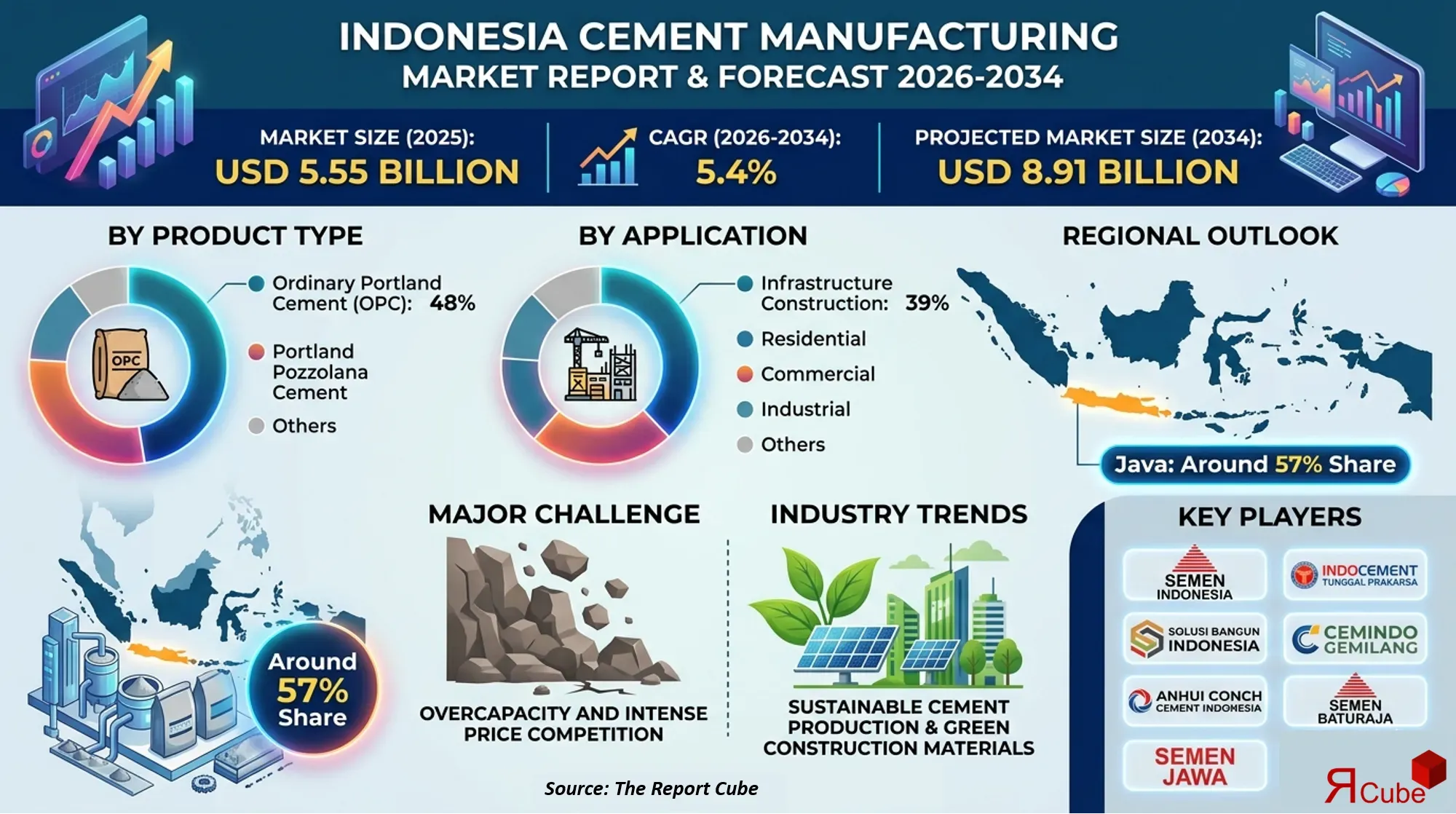
Ordinary Portland Cement (OPC) segment leads the market, with around 48% share.
By Application:
Infrastructure Construction segment dominates the market, accounting for nearly 39% of total revenue.
Regional Outlook:
Java region dominates the Indonesia cement manufacturing market, with around 57% share.
Government Initiatives & Policies
- Indonesia National Strategic Projects (PSN) Infrastructure Program: The Indonesian government continues accelerating national infrastructure through the PSN program, including highways, ports, airports, and housing projects that significantly increase domestic cement consumption.
- Indonesia Green Construction & Low Carbon Development Initiative: The government promotes environmentally friendly construction materials and low-carbon infrastructure development through national sustainable construction regulations supporting greener cement production.
Indonesia Cement Manufacturing Market Insights & Analysis
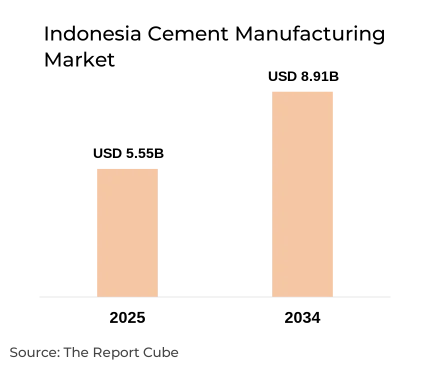
The Indonesia Cement Manufacturing Market is anticipated to register a 5.4% CAGR during 2026-2034. The market size was valued at USD 5.55 billion in 2025 and is projected to reach USD 8.91 billion by 2034. Indonesia represents one of Southeast Asia’s largest cement production hubs, supported by rising construction activity, large-scale infrastructure investment, and a rapidly growing urban population. As the country continues to expand transportation networks, housing developments, and industrial facilities, demand for cement is expected to grow steadily across multiple sectors.
Infrastructure modernization remains one of the strongest growth catalysts. The Indonesian government continues to prioritize strategic projects including toll roads, seaports, airports, dams, and new industrial estates. Major national programs such as the National Strategic Projects initiative aim to accelerate economic connectivity across islands. These projects significantly increase demand for cement in road construction, bridge development, and marine infrastructure. In addition, Indonesia’s plan to relocate its capital city to Nusantara in East Kalimantan has generated new construction demand for residential zones, administrative buildings, and transportation infrastructure, further strengthening long-term cement consumption.
Urbanization and housing demand also play a crucial role in the growth of the Indonesia cement manufacturing market. Indonesia’s urban population is projected to surpass 70% by 2035, leading to increased residential construction and property development. Real estate developers are expanding high-rise residential complexes, commercial buildings, and mixed-use developments in cities such as Jakarta, Surabaya, and Bandung. These urban projects require substantial volumes of cement for structural foundations and concrete production. In addition, government programs focused on affordable housing development are increasing demand from individual homebuilders and small contractors.
Technological advancements and sustainability initiatives are shaping the future of cement production in Indonesia. Manufacturers are increasingly investing in energy-efficient kilns, alternative fuels, and low-carbon cement formulations to reduce environmental impact. The adoption of blended cement types such as Portland Pozzolana Cement and Portland Slag Cement is increasing as these products reduce clinker consumption and carbon emissions. Many producers are also implementing digital monitoring systems and predictive maintenance technologies in production plants to improve operational efficiency and reduce downtime. These developments strengthen the competitiveness of Indonesia’s cement industry while aligning with global sustainability trends.
Indonesia Cement Manufacturing Market Dynamics
Key Driver: Expanding Infrastructure Development and National Construction Programs
Large-scale infrastructure development across Indonesia remains the most important driver for cement demand. The government continues to invest heavily in transportation corridors, logistics networks, and urban infrastructure to support economic growth and regional connectivity. Projects such as toll road expansion, railway modernization, seaport upgrades, and airport development require substantial cement volumes for foundations, bridges, tunnels, and pavement structures. These developments stimulate demand from both government contractors and private construction firms.
Indonesia’s National Strategic Projects program includes more than 200 infrastructure projects across energy, transportation, and housing sectors. These projects contribute to sustained cement consumption over the next decade. For example, major toll road construction projects connecting Sumatra, Java, and Kalimantan require large quantities of cement for concrete structures and road bases. Similarly, the development of industrial zones and logistics hubs across multiple islands drives demand for factory construction, warehouses, and supporting infrastructure.
Another important demand source comes from Indonesia’s new capital city project, Nusantara. The construction of administrative complexes, residential districts, and public facilities is expected to generate long-term cement demand. As construction progresses through multiple phases, cement manufacturers benefit from stable project-based sales volumes. These factors collectively strengthen the Indonesia cement manufacturing market and support consistent industry growth.
Book your FREE 30-minute expert consultation today
Contact UsIndustry Trends: Sustainable Cement Production and Green Construction Materials
Sustainability has become a major trend shaping the Indonesian cement industry. Cement production traditionally generates significant carbon emissions, encouraging manufacturers to adopt cleaner production methods and eco-friendly materials. Companies are increasingly investing in energy-efficient technologies, waste heat recovery systems, and alternative fuels to reduce environmental impact while maintaining production efficiency.
Blended cement products are gaining popularity as they require less clinker and generate lower emissions during production. Portland Pozzolana Cement and Portland Slag Cement are widely used in infrastructure and marine construction projects due to their improved durability and resistance to chemical exposure. These products also align with government initiatives encouraging sustainable building practices.
Another important trend involves the use of industrial by-products such as fly ash and slag in cement production. These materials improve cement performance while reducing reliance on traditional raw materials. Many cement producers in Indonesia have partnered with energy companies and steel manufacturers to secure a steady supply of these materials.
Digital transformation is also reshaping plant operations. Advanced process automation, predictive maintenance systems, and AI-based monitoring tools are helping cement manufacturers improve energy efficiency and optimize production output. These technologies reduce operational costs while enhancing production consistency. As environmental regulations become stricter, these innovations will play an increasingly important role in the industry’s long-term development.
Major Challenge: Overcapacity and Intense Price Competition
One of the primary challenges affecting the Indonesia cement manufacturing market is the issue of production overcapacity. Over the past decade, many cement manufacturers expanded their production capacity to capture anticipated infrastructure demand. However, the growth of cement consumption has not always matched these expansions, resulting in supply exceeding domestic demand in certain periods.
Overcapacity intensifies price competition among manufacturers, particularly in highly populated regions such as Java. Companies often reduce prices to maintain market share, which compresses profit margins across the industry. Smaller producers may face financial pressure due to limited economies of scale and rising operational costs.
Transportation costs also pose challenges for cement producers. Indonesia’s archipelagic geography makes logistics complex, especially when transporting cement across multiple islands. Companies must maintain extensive distribution networks including terminals, bulk carriers, and shipping routes. These logistical expenses increase operational costs and impact profitability.
Additionally, energy costs represent a significant portion of cement production expenses. Fuel and electricity are essential for kiln operations and clinker production. Fluctuating energy prices can therefore affect production costs and overall financial performance for cement manufacturers. Addressing these challenges requires efficient plant operations, optimized supply chains, and strategic capacity management.
Opportunity: Rising Demand from Housing Development and Regional Urbanization
Indonesia’s growing population and rising urbanization present significant opportunities for cement manufacturers. The country continues to experience strong population growth, with millions of people migrating to urban centers each year. This trend increases demand for residential housing, commercial buildings, and public infrastructure.
The government has launched several housing programs aimed at improving access to affordable homes for middle-income and low-income families. These initiatives encourage construction companies and real estate developers to build large housing complexes and apartment projects across major cities. Such projects require large volumes of cement for foundations, structural frames, and finishing works.
Regional development programs are also driving construction activity outside major metropolitan areas. Industrial zones, tourism infrastructure, and transportation networks are expanding in provinces such as Kalimantan, Sulawesi, and Nusa Tenggara. These developments stimulate local construction demand and create new markets for cement suppliers.
Export opportunities also offer potential growth. Indonesian cement producers have the capacity to supply neighboring Southeast Asian markets, particularly where domestic supply is limited. By strengthening port infrastructure and distribution capabilities, manufacturers can expand their presence in regional markets and balance domestic demand fluctuations.
Indonesia Cement Manufacturing Market Segment-wise Analysis
By Product Type:
- Ordinary Portland Cement
- OPC 33 Grade
- OPC 43 Grade
- OPC 53 Grade
- Portland Pozzolana Cement
- Fly Ash-Based Portland Pozzolana Cement
- Calcined Clay-Based Portland Pozzolana Cement
- Portland Slag Cement
- White Cement
- Oil Well Cement
- Specialty Cement
Ordinary Portland Cement (OPC) remains the leading product segment in the Indonesia cement manufacturing market, accounting for approximately 48% of total market share in 2025. OPC is widely used in general construction applications due to its strong compressive strength, quick setting properties, and versatility in concrete production. The availability of multiple OPC grades such as 33, 43, and 53 allows contractors to choose cement based on project strength requirements and construction timelines.
Infrastructure projects and residential construction heavily rely on OPC for structural foundations, beams, columns, and road construction. Major infrastructure developments such as highways, bridges, and ports require high-strength concrete that can withstand heavy loads and environmental stress. OPC 53 grade is particularly preferred in large infrastructure projects because it offers higher compressive strength and faster early strength gain.
Additionally, OPC benefits from well-established production infrastructure across Indonesia. Most cement plants are designed to produce OPC clinker, enabling manufacturers to maintain consistent supply levels across domestic markets. Its cost-effectiveness and widespread availability continue to support its dominance in the cement market.
By Application:
- Residential Construction
- Commercial Construction
- Industrial Construction
- Infrastructure Construction
Infrastructure construction represents the largest application segment in the Indonesia cement manufacturing market, accounting for nearly 39% of total demand. Cement is an essential material in large infrastructure projects including highways, bridges, railways, airports, and seaports. These projects require massive volumes of cement for concrete structures, road surfaces, and structural reinforcement.
The Indonesian government’s commitment to expanding national infrastructure has significantly increased cement consumption across multiple regions. Toll road expansion projects alone require millions of tons of cement annually. Similarly, the construction of dams, flood control systems, and irrigation networks further increases demand for durable cement products.
Infrastructure projects typically involve large-scale contractors and long project timelines, ensuring consistent cement supply contracts for manufacturers. These projects also demand specialized cement formulations capable of withstanding harsh environmental conditions such as marine exposure, heavy loads, and temperature fluctuations. As Indonesia continues to modernize its transportation and logistics networks, infrastructure construction will remain a major contributor to cement market growth.
Regional Projection of Indonesia Cement Manufacturing Industry
- Sumatra
- Java
- Kalimantan
- Sulawesi
- Nusa Tenggara
- Maluku
- Papua
Java dominates the Indonesia cement manufacturing market with approximately 57% of total consumption due to its dense population, advanced infrastructure, and concentration of industrial activity. Major cities including Jakarta, Surabaya, and Bandung are located on the island, making Java the center of Indonesia’s economic and construction activities.
The region hosts numerous large-scale infrastructure projects including toll roads, urban rail systems, airports, and port expansions. These projects require continuous cement supply, strengthening demand across both public and private sectors. Additionally, Java is home to several major cement production plants and distribution terminals, enabling efficient supply chains and reducing transportation costs.
Residential and commercial construction activities are also highly concentrated in Java due to rapid urbanization and property development. High-rise apartment complexes, office buildings, and retail centers are continuously being built to accommodate the growing urban population. These factors collectively support the region’s leading position in the Indonesian cement market.
Indonesia Cement Manufacturing Market Recent Developments
- 2025: PT Cemindo Gemilang Tbk secured a consolidated loan facility agreement with Bangkok Bank to restructure approximately USD 450 million in long-term and working-capital loans. The initiative aims to strengthen financial efficiency while supporting transportation asset expansion and broader cement distribution across Indonesia.
- 2025: PT Indocement Tunggal Prakarsa Tbk introduced alternative fuel feeding facilities at the Semen Grobogan and Semen Maros plants and acquired the Siawung terminal from Semen Bosowa. These improvements enhance fuel flexibility, production efficiency, and logistics network strength.
- 2025: PT Solusi Bangun Indonesia Tbk reported a 12.3% year-on-year profit increase driven by efficiency initiatives and the expansion of sustainable construction products such as value-added concrete and precision flooring used in infrastructure and port projects.
- 2025: PT Semen Indonesia (Persero) Tbk partnered with Indonesia’s National Research and Innovation Agency to develop environmentally friendly green concrete materials aimed at supporting low-carbon infrastructure development and sustainable marine construction.
Need insights for a specific region within this market?
Request Regional DataWhy Choose This Report?
- Provides a comprehensive overview of the overall market analysis, encompassing key trends, consumer behavior analysis, and risk assessment to support strategic decision-making.
- Provides accurate, up-to-date insights into market size, segmentation, and emerging opportunities, helping to minimize risk & capitalizing on growth.
- Gives deep understanding of target audience preferences, investment habits, and communication channels for enhanced product development & marketing effectiveness.
- Delivers competitive analysis & benchmarking, uncovering the strengths & weaknesses of market competitors to guide strategies.
- Consolidate comprehensive market intelligence, reducing reasoning & streamlining research efforts.
- Facilitates customized market segmentation & risk mitigation strategies, fine-tuned to the business objectives.
- Aids in identifying both market challenges & untapped opportunities within the industry to drive long-term business growth.
- Provides valuable information based on actual customer data & search trends.
Table of Contents
- Introduction
- Objective of the Study
- Product and Category Definition
- Market Segmentation
- Study Variables
- Research Methodology
- Secondary Data Points
- Breakdown of Secondary Sources
- Primary Data Points
- Breakdown of Primary Interviews
- Secondary Data Points
- Executive Summary
- Market Dynamics
- Drivers
- Challenges
- Opportunity Assessment
- Recent Trends and Developments
- Regulatory and Policy Landscape
- Indonesia Cement Manufacturing Market Overview (2021-2034)
- Market Size, By Value (USD Billion)
- Market Share, By Product Type
- Ordinary Portland Cement
- OPC 33 Grade
- OPC 43 Grade
- OPC 53 Grade
- Portland Pozzolana Cement
- Fly Ash-Based Portland Pozzolana Cement
- Calcined Clay-Based Portland Pozzolana Cement
- Portland Slag Cement
- White Cement
- Oil Well Cement
- Specialty Cement
- Ordinary Portland Cement
- Market Share, By Application
- Residential Construction
- Commercial Construction
- Industrial Construction
- Infrastructure Construction
- Market Share, By End User
- Individual Homebuilders
- Real Estate Developers
- Government and Public Works
- Industrial Customers
- Market Share, By Distribution Channel
- Direct Sales
- Dealer and Distributor Network
- Project Sales
- Others
- Market Share, By Region
- Sumatra
- Java
- Kalimantan
- Sulawesi
- Nusa Tenggara
- Maluku
- Papua
- Market Share, By Company
- Revenue Shares and Analysis
- Competitive Landscape
- Sumatra Cement Manufacturing Market
- Market Size, By Value (USD Billion/Million)
- Market Share, By Product Type
- Market Share, By Application
- Market Share, By End User
- Java Cement Manufacturing Market
- Market Size, By Value (USD Billion/Million)
- Market Share, By Product Type
- Market Share, By Application
- Market Share, By End User
- Kalimantan Cement Manufacturing Market
- Market Size, By Value (USD Billion/Million)
- Market Share, By Product Type
- Market Share, By Application
- Market Share, By End User
- Sulawesi Cement Manufacturing Market
- Market Size, By Value (USD Billion/Million)
- Market Share, By Product Type
- Market Share, By Application
- Market Share, By End User
- Nusa Tenggara Cement Manufacturing Market
- Market Size, By Value (USD Billion/Million)
- Market Share, By Product Type
- Market Share, By Application
- Market Share, By End User
- Maluku Cement Manufacturing Market
- Market Size, By Value (USD Billion/Million)
- Market Share, By Product Type
- Market Share, By Application
- Market Share, By End User
- Papua Cement Manufacturing Market
- Market Size, By Value (USD Billion/Million)
- Market Share, By Product Type
- Market Share, By Application
- Market Share, By End User
- Competitive Outlook and Company Profiles
- Semen Indonesia
- Company Overview
- Product Portfolio
- Strategic Alliances/Partnerships
- Recent Developments
- Indocement Tunggal Prakarsa
- Company Overview
- Product Portfolio
- Strategic Alliances/Partnerships
- Recent Developments
- Solusi Bangun Indonesia
- Company Overview
- Product Portfolio
- Strategic Alliances/Partnerships
- Recent Developments
- Cemindo Gemilang
- Company Overview
- Product Portfolio
- Strategic Alliances/Partnerships
- Recent Developments
- Anhui Conch Cement Indonesia
- Company Overview
- Product Portfolio
- Strategic Alliances/Partnerships
- Recent Developments
- Semen Baturaja
- Company Overview
- Product Portfolio
- Strategic Alliances/Partnerships
- Recent Developments
- Semen Jawa
- Company Overview
- Product Portfolio
- Strategic Alliances/Partnerships
- Recent Developments
- Semen Bosowa Maros
- Company Overview
- Product Portfolio
- Strategic Alliances/Partnerships
- Recent Developments
- Jui Shin Indonesia
- Company Overview
- Product Portfolio
- Strategic Alliances/Partnerships
- Recent Developments
- Semen Grobogan
- Company Overview
- Product Portfolio
- Strategic Alliances/Partnerships
- Recent Developments
- Semen Imasco Asiatic
- Company Overview
- Product Portfolio
- Strategic Alliances/Partnerships
- Recent Developments
- Sinar Tambang Arthalestari
- Company Overview
- Product Portfolio
- Strategic Alliances/Partnerships
- Recent Developments
- Semen Kupang
- Company Overview
- Product Portfolio
- Strategic Alliances/Partnerships
- Recent Developments
- Haohan Cement Indonesia
- Company Overview
- Product Portfolio
- Strategic Alliances/Partnerships
- Recent Developments
- Panasia Cement
- Company Overview
- Product Portfolio
- Strategic Alliances/Partnerships
- Recent Developments
- Kobexindo Cement
- Company Overview
- Product Portfolio
- Strategic Alliances/Partnerships
- Recent Developments
- Others
- Semen Indonesia
- Contact Us and Disclaimer
Top Key Players & Market Share Outlook
- Semen Indonesia
- Indocement Tunggal Prakarsa
- Solusi Bangun Indonesia
- Cemindo Gemilang
- Anhui Conch Cement Indonesia
- Semen Baturaja
- Semen Jawa
- Semen Bosowa Maros
- Jui Shin Indonesia
- Semen Grobogan
- Semen Imasco Asiatic
- Sinar Tambang Arthalestari
- Semen Kupang
- Haohan Cement Indonesia
- Panasia Cement
- Kobexindo Cement
Frequently Asked Questions