



Build Your Custom Market Intelligence Report
Customize Your ReportIndonesia Healthcare (Hospitals) Real Estate Market Key Highlights
By Asset Type:
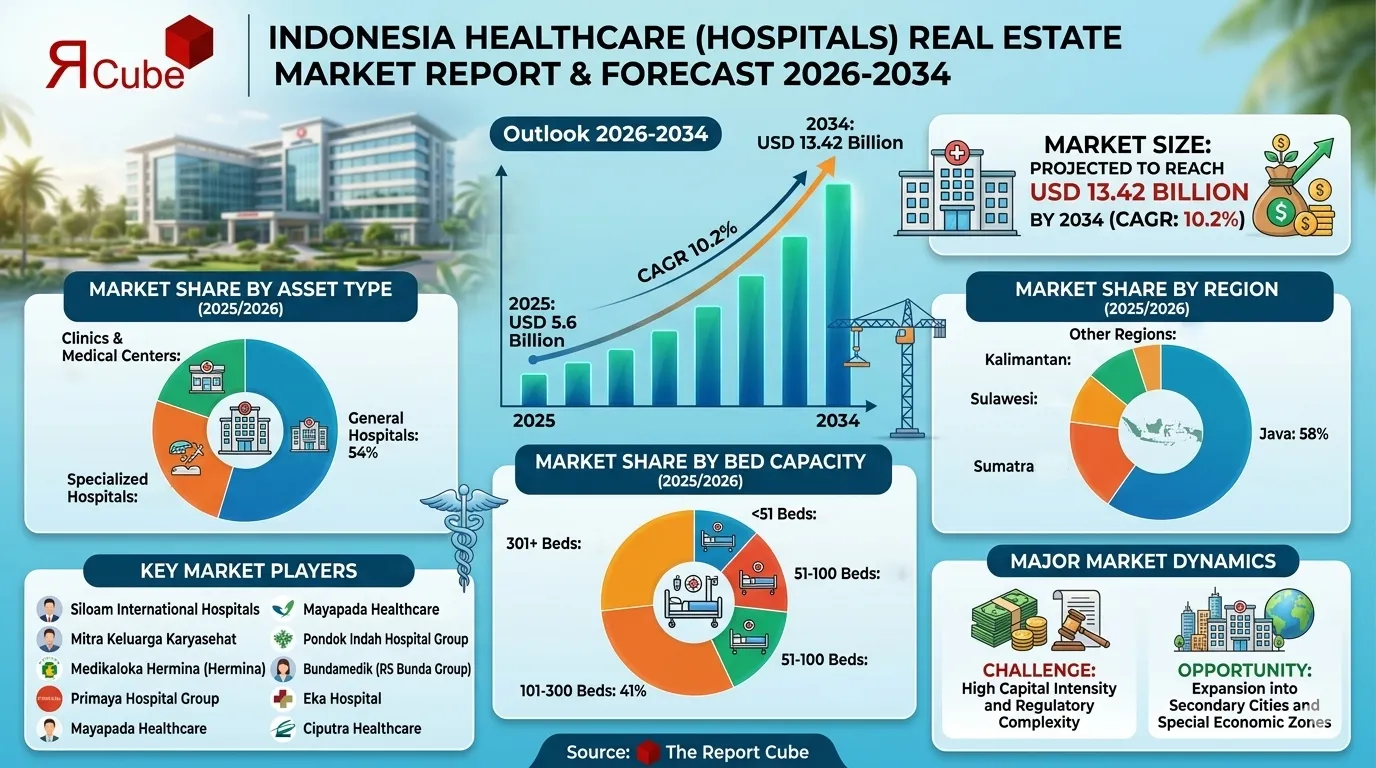
General Hospitals segment leads the market, with around 54% share.
By Bed Capacity:
101-300 Beds segment dominates the market, accounting for nearly 41% of total revenue.
Regional Outlook:
Java region dominates the Indonesia Healthcare (Hospitals) Real Estate Market, with around 58% share.
Government Initiatives & Policies
- Indonesia Health Transformation Program (2022-2027, updated 2025 roadmap): Ministry of Health initiative focusing on hospital infrastructure upgrades, digital health integration, and expansion of referral hospital capacity.
- National Health Insurance (JKN) Strengthening Policy 2025: Expansion of BPJS Kesehatan coverage and hospital reimbursement reforms to improve service accessibility and encourage private sector hospital investment.
Indonesia Healthcare (Hospitals) Real Estate Market Insights & Analysis
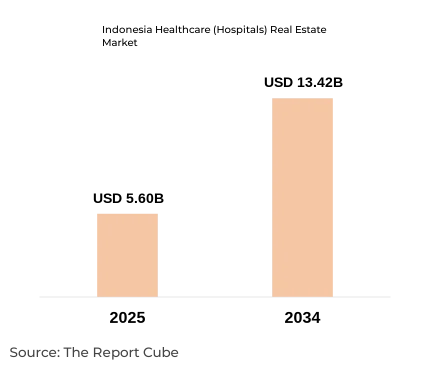
The Indonesia Healthcare (Hospitals) Real Estate Market is anticipated to register a CAGR: 10.2% during 2026-34. The market size was valued at USD 5.6 billion in 2025 and is projected to reach USD 13.42 billion by 2034. Rapid population growth, universal healthcare expansion, and rising middle-class income levels are accelerating demand for modern hospital infrastructure across Indonesia’s major islands.
Indonesia, with a population exceeding 280 million, maintains a hospital bed ratio of approximately 1.4 beds per 1,000 people, below the WHO recommendation of 3 beds per 1,000. This structural gap is creating sustained demand for new hospital construction and asset modernization. Government reforms under the Health Transformation Program emphasize upgrading referral hospitals, expanding specialist centers, and integrating digital health systems. Private hospital operators are aligning capital expenditure with these priorities, targeting secondary cities where healthcare penetration remains low.
Urbanization and rising non-communicable diseases are further reshaping hospital real estate demand. Cardiovascular diseases, oncology cases, and metabolic disorders have increased by nearly 25% over the past decade, driving the need for specialty hospital facilities equipped with advanced imaging, robotic surgery suites, and intensive care units. Real estate strategies now focus on vertically integrated medical campuses, combining inpatient services, outpatient clinics, diagnostic centers, and retail healthcare amenities within a single property ecosystem.
Foreign direct investment and public-private partnerships are also strengthening market liquidity. Indonesia’s healthcare sector liberalization allows greater foreign ownership in hospital facilities, encouraging institutional investors and private equity funds to enter the asset class. Long-term lease agreements between developers and hospital operators are improving predictable rental yields, while owner-occupied expansion models remain common among leading operators. This structural evolution positions hospital real estate as one of the fastest-growing property sub-segments in Indonesia.
Indonesia Healthcare (Hospitals) Real Estate Market Dynamics
Key Driver: Expanding Universal Healthcare Coverage and Demographic Growth
Indonesia’s National Health Insurance (JKN) program covers over 260 million citizens, significantly increasing patient volumes in both public and private hospitals. As reimbursement mechanisms improve, private hospital operators are expanding bed capacity and specialist offerings. Indonesia’s elderly population is projected to reach 15% of total population by 2035, increasing demand for long-term care facilities and rehabilitation centers. Additionally, medical tourism recovery and regional referral expansion are encouraging international-standard hospital development in urban hubs such as Jakarta, Surabaya, and Batam. These structural drivers create sustained demand for new hospital construction, refurbishment, and managed facility contracts across multiple regions.
Book your FREE 30-minute expert consultation today
Contact UsIndustry Trends: Vertical Medical Campuses and Technology-Integrated Facilities
Hospital real estate development is transitioning toward high-rise, technology-enabled campuses. Operators are investing heavily in robotic surgical systems, AI-powered diagnostics, and digital medical records infrastructure, requiring specialized building layouts and reinforced structural design. Green building certifications and energy-efficient hospital designs are gaining traction to reduce operating costs. Flexible facility models, including managed hospitals under third-party real estate ownership, are emerging to optimize capital allocation. Investors increasingly favor integrated healthcare hubs that combine outpatient clinics, diagnostic labs, and pharmacy retail spaces within a single property footprint, enhancing patient convenience and rental yield diversification.
Major Challenge: High Capital Intensity and Regulatory Complexity
Hospital real estate development requires substantial upfront investment, often exceeding USD 50-150 million for mid-to-large-scale facilities. Construction timelines average 24-36 months, influenced by regulatory approvals, zoning compliance, and medical equipment installation. Fluctuations in construction material costs and imported medical equipment pricing can impact project budgets. Licensing processes across provinces vary, creating administrative delays. Additionally, ensuring compliance with fire safety, infection control, and seismic standards increases development complexity. These factors may delay new supply entering the market, particularly in outer islands where infrastructure readiness is still evolving.
Opportunity: Expansion into Secondary Cities and Special Economic Zones
Secondary cities across Sumatra, Kalimantan, and Sulawesi present significant untapped potential. Rising disposable income and government decentralization policies are stimulating healthcare demand outside Jakarta. Special economic zones, such as Batam, are attracting international-standard hospital projects targeting regional medical tourism. Public-private partnerships for referral hospital upgrades also provide stable revenue models for investors. Rehabilitation centers and long-term care facilities represent emerging niches, particularly as Indonesia’s aging population expands. Real estate developers partnering with hospital operators can leverage build-to-suit models to accelerate capacity expansion while reducing capital burden on operators.
Indonesia Healthcare (Hospitals) Real Estate Market Segment-wise Analysis
By Asset Type:
- General Hospitals
- Specialty Hospitals
- Clinic Buildings
- Diagnostic Centers
- Rehabilitation Centers
- Long-term Care Facilities
General hospitals account for approximately 54% of total market share in 2025, supported by comprehensive inpatient and outpatient services. These facilities typically operate with 150-300 beds and multi-specialty departments, generating diversified revenue streams. Expansion strategies by leading operators focus on upgrading general hospitals with advanced surgical suites and oncology centers, enhancing property value. General hospital assets attract institutional investors due to stable occupancy rates exceeding 70% in urban areas. Their integrated design allows adaptability for specialty additions, making them the preferred real estate model across Indonesia’s expanding metropolitan regions.
By Bed Capacity:
- Up to 100 Beds
- 101-300 Beds
- 301-500 Beds
- Above 500 Beds
The 101-300 beds category holds nearly 41% of market revenue, reflecting optimal scale for profitability and operational efficiency. Facilities within this range balance capital expenditure with manageable staffing and infrastructure requirements. They are particularly suited for tier-2 cities where patient volumes are growing steadily. Mid-sized hospitals also demonstrate faster break-even timelines compared to mega-hospitals exceeding 500 beds. Developers prefer this category for phased expansion projects, allowing incremental capacity addition aligned with demand growth. As healthcare decentralization continues, this segment is expected to sustain dominant positioning through 2034.
Regional Projection of Indonesia Healthcare (Hospitals) Real Estate Industry
- Sumatra
- Java
- Kalimantan
- Sulawesi
- Nusa Tenggara
- Maluku
- Papua
Java dominates with approximately 58% of total market share, driven by dense population centers including Jakarta, Surabaya, and Bandung. The island hosts the majority of tertiary referral hospitals and private healthcare networks. Infrastructure readiness, higher income levels, and strong insurance penetration enhance occupancy stability. Sumatra and Kalimantan are emerging growth corridors, supported by industrial development and urban migration. Eastern regions such as Papua and Maluku remain underpenetrated but present long-term potential as government infrastructure investment increases. Regional disparities in bed ratios and income levels directly influence real estate expansion priorities.
Indonesia Healthcare (Hospitals) Real Estate Market Recent Developments
- 2025: Siloam International Hospitals announced the introduction of advanced brain and knee surgical robots at Mampang and Kebon Jeruk facilities, supported by an IDR 2 trillion capital expenditure plan, reinforcing high-tech hospital infrastructure expansion.
- 2025: Medikaloka Hermina (Hermina) disclosed that PT Dwimuria Investama Andalan acquired shares worth approximately IDR 1.04 trillion, strengthening ownership structure to support network expansion and facility upgrades.
- 2025: Mayapada Healthcare began developing an 11-story, 250-bed international hospital in Batam’s special economic zone with over IDR 1 trillion investment, enhancing Indonesia’s medical tourism real estate landscape.
Need insights for a specific region within this market?
Request Regional DataWhy Choose This Report?
- Provides a comprehensive overview of the overall market analysis, encompassing key trends, consumer behavior analysis, and risk assessment to support strategic decision-making.
- Provides accurate, up-to-date insights into market size, segmentation, and emerging opportunities, helping to minimize risk & capitalizing on growth.
- Gives deep understanding of target audience preferences, investment habits, and communication channels for enhanced product development & marketing effectiveness.
- Delivers competitive analysis & benchmarking, uncovering the strengths & weaknesses of market competitors to guide strategies.
- Consolidate comprehensive market intelligence, reducing reasoning & streamlining research efforts.
- Facilitates customized market segmentation & risk mitigation strategies, fine-tuned to the business objectives.
- Aids in identifying both market challenges & untapped opportunities within the industry to drive long-term business growth.
- Provides valuable information based on actual customer data & search trends.
Table of Contents
- Introduction
- Objective of the Study
- Product and Category Definition
- Market Segmentation
- Study Variables
- Research Methodology
- Secondary Data Points
- Breakdown of Secondary Sources
- Primary Data Points
- Breakdown of Primary Interviews
- Secondary Data Points
- Executive Summary
- Market Dynamics
- Drivers
- Challenges
- Opportunity Assessment
- Recent Trends and Developments
- Regulatory and Policy Landscape
- Indonesia Healthcare (Hospitals) Real Estate Market Overview (2021-2034)
- Market Size, By Value (USD Billion)
- Market Share, By Asset Type
- General Hospitals
- Specialty Hospitals
- Clinic Buildings
- Diagnostic Centers
- Rehabilitation Centers
- Long-term Care Facilities
- Market Share, By Bed Capacity
- Up to 100 Beds
- 101-300 Beds
- 301-500 Beds
- Above 500 Beds
- Market Share, By Ownership
- Public Sector
- Private Sector
- Public-Private Partnership
- Market Share, By Business Model
- Owner-Occupied
- Leased Facilities
- Managed Facilities
- Market Share, By Investor Type
- Hospital Operators
- Real Estate Developers
- Institutional Investors
- Private Equity Funds
- Market Share, By Region
- Sumatra
- Java
- Kalimantan
- Sulawesi
- Nusa Tenggara
- Maluku
- Papua
- Market Share, By Company
- Revenue Shares & Analysis
- Competitive Landscape
- Sumatra Healthcare (Hospitals) Real Estate Market
- Market Size, By Value (USD Billion/Million)
- Market Share, By Asset Type
- Market Share, By Bed Capacity
- Market Share, By Ownership
- Market Share, By Business Model
- Market Share, By Investor Type
- Java Healthcare (Hospitals) Real Estate Market
- Market Size, By Value (USD Billion/Million)
- Market Share, By Asset Type
- Market Share, By Bed Capacity
- Market Share, By Ownership
- Market Share, By Business Model
- Market Share, By Investor Type
- Kalimantan Healthcare (Hospitals) Real Estate Market
- Market Size, By Value (USD Billion/Million)
- Market Share, By Asset Type
- Market Share, By Bed Capacity
- Market Share, By Ownership
- Market Share, By Business Model
- Market Share, By Investor Type
- Sulawesi Healthcare (Hospitals) Real Estate Market
- Market Size, By Value (USD Billion/Million)
- Market Share, By Asset Type
- Market Share, By Bed Capacity
- Market Share, By Ownership
- Market Share, By Business Model
- Market Share, By Investor Type
- Nusa Tenggara Healthcare (Hospitals) Real Estate Market
- Market Size, By Value (USD Billion/Million)
- Market Share, By Asset Type
- Market Share, By Bed Capacity
- Market Share, By Ownership
- Market Share, By Business Model
- Market Share, By Investor Type
- Maluku Healthcare (Hospitals) Real Estate Market
- Market Size, By Value (USD Billion/Million)
- Market Share, By Asset Type
- Market Share, By Bed Capacity
- Market Share, By Ownership
- Market Share, By Business Model
- Market Share, By Investor Type
- Papua Healthcare (Hospitals) Real Estate Market
- Market Size, By Value (USD Billion/Million)
- Market Share, By Asset Type
- Market Share, By Bed Capacity
- Market Share, By Ownership
- Market Share, By Business Model
- Market Share, By Investor Type
- Competitive Outlook and Company Profiles
- Lippo Karawaci
- Company Overview
- Product Portfolio
- Strategic Alliances/Partnerships
- Recent Developments
- Ciputra Development
- Company Overview
- Product Portfolio
- Strategic Alliances/Partnerships
- Recent Developments
- Sinar Mas Land
- Company Overview
- Product Portfolio
- Strategic Alliances/Partnerships
- Recent Developments
- CBRE Indonesia
- Company Overview
- Product Portfolio
- Strategic Alliances/Partnerships
- Recent Developments
- JMM Consulting
- Company Overview
- Product Portfolio
- Strategic Alliances/Partnerships
- Recent Developments
- Talenta Hospital Consulting
- Company Overview
- Product Portfolio
- Strategic Alliances/Partnerships
- Recent Developments
- JLL Indonesia
- Company Overview
- Product Portfolio
- Strategic Alliances/Partnerships
- Recent Developments
- Colliers Indonesia
- Company Overview
- Product Portfolio
- Strategic Alliances/Partnerships
- Recent Developments
- Tokyu Land Indonesia
- Company Overview
- Product Portfolio
- Strategic Alliances/Partnerships
- Recent Developments
- Savills Indonesia
- Company Overview
- Product Portfolio
- Strategic Alliances/Partnerships
- Recent Developments
- Agung Podomoro Land
- Company Overview
- Product Portfolio
- Strategic Alliances/Partnerships
- Recent Developments
- Cushman & Wakefield
- Company Overview
- Product Portfolio
- Strategic Alliances/Partnerships
- Recent Developments
- Knight Frank Indonesia
- Company Overview
- Product Portfolio
- Strategic Alliances/Partnerships
- Recent Developments
- PP Properti
- Company Overview
- Product Portfolio
- Strategic Alliances/Partnerships
- Recent Developments
- Inspiry Indonesia
- Company Overview
- Product Portfolio
- Strategic Alliances/Partnerships
- Recent Developments
- Assegaf Hamzah & Partners
- Company Overview
- Product Portfolio
- Strategic Alliances/Partnerships
- Recent Developments
- Others
- Lippo Karawaci
- Contact Us and Disclaimer
Top Key Players & Market Share Outlook
- Siloam International Hospitals
- Mitra Keluarga Karyasehat
- Medikaloka Hermina (Hermina)
- Primaya Hospital Group
- Mayapada Healthcare
- Pondok Indah Hospital Group
- Bundamedik (RS Bunda Group)
- Eka Hospital
- Ciputra Healthcare
- Mandaya Hospital Group
- Brawijaya Healthcare
- Sari Asih Hospital Group
- Ramsay Sime Darby (RS Premier)
- Bethsaida Hospital
- IHC (Pertamedika / BUMN)
- RSCM (Referral Hospital)
Frequently Asked Questions






