



Build Your Custom Market Intelligence Report
Customize Your ReportIndonesia Health Data Interoperability Market Key Highlights
By Solution:
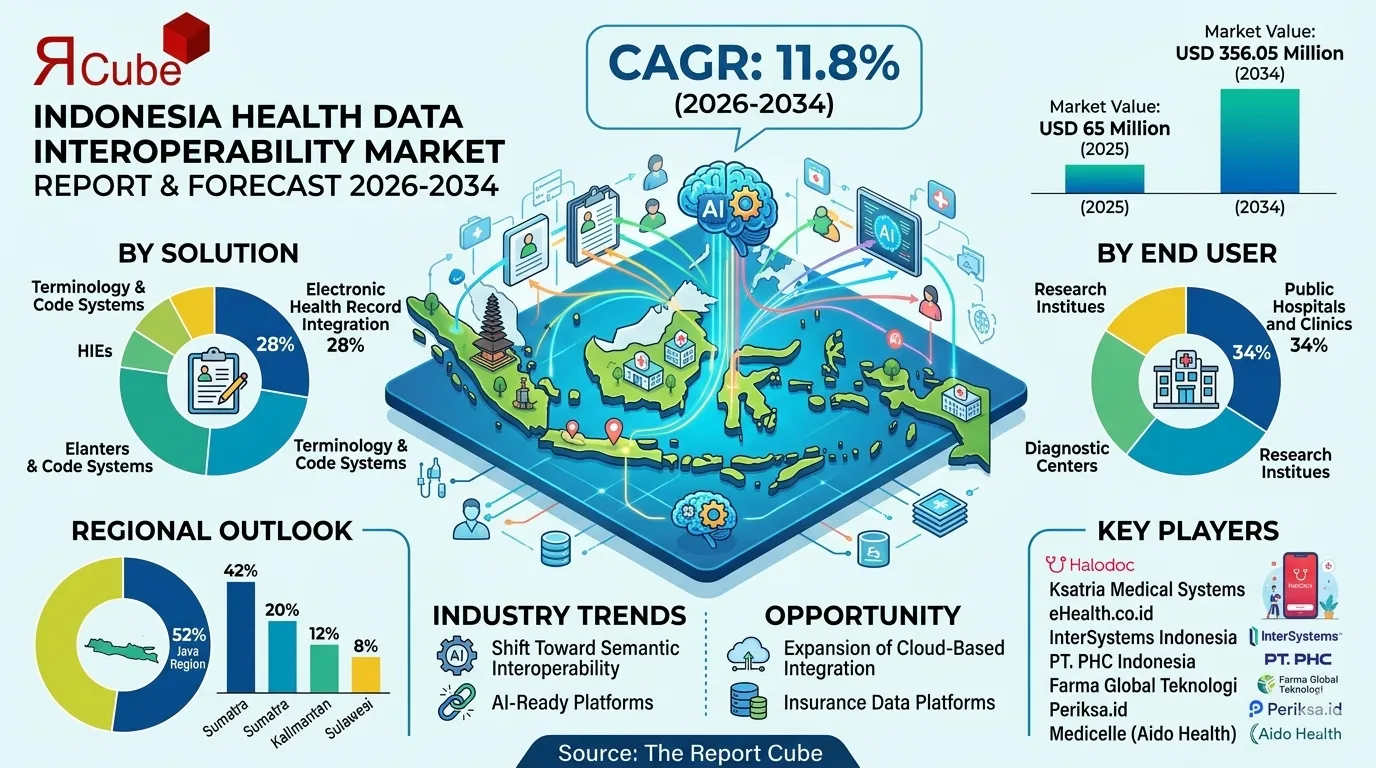
Electronic Health Record Integration segment leads the market, with around 28% share.
By End User:
Public Hospitals and Clinics segment dominates the market, accounting for nearly 34% of total revenue.
Regional Outlook:
Java region dominates the indonesia health data interoperability market, with around 52% share.
Government Initiatives & Policies
- SATUSEHAT Platform Expansion (Ministry of Health, updated 2025 roadmap): Mandates nationwide integration of electronic medical records with standardized APIs and interoperability protocols to create a unified national health data exchange.
- National Health Compact 2025-2029: Commits to full EMR implementation and structured interoperability enforcement across primary, referral, and laboratory systems.
Indonesia Health Data Interoperability Market Insights & Analysis
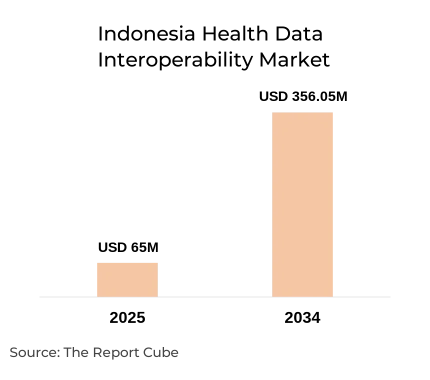
The Indonesia Health Data Interoperability Market is anticipated to register a CAGR: 11.8% during 2026-34. The market size was valued at USD 65 million in 2025 and is projected to reach USD 356.05 million by 2034. Accelerated digitization of healthcare services, regulatory enforcement of standardized electronic medical records, and rapid telehealth penetration are shaping Indonesia’s connected-care ecosystem.
Indonesia’s healthcare system serves over 275 million citizens across more than 17,000 islands, making interoperability a strategic necessity rather than a technical upgrade. By 2025, more than 60% of public hospitals had implemented some form of electronic medical record system, yet only a portion operated under standardized semantic frameworks. The Ministry of Health’s SATUSEHAT mandate is bridging this gap by enforcing national data standards, structured coding systems, and API-based integration across hospitals, laboratories, and pharmacies.
Private sector momentum is equally strong. Digital health platforms such as Halodoc and Klinik Pintar are integrating with national registries and insurance claims platforms to enable seamless patient data exchange. Insurance administrators including AdMedika (Telkom Group) are strengthening claims data integration with provider systems, improving adjudication efficiency and fraud detection. Industry estimates indicate that digital claim processing has reduced reimbursement turnaround times by nearly 30% compared to manual systems, encouraging further adoption of interoperable infrastructures.
Cloud deployment models are accelerating growth, particularly among primary care centers and regional hospitals. Over 55% of newly deployed interoperability solutions in 2025 are cloud-based, offering scalability and centralized data governance. As artificial intelligence-driven analytics become embedded within EHR systems, demand for structured and semantic interoperability is increasing. This structural transformation positions Indonesia as one of Southeast Asia’s fastest-growing digital health integration markets.
Indonesia Health Data Interoperability Market Dynamics
Key Driver: National Digital Health Standardization Through SATUSEHAT
The enforcement of SATUSEHAT as a national interoperability backbone is the primary growth engine. Healthcare providers must comply with standardized data exchange protocols to maintain operational licensing and insurance reimbursement alignment. By late 2025, more than 2,800 hospitals and 10,000 primary care facilities were connected or in onboarding phases. This regulatory clarity reduces vendor fragmentation and accelerates solution procurement. Additionally, government-backed incentives for EMR implementation in Puskesmas facilities are driving rural digitization. Structured interoperability enables accurate epidemiological monitoring and supports Indonesia’s universal health coverage expansion. These regulatory measures create a predictable demand pipeline for integration vendors and health IT providers.
Book your FREE 30-minute expert consultation today
Contact UsIndustry Trends: Shift Toward Semantic Interoperability and AI-Ready Platforms
The market is transitioning from foundational data exchange toward semantic and organizational interoperability. Hospitals are adopting standardized clinical terminologies such as SNOMED CT and ICD-11 mapping to improve cross-platform understanding. AI-enabled EHR systems require structured, high-quality datasets to support predictive diagnostics and population health analytics. In 2025, approximately 40% of tertiary hospitals in Java integrated advanced analytics dashboards linked to interoperable data platforms. Vendors are embedding API-first architectures to simplify third-party integrations, enabling telehealth, pharmacy systems, and insurance platforms to exchange data in real time. This trend enhances patient continuity of care and operational transparency.
Major Challenge: Infrastructure Disparities Across Islands
Indonesia’s geographic complexity presents connectivity and infrastructure challenges. Remote regions such as Papua and Maluku face bandwidth limitations and limited IT workforce capacity. While Java and Sumatra exhibit high digital maturity, eastern provinces lag in structured interoperability deployment. Implementation costs for comprehensive EMR integration can range between USD 100,000 to USD 500,000 per hospital, creating budget constraints for smaller facilities. Data privacy compliance under evolving cybersecurity regulations also requires additional investment in encryption and governance systems. Addressing these disparities is critical to achieving nationwide data harmonization.
Opportunity: Expansion of Cloud-Based Integration and Insurance Data Platforms
Cloud-based interoperability platforms offer scalable deployment models for smaller healthcare providers. Hybrid models combining on-premise clinical systems with cloud-based analytics are gaining traction. Health insurance payers and TPAs are investing in real-time claims integration to reduce fraud and improve member experience. Population health analytics platforms are emerging as strategic tools for chronic disease management, particularly for diabetes and cardiovascular conditions affecting millions nationwide. As digital literacy improves and broadband penetration expands, interoperability vendors have significant opportunities to expand beyond major urban centers into underserved provinces.
Indonesia Health Data Interoperability Market Segment-wise Analysis
By Solution:
- Electronic Health Record Integration
- Health Information Exchange Platforms
- Laboratory Information System Integration
- Radiology Information System Integration
- Pharmacy Information System Integration
- Patient Engagement and Portal Solutions
- Telehealth and Remote Monitoring Integration
- Revenue Cycle and Claims Data Integration
- Population Health and Analytics Platforms
Electronic Health Record Integration leads with nearly 28% market share in 2025, driven by mandatory EMR adoption and SATUSEHAT connectivity requirements. Hospitals upgrading legacy systems require standardized API integration to ensure structured and semantic interoperability. Demand is strongest among public referral hospitals and private tertiary centers seeking accreditation alignment. Integration projects typically include laboratory, radiology, and pharmacy modules, expanding contract value. As AI-powered decision support tools require unified datasets, EHR integration remains the foundation of Indonesia’s interoperability ecosystem.
By End User:
- Public Hospitals and Clinics
- Private Hospitals and Clinics
- Primary Care Centers and Puskesmas
- Diagnostic and Imaging Centers
- Health Insurance Payers and TPAs
- Pharmacies and Pharmacy Chains
- Government and Public Health Agencies
- Others
Public Hospitals and Clinics account for around 34% of total revenue, reflecting government-led digitalization initiatives. Integration with national health insurance claims systems and centralized disease surveillance platforms drives procurement budgets. Public facilities in Java and Sumatra exhibit higher adoption rates due to stronger infrastructure and funding support. Primary care centers are emerging as the next growth segment as nationwide EMR mandates extend beyond tertiary hospitals. Public sector dominance is expected to continue as regulatory enforcement strengthens across all provinces.
Regional Projection of Indonesia Health Data Interoperability Industry
- Sumatra
- Java
- Kalimantan
- Sulawesi
- Nusa Tenggara
- Maluku
- Papua
Java leads with approximately 52% market share, supported by dense hospital networks, higher IT maturity, and concentration of private healthcare providers. Jakarta serves as the central hub for digital health innovation and vendor headquarters. Sumatra follows with expanding hospital digitization and insurance network integration. Kalimantan and Sulawesi are gradually increasing adoption due to regional development initiatives. Eastern provinces including Papua face infrastructure gaps but represent long-term expansion opportunities as government broadband initiatives mature.
Indonesia Health Data Interoperability Market Recent Developments
- 2025: InterSystems Indonesia hosted the Asia Healthcare Summit 2025 in Jakarta, highlighting deployments of interoperable, AI-ready EHR platforms supporting national lab networks and private hospitals aligned with Indonesia’s connected-care roadmap.
- 2025: AdMedika (Telkom Group) partnered with Kitabisa.ORG to expand healthcare access initiatives, strengthening ecosystem integration and increasing utilization of its digital health benefit and claims data platforms.
- 2025: Indonesia Health System (SATUSEHAT context) reinforced mandatory full EMR implementation and national interoperability standards under the 2025-2029 Health Compact, expanding integration requirements for vendors including Klinik Pintar, Halodoc, and Zi.Care.
Need insights for a specific region within this market?
Request Regional DataWhy Choose This Report?
- Provides a comprehensive overview of the overall market analysis, encompassing key trends, consumer behavior analysis, and risk assessment to support strategic decision-making.
- Provides accurate, up-to-date insights into market size, segmentation, and emerging opportunities, helping to minimize risk & capitalizing on growth.
- Gives deep understanding of target audience preferences, investment habits, and communication channels for enhanced product development & marketing effectiveness.
- Delivers competitive analysis & benchmarking, uncovering the strengths & weaknesses of market competitors to guide strategies.
- Consolidate comprehensive market intelligence, reducing reasoning & streamlining research efforts.
- Facilitates customized market segmentation & risk mitigation strategies, fine-tuned to the business objectives.
- Aids in identifying both market challenges & untapped opportunities within the industry to drive long-term business growth.
- Provides valuable information based on actual customer data & search trends.
Table of Contents
- Introduction
- Objective of the Study
- Product and Category Definition
- Market Segmentation
- Study Variables
- Research Methodology
- Secondary Data Points
- Breakdown of Secondary Sources
- Primary Data Points
- Breakdown of Primary Interviews
- Secondary Data Points
- Executive Summary
- Market Dynamics
- Drivers
- Challenges
- Opportunity Assessment
- Recent Trends and Developments
- Regulatory and Policy Landscape
- Indonesia Health Data Interoperability Market Overview (2021-2034)
- Market Size, By Value (USD Million)
- Market Share, By Solution
- Electronic Health Record Integration
- Health Information Exchange Platforms
- Laboratory Information System Integration
- Radiology Information System Integration
- Pharmacy Information System Integration
- Patient Engagement and Portal Solutions
- Telehealth and Remote Monitoring Integration
- Revenue Cycle and Claims Data Integration
- Population Health and Analytics Platforms
- Market Share, By Interoperability Level
- Foundational Interoperability
- Structural Interoperability
- Semantic Interoperability
- Organizational Interoperability
- Market Share, By Deployment Mode
- On-premise Deployment
- Cloud-based Deployment
- Hybrid Deployment
- Market Share, By End User
- Public Hospitals and Clinics
- Private Hospitals and Clinics
- Primary Care Centers and Puskesmas
- Diagnostic and Imaging Centers
- Health Insurance Payers and TPAs
- Pharmacies and Pharmacy Chains
- Government and Public Health Agencies
- Others
- Market Share, By Region
- Sumatra
- Java
- Kalimantan
- Sulawesi
- Nusa Tenggara
- Maluku
- Papua
- Market Share, By Company
- Revenue Shares and Analysis
- Competitive Landscape
- Sumatra Indonesia Health Data Interoperability Market
- Market Size, By Value (USD Million)
- Market Share, By Solution
- Market Share, By Interoperability Level
- Market Share, By Deployment Mode
- Market Share, By End User
- Java Indonesia Health Data Interoperability Market
- Market Size, By Value (USD Million)
- Market Share, By Solution
- Market Share, By Interoperability Level
- Market Share, By Deployment Mode
- Market Share, By End User
- Kalimantan Indonesia Health Data Interoperability Market
- Market Size, By Value (USD Million)
- Market Share, By Solution
- Market Share, By Interoperability Level
- Market Share, By Deployment Mode
- Market Share, By End User
- Sulawesi Indonesia Health Data Interoperability Market
- Market Size, By Value (USD Million)
- Market Share, By Solution
- Market Share, By Interoperability Level
- Market Share, By Deployment Mode
- Market Share, By End User
- Nusa Tenggara Indonesia Health Data Interoperability Market
- Market Size, By Value (USD Million)
- Market Share, By Solution
- Market Share, By Interoperability Level
- Market Share, By Deployment Mode
- Market Share, By End User
- Maluku Indonesia Health Data Interoperability Market
- Market Size, By Value (USD Million)
- Market Share, By Solution
- Market Share, By Interoperability Level
- Market Share, By Deployment Mode
- Market Share, By End User
- Papua Indonesia Health Data Interoperability Market
- Market Size, By Value (USD Million)
- Market Share, By Solution
- Market Share, By Interoperability Level
- Market Share, By Deployment Mode
- Market Share, By End User
- Competitive Outlook and Company Profiles
- Zi.Care (PT. Arzi Mahesa Tech)
- Company Overview
- Product Portfolio
- Strategic Alliances/Partnerships
- Recent Developments
- DHealth (PT. Daya Dinamika)
- Company Overview
- Product Portfolio
- Strategic Alliances/Partnerships
- Recent Developments
- AdMedika (Telkom Group)
- Company Overview
- Product Portfolio
- Strategic Alliances/Partnerships
- Recent Developments
- Halodoc
- Company Overview
- Product Portfolio
- Strategic Alliances/Partnerships
- Recent Developments
- Ksatria Medical Systems
- Company Overview
- Product Portfolio
- Strategic Alliances/Partnerships
- Recent Developments
- eHealth.co.id
- Company Overview
- Product Portfolio
- Strategic Alliances/Partnerships
- Recent Developments
- InterSystems Indonesia
- Company Overview
- Product Portfolio
- Strategic Alliances/Partnerships
- Recent Developments
- PT. PHC Indonesia
- Company Overview
- Product Portfolio
- Strategic Alliances/Partnerships
- Recent Developments
- Farma Global Teknologi
- Company Overview
- Product Portfolio
- Strategic Alliances/Partnerships
- Recent Developments
- Periksa.id
- Company Overview
- Product Portfolio
- Strategic Alliances/Partnerships
- Recent Developments
- Medicelle (Aido Health)
- Company Overview
- Product Portfolio
- Strategic Alliances/Partnerships
- Recent Developments
- Klinik Pintar
- Company Overview
- Product Portfolio
- Strategic Alliances/Partnerships
- Recent Developments
- Philips Healthcare ID
- Company Overview
- Product Portfolio
- Strategic Alliances/Partnerships
- Recent Developments
- IQVIA Indonesia
- Company Overview
- Product Portfolio
- Strategic Alliances/Partnerships
- Recent Developments
- NTT DATA Indonesia
- Company Overview
- Product Portfolio
- Strategic Alliances/Partnerships
- Recent Developments
- Infor (Cloverleaf)
- Company Overview
- Product Portfolio
- Strategic Alliances/Partnerships
- Recent Developments
- Others
- Zi.Care (PT. Arzi Mahesa Tech)
- Contact Us and Disclaimer
List of Figure
List of Table
Top Key Players & Market Share Outlook
- Zi.Care (PT. Arzi Mahesa Tech)
- DHealth (PT. Daya Dinamika)
- AdMedika (Telkom Group)
- Halodoc
- Ksatria Medical Systems
- eHealth.co.id
- InterSystems Indonesia
- PT. PHC Indonesia
- Farma Global Teknologi
- Periksa.id
- Medicelle (Aido Health)
- Klinik Pintar
- Philips Healthcare ID
- IQVIA Indonesia
- NTT DATA Indonesia
- Infor (Cloverleaf)
Frequently Asked Questions






