




Build Your Custom Market Intelligence Report
Customize Your ReportUS Centesis Catheters Market Key Highlights
By Product Type:
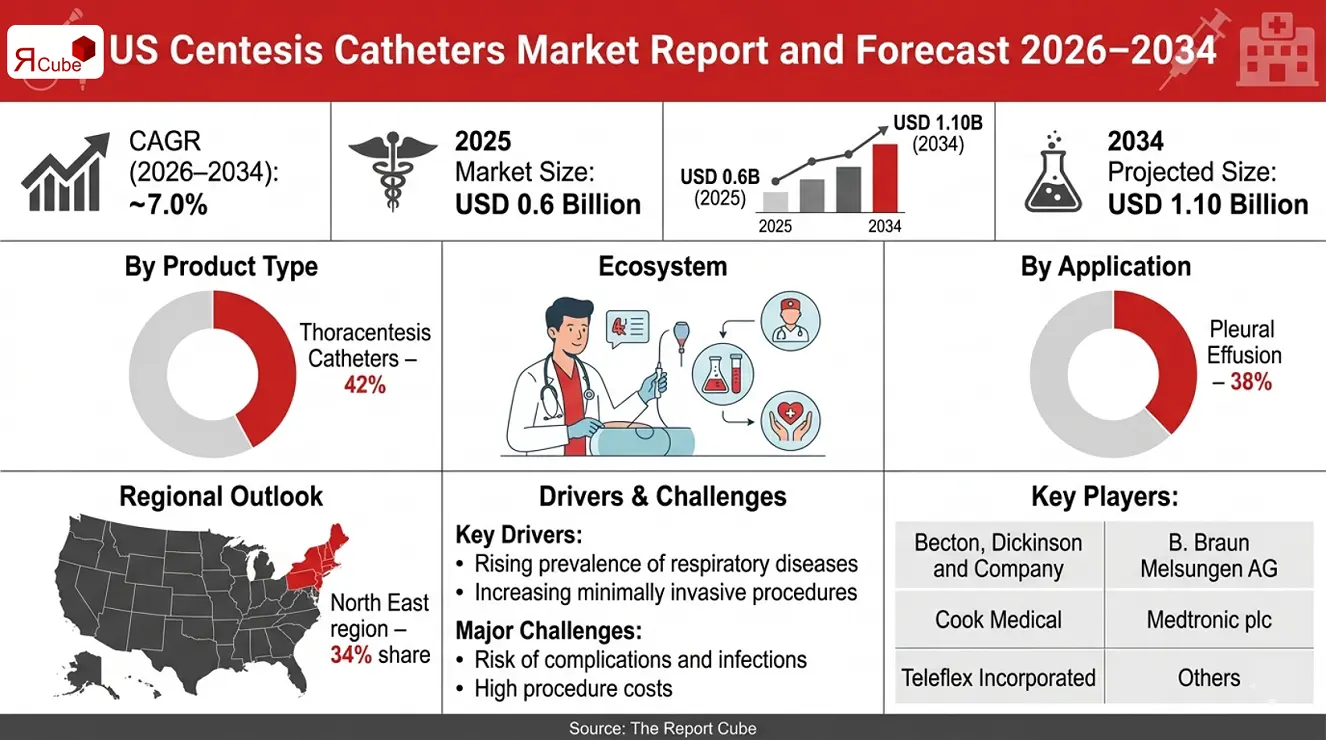
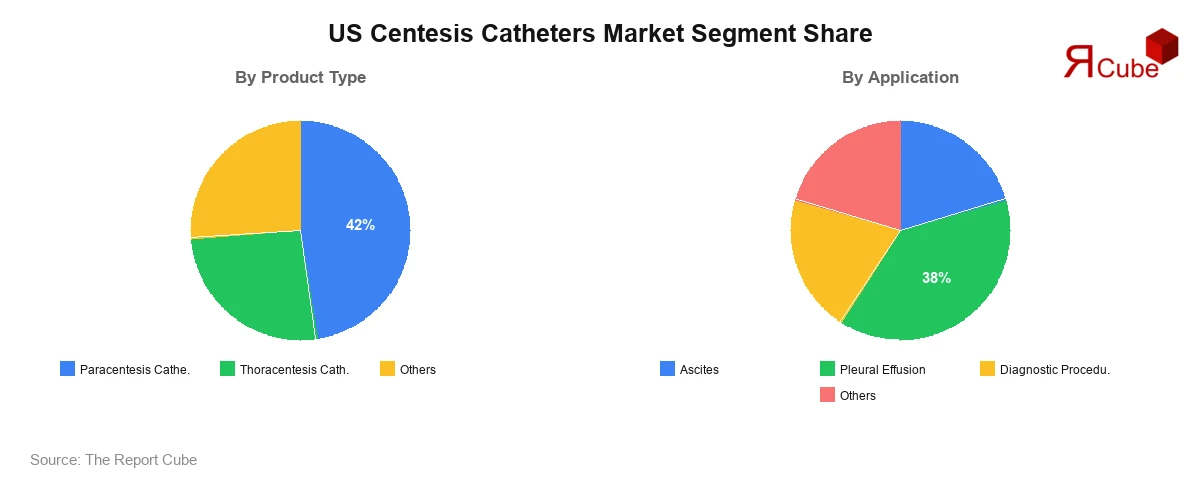
Thoracentesis catheters segment lead the market, with around 42% share.
By Application:
Pleural effusion segment dominate the market, accounting for nearly 38% of total revenue.
Regional Outlook:
North East region dominates the market, with around 34% share.
Government Initiatives & Policies
- U.S. FDA Medical Device Safety Action Plan: Strengthens device safety monitoring and innovation in catheter technologies.
- CMS Hospital Outpatient Prospective Payment System (OPPS): Supports reimbursement for minimally invasive drainage procedures.
US Centesis Catheters Market Insights & Analysis
The US Centesis Catheters Market Market is anticipated to register a 7.0% during 2026-2034. the market size was valued at USD 0.6 Billion and is projected to reach USD 1.10 Billion by 2034.
The market is experiencing consistent growth due to the rising prevalence of chronic diseases such as liver cirrhosis, cancer-related ascites, and pleural effusion conditions across the United States. Clinical data indicates that nearly 1.5 million patients annually require fluid drainage procedures, creating sustained demand for centesis catheters. Hospitals and specialty clinics are increasingly adopting minimally invasive procedures, contributing to higher procedural volumes and device utilization rates.
Technological advancements are shaping product innovation, with manufacturers focusing on improved catheter materials such as silicone and polyurethane to enhance flexibility, reduce infection risk, and improve patient comfort. Additionally, the integration of ultrasound-guided procedures has increased procedural success rates by over 20%, boosting clinician confidence and driving product adoption.
US Centesis Catheters Market Dynamics
Key Driver:
- Increasing prevalence of liver disease and cancer-related fluid accumulation conditions
- Growing adoption of minimally invasive procedures in hospitals and outpatient settings
- Rising geriatric population requiring frequent drainage procedures
Industry Trends:
- Shift toward ultrasound-guided centesis procedures improving accuracy and safety
- Development of antimicrobial and biocompatible catheter materials
- Increasing use of outpatient and ambulatory surgical centers for procedures
Book your FREE 30-minute expert consultation today
Contact UsMajor Challenge:
- Risk of infection and procedural complications affecting adoption rates
- High dependency on skilled professionals for catheter placement
- Variability in reimbursement policies across healthcare facilities
Opportunity:
- Growing demand for home-based drainage solutions and portable devices
- Expansion of specialty clinics increasing access to procedures
- Technological innovations in catheter design enhancing patient outcomes
US Centesis Catheters Market Segment-wise Analysis
By Product Type:
- Paracentesis Catheters
- Thoracentesis Catheters
- Others
Out of all segments, thoracentesis catheters lead the market due to their widespread use in managing pleural effusion cases, accounting for nearly 42% market share. Clinical reports indicate that pleural effusion affects over 1 million patients annually in the U.S., driving demand for thoracentesis procedures. These catheters are preferred due to their higher precision and compatibility with imaging-guided techniques. Hospitals increasingly adopt advanced thoracentesis kits that reduce complication rates by approximately 18%, improving patient safety. Additionally, rising incidences of lung cancer and respiratory disorders further accelerate the segment’s growth trajectory.
By Application:
- Ascites
- Pleural Effusion
- Diagnostic Procedures
- Others
Pleural effusion dominates the application segment, contributing around 38% of total revenue. The increasing prevalence of cardiopulmonary disorders and malignancies has significantly raised the number of thoracic fluid drainage procedures. Healthcare facilities report a 15% annual rise in diagnostic thoracentesis procedures, highlighting growing clinical demand. Additionally, improved diagnostic accuracy and faster treatment outcomes have made pleural effusion management a priority area. The segment benefits from continuous technological upgrades and increased awareness among clinicians, ensuring sustained growth throughout the forecast period.
Regional Projection of US Centesis Catheters Industry
- North East
- Midwest
- South
- West
The North East region holds the leading position with approximately 34% market share, supported by advanced healthcare infrastructure and high patient awareness. The region reports a higher concentration of specialty hospitals and academic medical centers performing complex centesis procedures. Additionally, the Midwest shows steady growth due to increasing healthcare investments, while the South region benefits from a large patient population and rising chronic disease prevalence. The West region is witnessing rapid adoption of innovative technologies and outpatient procedures, contributing to overall market expansion. Regional disparities in healthcare access and reimbursement policies influence growth patterns, yet all regions demonstrate consistent demand for centesis catheter procedures.
US Centesis Catheters Market Recent Developments
- 2025: Becton, Dickinson and Company introduced an advanced centesis catheter with integrated safety valves, reducing procedural complications and improving clinician efficiency across hospital settings.
- 2025: B. Braun Melsungen AG launched a next-generation polyurethane catheter designed for enhanced flexibility and reduced infection risk, targeting high-volume healthcare facilities.
- 2025: Cook Medical expanded its centesis product portfolio with ultrasound-compatible drainage kits, improving procedural success rates and strengthening its U.S. market presence.
- 2025: Medtronic plc focused on strategic collaborations with healthcare providers to develop minimally invasive drainage solutions, enhancing patient outcomes and clinical adoption.
- 2025: Teleflex Incorporated introduced antimicrobial-coated centesis catheters, addressing infection concerns and improving safety standards in outpatient and inpatient procedures.
Build Your Custom Market Intelligence Report
Customized Your ReportWhy Choose This Report?
- Provides a comprehensive overview of the overall market analysis, encompassing key trends, consumer behavior analysis, and risk assessment to support strategic decision-making.
- Provides accurate, up-to-date insights into market size, segmentation, and emerging opportunities, helping to minimize risk & capitalizing on growth.
- Gives deep understanding of target audience preferences, investment habits, and communication channels for enhanced product development & marketing effectiveness.
- Delivers competitive analysis & benchmarking, uncovering the strengths & weaknesses of market competitors to guide strategies.
- Consolidate comprehensive market intelligence, reducing reasoning & streamlining research efforts.
- Facilitates customized market segmentation & risk mitigation strategies, fine-tuned to the business objectives.
- Aids in identifying both market challenges & untapped opportunities within the industry to drive long-term business growth.
- Provides valuable information based on actual customer data & search trends.
Table of Contents
- Introduction
- Objective of the Study
- Product and Category Definition
- Market Segmentation
- Study Variables
- Research Methodology
- Secondary Data Points
- Breakdown of Secondary Sources
- Primary Data Points
- Breakdown of Primary Interviews
- Secondary Data Points
- Executive Summary
- Market Dynamics
- Drivers
- Challenges
- Opportunity Assessment
- Recent Trends and Developments
- Regulatory and Policy Landscape
- United States Centesis Catheters Market Overview (2026-2034)
- Market Size, By Value (USD Billion)
- Market Share, By Product Type
- Paracentesis Catheters
- Thoracentesis Catheters
- Others
- Market Share, By Application
- Ascites
- Pleural Effusion
- Diagnostic Procedures
- Others
- Market Share, By End User
- Hospitals
- Ambulatory Surgical Centers
- Specialty Clinics
- Market Share, By Material Type
- Silicone
- Polyurethane
- Others
- Market Share, By Distribution Channel
- Direct Sales
- Distributors
- Online Sales
- Market Share, By Region
- North East
- Midwest
- South
- West
- Market Share, By Company
- Revenue Shares and Analysis
- Competitive Landscape
- North East Centesis Catheters Market
- Market Size, By Value (USD Billion/Million)
- Market Share, By Product Type
- Market Share, By Application
- Market Share, By End User
- Midwest Centesis Catheters Market
- Market Size, By Value (USD Billion/Million)
- Market Share, By Product Type
- Market Share, By Application
- Market Share, By End User
- South Centesis Catheters Market
- Market Size, By Value (USD Billion/Million)
- Market Share, By Product Type
- Market Share, By Application
- Market Share, By End User
- West Centesis Catheters Market
- Market Size, By Value (USD Billion/Million)
- Market Share, By Product Type
- Market Share, By Application
- Market Share, By End User
- Competitive Outlook and Company Profiles
- Becton, Dickinson and Company (BD)
- Company Overview
- Product Portfolio
- Strategic Alliances/Partnerships
- Recent Developments
- B. Braun Melsungen AG
- Company Overview
- Product Portfolio
- Strategic Alliances/Partnerships
- Recent Developments
- Cook Medical
- Company Overview
- Product Portfolio
- Strategic Alliances/Partnerships
- Recent Developments
- Medtronic plc
- Company Overview
- Product Portfolio
- Strategic Alliances/Partnerships
- Recent Developments
- Teleflex Incorporated
- Company Overview
- Product Portfolio
- Strategic Alliances/Partnerships
- Recent Developments
- Cardinal Health, Inc.
- Company Overview
- Product Portfolio
- Strategic Alliances/Partnerships
- Recent Developments
- Becton, Dickinson and Company (BD)
- Contact Us and Disclaimer
Top Key Players & Market Share Outlook
- Becton, Dickinson and Company
- B. Braun Melsungen AG
- Cook Medical
- Medtronic plc
- Teleflex Incorporated
- Cardinal Health, Inc. &
- Others
Frequently Asked Questions






