



Build Your Custom Market Intelligence Report
Customize Your ReportUS Childrenswear Market Key Highlights
By Product Type:
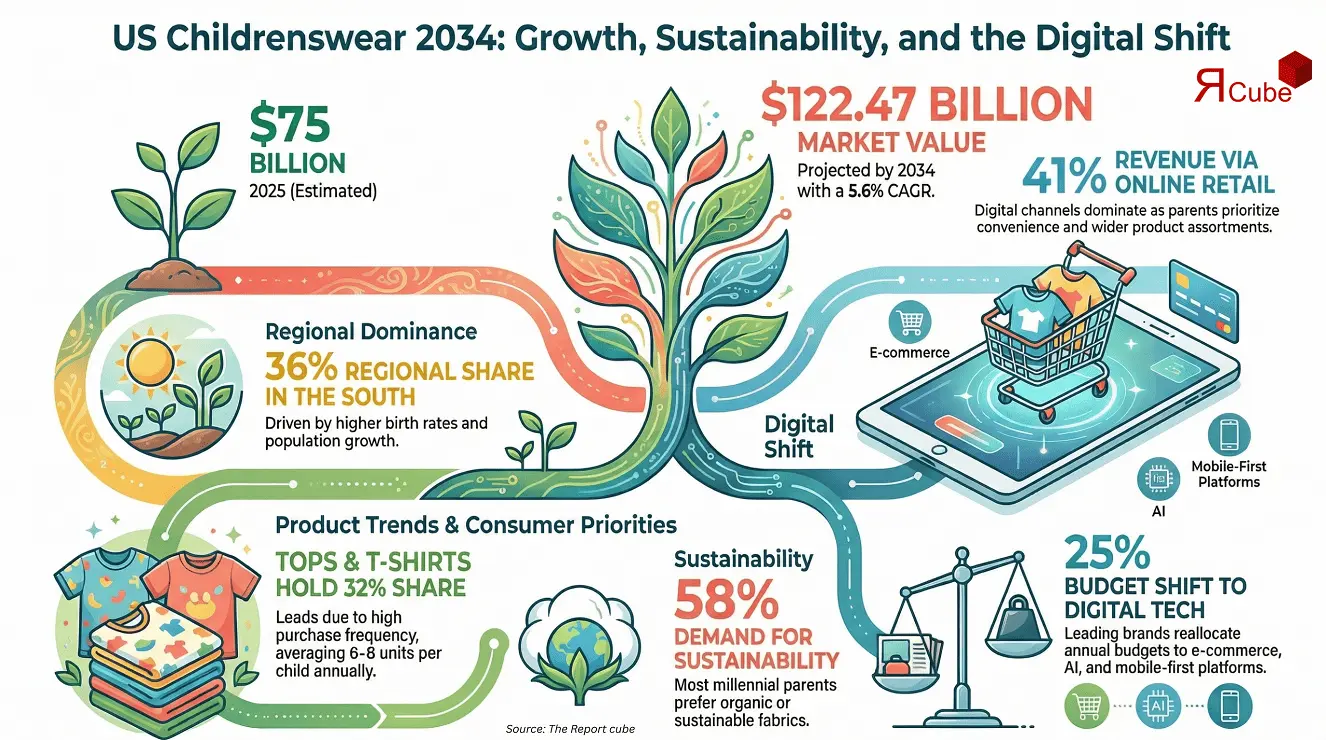
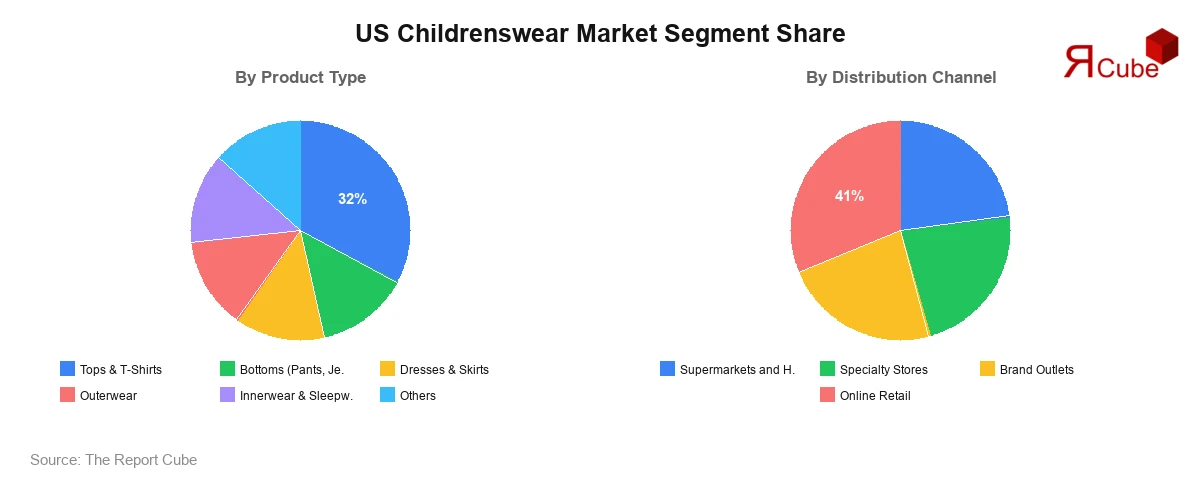
Tops & T-Shirts segment lead the market, with around 32% share.
By Distribution Channel:
Online Retail segment dominate the market, accounting for nearly 41% of total revenue.
Regional Outlook:
South United States region dominates the market, with around 36% share.
Government Initiatives & Policies
- U.S. Consumer Product Safety Improvement Act (CPSIA): Regulates children’s apparel safety standards including lead content and flammability.
- Made in America Initiative: Encourages domestic textile manufacturing and apparel sourcing through federal procurement incentives.
US Childrenswear Market Insights & Analysis
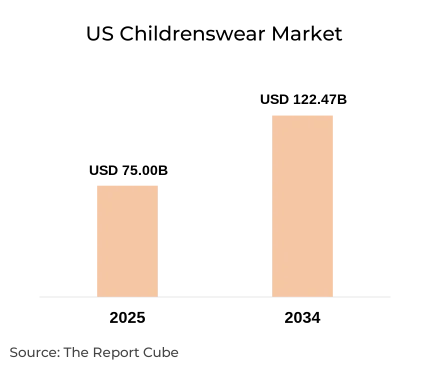
The US Childrenswear Market Market is anticipated to register a 5.6% during 2026-2034. the market size was valued at USD 75 Billion and is projected to reach USD 122.47 Billion by 2034.
The US childrenswear market is witnessing consistent expansion driven by evolving consumer preferences, rising disposable incomes, and increasing focus on comfort and sustainability. Parents are now prioritizing high-quality, durable, and ethically produced clothing, which has significantly reshaped product development strategies. Over 58% of millennial parents prefer organic or sustainable fabrics for children’s clothing, reflecting a structural shift toward eco-conscious consumption. This trend is further supported by growing awareness around skin sensitivity and environmental impact.
Investment in digital retail infrastructure has significantly enhanced market accessibility. Leading brands are allocating nearly 20–25% of their annual budgets toward e-commerce optimization, including mobile-first platforms and AI-driven recommendation engines. Subscription-based childrenswear models and resale platforms have also gained traction, particularly among urban households seeking cost efficiency. These models are estimated to account for nearly 12% of total online childrenswear sales in 2025.
US Childrenswear Market Dynamics
Key Driver:
- Rising demand for sustainable and organic childrenswear products
- Growth of e-commerce and direct-to-consumer retail channels
- Increasing disposable income and premium product adoption
Industry Trends:
- Expansion of resale and rental childrenswear platforms
- Integration of smart fabrics and functional apparel
- Personalized and subscription-based clothing services gaining traction
Major Challenge:
- Price sensitivity among middle-income households
- Frequent size changes reducing product lifecycle
- Supply chain disruptions impacting inventory planning
Book your FREE 30-minute expert consultation today
Contact UsOpportunity:
- Growth in eco-friendly and biodegradable fabric segments
- Expansion into niche categories like adaptive clothing
- Increasing penetration of digital-first brands in suburban markets
US Childrenswear Market Segment-wise Analysis
By Product Type:
- Tops & T-Shirts
- Bottoms (Pants, Jeans, Shorts)
- Dresses & Skirts
- Outerwear
- Innerwear & Sleepwear
- Others
Out of all product categories, Tops & T-Shirts dominate the US childrenswear market, accounting for approximately 32% of total revenue share. This dominance is primarily driven by high purchase frequency and versatility across seasons. On average, households purchase 6–8 units of tops per child annually, compared to 3–4 units of other apparel categories. Brands are increasingly introducing graphic prints, licensed character merchandise, and customizable options, which enhance product appeal among children and parents alike. Additionally, the availability of affordable multipack options and rapid design turnover in fast fashion has further boosted demand in this segment.
By Distribution Channel:
- Supermarkets and Hypermarkets
- Specialty Stores
- Brand Outlets
- Online Retail
Among distribution channels, Online Retail leads the market with nearly 41% share, reflecting a strong shift toward digital purchasing behavior. Convenience, wider product assortment, and competitive pricing have made online platforms the preferred choice for parents. Approximately 68% of millennial consumers purchase childrenswear online at least once every quarter. Additionally, features such as virtual sizing tools, easy return policies, and personalized recommendations enhance customer experience. The integration of social commerce and influencer marketing has also accelerated product discovery, making online channels a key growth driver for the industry.
Regional Projection of US Childrenswear Industry
- South United States
- West United States
- Midwest United States
- Northeast United States
Among all regions, the South United States holds the largest share of approximately 36% in the US childrenswear market. This regional dominance is supported by a higher birth rate compared to other regions and a growing population base. States such as Texas and Florida contribute significantly to demand due to their large family-oriented demographics. Additionally, favorable retail expansion strategies, including the presence of major discount chains and outlet stores, enhance product accessibility. Seasonal demand patterns, particularly for lightweight and casual clothing, further boost sales volumes in this region.
The West United States is witnessing strong growth driven by sustainability-focused consumers and higher adoption of premium childrenswear brands. The Midwest United States demonstrates stable demand supported by value-driven purchasing behavior and strong presence of supermarket chains. Meanwhile, the Northeast United States shows increasing preference for branded and designer childrenswear, particularly in urban centers with higher disposable incomes.
US Childrenswear Market Recent Developments
- 2025: Carter's, Inc. expanded its sustainable clothing line by introducing organic cotton collections across all major retail channels, targeting eco-conscious consumers and increasing its sustainable product portfolio share by over 18%.
- 2025: The Children's Place, Inc. launched a new AI-powered personalization platform on its e-commerce website, improving customer engagement and increasing online conversion rates by approximately 12%.
- 2025: Gap Inc. introduced a circular fashion initiative for kidswear, enabling customers to return used clothing for recycling, supporting sustainability goals and enhancing brand loyalty among environmentally conscious families.
- 2025: Nike, Inc. expanded its kids apparel segment by launching performance-based activewear collections designed for school and sports activities, strengthening its presence in the premium childrenswear category.
- 2025: H&M Hennes & Mauritz AB enhanced its digital retail capabilities in the US by integrating augmented reality fitting tools, improving online shopping experiences and reducing return rates.
Build Your Custom Market Intelligence Report
Customized Your ReportWhy Choose This Report?
- Provides a comprehensive overview of the overall market analysis, encompassing key trends, consumer behavior analysis, and risk assessment to support strategic decision-making.
- Provides accurate, up-to-date insights into market size, segmentation, and emerging opportunities, helping to minimize risk & capitalizing on growth.
- Gives deep understanding of target audience preferences, investment habits, and communication channels for enhanced product development & marketing effectiveness.
- Delivers competitive analysis & benchmarking, uncovering the strengths & weaknesses of market competitors to guide strategies.
- Consolidate comprehensive market intelligence, reducing reasoning & streamlining research efforts.
- Facilitates customized market segmentation & risk mitigation strategies, fine-tuned to the business objectives.
- Aids in identifying both market challenges & untapped opportunities within the industry to drive long-term business growth.
- Provides valuable information based on actual customer data & search trends.
Table of Contents
- Introduction
- Objective of the Study
- Product and Category Definition
- Market Segmentation
- Study Variables
- Research Methodology
- Secondary Data Points
- Breakdown of Secondary Sources
- Primary Data Points
- Breakdown of Primary Interviews
- Secondary Data Points
- Executive Summary
- Market Dynamics
- Drivers
- Challenges
- Opportunity Assessment
- Recent Trends and Developments
- Regulatory and Policy Landscape
- United States Childrenswear Market Overview (2026-2034)
- Market Size, By Value (USD Billion)
- Market Share, By Product Type
- Tops & T-Shirts
- Bottoms (Pants, Jeans, Shorts)
- Dresses & Skirts
- Outerwear
- Innerwear & Sleepwear
- Others
- Market Share, By Age Group
- Infants (0–2 Years)
- Toddlers (3–5 Years)
- Kids (6–12 Years)
- Teens (13–16 Years)
- Market Share, By Gender
- Boys
- Girls
- Unisex
- Market Share, By Fabric Type
- Cotton
- Polyester
- Denim
- Organic Fabrics
- Others
- Market Share, By Distribution Channel
- Supermarkets and Hypermarkets
- Specialty Stores
- Brand Outlets
- Online Retail
- Market Share, By Price Range
- Economy
- Mid-Range
- Premium
- Market Share, By End User
- Household Consumers
- Institutional Buyers (Schools, Organizations)
- Market Share, By Region
- West United States
- Midwest United States
- Northeast United States
- South United States
- Market Share, By Company
- Revenue Shares and Analysis
- Competitive Landscape
- West United States Childrenswear Market
- Market Size, By Value (USD Billion/Million)
- Market Share, By Product Type
- Market Share, By Age Group
- Market Share, By Gender
- Market Share, By Distribution Channel
- Midwest United States Childrenswear Market
- Market Size, By Value (USD Billion/Million)
- Market Share, By Product Type
- Market Share, By Age Group
- Market Share, By Gender
- Market Share, By Distribution Channel
- Northeast United States Childrenswear Market
- Market Size, By Value (USD Billion/Million)
- Market Share, By Product Type
- Market Share, By Age Group
- Market Share, By Gender
- Market Share, By Distribution Channel
- South United States Childrenswear Market
- Market Size, By Value (USD Billion/Million)
- Market Share, By Product Type
- Market Share, By Age Group
- Market Share, By Gender
- Market Share, By Distribution Channel
- Competitive Outlook and Company Profiles
- The Children's Place, Inc.
- Company Overview
- Product Portfolio
- Strategic Alliances/Partnerships
- Recent Developments
- Carter's, Inc.
- Company Overview
- Product Portfolio
- Strategic Alliances/Partnerships
- Recent Developments
- Gap Inc. (Gap Kids & Baby Gap)
- Company Overview
- Product Portfolio
- Strategic Alliances/Partnerships
- Recent Developments
- Nike, Inc.
- Company Overview
- Product Portfolio
- Strategic Alliances/Partnerships
- Recent Developments
- H&M Hennes & Mauritz AB
- Company Overview
- Product Portfolio
- Strategic Alliances/Partnerships
- Recent Developments
- Zara (Inditex Group)
- Company Overview
- Product Portfolio
- Strategic Alliances/Partnerships
- Recent Developments
- The Children's Place, Inc.
- Contact Us and Disclaimer
Top Key Players & Market Share Outlook
- The Children's Place, Inc.
- Carter's, Inc.
- Gap Inc. (Gap Kids & Baby Gap)
- Nike, Inc.
- H&M Hennes & Mauritz AB
- Zara (Inditex Group)
- Others
Frequently Asked Questions






