



Build Your Custom Market Intelligence Report
Customize Your ReportSingapore Chip Packaging Supply Chain Market Key Highlights
By Value Chain Function:
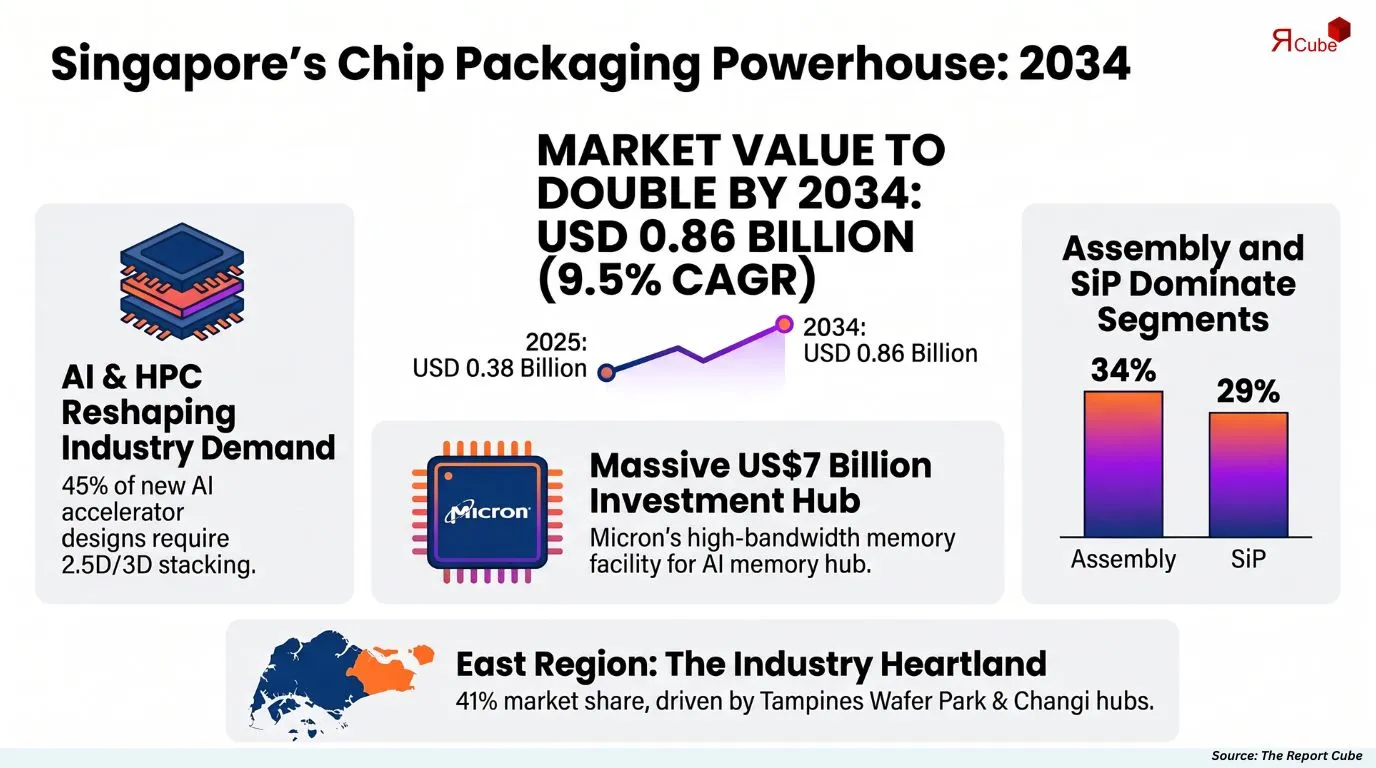
Assembly and Packaging segment leads the market, with around 34% share.
By Packaging Type:
System-in-Package segment dominates the market, accounting for nearly 29% of total revenue.
Regional Outlook:
East region dominates the singapore chip packaging supply chain market, with around 41% share.
Government Initiatives & Policies
- Singapore Research, Innovation and Enterprise (RIE2025) Plan - Semiconductor and Advanced Manufacturing Focus: Allocates multi-billion-dollar funding to strengthen semiconductor R&D, advanced packaging, and supply chain resilience.
- EDB Semiconductor Industry Transformation Map (Updated 2025): Supports advanced packaging capacity, workforce development, and automation adoption across Singapore’s chip ecosystem.
Singapore Chip Packaging Supply Chain Market Insights & Analysis
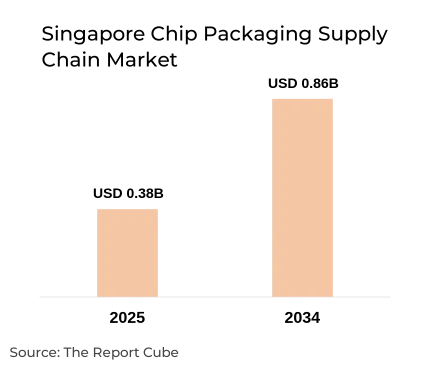
The Singapore Chip Packaging Supply Chain Market is anticipated to register a CAGR: 9.5% during 2026-34. The market size was valued at USD 0.38 billion in 2025 and is projected to reach USD 0.86 billion by 2034. Singapore continues to strengthen its position as a critical node in the global semiconductor value chain, particularly in assembly, testing, and advanced packaging technologies serving AI, high-performance computing (HPC), automotive electronics, and 5G infrastructure.
Singapore contributes nearly 10% of global semiconductor output by value, with packaging and testing forming a substantial share of downstream operations. The city-state hosts major OSAT (Outsourced Semiconductor Assembly and Test) players such as ASE Singapore, JCET Group (STATS ChipPAC), UTAC Group, and Amkor Technology, alongside integrated device manufacturers (IDMs) and foundries including Micron Semiconductor Asia, Infineon Technologies, GlobalFoundries, Samsung Semiconductor, and UMC. This concentration supports a tightly integrated ecosystem spanning wafer fabrication, advanced packaging, materials supply, equipment manufacturing, and system-level testing.
Advanced packaging is becoming central to Singapore’s semiconductor growth strategy. With Moore’s Law scaling slowing at the transistor level, heterogeneous integration through 2.5D/3D packaging, chiplets, and system-in-package architectures is gaining commercial momentum. By 2025, more than 45% of new AI accelerator designs globally incorporate advanced packaging formats, increasing demand for bumping, wafer-level packaging, and thermo-compression bonding technologies. Singapore’s high automation levels and engineering workforce enable efficient deployment of these high-mix, high-precision processes.
Investment momentum is accelerating. Micron Semiconductor Asia broke ground on a US$7 billion high-bandwidth memory (HBM) advanced packaging facility in 2025, positioning Singapore as a hub for AI memory packaging. At the same time, Silicon Box is scaling panel-level packaging (PLP) from its Tampines Wafer Park facility, targeting chiplet integration for AI, automotive, and robotics markets. These capital-intensive expansions signal a structural shift toward high-density, high-value packaging solutions, reinforcing Singapore’s strategic relevance in the global semiconductor supply chain through 2034.
Singapore Chip Packaging Supply Chain Market Dynamics
Key Driver: AI and High-Performance Computing Demand Reshaping Packaging Requirements
Artificial intelligence workloads and data center expansion are fundamentally changing chip design and packaging complexity. AI accelerators require high-bandwidth memory integration, advanced interposers, and dense 2.5D/3D stacking technologies. Global data center capacity is projected to grow at over 12% annually, increasing demand for advanced packaging services capable of handling high I/O counts and thermal management challenges. Singapore’s advanced packaging facilities are benefiting from this shift, particularly in bumping, wafer-level packaging, and system-level test (SLT). Equipment suppliers such as ASMPT, Applied Materials, BesI, and Kulicke & Soffa are supporting this transition through next-generation bonding, plating, and die-attach systems. As customers prioritize performance per watt and space efficiency, advanced packaging becomes a differentiator rather than a back-end function, directly fueling market expansion.
Book your FREE 30-minute expert consultation today
Contact UsIndustry Trends: Transition Toward Panel-Level Packaging and Heterogeneous Integration
Panel-level packaging is gaining traction as a cost-efficient alternative to traditional wafer-level formats. Silicon Box’s large-format PLP facility demonstrates Singapore’s capability to scale beyond pilot volumes into high-yield mass production. PLP enables larger substrate areas, better cost per function, and enhanced integration density for chiplets. Concurrently, system-in-package and 2.5D/3D architectures are expanding across automotive ADAS systems, 5G base stations, and industrial IoT devices. Heterogeneous integration allows mixing logic, memory, and analog components within a compact footprint, reducing latency and improving signal integrity. Automation and robotics integration within Singapore’s packaging lines further enhances throughput and yield, positioning the country as a leader in complex package assembly.
Major Challenge: Rising Capital Intensity and Supply Chain Volatility
Advanced packaging requires significant upfront investment in bonding tools, inspection systems, plating equipment, and cleanroom infrastructure. Individual thermo-compression bonding systems can exceed several million dollars per unit. The need for continuous technology upgrades increases financial pressure, especially for mid-sized OSAT players. In addition, supply chain disruptions for substrates, interposers, and specialty materials can affect production timelines. Advanced substrates for 2.5D packages have experienced tight supply cycles globally, influencing lead times. While Singapore benefits from strong logistics connectivity, external geopolitical and material supply uncertainties remain operational risks that companies must actively manage through diversified sourcing strategies.
Opportunity: Expansion of System-Level Test and Burn-in Ecosystems
System-level testing is emerging as a high-growth segment within the packaging value chain. As chips become more complex, validation at system level rather than component level is essential. AEM Holdings’ collaboration with Intel Foundry to expand SLT and burn-in access illustrates this shift. SLT demand is expected to grow at over 10% annually through 2030, particularly for AI and HPC processors. Singapore’s expertise in precision engineering and automation makes it well-positioned to scale advanced test platforms. Expanding SLT capacity not only enhances reliability assurance but also increases value capture within the domestic supply chain, strengthening overall ecosystem competitiveness.
Singapore Chip Packaging Supply Chain Market Segment-wise Analysis
By Value Chain Function:
- Assembly and Packaging
- Testing and Burn-in
- Bump and Wafer-Level
- Substrate and Interposer
- Materials and Consumables
- Equipment and Automation
- Logistics and Services
Assembly and Packaging accounts for approximately 34% of total market revenue in 2025, reflecting Singapore’s strong OSAT presence. Facilities operated by ASE Singapore, JCET Group (STATS ChipPAC), UTAC Group, and Amkor Technology collectively handle millions of units daily across diverse package formats. Advanced packaging lines integrating thermo-compression bonding, flip-chip, and wafer-level processes are expanding to meet AI and automotive demand. Yield optimization and high-mix flexibility enable Singapore-based facilities to manage complex production portfolios efficiently. As advanced packaging grows in share relative to traditional leadframe assembly, this segment will continue capturing the largest portion of value chain revenues through 2034.
By Packaging Type:
- Leadframe Packages
- Ball Grid Array
- Chip-Scale Packages
- System-in-Package
- Fan-Out Wafer-Level
- 2.5D and 3D Packages
- Others
System-in-Package holds nearly 29% of the packaging type revenue share, driven by demand for compact, multifunctional devices. SiP integrates processors, memory, sensors, and RF components within a single module, making it ideal for wearables, automotive control units, and IoT modules. Singapore’s high-precision assembly lines and advanced substrate ecosystem support scalable SiP manufacturing. Growing adoption of chiplet architectures further strengthens SiP relevance. Meanwhile, 2.5D and 3D packages are witnessing accelerated growth due to AI accelerators and HBM integration. As customers prioritize miniaturization and performance optimization, advanced multi-die configurations are expected to expand their revenue contribution steadily.
Regional Projection of Singapore Chip Packaging Supply Chain Industry
- East
- North
- Northeast
- West
- Central
The East region commands around 41% market share, anchored by Tampines Wafer Park and Changi industrial zones where major packaging and testing facilities are concentrated. Proximity to logistics hubs, including Changi Airport and Tuas Port connectivity, supports efficient global distribution. The West region follows due to wafer fabrication and equipment clusters, particularly around Jurong. Northern and Northeast industrial estates contribute through specialized automation and equipment manufacturing operations. Central areas primarily support corporate headquarters and R&D centers. Regional clustering enhances supply chain efficiency, workforce specialization, and cross-collaboration across the semiconductor ecosystem.
Singapore Chip Packaging Supply Chain Market Recent Developments
- 2025: Micron Semiconductor Asia (Micron Technology, Inc.) broke ground on a US$7 billion HBM advanced packaging facility in Singapore, strengthening AI memory supply capacity and expanding advanced packaging operations from 2027 onward.
- 2025: Silicon Box completed rapid scale-up of its 73,000-square-meter advanced packaging plant and secured a US$302.5 million Series B round, supporting continued technology expansion.
- 2025: AEM Holdings expanded access to its production-proven system-level test and burn-in ecosystem through collaboration with Intel Foundry, enhancing advanced computing customer access to SLT platforms.
- 2025: ASMPT (ASM Pacific) unveiled advanced packaging equipment including thermo-compression bonding, laser dicing, and panel-plating systems at SEMICON West 2025, supporting dense 2.5D/3D chip integration.
Need insights for a specific region within this market?
Request Regional DataWhy Choose This Report?
- Provides a comprehensive overview of the overall market analysis, encompassing key trends, consumer behavior analysis, and risk assessment to support strategic decision-making.
- Provides accurate, up-to-date insights into market size, segmentation, and emerging opportunities, helping to minimize risk & capitalizing on growth.
- Gives deep understanding of target audience preferences, investment habits, and communication channels for enhanced product development & marketing effectiveness.
- Delivers competitive analysis & benchmarking, uncovering the strengths & weaknesses of market competitors to guide strategies.
- Consolidate comprehensive market intelligence, reducing reasoning & streamlining research efforts.
- Facilitates customized market segmentation & risk mitigation strategies, fine-tuned to the business objectives.
- Aids in identifying both market challenges & untapped opportunities within the industry to drive long-term business growth.
- Provides valuable information based on actual customer data & search trends.
Table of Contents
- Introduction
- Objective of the Study
- Product and Category Definition
- Market Segmentation
- Study Variables
- Research Methodology
- Secondary Data Points
- Breakdown of Secondary Sources
- Primary Data Points
- Breakdown of Primary Interviews
- Secondary Data Points
- Executive Summary
- Market Dynamics
- Drivers
- Challenges
- Opportunity Assessment
- Recent Trends and Developments
- Regulatory and Policy Landscape
- Singapore Chip Packaging Supply Chain Market Overview (2021-2034)
- Market Size, By Value (USD Billion)
- Market Share, By Value Chain Function
- Assembly and Packaging
- Testing and Burn-in
- Bump and Wafer-Level
- Substrate and Interposer
- Materials and Consumables
- Equipment and Automation
- Logistics and Services
- Market Share, By Packaging Type
- Leadframe Packages
- Ball Grid Array
- Chip-Scale Packages
- System-in-Package
- Fan-Out Wafer-Level
- 2.5D and 3D Packages
- Others
- Market Share, By End Application
- Consumer Electronics
- Data Center and Cloud
- Automotive and Mobility
- Industrial Electronics
- Communications and 5G
- Others
- Market Share, By Customer Type
- Foundries
- IDMs
- Fabless Companies
- Electronics OEMs
- Market Share, By Region
- East
- North
- Northeast
- West
- Central
- Market Share, By Company
- Revenue Shares and Analysis
- Competitive Landscape
- East Region Chip Packaging Supply Chain Market
- Market Size, By Value (USD Billion/Million)
- Market Share, By Value Chain Function
- Market Share, By Packaging Type
- Market Share, By End Application
- Market Share, By Customer Type
- North Region Chip Packaging Supply Chain Market
- Market Size, By Value (USD Billion/Million)
- Market Share, By Value Chain Function
- Market Share, By Packaging Type
- Market Share, By End Application
- Market Share, By Customer Type
- Northeast Region Chip Packaging Supply Chain Market
- Market Size, By Value (USD Billion/Million)
- Market Share, By Value Chain Function
- Market Share, By Packaging Type
- Market Share, By End Application
- Market Share, By Customer Type
- West Region Chip Packaging Supply Chain Market
- Market Size, By Value (USD Billion/Million)
- Market Share, By Value Chain Function
- Market Share, By Packaging Type
- Market Share, By End Application
- Market Share, By Customer Type
- Central Region Chip Packaging Supply Chain Market
- Market Size, By Value (USD Billion/Million)
- Market Share, By Value Chain Function
- Market Share, By Packaging Type
- Market Share, By End Application
- Market Share, By Customer Type
- Competitive Outlook and Company Profiles
- ASE Singapore
- Company Overview
- Product Portfolio
- Strategic Alliances/Partnerships
- Recent Developments
- JCET Group (STATS ChipPAC)
- Company Overview
- Product Portfolio
- Strategic Alliances/Partnerships
- Recent Developments
- UTAC Group
- Company Overview
- Product Portfolio
- Strategic Alliances/Partnerships
- Recent Developments
- Amkor Technology
- Company Overview
- Product Portfolio
- Strategic Alliances/Partnerships
- Recent Developments
- Silicon Box
- Company Overview
- Product Portfolio
- Strategic Alliances/Partnerships
- Recent Developments
- Micron Semiconductor Asia
- Company Overview
- Product Portfolio
- Strategic Alliances/Partnerships
- Recent Developments
- Applied Materials
- Company Overview
- Product Portfolio
- Strategic Alliances/Partnerships
- Recent Developments
- ASMPT (ASM Pacific)
- Company Overview
- Product Portfolio
- Strategic Alliances/Partnerships
- Recent Developments
- KLA Corporation
- Company Overview
- Product Portfolio
- Strategic Alliances/Partnerships
- Recent Developments
- AEM Holdings
- Company Overview
- Product Portfolio
- Strategic Alliances/Partnerships
- Recent Developments
- BesI (BE Semiconductor)
- Company Overview
- Product Portfolio
- Strategic Alliances/Partnerships
- Recent Developments
- Kulicke & Soffa (K&S)
- Company Overview
- Product Portfolio
- Strategic Alliances/Partnerships
- Recent Developments
- TOPPAN
- Company Overview
- Product Portfolio
- Strategic Alliances/Partnerships
- Recent Developments
- GlobalFoundries
- Company Overview
- Product Portfolio
- Strategic Alliances/Partnerships
- Recent Developments
- Infineon Technologies
- Company Overview
- Product Portfolio
- Strategic Alliances/Partnerships
- Recent Developments
- Samsung Semiconductor
- Company Overview
- Product Portfolio
- Strategic Alliances/Partnerships
- Recent Developments
- UMC
- Company Overview
- Product Portfolio
- Strategic Alliances/Partnerships
- Recent Developments
- Others
- ASE Singapore
- Contact Us and Disclaimer
Top Key Players & Market Share Outlook
- ASE Singapore
- JCET Group (STATS ChipPAC)
- UTAC Group
- Amkor Technology
- Silicon Box
- Micron Semiconductor Asia
- Applied Materials
- ASMPT (ASM Pacific)
- KLA Corporation
- AEM Holdings
- BesI (BE Semiconductor)
- Kulicke & Soffa (K&S)
- TOPPAN
- GlobalFoundries
- Infineon Technologies
- Samsung Semiconductor
- UMC
- Others
Frequently Asked Questions






