



Build Your Custom Market Intelligence Report
Customize Your ReportGlobal Climate Data Analysis Market Key Takeaways
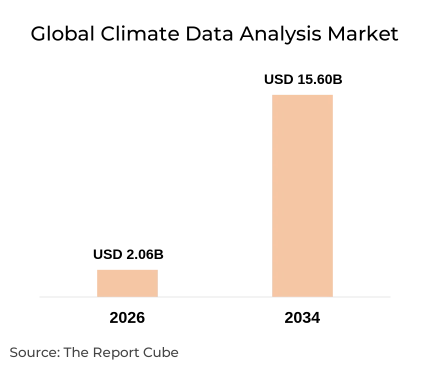
- Market valued at USD 2.06 billion in 2026, driven by surging climate intelligence demand.
- Industry projected to reach USD 15.60 billion by 2034, expanding at 28.80% CAGR.
- Climate Data Processing and Visualization dominates the By Type segment globally.
- Government and Public Sector leads end-user adoption of climate data platforms.
- North America holds regional leadership through advanced regulatory and research frameworks.
- Asia-Pacific represents the fastest-growing region fueled by climate-resilient infrastructure programs.
- Leading companies include IBM Corporation, Verisk Analytics, AccuWeather, and ESRI.
- AI-driven predictive modeling and real-time climate monitoring reshape enterprise data adoption.
Global Climate Data Analysis Market Insights & Analysis
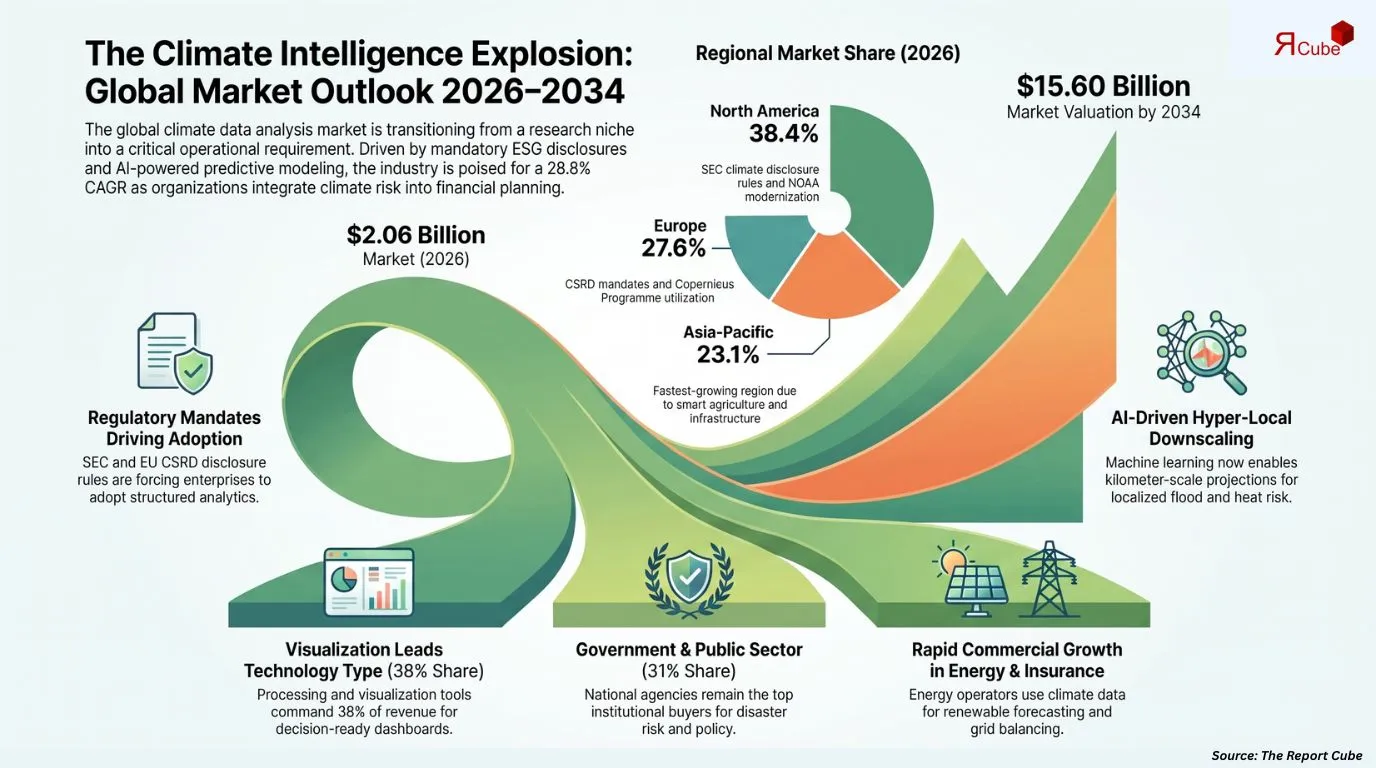
The Global Climate Data Analysis Market is anticipated to register a 28.80% CAGR during 2026–2034. The market size was valued at USD 2.06 billion in 2026 and is projected to reach USD 15.60 billion by 2034. Accelerating climate change adaptation mandates, expansion of Earth observation satellite networks, and growing cross-sector demand for granular weather and environmental intelligence are collectively propelling the market. Governments across North America, Europe, and Asia-Pacific have committed over USD 180 billion in combined climate technology investment through 2030, substantially reinforcing the demand for advanced climate data processing and visualization platforms.
Corporate sustainability reporting obligations under frameworks including the SEC Climate Disclosure Rule and the EU Corporate Sustainability Reporting Directive (CSRD) are compelling enterprises across energy, agriculture, insurance, and infrastructure sectors to integrate structured climate analytics into operational planning. Organizations including IBM Corporation and Verisk Analytics have expanded dedicated climate risk intelligence divisions since 2024. Increasing deployment of IoT-connected environmental sensors, high-resolution reanalysis datasets, and machine learning-based downscaling techniques is further enabling enterprises to translate climate model evaluation and scenario planning into quantifiable risk-adjusted financial strategies across long-term asset portfolios.
Global Climate Data Analysis Market Dynamics
Demand across the Global Climate Data Analysis Market is expanding as organizations in energy, agriculture, public administration, healthcare, and financial services recognize climate intelligence as a non-negotiable operational input. Rising physical climate risks, mandatory ESG disclosures, and the growing sophistication of ensemble modeling platforms are reshaping how enterprises consume, process, and act on environmental data. Continuous modernization of geospatial data infrastructure further reinforces investment pipelines across both public and commercial sectors.
|
Factor |
Type |
Specific Impact on Market |
Magnitude |
|---|---|---|---|
|
Mandatory climate disclosure regulations |
Driver |
Accelerates enterprise adoption of structured climate analytics platforms |
Very High |
|
Expansion of satellite Earth observation networks |
Driver |
Increases volume, resolution, and frequency of available climate datasets |
High |
|
Physical climate risk integration in financial models |
Opportunity |
Drives demand for probabilistic scenario and actuarial climate tools |
High |
|
Interoperability of heterogeneous climate data formats |
Challenge |
Complicates multi-source data integration across enterprise platforms |
High |
|
Machine learning-based climate downscaling |
Trend |
Improves spatial resolution and predictive accuracy of regional forecasts |
Very High |
Key Market Driver: Mandatory ESG and Climate Disclosure Frameworks
Regulatory mandates requiring organizations to quantify and disclose physical and transition climate risks are significantly accelerating enterprise adoption of structured climate data platforms. The SEC's finalized climate disclosure rules and the European CSRD now require listed companies to report scenario-based climate exposure, driving sustained procurement of climate analytics tools. In 2025, global corporate spending on climate risk compliance platforms exceeded USD 4.2 billion, with demand concentrated among financial institutions, utilities, and multinational manufacturers integrating climate risk quantification for insurance underwriting into their enterprise reporting infrastructure.
Major Industry Challenge: Fragmented Climate Data Format Interoperability
One of the most persistent structural challenges facing the market involves the lack of standardized interoperability across competing climate data formats, including NetCDF, GRIB2, HDF5, and proprietary vendor schemas. Enterprises integrating satellite reanalysis products, ground-based observational datasets, and numerical weather prediction outputs routinely encounter preprocessing bottlenecks that increase latency, reduce analytical accuracy, and elevate infrastructure costs. As of 2025, fewer than 30% of enterprise climate data workflows operated on fully harmonized pipelines, underscoring the critical demand for middleware solutions, open data standards, and API-based integration architectures across multi-source climate intelligence platforms.
Emerging Trend Shaping Outlook: Machine Learning-Driven Climate Downscaling
Statistical and dynamical downscaling techniques augmented by deep learning are fundamentally transforming the spatial resolution and predictive specificity of regional climate projections. Organizations including The Weather Company (IBM) and Vaisala Corporation are deploying convolutional neural networks and transformer-based architectures to generate kilometer-scale climate projections from coarser global circulation model outputs. These methods enable granular flood risk mapping, localized agricultural yield modeling, and city-level urban heat island forecasting. The integration of high-resolution urban climate modeling with infrastructure design workflows represents a rapidly expanding application segment expected to generate over USD 1.8 billion in incremental annual revenue by 2030.
Need Specific Data, Let’s Customize the Report for You
Request CustomizationGlobal Climate Data Analysis Market Segment-wise Analysis
Enterprises across public administration, energy, agriculture, insurance, and healthcare continue expanding investment across multiple climate data solution types and end-use verticals. Advanced processing platforms now support government climate policy design, actuarial catastrophe modeling, crop yield prediction, and critical infrastructure resilience planning, reflecting the broadening commercial scope of climate intelligence solutions.
By Type
- Climate Model Evaluation
- Climate Data Processing and Visualization
- Climate Data Formats
- Statistical Methods
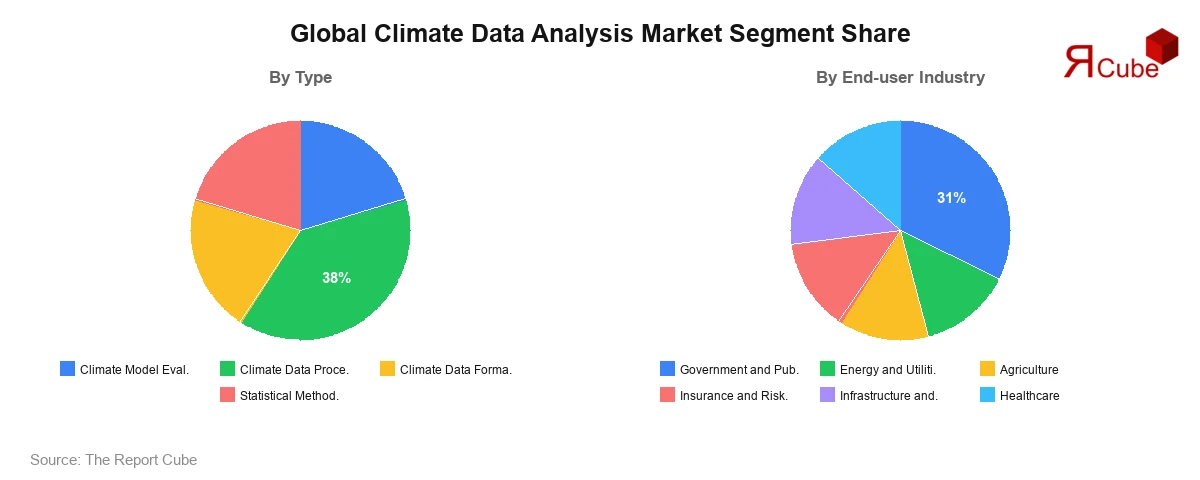
Climate Data Processing and Visualization commands the largest share of the By Type segment, accounting for an estimated 38% of total market revenue in 2026. This dominance reflects the fundamental requirement for organizations to transform raw observational and model output datasets into interpretable dashboards, geospatial visualizations, and decision-ready intelligence layers. Platforms offered by Environmental Systems Research Institute Inc. (ESRI) and IBM Corporation have become essential infrastructure for government climate agencies, utility operators, and risk management firms requiring real-time and historical environmental data synthesis across large geographies.
Climate Model Evaluation represents the second-largest sub-segment, driven by growing adoption of multi-model ensemble assessment frameworks within national meteorological agencies and research institutions. Statistical Methods are experiencing accelerated adoption among insurance actuaries and agricultural analysts requiring probabilistic climate projections and trend attribution analytics. Climate Data Formats solutions, while currently the smallest sub-segment, are gaining traction as enterprises seek standardized middleware and API connectors to harmonize NetCDF, GRIB, and HDF5 data pipelines, and this segment is projected to register the fastest growth rate through 2034.
By End-user Industry
- Government and Public Sector
- Energy and Utilities
- Agriculture
- Insurance and Risk Management
- Infrastructure and Transportation
- Healthcare
Government and Public Sector is the dominant end-user segment, representing approximately 31% of total market revenue in 2026. National meteorological agencies, environmental ministries, defense climate intelligence units, and multilateral climate funds represent the primary institutional buyers. Government procurement is reinforced by international climate frameworks including the Paris Agreement's Global Stocktake process and the Sendai Framework for Disaster Risk Reduction, which mandate continuous climate data monitoring, reporting, and scenario modeling across member nations. Agencies including Meteo-France and the U.S. National Oceanic and Atmospheric Administration (NOAA) have substantially increased platform procurement and data licensing expenditure since 2023.
Energy and Utilities and Insurance and Risk Management represent the two fastest-growing commercial end-user categories. Energy operators increasingly rely on climate analytics for renewable energy generation forecasting, particularly for solar irradiance prediction and wind resource assessment supporting grid balancing. Insurers, reinsurers, and catastrophe modeling firms such as Risk Management Solutions Inc. and Verisk Analytics are deploying probabilistic climate scenario tools to recalibrate underwriting assumptions for flood, drought, wildfire, and extreme heat exposures. Agriculture and Infrastructure verticals continue expanding platform adoption supported by precision farming digitization initiatives and climate-resilient urban planning mandates across major economies.
Regional Projection of Global Climate Data Analysis Market
The Global Climate Data Analysis Market exhibits significant regional variation shaped by climate policy maturity, digital infrastructure investment levels, the presence of national meteorological institutions, and sector-specific regulatory compliance requirements across five principal geographic markets.
|
Region |
Estimated Market Share |
Key Growth Factors |
Consumer Trends |
|---|---|---|---|
|
North America |
38.4% |
NOAA modernization, SEC climate disclosure rules, enterprise ESG integration |
High adoption of AI-enhanced weather intelligence platforms |
|
Europe |
27.6% |
Copernicus Programme, CSRD mandates, carbon border adjustment mechanisms |
Demand for GDPR-compliant climate data sharing architectures |
|
Asia-Pacific |
23.1% |
National climate adaptation programs, smart agriculture investment |
Rising procurement of localized downscaling and flood risk platforms |
|
Latin America |
6.4% |
Agricultural climate resilience programs, disaster risk reduction funding |
Growing adoption of satellite-based deforestation monitoring tools |
|
Middle East and Africa |
4.5% |
Water scarcity analytics, Vision 2030 climate infrastructure investments |
Expanding interest in extreme heat and drought early-warning systems |
- North America: North America leads the global market with approximately 38.4% revenue share, supported by federal investments in NOAA digital modernization, SEC climate disclosure enforcement, and strong enterprise ESG analytics adoption across financial and energy sectors.
- Europe: Europe maintains the second-largest regional share driven by mandatory Copernicus climate data utilization requirements, CSRD-driven corporate climate risk disclosures, and substantial European Commission funding for climate data infrastructure across EU member states.
- Asia-Pacific: Asia-Pacific is the fastest-growing regional market, propelled by national adaptation investment programs in China, India, Japan, and Australia, expanding smart agriculture platforms, and government-mandated climate resilience frameworks for coastal and urban infrastructure.
- Latin America: Latin America is expanding climate data investment through agricultural resilience programs in Brazil and Argentina, multilateral disaster risk reduction financing, and satellite-based land use and deforestation monitoring across the Amazon basin.
- Middle East and Africa: Middle East and Africa represent an emerging frontier driven by GCC sustainability mandates under Saudi Vision 2030 and UAE Net Zero 2050, water resource monitoring requirements, and increasing demand for extreme heat and dust-storm early-warning platforms.
Global Climate Data Analysis Market: Recent Development (2025)
- IBM Corporation launched an AI-enhanced climate risk analytics suite integrated with enterprise ESG reporting workflows.
- Verisk Analytics expanded its Atmospheric and Environmental Research division with upgraded catastrophe climate models.
- AccuWeather Inc. partnered with a global infrastructure firm to deliver city-level climate resilience intelligence solutions.
- Vaisala Corporation introduced an upgraded radiosonde observation system enhancing upper-atmosphere climate data collection globally.
Global Climate Data Analysis Market Future Outlook (2034)
The Global Climate Data Analysis Market is projected to expand at a 28.80% CAGR, reaching approximately USD 15.60 billion by 2034. Continued intensification of physical climate risks, universal adoption of corporate climate disclosure obligations, and growing reliance on real-time satellite earth observation data will sustain enterprise demand across government, financial services, energy, and agricultural sectors. Investments in autonomous climate sensor networks, open geospatial data platforms, and federated machine learning architectures will progressively lower analytical barriers for mid-market and emerging-economy buyers, substantially broadening the addressable commercial landscape through the forecast period.
Future market expansion will be driven by seamless integration of climate analytics with enterprise resource planning systems, financial stress-testing frameworks, and infrastructure lifecycle management platforms. Advances in probabilistic ensemble modeling, digital twin climate simulation, and end-of-decade climate adaptation investment strategies will create significant incremental revenue opportunities for leading vendors. Organizations that successfully commercialize explainable AI climate forecasting and interoperable multi-format data pipelines will capture disproportionate market share as regulatory compliance complexity intensifies and cross-sector climate intelligence demand reaches institutional maturity.
Global Climate Data Analysis Market Report Coverage
|
Report Attribute |
Details |
|---|---|
|
Market Name |
Global Climate Data Analysis Market |
|
Market Size (2026) |
USD 2.06 Billion |
|
Market Size (2034) |
USD 15.60 Billion |
|
Forecast Period |
2026–2034 |
|
CAGR |
28.80% |
|
Base Year |
2026 |
|
Historical Years |
2021–2025 |
|
Forecast Years |
2026–2034 |
|
Segments Covered |
By Type, By End-user Industry |
|
Regions Covered |
North America, Europe, Asia-Pacific, Latin America, Middle East and Africa |
|
Key Companies |
IBM Corporation, Schneider Electric SE, Verisk Analytics Inc., MSCI Inc., Risk Management Solutions Inc., Environmental Systems Research Institute Inc., Vaisala Corporation, Meteo-France, AccuWeather Inc., Others |
|
Report Format |
PDF, Excel, PPT |
|
Customization |
Available as per client requirements |
Why Choose This Report?
- Comprehensive analysis of all climate data solution types and end-user verticals.
- Accurate market sizing with a reliable 28.80% CAGR forecast through 2034.
- Detailed segmentation covering By Type and By End-user Industry revenue contributions.
- Regional insights supported by regulatory, institutional, and investment-level developments.
- Competitive profiling of major global climate analytics and data intelligence vendors.
- Analysis of AI-driven downscaling, ESG compliance, and satellite data integration trends.
- Strategic insights supporting enterprise investment, product positioning, and market entry.
Table of Contents
- Introduction
- Objective of the Study
- Product Definition
- Market Segmentation
- Study Variables
- Research Methodology
- Secondary Data Points
- Companies Interviewed
- Primary Data Points
- Breakdown of Primary Interviews
- Secondary Data Points
- Executive Summary
- Market Dynamics
- Drivers
- Challenges
- Opportunity Assessment
- Recent Trends and Developments
- Policy and Regulatory Landscape
- Global Climate Data Analysis Market Overview and Forecast Analysis (2021-2034)
- Market Size, By Value, By Growth Rate (CAGR/USD Billions)
- Demand – Supply Trends
- Market Share, By Type
- Climate Model Evaluation
- Climate Data Processing and Visualization
- Climate Data Formats
- Statistical Methods
- Market Share, By End-user Industry
- Government and Public Sector
- Energy and Utilities
- Agriculture
- Insurance and Risk Management
- Infrastructure and Transportation
- Healthcare
- Market Share, By Region
- North America
- Europe
- Asia-Pacific
- Latin America
- Middle East and Africa
- Market Share, By Competitors
- Competition Characteristics
- Revenue Shares
- Climate Model Evaluation Global Climate Data Analysis Market Overview, 2021-2034F
- By Value (USD Million)
- By End-user Industry – Market Size & Forecast 2021-2034, USD Million
- Government and Public Sector
- Energy and Utilities
- Agriculture
- Insurance and Risk Management
- Infrastructure and Transportation
- Healthcare
- Climate Data Processing and Visualization Global Climate Data Analysis Market Overview, 2021-2034F
- By Value (USD Million)
- By End-user Industry – Market Size & Forecast 2021-2034, USD Million
- Government and Public Sector
- Energy and Utilities
- Agriculture
- Insurance and Risk Management
- Infrastructure and Transportation
- Healthcare
- Climate Data Formats Global Climate Data Analysis Market Overview, 2021-2034F
- By Value (USD Million)
- By End-user Industry – Market Size & Forecast 2021-2034, USD Million
- Government and Public Sector
- Energy and Utilities
- Agriculture
- Insurance and Risk Management
- Infrastructure and Transportation
- Healthcare
- Statistical Methods Global Climate Data Analysis Market Overview, 2021-2034F
- By Value (USD Million)
- By End-user Industry – Market Size & Forecast 2021-2034, USD Million
- Government and Public Sector
- Energy and Utilities
- Agriculture
- Insurance and Risk Management
- Infrastructure and Transportation
- Healthcare
- Competitive Outlook (Company Profile – Partial List)
- IBM Corporation
- Company Overview
- Business Segments
- Strategic Alliances/Partnerships
- Recent Developments
- Schneider Electric SE
- Company Overview
- Business Segments
- Strategic Alliances/Partnerships
- Recent Developments
- Verisk Analytics Inc
- Company Overview
- Business Segments
- Strategic Alliances/Partnerships
- Recent Developments
- MSCI Inc
- Company Overview
- Business Segments
- Strategic Alliances/Partnerships
- Recent Developments
- Risk Management Solutions Inc.
- Company Overview
- Business Segments
- Strategic Alliances/Partnerships
- Recent Developments
- Environmental Systems Research Institute Inc.
- Company Overview
- Business Segments
- Strategic Alliances/Partnerships
- Recent Developments
- Vaisala Corporation
- Company Overview
- Business Segments
- Strategic Alliances/Partnerships
- Recent Developments
- Meteo-France
- Company Overview
- Business Segments
- Strategic Alliances/Partnerships
- Recent Developments
- AccuWeather Inc.
- Company Overview
- Business Segments
- Strategic Alliances/Partnerships
- Recent Developments
- Others
- IBM Corporation
- Contact Us & Disclaimer
Top Key Players & Market Share Outlook
- IBM Corporation
- Schneider Electric SE
- Verisk Analytics Inc
- MSCI Inc
- Risk Management Solutions Inc.
- Environmental Systems Research Institute Inc.
- Vaisala Corporation
- Meteo-France
- AccuWeather Inc.
- Others
Frequently Asked Questions






