



Build Your Custom Market Intelligence Report
Customize Your ReportU.S. Cocoa Butter Alternatives Market Key Takeaways
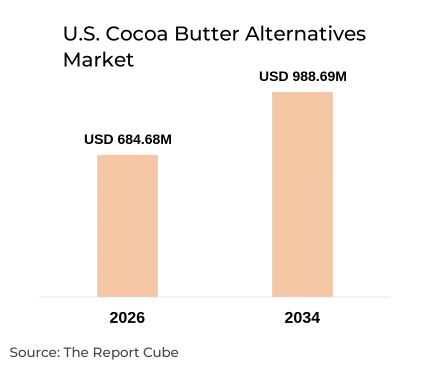
- The market is valued at USD 684.68 million in 2026.
- Industry is projected to reach USD 988.69 million by 2034.
- Market expansion is expected at a 4.70% CAGR through 2034.
- ADM, Cargill, AAK USA, Bunge, and Olam lead competition.
- Palm oil and palm kernel oil dominate the source segment.
- The Midwest leads regional demand across the U.S. market.
- The West is the fastest-growing region through 2034.
- Cocoa price volatility is accelerating cocoa butter replacement strategies.
U.S. Cocoa Butter Alternatives Market Insights & Analysis
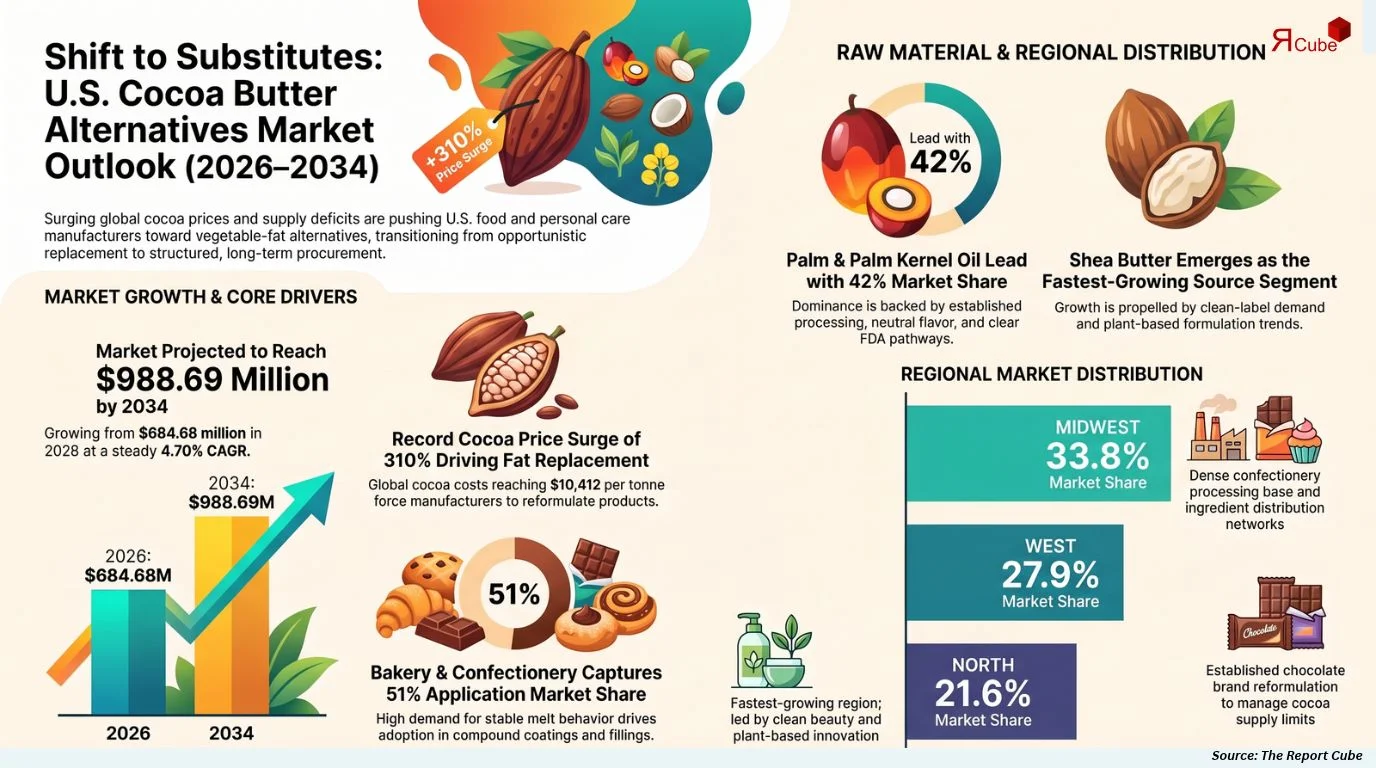
The U.S. Cocoa Butter Alternatives Market is anticipated to register a 4.70% CAGR during 2026–2034. The market size was valued at USD 684.68 million in 2026 and is projected to reach USD 988.69 million by 2034. Cocoa cost pressure is the central catalyst. USDA Economic Research Service data shows global cocoa bean prices rose 310% through December 2024 to a record USD 10,412 per metric tonne, while U.S. cocoa bean import volumes fell 22% in 2023 and 26% in 2024. Manufacturers are responding by reformulating chocolate-style products with vegetable fats.
Regulatory clarity and ingredient innovation are reinforcing adoption. The U.S. Food and Drug Administration lists specified cocoa butter substitutes made from palm oil or coconut and palm kernel oils in its food-substance resources, and it reviewed GRAS Notice No. 654 for a palm-stearin-based substitute used in confections, coatings, and toppings. Industry investment is following. Fuji Oil Holdings, which owns Blommer Chocolate, has positioned cocoa butter equivalent fats as a growth area in its medium-term plan. Suppliers are targeting bloom resistance, enrobing performance, and heat stability.
U.S. Cocoa Butter Alternatives Market Dynamics
Demand for cocoa butter alternatives in the United States is shaped by cocoa supply stress, evolving formulation science, and regulatory guardrails. Chocolate makers, bakers, and personal care formulators are evaluating vegetable-fat systems that replicate melt profile, snap, and bloom resistance. Supply disruptions in producing countries, tighter ingredient disclosure expectations, and ongoing product reformulation are keeping alternative fats on procurement roadmaps. As a result, demand is shifting from opportunistic substitution toward structured, long-term fat strategy.
|
Factor |
Type |
Specific Impact on Market |
Magnitude |
|---|---|---|---|
|
Cocoa bean price surge |
Driver |
Prompts evaluation of alternative fats after USDA-reported prices reached USD 10,412 per tonne |
Very High |
|
Established FDA reference pathways |
Driver |
Provides regulatory reference points for palm-based cocoa butter substitutes |
High |
|
Specialized vegetable-fat formulations |
Opportunity |
Enables targeted functionality in coatings, fillings, sauces, and toppings |
High |
|
Functionality and labeling focus |
Trend |
Raises technical formulation and ingredient disclosure standards |
Medium |
|
Standards of identity limits |
Challenge |
Restricts substitution in products with defined cocoa butter content |
Medium |
Key Market Driver: Cocoa Scarcity Drives Fat Substitution
ICCO reports global cocoa production fell 12.9% year over year in the 2023/24 season, widening the global supply deficit to 494,000 tonnes. USDA ERS notes that elevated prices led U.S. confectionery manufacturers to adjust product sizes and expand flavor variety during major chocolate-selling seasons. These signals show how shifting cost structures across the U.S. chocolate confectionery landscape are pushing formulators to test vegetable-fat systems that maintain sensory and technical performance. Palm-derived and specialty butters give manufacturers a way to reduce dependence on cocoa-derived fats without redesigning entire product lines.
Major Industry Challenge: Federal Identity Standards Limit Substitution
FDA standards of identity specify permitted ingredients and compositional requirements for certain foods. White chocolate, for example, must contain at least 20% cocoa butter, so manufacturers cannot assume every alternative fat fits every chocolate product without changing its legal designation or label. Ingredient declarations must also use common or usual names. Alternative fats carry their own sourcing exposure, since palm-derived oils and specialty butters depend on agricultural supply and processing, much like cocoa butter market supply dynamics. Formulators must therefore balance functionality, compliance, and consistent supply.
Emerging Trend Shaping Outlook: Functionality-Led Fat Formulation Innovation Grows
Formulation science is shifting from simple price substitution to performance engineering. The FDA’s GRAS Notice No. 654 response described a substitute built from palm oil stearin and stearic acid for confections, frostings, candy coatings, sauces, and toppings, offering a technical precedent for targeted functionality. Suppliers are now prioritizing melt behavior, snap, and bloom resistance, while brands are reviewing labels and naming practices to stay compliant with chocolate identity rules. Specialty butters such as shea, kokum, and mango kernel fat are gaining attention for tailored texture in premium applications.
Need Specific Data, Let’s Customize the Report for You
Request CustomizationU.S. Cocoa Butter Alternatives Market Segment-wise Analysis
Demand varies by raw-material source and end-use application. Manufacturers select fats based on melt profile, compatibility with cocoa butter, bloom resistance, and regulatory fit. Across the United States, palm-derived systems anchor volume, while specialty butters and non-food applications broaden the revenue base. This creates distinct adoption patterns by segment.
By Source
- Palm Oil & Palm Kernel Oil
- Shea Butter
- Kokum Butter
- Mango Kernel Fat
- Others
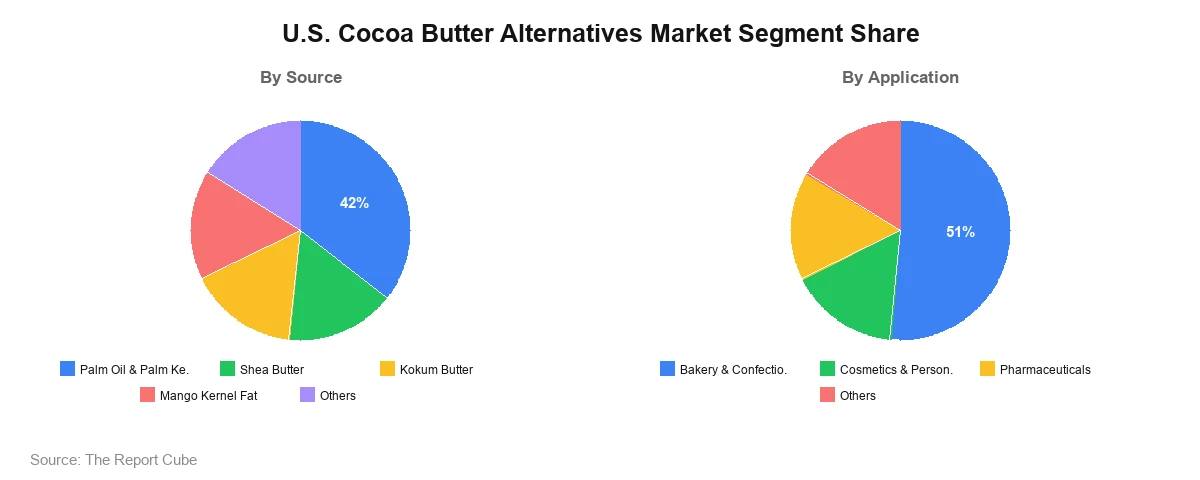
Palm oil and palm kernel oil dominate with an estimated 42% market share in 2026. Their lead rests on dependable fractionation, neutral flavor, and proven compatibility with chocolate, coatings, and bakery fats. FDA food-substance resources already list cocoa butter substitutes made from palm oil or coconut and palm kernel oils, giving formulators a clear regulatory reference point. Large U.S. suppliers also operate established processing and blending capabilities, which supports consistent supply for high-volume confectionery lines. Sourcing sustainability remains a procurement focus.
Shea butter, kokum butter, and mango kernel fat collectively serve premium and clean-label positioning. Shea-based systems are gaining traction because their stearin fractions closely mimic cocoa butter’s melt behavior, and interest in shea-based fat fractions for premium formulations is rising among chocolate and cosmetics formulators. Kokum and mango kernel fat support heat-resistant coatings, creams, and specialty confectionery. Shea butter is expected to be the fastest-growing source segment, driven by plant-based and traceability-focused product development. Other sources, including illipe and sal derivatives, hold the remaining share.
By Application
- Bakery & Confectionery
- Cosmetics & Personal Care
- Pharmaceuticals
- Others
Bakery and confectionery leads with an estimated 51% market share in 2026. Chocolate coatings, fillings, compound coatings, and baked goods rely on fats that deliver snap, gloss, and stable melt behavior. Cocoa price pressure documented by USDA ERS, alongside product size adjustments by confectioners, has increased the commercial relevance of alternative fats in these lines. Demand from North American bakery fats and oils applications further supports revenue contribution through fillings, glazes, and inclusions. Recurring high-volume purchasing keeps this segment firmly ahead.
Cosmetics and personal care is the second-largest application, using butters in lotions, lip products, and balms for emolliency and texture. Pharmaceuticals rely on specialty fats as suppository bases and topical carriers, where melting behavior near body temperature matters. Other uses include nutrition products and coated snacks. Cosmetics and personal care is projected to be the fastest-growing application, supported by demand for plant-derived, naturally sourced ingredients in clean beauty formulations. Each of these end uses values consistent crystallization, oxidative stability, and reliable supplier documentation.
U.S. Cocoa Butter Alternatives Market Country Insights
Demand for cocoa butter alternatives varies across U.S. regions based on confectionery manufacturing density, bakery clusters, personal care production, and ingredient logistics. The Midwest currently leads, while the West is advancing fastest on personal care and food innovation. Midwest and North regions remain important through established confectionery and bakery processing bases.
|
Region |
Estimated Market Share |
Key Growth Factors |
Consumer Trends |
|---|---|---|---|
|
Midwest |
33.8% |
Dense confectionery, bakery, and ingredient-processing base |
Demand for cost-stable chocolate coatings and fillings |
|
West |
27.9% |
Clean beauty, plant-based food innovation, specialty bakery |
Preference for plant-derived butters and clean labels |
|
North |
21.6% |
Established chocolate brands and reformulation activity |
Focus on consistent taste and labeling compliance |
|
Southwest |
16.7% |
Expanding food manufacturing and import logistics |
Growing packaged bakery and snack consumption |
- Midwest: The Midwest leads with approximately 33.8% share, supported by dense confectionery, bakery, and ingredient-processing operations, large chocolate coating production, and established distribution networks serving national food manufacturers.
- West: The West is the fastest-growing region, driven by clean beauty formulation, plant-based food innovation, and growing specialty bakery demand for shea and kokum-based butters.
- North: The North benefits from established chocolate brands, bakery manufacturing, and reformulation activity, with manufacturers adjusting formulations to manage cocoa supply constraints while maintaining labeling compliance.
- Southwest: The Southwest shows steady adoption through expanding food manufacturing, regional bakery growth, and logistics access to imported palm-derived and specialty fats via Gulf and border trade corridors.
U.S. Cocoa Butter Alternatives Market: Recent Development (2025)
- Fuji Oil launched Ano-The M in March 2025, a cocoa-free ingredient countering high cocoa prices.
- Fuji Oil deepened its 2025 Planet A Foods collaboration on cocoa-free chocolate technologies in Europe.
- AAK launched a compound coating fat in August 2025 supporting indulgent chocolate-style confectionery treat formulations.
- Bunge advanced 100% shea-based cocoa butter equivalent solutions in 2025 within specialty oils and fats.
U.S. Cocoa Butter Alternatives Market Future Outlook (2034)
The U.S. Cocoa Butter Alternatives Market is projected to expand at a 4.70% CAGR, reaching approximately USD 988.69 million by 2034. Growth will be anchored by sustained cocoa supply uncertainty, regulatory pathways for alternative fats, and wider use of specialty butters across food and personal care. Opportunities are strongest in heat-stable coatings, bloom-resistant bakery fats, and premium shea-based systems. Suppliers that document functionality and compliance clearly will capture formulation wins. Long-term expansion will also reflect broader ingredient diversification across North American manufacturing.
Technology will reshape how alternative fats are designed and deployed. Computational modeling and AI-assisted formulation tools are shortening the path to matching cocoa butter’s melting profile, crystallization, and bloom behavior. Fermentation-derived and cell-cultured fats are advancing in development, and may widen the supplier base beyond palm and shea over time. Predictive analytics in plant operations will improve tempering control, quality consistency, and supply planning, supporting confident, large-scale adoption across the U.S. through 2034. Companies investing early in these capabilities are likely to strengthen long-term competitiveness.
U.S. Cocoa Butter Alternatives Market Report Coverage
|
Report Attribute |
Details |
|---|---|
|
Market Name |
U.S. Cocoa Butter Alternatives Market |
|
Market Size (2026) |
USD 684.68 Million |
|
Market Size (2034) |
USD 988.69 Million |
|
Forecast Period |
2026–2034 |
|
CAGR |
4.70% |
|
Base Year |
2026 |
|
Historical Years |
2021–2025 |
|
Forecast Years |
2026–2034 |
|
Segments Covered |
By Source, By Application, By Region |
|
Regions Covered |
West, Southwest, North, Midwest |
|
Key Companies |
ADM, Cargill Incorporated, AAK USA Inc., Bunge, Olam International Limited, C16 Biosciences Ingredients, Blommer Chocolate Company, Azelis Americas, Fuji Oil Holdings, The Nisshin OilliO Group Ltd. |
|
Report Format |
PDF, Excel, PPT |
|
Customization |
Available as per client requirements |
Why Choose This Report?
- Comprehensive analysis of cocoa butter alternatives across U.S. regions.
- Accurate market sizing with reliable forecast through 2034.
- Detailed segmentation highlighting revenue-leading sources and application opportunities.
- Regional insights supported by evolving regulatory and supply developments.
- Competitive profiling of leading cocoa butter alternative suppliers.
- Analysis of FDA standards, labeling rules, and formulation constraints.
- Strategic insights supporting sourcing, investment, and business planning.
- Data-driven research following industry best practices and current trends.
Table of Contents
- Introduction
- Objective of the Study
- Product Definition
- Market Segmentation
- Study Variables
- Research Methodology
- Secondary Data Points
- Companies Interviewed
- Primary Data Points
- Breakdown of Primary Interviews
- Secondary Data Points
- Executive Summary
- Market Dynamics
- Drivers
- Challenges
- Opportunity Assessment
- Recent Trends and Developments
- Policy and Regulatory Landscape
- U.S. Cocoa Butter Alternatives Market Overview and Forecast Analysis (2021-2034)
- Market Size, By Value, By Growth Rate (CAGR/USD Millions)
- Demand – Supply Trends
- Market Share, By Source
- Palm Oil & Palm Kernel Oil
- Shea Butter
- Kokum Butter
- Mango Kernel Fat
- Others
- Market Share, By Application
- Bakery & Confectionery
- Cosmetics & Personal Care
- Pharmaceuticals
- Others
- Market Share, By Region
- West
- Southwest
- North
- Midwest
- Market Share, By Competitors
- Competition Characteristics
- Revenue Shares
- Palm Oil & Palm Kernel Oil U.S. Cocoa Butter Alternatives Market Overview, 2021-2034F
- By Value (USD Million)
- By Application – Market Size & Forecast 2021-2034, USD Million
- Bakery & Confectionery
- Cosmetics & Personal Care
- Pharmaceuticals
- Others
- Shea Butter U.S. Cocoa Butter Alternatives Market Overview, 2021-2034F
- By Value (USD Million)
- By Application – Market Size & Forecast 2021-2034, USD Million
- Bakery & Confectionery
- Cosmetics & Personal Care
- Pharmaceuticals
- Others
- Kokum Butter U.S. Cocoa Butter Alternatives Market Overview, 2021-2034F
- By Value (USD Million)
- By Application – Market Size & Forecast 2021-2034, USD Million
- Bakery & Confectionery
- Cosmetics & Personal Care
- Pharmaceuticals
- Others
- Mango Kernel Fat U.S. Cocoa Butter Alternatives Market Overview, 2021-2034F
- By Value (USD Million)
- By Application – Market Size & Forecast 2021-2034, USD Million
- Bakery & Confectionery
- Cosmetics & Personal Care
- Pharmaceuticals
- Others
- Others U.S. Cocoa Butter Alternatives Market Overview, 2021-2034F
- By Value (USD Million)
- By Application – Market Size & Forecast 2021-2034, USD Million
- Bakery & Confectionery
- Cosmetics & Personal Care
- Pharmaceuticals
- Others
- Competitive Outlook (Company Profile – Partial List)
- ADM
- Company Overview
- Business Segments
- Strategic Alliances/Partnerships
- Recent Developments
- Cargill Incorporated
- Company Overview
- Business Segments
- Strategic Alliances/Partnerships
- Recent Developments
- AAK USA Inc.
- Company Overview
- Business Segments
- Strategic Alliances/Partnerships
- Recent Developments
- Bunge
- Company Overview
- Business Segments
- Strategic Alliances/Partnerships
- Recent Developments
- Olam International Limited.
- Company Overview
- Business Segments
- Strategic Alliances/Partnerships
- Recent Developments
- C16 Biosciences Ingredients
- Company Overview
- Business Segments
- Strategic Alliances/Partnerships
- Recent Developments
- Blommer Chocolate Company
- Company Overview
- Business Segments
- Strategic Alliances/Partnerships
- Recent Developments
- Azelis Americas
- Company Overview
- Business Segments
- Strategic Alliances/Partnerships
- Recent Developments
- Fuji Oil Holdings
- Company Overview
- Business Segments
- Strategic Alliances/Partnerships
- Recent Developments
- The Nisshin OilliO Group Ltd.
- Company Overview
- Business Segments
- Strategic Alliances/Partnerships
- Recent Developments
- ADM
- Contact Us & Disclaimer
Top Key Players & Market Share Outlook
- ADM
- Cargill Incorporated
- AAK USA Inc.
- Bunge
- Olam International Limited.
- C16 Biosciences Ingredients
- Blommer Chocolate Company
- Azelis Americas
- Fuji Oil Holdings
- The Nisshin OilliO Group Ltd.
Frequently Asked Questions