



Build Your Custom Market Intelligence Report
Customize Your ReportUnited States Ginger Market Insights & Analysis
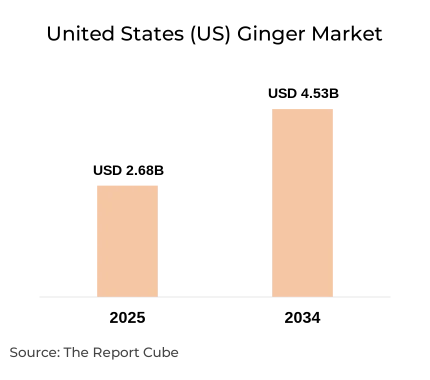
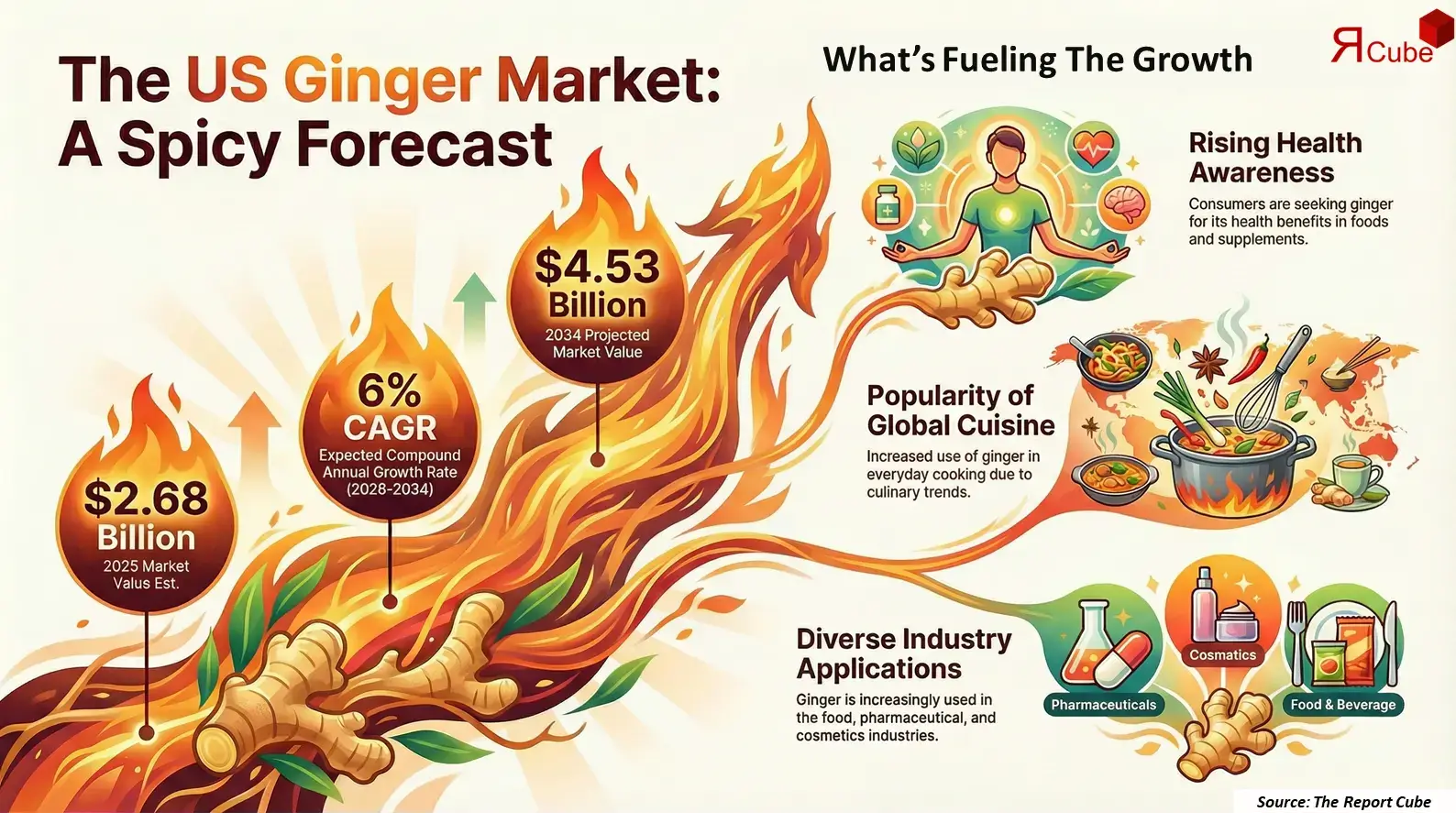
The United States Ginger Market is anticipated to register a CAGR of 6% during 2026-2034. The market size was valued at USD 2.68 billion in 2025 and is projected to reach USD 4.53 billion by 2034. The market is expanding steadily, supported by rising consumer awareness of ginger’s health benefits, growing demand for functional foods, and increasing application across pharmaceuticals and nutraceuticals. Ginger’s anti-inflammatory, digestive, and immunity-boosting properties have strengthened its role in daily diets, particularly among health-conscious consumers.
In the United States, consumption patterns are shifting toward natural and plant-based ingredients, positioning ginger as a preferred component in beverages, supplements, and ready-to-eat food products. Food and beverage manufacturers are increasingly incorporating ginger into teas, flavored waters, snacks, and ethnic cuisines, reflecting changing taste preferences and multicultural influences. Simultaneously, demand for organic ginger is rising as consumers prioritize clean-label and sustainably sourced products.
Furthermore, advancements in processing technologies have enabled the availability of ginger in multiple forms such as powders, oils, and extracts, enhancing shelf life and usability across industries. Strong distribution networks, coupled with the expansion of household retail and online grocery platforms, are improving product accessibility nationwide. These interconnected factors collectively support sustained growth of the United States Ginger Market through the forecast period.
United States Ginger Market Recent Developments
- 2025: McCormick & Company expanded U.S. ginger range with new seasonal baking blends for holiday applications.
- 2025: Sensient Technologies launched BioSymphony natural flavor compounds supporting ginger-forward wellness beverages for American manufacturers.
Government Initiatives & Policies
- USDA Organic Certification Program: Supports organic ginger farming and labeling standards nationwide.
- US Specialty Crop Block Grant Program: Provides funding to enhance cultivation and market access for crops including ginger.
United States Ginger Market Dynamics
Key Driver: Rising Consumer Preference for Natural and Functional Ingredients
The growing preference for natural and functional ingredients is a primary driver of the United States Ginger Market. Consumers increasingly associate ginger with immunity enhancement, digestive health, and inflammation reduction, driving its integration into everyday food and wellness routines. Nearly 55% of U.S. consumers now prefer plant-based remedies for minor health concerns, significantly boosting ginger demand. This shift is reinforced by clean-label trends, where ginger’s natural origin aligns with transparency and minimal processing expectations. As food, beverage, and supplement manufacturers reformulate products to replace synthetic additives, ginger’s multifunctional benefits continue to elevate its market relevance.
Book your FREE 30-minute expert consultation today
Contact UsIndustry Trends: Product Diversification Across Multiple Forms
Product diversification is a defining trend shaping the United States Ginger Market. Manufacturers are offering ginger in fresh, dried, powdered, oil, and extract forms to cater to diverse end-use industries. Ginger powder and extracts are gaining popularity due to ease of incorporation into supplements and packaged foods. Additionally, ginger oil is increasingly used in cosmetics and personal care products for its aromatic and therapeutic properties. This diversification improves market penetration and supports consistent demand across food, pharmaceutical, and household retail segments.
Major Challenge: Dependence on Imports and Price Volatility
Despite growing demand, the U.S. ginger market faces challenges related to import dependence and price volatility. A significant share of ginger supply is imported, exposing the market to fluctuations in global pricing, logistics disruptions, and climatic impacts in producing regions. Transportation costs and currency variations further influence retail prices, creating uncertainty for distributors and end-users. These factors can limit profit margins and complicate long-term supply planning for manufacturers and retailers.
Opportunity: Expanding Use in Nutraceuticals and Preventive Healthcare
The expanding nutraceutical and preventive healthcare sectors present a strong growth opportunity for the United States Ginger Market. Consumers are increasingly investing in supplements to manage immunity, digestion, and joint health proactively. Ginger extracts and capsules are witnessing rising adoption, particularly among aging populations. As healthcare costs increase, preventive solutions using natural ingredients are gaining traction, positioning ginger as a key component in future product innovation and market expansion.
United States Ginger Market Segment-wise Analysis
By Form:
- Fresh Ginger
- Dried Ginger
- Preserved Ginger
- Ginger Oil
- Ginger Powder
- Ginger Extracts
- Others
Ginger Powder leads the market by form, accounting for approximately 34% of total market share in 2025. Its dominance is driven by long shelf life, easy storage, and widespread application across food processing, nutraceuticals, and household retail. Manufacturers favor ginger powder for consistent flavor and dosage control, while consumers value its convenience. Fresh ginger remains popular in culinary applications, but powdered forms continue to gain share due to scalability and cost efficiency.
By Type:
- Organic
- Conventional
The conventional segment currently holds the larger share, contributing nearly 62% of total market revenue. This is attributed to wider availability and lower pricing compared to organic variants. However, organic ginger is growing faster, supported by increasing consumer focus on sustainability and chemical-free produce. Retailers are gradually expanding organic offerings to meet this evolving demand.
By End Use:
- Food and Beverage
- Pharmaceuticals
- Nutraceuticals
- Cosmetics and Personal Care
- Household Retail
- Others
Food and Beverage dominates end-use applications, accounting for about 40% market share in 2025. Ginger’s widespread use in beverages, sauces, bakery items, and ethnic foods underpins this leadership. Nutraceuticals represent the fastest-growing segment, driven by preventive healthcare trends and rising supplement consumption.
Regional Projection of United States Ginger Industry
- Northeast
- Midwest
- South
- West
The West region leads the United States Ginger Market, contributing approximately 37% of total revenue in 2025. This dominance is supported by higher consumption of organic and health-focused foods, strong presence of food processing industries, and diverse culinary preferences. States in the West also exhibit higher adoption of nutraceuticals and natural remedies, reinforcing demand. The South follows closely, driven by expanding food manufacturing and household retail distribution networks.
Need insights for a specific region within this market?
Request Regional DataWhy Choose This Report?
- Provides a comprehensive overview of the overall market analysis, encompassing key trends, consumer behavior analysis, and risk assessment to support strategic decision-making.
- Provides accurate, up-to-date insights into market size, segmentation, and emerging opportunities, helping to minimize risk & capitalizing on growth.
- Gives deep understanding of target audience preferences, investment habits, and communication channels for enhanced product development & marketing effectiveness.
- Delivers competitive analysis & benchmarking, uncovering the strengths & weaknesses of market competitors to guide strategies.
- Consolidate comprehensive market intelligence, reducing reasoning & streamlining research efforts.
- Facilitates customized market segmentation & risk mitigation strategies, fine-tuned to the business objectives.
- Aids in identifying both market challenges & untapped opportunities within the industry to drive long-term business growth.
- Provides valuable information based on actual customer data & search trends.
Table of Contents
- Introduction
- Objective of the Study
- Product and Category Definition
- Market Segmentation
- Study Variables
- Research Methodology
- Secondary Data Points
- Breakdown of Secondary Sources
- Primary Data Points
- Breakdown of Primary Interviews
- Secondary Data Points
- Executive Summary
- Market Dynamics
- Drivers
- Challenges
- Opportunity Assessment
- Recent Trends and Developments
- Regulatory and Policy Landscape
- United States Ginger Market Overview (2020-2034)
- Market Size, By Value (USD Billion)
- Market Share, By Form
- Fresh Ginger
- Dried Ginger
- Preserved Ginger
- Ginger Oil
- Ginger Powder
- Ginger Extracts
- Others
- Market Share, By Type
- Organic
- Conventional
- Market Share, By End Use
- Food and Beverage
- Pharmaceuticals
- Nutraceuticals
- Cosmetics and Personal Care
- Household Retail
- Others
- Market Share, By Distribution
- Supermarkets Hypermarkets
- Wholesale Direct
- Grocery Stores
- Specialty Health Stores
- Convenience Stores
- Online Retail
- Market Share, By Region
- Northeast
- Midwest
- South
- West
- Market Share, By Company
- Competition Characteristics
- Revenue Shares & Analysis
- Northeast United States Ginger Market
- Market Size, By Value (USD Billion)
- Market Share, By Form
- Market Share, By Type
- Market Share, By End Use
- Market Share, By Distribution
- Midwest United States Ginger Market
- Market Size, By Value (USD Billion)
- Market Share, By Form
- Market Share, By Type
- Market Share, By End Use
- Market Share, By Distribution
- South United States Ginger Market
- Market Size, By Value (USD Billion)
- Market Share, By Form
- Market Share, By Type
- Market Share, By End Use
- Market Share, By Distribution
- West United States Ginger Market
- Market Size, By Value (USD Billion)
- Market Share, By Form
- Market Share, By Type
- Market Share, By End Use
- Market Share, By Distribution
- Competitive Outlook and Company Profiles
- The Ginger People
- Company Overview
- Product Portfolio
- Strategic Alliances Partnerships
- Recent Developments
- McCormick & Company
- Company Overview
- Product Portfolio
- Strategic Alliances Partnerships
- Recent Developments
- Frontier Co op
- Company Overview
- Product Portfolio
- Strategic Alliances Partnerships
- Recent Developments
- Badia Spices
- Company Overview
- Product Portfolio
- Strategic Alliances Partnerships
- Recent Developments
- Simply Organic
- Company Overview
- Product Portfolio
- Strategic Alliances Partnerships
- Recent Developments
- Pacific Spice Company
- Company Overview
- Product Portfolio
- Strategic Alliances Partnerships
- Recent Developments
- Spice World
- Company Overview
- Product Portfolio
- Strategic Alliances Partnerships
- Recent Developments
- Naturex Givaudan
- Company Overview
- Product Portfolio
- Strategic Alliances Partnerships
- Recent Developments
- Sensient Technologies
- Company Overview
- Product Portfolio
- Strategic Alliances Partnerships
- Recent Developments
- Kerry Group USA
- Company Overview
- Product Portfolio
- Strategic Alliances Partnerships
- Recent Developments
- Others
- The Ginger People
- Contact Us and Disclaimer
Top Key Players & Market Share Outlook
- The Ginger People
- McCormick & Company
- Frontier Co op
- Badia Spices
- Simply Organic
- Pacific Spice Company
- Spice World
- Naturex Givaudan
- Sensient Technologies
- Kerry Group USA
- Others
"
Frequently Asked Questions






