



Build Your Custom Market Intelligence Report
Customize Your ReportUnited States Food Certification Market Key Highlights
By Certification Type:
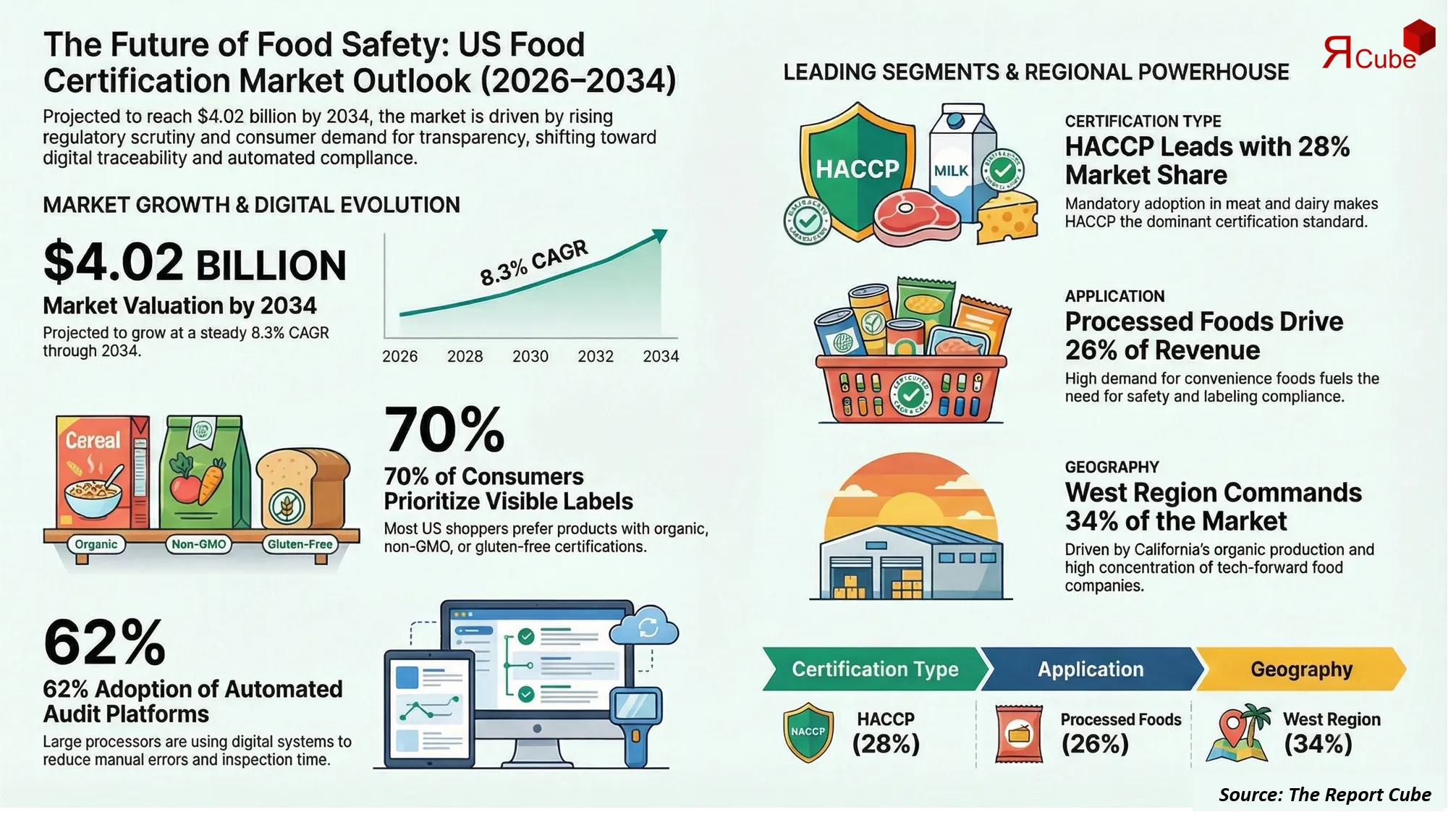
Hazard Analysis and Critical Control Points (HACCP) segment leads the market with nearly 28% share.
By Application:
Processed Foods segment dominates the market with around 26% of total revenue.
Regional Outlook:
West region dominates the United States Food Certification market with approximately 34% share.
United States Food Certification Market Insights & Analysis
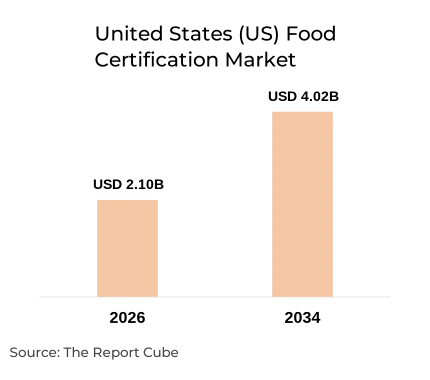
The United States Food Certification Market is anticipated to register a CAGR of around 8.3% during the forecast period 2026-2034. The market size is valued at USD 2.10 billion in 2026 and is projected to reach USD 4.02 billion by 2034. The steady expansion of the market reflects increasing regulatory scrutiny, rising consumer awareness regarding food safety, and growing demand for verified quality standards across domestic and export supply chains. The United States food certification market size continues to expand as manufacturers prioritize compliance with global food safety benchmarks to access international markets and maintain brand trust.
Investment trends indicate a strong push toward digital certification systems and real-time compliance monitoring. Over 62% of mid-to-large food processors in the US have adopted automated audit and traceability platforms as of 2025, enhancing certification efficiency and reducing manual inspection errors. In addition, food retailers are strengthening private-label certification programs to meet evolving consumer preferences for transparency, sustainability, and clean-label products. The United States food certification market growth is further supported by increasing cross-border trade requirements and rising incidents of food recalls, which have elevated the importance of third-party validation. As companies integrate blockchain and IoT-based traceability solutions, the market value is expected to rise steadily through 2034.
United States Food Certification Market Dynamics
Key Driver: Rising Demand for Food Safety Compliance and Transparency
The primary driver of the United States food certification market is the growing demand for stringent food safety compliance. Foodborne illness outbreaks impact nearly 48 million Americans annually, creating a strong need for standardized safety frameworks such as HACCP and ISO 22000. This has pushed manufacturers to adopt certifications not only for regulatory compliance but also to enhance consumer trust. Retailers are increasingly mandating certifications for supplier onboarding, especially in large supermarket chains and export-oriented businesses.
Moreover, consumer demand for transparency is reshaping purchasing behavior. Surveys in 2025 indicate that over 70% of US consumers prefer products with visible certification labels such as organic, non-GMO, or gluten-free. This shift is encouraging brands to invest in multiple certifications to differentiate their offerings. As a result, the United States food certification market share is expanding across both premium and mid-tier product segments.
Book your FREE 30-minute expert consultation today
Contact UsIndustry Trends: Integration of Digital Traceability and Smart Certification Systems
A significant trend in the United States food certification market is the adoption of digital traceability technologies. Blockchain-enabled certification systems are being increasingly deployed to track food products from farm to shelf, ensuring authenticity and reducing fraud. By 2025, nearly 35% of large food companies in the US had integrated blockchain into their supply chain processes.
Additionally, AI-powered audit systems are transforming certification procedures. These systems allow remote inspections, predictive risk analysis, and automated documentation, reducing audit time by nearly 40%. Certification bodies are also expanding services to include sustainability and ESG-based certifications, reflecting broader industry trends toward environmental responsibility. These advancements are enhancing operational efficiency and driving long-term market growth.
Major Challenge: High Certification Costs and Complexity for Small Businesses
One of the major challenges in the United States food certification market is the high cost associated with obtaining and maintaining certifications. Small and medium-sized enterprises (SMEs) often face financial constraints due to audit fees, infrastructure upgrades, and compliance requirements. Certification costs can range between USD 5,000 to USD 50,000 annually depending on scope and complexity, making it difficult for smaller players to participate.
In addition, the complexity of managing multiple certifications creates operational challenges. Companies dealing with international exports often require compliance with different standards such as BRCGS, SQF, and FSSC 22000 simultaneously. This increases administrative burden and slows down operational processes. As a result, cost and complexity remain key barriers affecting broader adoption.
Opportunity: Expansion of Clean Label and Specialty Certifications
The rising popularity of clean-label and specialty food products presents a significant opportunity for the United States food certification market. Certifications such as organic, non-GMO, gluten-free, halal, and kosher are gaining traction as consumers seek healthier and ethically sourced products. The organic food segment alone recorded over USD 67 billion in sales in 2025, driving demand for USDA Organic certification.
Furthermore, export-oriented food manufacturers are increasingly seeking international certifications to access global markets. The growing demand for plant-based, allergen-free, and sustainable food products is also opening new certification avenues. These trends are expected to boost the United States food certification market value and create long-term growth opportunities.
United States Food Certification Market Segment-wise Analysis
By Certification Type:
- ISO 22000
- Hazard Analysis and Critical Control Points (HACCP)
- Good Manufacturing Practices (GMP)
- Safe Quality Food (SQF)
- BRCGS Food Safety
- FSSC 22000
- USDA Organic
- Non-GMO Project Verification
- Gluten-Free Certification
- Halal Certification
- Kosher Certification
- Allergen-Free Certification
- Others
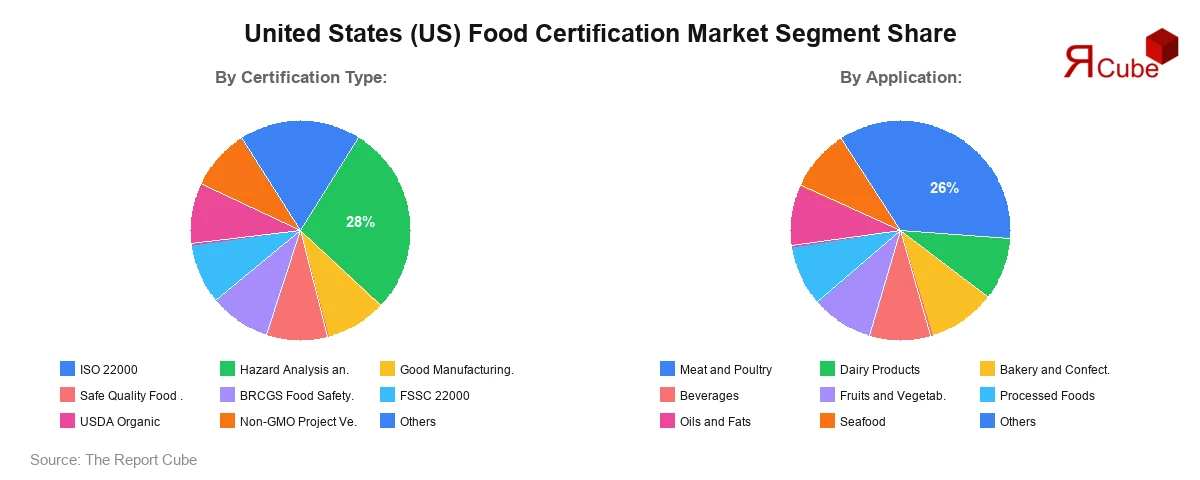
The Hazard Analysis and Critical Control Points (HACCP) segment leads the United States food certification market with an estimated share of around 28%. Its dominance is attributed to its mandatory adoption across multiple food processing sectors and its effectiveness in preventing contamination risks.
HACCP is widely used in meat, poultry, seafood, and dairy industries, where safety compliance is critical. Over 75% of large-scale food manufacturers in the US have implemented HACCP-based systems as part of their operational framework. The increasing number of FDA inspections and export compliance requirements further strengthens its adoption. Additionally, integration with digital monitoring tools has improved real-time hazard detection, making HACCP a preferred certification standard across industries.
By Application:
- Meat and Poultry
- Dairy Products
- Bakery and Confectionery
- Beverages
- Fruits and Vegetables
- Processed Foods
- Oils and Fats
- Food Ingredients and Additives
- Seafood
- Ready-to-Eat Meals
- Others
The processed foods segment dominates the United States food certification market with approximately 26% revenue share. This growth is driven by increasing demand for packaged and convenience foods among urban consumers. Processed food manufacturers rely heavily on certifications to ensure product safety, shelf-life stability, and compliance with labeling standards.
In 2025, processed food consumption in the US grew by nearly 9%, driven by busy lifestyles and increased demand for ready-to-eat meals. Certification ensures that these products meet stringent quality and safety benchmarks, making them suitable for both domestic consumption and export markets. As innovation in food processing continues, certification demand within this segment is expected to grow further.
Regional Projection of United States Food Certification Industry
- West
- East
- South
- Midwest
- Others
The West region leads the United States food certification market with an estimated share of around 34%. This dominance is driven by the presence of major food processing hubs, strong organic food production, and higher adoption of sustainability certifications. States such as California and Washington are key contributors, with California alone accounting for over 40% of organic food production in the country.
The region also has a high concentration of technology-driven food companies that adopt advanced certification and traceability systems. Additionally, strong export activities to Asia-Pacific markets further boost certification demand. The presence of leading certification bodies and strict state-level regulations also contribute to the region’s leadership in the market.
Government Initiatives & Policies
- FDA Food Traceability Rule (FSMA 204): Enhances end-to-end food traceability requirements across supply chains to improve recall efficiency and safety compliance.
- USDA Organic Enforcement Rule 2025: Strengthens organic certification oversight, reduces fraud, and ensures consistent labeling standards across domestic and imported products.
United States Food Certification Industry Recent Developments
- 2025: NSF International launched NSF Protocol 525, introducing advanced certification for food packaging safety by evaluating chemicals like PFAS and BPA, expanding compliance standards in food safety systems.
Need insights for a specific region within this market?
Request Regional DataWhy Choose This Report?
- Provides a comprehensive overview of the overall market analysis, encompassing key trends, consumer behavior analysis, and risk assessment to support strategic decision-making.
- Provides accurate, up-to-date insights into market size, segmentation, and emerging opportunities, helping to minimize risk & capitalizing on growth.
- Gives deep understanding of target audience preferences, investment habits, and communication channels for enhanced product development & marketing effectiveness.
- Delivers competitive analysis & benchmarking, uncovering the strengths & weaknesses of market competitors to guide strategies.
- Consolidate comprehensive market intelligence, reducing reasoning & streamlining research efforts.
- Facilitates customized market segmentation & risk mitigation strategies, fine-tuned to the business objectives.
- Aids in identifying both market challenges & untapped opportunities within the industry to drive long-term business growth.
- Provides valuable information based on actual customer data & search trends.
Table of Contents
- Introduction
- Objective of the Study
- Product and Category Definition
- Market Segmentation
- Study Variables
- Research Methodology
- Secondary Data Points
- Breakdown of Secondary Sources
- Primary Data Points
- Breakdown of Primary Interviews
- Secondary Data Points
- Executive Summary
- Market Dynamics
- Drivers
- Challenges
- Opportunity Assessment
- Recent Trends and Developments
- Regulatory and Policy Landscape
- United States Food Certification Market Overview (2021-2034)
- Market Size, By Value (USD Billion)
- Market Share, By Certification Type
- ISO 22000
- Hazard Analysis and Critical Control Points (HACCP)
- Good Manufacturing Practices (GMP)
- Safe Quality Food (SQF)
- BRCGS Food Safety
- FSSC 22000
- USDA Organic
- Non-GMO Project Verification
- Gluten-Free Certification
- Halal Certification
- Kosher Certification
- Allergen-Free Certification
- Others
- Market Share, By Application
- Meat and Poultry
- Dairy Products
- Bakery and Confectionery
- Beverages
- Fruits and Vegetables
- Processed Foods
- Oils and Fats
- Food Ingredients and Additives
- Seafood
- Ready-to-Eat Meals
- Others
- Market Share, By End-user
- Food and Beverage Manufacturers
- Food Service and Hospitality
- Retailers and Private Labels
- Importers and Exporters
- Central Kitchens and Caterers
- Food Logistics and Storage Providers
- Others
- Market Share, By Certification Scope
- Product Certification
- Process Certification
- System Certification
- Facility Certification
- Supply Chain Certification
- Market Share, By Price Sensitivity
- Economy Services
- Standard Services
- Premium Services
- Market Share, By Region
- West
- East
- South
- Midwest
- Others
- Market Share, By Company
- Revenue Shares and Analysis
- Competitive Landscape
- West United States Food Certification Market
- Market Size, By Value (USD Billion/Million)
- Market Share, By Certification Type
- Market Share, By Application
- Market Share, By End-user
- Market Share, By Certification Scope
- Market Share, By Price Sensitivity
- East United States Food Certification Market
- Market Size, By Value (USD Billion/Million)
- Market Share, By Certification Type
- Market Share, By Application
- Market Share, By End-user
- Market Share, By Certification Scope
- Market Share, By Price Sensitivity
- South United States Food Certification Market
- Market Size, By Value (USD Billion/Million)
- Market Share, By Certification Type
- Market Share, By Application
- Market Share, By End-user
- Market Share, By Certification Scope
- Market Share, By Price Sensitivity
- Midwest United States Food Certification Market
- Market Size, By Value (USD Billion/Million)
- Market Share, By Certification Type
- Market Share, By Application
- Market Share, By End-user
- Market Share, By Certification Scope
- Market Share, By Price Sensitivity
- Competitive Outlook and Company Profiles
- Intertek
- Company Overview
- Product Portfolio
- Strategic Alliances/Partnerships
- Recent Developments
- NSF International
- Company Overview
- Product Portfolio
- Strategic Alliances/Partnerships
- Recent Developments
- SCS Global Services
- Company Overview
- Product Portfolio
- Strategic Alliances/Partnerships
- Recent Developments
- Eurofins Food Assurance
- Company Overview
- Product Portfolio
- Strategic Alliances/Partnerships
- Recent Developments
- BSI Group America
- Company Overview
- Product Portfolio
- Strategic Alliances/Partnerships
- Recent Developments
- SGS North America
- Company Overview
- Product Portfolio
- Strategic Alliances/Partnerships
- Recent Developments
- DNV Business Assurance
- Company Overview
- Product Portfolio
- Strategic Alliances/Partnerships
- Recent Developments
- UL Solutions
- Company Overview
- Product Portfolio
- Strategic Alliances/Partnerships
- Recent Developments
- AIB International
- Company Overview
- Product Portfolio
- Strategic Alliances/Partnerships
- Recent Developments
- Bureau Veritas (BVCNA)
- Company Overview
- Product Portfolio
- Strategic Alliances/Partnerships
- Recent Developments
- Oregon Tilth
- Company Overview
- Product Portfolio
- Strategic Alliances/Partnerships
- Recent Developments
- QAI (Quality Assurance International)
- Company Overview
- Product Portfolio
- Strategic Alliances/Partnerships
- Recent Developments
- CCOF (California Certified Organic Farmers)
- Company Overview
- Product Portfolio
- Strategic Alliances/Partnerships
- Recent Developments
- PJR Food Safety
- Company Overview
- Product Portfolio
- Strategic Alliances/Partnerships
- Recent Developments
- Mérieux NutriSciences
- Company Overview
- Product Portfolio
- Strategic Alliances/Partnerships
- Recent Developments
- LNE/G-MED North America
- Company Overview
- Product Portfolio
- Strategic Alliances/Partnerships
- Recent Developments
- TÜV SÜD America
- Company Overview
- Product Portfolio
- Strategic Alliances/Partnerships
- Recent Developments
- Others
- Intertek
- Contact Us and Disclaimer
Top Key Players & Market Share Outlook
- Intertek
- NSF International
- SCS Global Services
- Eurofins Food Assurance
- BSI Group America
- SGS North America
- DNV Business Assurance
- UL Solutions
- AIB International
- Bureau Veritas (BVCNA)
- Oregon Tilth
- QAI (Quality Assurance International)
- CCOF (California Certified Organic Farmers)
- PJR Food Safety
- Mérieux NutriSciences
- LNE/G-MED North America
- TÜV SÜD America
Frequently Asked Questions






