



Build Your Custom Market Intelligence Report
Customize Your ReportBrazil Complementary and Alternative Medicine Market Statistics and Insights
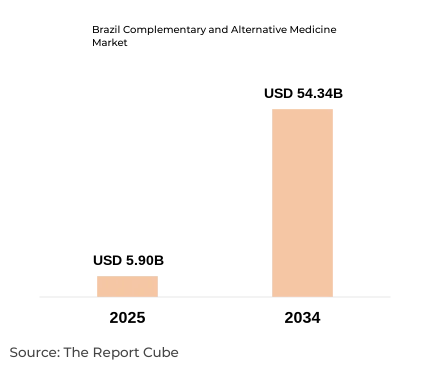
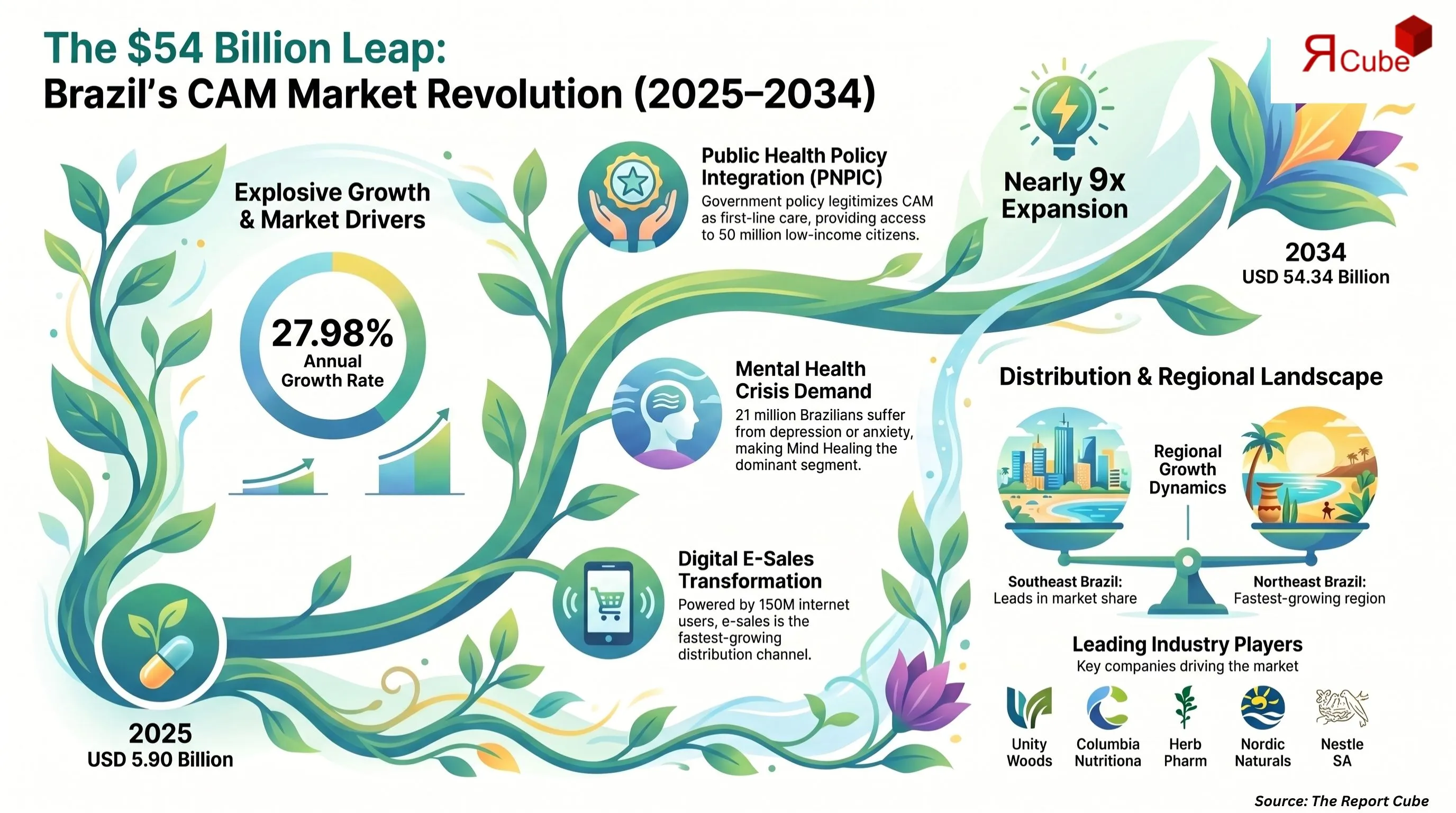
- Market value 2025: USD 5.90 billion
- Market value 2034: USD 54.34 billion
- CAGR 2026 to 2034: 27.98%
- Dominant intervention segment: Mind Healing, driven by Brazil's 12 million people living with depression and 9 million with anxiety disorders (WHO Global Health Estimates, 2023)
- Leading distribution channel: E-sales, powered by Brazil's 150 million internet users and 90%+ smartphone penetration
- Fastest-growing region: Northeast Brazil, anchored by cultural CAM traditions and accelerating PNPIC integration
- Key players: Unity Woods Yoga Center, Columbia Nutritiona, Herb Pharm, The Healing Co Inc, Nordic Naturals, Nestle SA
Brazil Complementary and Alternative Medicine Market Insights and Analysis
Brazil carries one of the highest burdens of chronic non-communicable disease in Latin America, with cardiovascular disease and diabetes affecting over 15 million adults (Brazilian Ministry of Health, 2023). The SUS system, operating at roughly 3.8% of GDP in health expenditure per capita, cannot scale fast enough to meet rising demand from a population of over 215 million. That structural gap leaves tens of millions of Brazilians seeking accessible, affordable alternatives, fuelling demand that the formal health sector cannot absorb.
The Brazil CAM market, valued at USD 5.90 billion in 2025, is forecast to reach USD 54.34 billion by 2034, expanding at a 27.98% CAGR from 2026 to 2034. The National Policy on Integrative and Complementary Practices (PNPIC), active since 2006 and expanded in 2017 to formally add acupuncture, homeopathy, and meditation to the Unified Health System (SUS), legitimises CAM as a first-line care option across Brazil's 5,570 municipalities. Urbanisation-driven wellness culture in São Paulo and Rio de Janeiro, combined with a digitally active consumer base purchasing via e-sales platforms and subscription models, compounds structural demand. At 27.98% CAGR, Brazil is positioned to become the dominant CAM market in Latin America ahead of Mexico and Argentina by 2030.
Brazil Complementary and Alternative Medicine Market Dynamics
CAM markets in emerging economies are prone to regulatory ambiguity and consumer trust deficits. In Brazil, product fraud in herbal supplements and unlicensed therapy providers have historically slowed institutional adoption. Three forces are now resolving this tension: accelerating SUS integration, digital direct-to-consumer commerce, and a demographically young population open to non-pharmaceutical wellness.
Key Market Driver, SUS Integration Legitimising CAM as First-Line Care
When users bore the full cost of CAM therapies, public uptake was low. Brazil's bottom-40% income cohort spends less than USD 150 per year on any out-of-pocket healthcare, a barrier that effectively excluded the majority of the population from accessing qualified CAM services.
PNPIC Ordinance No. 849/2017 added 14 new practices to the SUS offer, including hypnotherapy, meditation, and herbal therapies under partial SUS reimbursement in participating municipalities. Over 12,000 SUS facilities offered at least one CAM therapy as of 2023 (Brazilian Ministry of Health, 2023). PNPIC integration removes the cost barrier for an estimated 50 million low-income Brazilians, and public-funded CAM purchases are simultaneously growing the direct-sales channel at municipal clinic level, a compound effect that no single private-sector initiative could replicate at this scale.
Major Industry Challenge, Regulatory Fragmentation and Unlicensed Provider Risk
Brazil has no single national licensing body for CAM practitioners. ANVISA regulates herbal products under RDC 26/2014 but holds no jurisdiction over therapy-room services, leaving hypnotherapists, spiritual healers, and meditation practitioners operating under self-regulated professional bodies with inconsistent standards.
Federal bills under consideration in Brazil's Chamber of Deputies, including PL 227/2023 and related proposals, aim to create unified credentialing. ANVISA's 2022 revision of herbal product registration rules (RDC 658/2022) represents a positive step, streamlining pathways for both domestic manufacturers and international importers. Regulatory uncertainty currently raises liability risk for institutional buyers and slows corporate wellness programme adoption, particularly in the direct-sales channel. Brands entering without local regulatory counsel face meaningful compliance exposure.
Emerging Trend, Digital Delivery Driving E-Sales and Subscription CAM Models
Traditional CAM delivery is geographically constrained: São Paulo and Rio de Janeiro hold the majority of certified practitioners in Brazil. With 150 million internet users and 90%+ smartphone penetration, most Brazilians outside major metros have no physical access to qualified CAM providers.
E-sales and distance-correspondence channels are bridging this gap through platforms including Mercado Livre, Shopee Brazil, and Amazon Brazil. Brazil ranked among the top 10 global e-commerce markets by total value in 2024. Monthly herbal supplement packs and app-guided transcendental meditation programmes represent the fastest-growing SKUs in this channel. The subscription wellness model raises customer lifetime value and converts one-time buyers into recurring CAM consumers, a structural shift that benefits both product brands and service-based practitioners delivering content digitally.
Need Specific Data, Let’s Customize the Report for You
Request CustomizationSegment-wise Analysis of Brazil Complementary and Alternative Medicine Market
By Intervention
|
Intervention Type |
Key Insights |
Growth Factors |
Notable Players |
|---|---|---|---|
|
Mind Healing |
Dominant and fastest-growing segment under PNPIC |
Rising mental health cases (12M depression, 9M anxiety), government support in SUS |
— |
|
Hypnotherapy |
Recognized as an auxiliary medical procedure (CFM Resolution 1986/2012) |
Clinical + wellness applications (pain, oncology, dentistry) |
The Healing Co Inc |
|
Autosuggestion |
Widely used in corporate wellness programs |
Productivity enhancement and cognitive performance |
Petrobras, Embraer, Banco do Brasil |
|
Self-hypnosis |
Entry-level CAM solution for new users |
App-based accessibility and bundled wellness products |
Nordic Naturals, Columbia Nutritiona |
|
Spiritual Mind Treatment |
Strong cultural adoption across Brazil |
Religious alignment (Candomblé, Umbanda, Catholic practices) |
Unity Woods Yoga Center |
|
Transcendental Meditation |
Rapid corporate adoption |
Largest TM teacher network in Latin America |
Nordic Naturals |
The Brazil CAM market is heavily shaped by mind-body interventions, with Mind Healing leading the pack. It’s not surprising - mental health concerns are rising sharply, with millions dealing with depression and anxiety. Government-backed initiatives like PNPIC have further pushed meditation and similar therapies into mainstream healthcare, making them both accessible and affordable.
Hypnotherapy, on the other hand, stands out because of its formal medical recognition. Unlike many regions, Brazil treats hypnosis as a legitimate clinical tool, which opens doors in areas like oncology and pain management. This dual positioning-medical and wellness-gives it a unique edge.
Then comes Autosuggestion, quietly gaining traction in corporate Brazil. Companies are investing in employee well-being, and cognitive performance tools are becoming part of everyday work culture. Meanwhile, Self-hypnosis works as an entry point for new users, often delivered via apps and bundled with wellness supplements.
One of the most culturally rooted segments is Spiritual Mind Treatment. Its growth isn’t just about health-it’s deeply tied to Brazil’s spiritual traditions. This makes it especially popular in rural and underserved regions.
Lastly, Transcendental Meditation is riding the corporate wellness wave. With a strong teacher network and integration with wellness products, it’s expanding both reach and revenue potential.
By Distribution Channel
|
Distribution Channel |
Key Insights |
Growth Drivers |
Notable Players |
|---|---|---|---|
|
E-sales |
Fastest-growing channel |
E-commerce platforms, subscription models |
Herb Pharm, Nordic Naturals, Nestle SA |
|
Direct Sales |
Traditional and dominant for services |
Strong practitioner relationships, legacy networks |
Unity Woods Yoga Center, The Healing Co Inc |
|
Distance Correspondence |
Critical for rural and remote access |
Telehealth expansion, repeat product orders |
Herb Pharm, Nordic Naturals |
When it comes to distribution, E-sales is clearly leading the growth curve. With platforms like Mercado Livre and DTC subscriptions, brands are reaching consumers faster than ever. Add to that bundled wellness offerings, and the average customer spend is increasing steadily.
Direct Sales, however, still holds its ground-especially for services. Brazil’s long-standing culture of relationship-based selling makes this channel highly effective for therapies like hypnotherapy and meditation training.
Then there’s Distance Correspondence, which plays a crucial role in a geographically vast country like Brazil. From herbal product deliveries to live telehealth sessions, this channel has evolved rapidly post-COVID. In many ways, it’s now overlapping with e-sales, especially for digital therapy services.
Pricing Analysis, Brazil Complementary and Alternative Medicine Market
Price opacity in the brazil alternative medicine market frustrates institutional buyers and individual consumers alike. Without transparent benchmarks, procurement managers at corporate wellness programmes and SUS facility administrators cannot build business cases for CAM integration.
|
Modality / Product |
Price Range (BRL) |
Channel |
Key Cost Driver |
|---|---|---|---|
|
Hypnotherapy session (major city) |
BRL 150 to BRL 400 |
Direct Sales |
Practitioner certification, clinic overhead |
|
Hypnotherapy session (secondary market) |
BRL 80 to BRL 150 |
Direct Sales / Distance |
Lower practitioner density, reduced overhead |
|
TM course (standard 4-day programme) |
BRL 800 to BRL 2,200 |
Direct Sales / E-sales |
Teacher certification, programme licensing |
|
Herbal supplement monthly subscription |
BRL 90 to BRL 350 |
E-sales |
ANVISA registration, import duties, brand tier |
|
Self-hypnosis app subscription (annual) |
BRL 120 to BRL 480 |
E-sales |
Platform fees, content production |
|
Autosuggestion audio programme |
BRL 60 to BRL 200 |
Distance / E-sales |
Content licensing, localisation |
Cost drivers across all categories include ANVISA registration fees, practitioner certification costs, and import duties on foreign supplement brands. Nestle SA and Nordic Naturals benefit from scale pricing advantages over smaller Brazilian-origin CAM brands, enabling more competitive price positioning in the e-sales channel where price comparison is immediate.
Regulatory and Import Landscape
International CAM brands entering Brazil navigate a three-layer regulatory process. ANVISA's RDC 26/2014 governs herbal medicinal products; RDC 240/2018 governs dietary supplements; and the CFM issues separate resolutions for clinical applications of therapies like hypnosis, with no single point of entry coordinating all three.
|
Regulatory Body |
Scope |
Key Instrument |
Implication for CAM Operators |
|---|---|---|---|
|
ANVISA |
Herbal products, dietary supplements, import registration |
RDC 26/2014; RDC 240/2018; RDC 658/2022 |
Product registration required before distribution; 60 to 360-day timeline depending on risk class |
|
CFM |
Clinical practitioner recognition for medical applications |
Resolution 1986/2012 (hypnosis) |
Enables clinical hypnotherapy in hospital and dental settings; no jurisdiction over wellness-only practices |
|
Ministry of Health / PNPIC |
CAM service integration into SUS public health system |
PNPIC Ordinance 849/2017 |
Mandates SUS coverage of 29 CAM therapies; drives public procurement demand |
ANVISA Resolution RDC 658/2022 is reducing time-to-market for foreign entrants by simplifying herbal product registration pathways. Herb Pharm and Nordic Naturals are registered ANVISA importers operating under the revised framework.
Regional Projection of the Brazil Complementary and Alternative Medicine Market
Brazil's five macro-regions show significant variation in CAM adoption driven by income levels, practitioner density, and cultural alignment with specific modalities.
- Southeast Brazil (São Paulo, Rio de Janeiro, Minas Gerais, Espírito Santo) leads by current market share. Corporate wellness CAM spending is highest here, top financial institutions and technology firms in São Paulo include CAM sessions in employee health plans. E-sales shipment volumes are highest from Southeast logistics hubs, and Nestle SA's Brazil health and wellness division operates its primary DTC channel from São Paulo.
- South Brazil (Paraná, Santa Catarina, Rio Grande do Sul) holds the highest per-capita income outside the Southeast, supported by a strong German and Italian immigrant cultural tradition that historically embraced homeopathic and herbal medicine. Columbia Nutritiona maintains significant direct-sales network presence in the Southern states, and distance-correspondence herbal supplement orders index above the national average in this region.
- Northeast Brazil is the fastest-growing region within the forecast period. Deep cultural tradition of Candomblé, Jurema-based spiritual practices, and use of native Caatinga medicinal plants creates strong organic demand for Spiritual Mind Treatment and herbal CAM. SUS PNPIC integration is expanding fastest here as the federal government prioritises CAM access in underfunded health districts. The distance-correspondence channel is the primary access point for rural Northeast consumers, and Columbia Nutritiona extended its direct-sales network into this region in 2024.
- North and Central-West Brazil collectively benefit from distinct geographic advantages. Amazon biome access in the North gives local providers a native plant medicine supply chain advantage, açaí-based, copaíba oil, and andiroba products are commercially distributed as CAM inputs. Central-West growth is driven by Brasília's public-sector workforce, which has above-average SUS access and employer wellness programme coverage.
Competitive Landscape
The brazil complementary and alternative medicine market is fragmented at the practitioner and local brand level but increasingly structured at the distributor and supplement brand level. Five companies drive the commercial distribution framework.
- Unity Woods Yoga Center is a specialised CAM service provider delivering mind-healing programmes including yoga, meditation, and spiritual mind treatment through studio-based and digital platforms in Brazil. In 2024, Unity Woods expanded its distance-correspondence meditation certification programme, adding Portuguese-language content modules targeting new registered practitioners across Brazil. The certification model converts practitioners into a distribution channel, each certified teacher becomes a direct-sales node for Unity Woods' companion product lines, compounding its market reach without adding fixed overhead.
- Columbia Nutritiona is a CAM-adjacent nutritional supplement manufacturer and direct-sales distributor operating in the Brazilian wellness market. Columbia Nutritiona extended its direct-sales network into Northeast Brazil in 2024, adding independent distributors in Bahia and Pernambuco. This Northeast expansion positions Columbia Nutritiona ahead of international competitors in the fastest-growing regional CAM market, capturing first-mover advantage in a geography where brand trust through personal sales relationships is a stronger purchase driver than e-sales.
- Herb Pharm is a US-origin herbal extract brand supplying liquid herbal preparations to the herbal supplement market Brazil through both e-sales and direct-sales channels. Herb Pharm obtained updated ANVISA registration for 12 herbal extracts under the revised RDC 658/2022 pathway in 2024, reducing time-to-shelf by an estimated 40% compared to the previous registration process. Faster registration creates a first-to-market advantage for Herb Pharm's new product launches.
- Nordic Naturals is a premium omega-3 and nutritional supplement brand whose Brazilian portfolio bridges conventional nutrition and CAM. In Q1 2025, Nordic Naturals launched a Portuguese-language subscription wellness bundle combining omega-3, adaptogens, and guided TM audio content, targeting the premium urban wellness consumer in São Paulo and Curitiba. The bundled approach raises average order value and increases customer lifetime value by tying supplement repurchase to ongoing CAM practice adherence.
- Nestle SA enters the Brazil CAM-adjacent market through its Nestle Health Science division, distributing medical nutrition and wellness supplement products that cross over with herbal and functional CAM categories. Nestle Health Science Brazil expanded its partnership with the SUS hospital network procurement in 2024, adding functional nutrition product lines to public-sector tender catalogues. Public-sector procurement access gives Nestle a distribution footprint inside SUS facilities that positions it as the default institutional CAM-adjacent nutrition supplier as PNPIC integration deepens.
Brazil CAM Market, Recent Developments (2024 to 2025)
- ANVISA (2024): RDC 658/2022 herbal registration pathway reached full implementation, cutting average product approval timelines for foreign entrants.
- Brazilian Ministry of Health (2024 to 2025): PNPIC continued expansion with additional CAM modalities under SUS coverage consideration in the Chamber of Deputies.
- Nordic Naturals (Q1 2025): Launched Portuguese-language subscription CAM wellness bundle targeting São Paulo and Curitiba urban premium consumers.
- Columbia Nutritiona (2024): Extended direct-sales network into Northeast Brazil across Bahia and Pernambuco states.
- Unity Woods Yoga Center (2024): Expanded distance-correspondence meditation certification programme with Portuguese-language content modules for Brazilian practitioners.
Brazil Complementary and Alternative Medicine Market, Future Outlook 2034
The gap between Brazil's cam market 2034 projection (USD 54.34 billion) and its 2025 baseline (USD 5.90 billion) represents a 9x scaling challenge that will stress current distribution, practitioner training, and regulatory infrastructure. Without coordinated policy and infrastructure investment, distribution will concentrate in Southeast Brazil, leaving the Northeast and North behind and undermining the inclusive growth trajectory the 27.98% CAGR implies.
Three forces will determine whether the 27.98% brazil alternative medicine market CAGR is achieved through 2034. First, continued SUS PNPIC funding expansion must sustain public-sector CAM access across all five macro-regions, not only Southeast metros. Second, e-sales logistics penetration into second and third-tier cities must reduce the geographic gap in product and service access that currently limits market growth outside major urban centres. Third, digital practitioner certification at scale, exemplified by Unity Woods Yoga Center's model, must expand the qualified practitioner pool fast enough to meet demand without sacrificing quality standards.
By 2030, the Latin America alternative medicine market as a whole will be shaped by whether Brazil's regulatory framework catches up with its commercial momentum. The country that resolves ANVISA's fragmented CAM oversight and creates a unified practitioner licensing framework will unlock institutional investment from global wellness brands currently taking a wait-and-see position. Brazil has all the structural ingredients, policy support, digital infrastructure, cultural depth, and demographic scale, to become the defining CAM market of the coming decade.
Table of Contents
- Introduction
- Objective of the study
- Product Definition
- Market Segmentation
- Study Variables
- Research Methodology
- Secondary Data Points
- Companies Interviewed
- Primary Data Points
- Breakdown of Primary Interviews
- Secondary Data Points
- Executive Summary
- Market Dynamics
- Drivers
- Challenges
- Opportunity Assessment
- Recent Trends and Developments
- Policy and Regulatory Landscape
- Brazil Complementary and Alternative Medicine Market Overview and Forecast Analysis (2021-2034)
- Market Size, By Value, By growth rate (CAGR/USD Billions)
- Demand - Supply Trends
- Market Share, By Intervention
- Mind Healing
- Hypnotherapy
- Autosuggestion
- Self-hypnosis
- Spiritual Mind Treatment
- Transcendental Meditation
- Others
- Market Share, By Distribution Channel
- E-sales
- Direct Sales
- Distance Correspondence
- Market Share, By Region
- Southeast Brazil
- South Brazil
- Northeast Brazil
- Centre-West and North Brazil
- Market Share, By Competitors
- Competition Characteristics
- Revenue Shares
- Brazil Mind Healing Complementary and Alternative Medicine Market Overview, 2021-2034F
- By Value (USD Million)
- By Distribution Channel- Market Size & Forecast 2021-2034, USD Million
- Brazil Hypnotherapy Complementary and Alternative Medicine Market Overview, 2021-2034F
- By Value (USD Million)
- By Distribution Channel- Market Size & Forecast 2021-2034, USD Million
- Brazil Autosuggestion Complementary and Alternative Medicine Market Overview, 2021-2034F
- By Value (USD Million)
- By Distribution Channel- Market Size & Forecast 2021-2034, USD Million
- Brazil Self-hypnosis Complementary and Alternative Medicine Market Overview, 2021-2034F
- By Value (USD Million)
- By Distribution Channel- Market Size & Forecast 2021-2034, USD Million
- Brazil Spiritual Mind Treatment Complementary and Alternative Medicine Market Overview, 2021-2034F
- By Value (USD Million)
- By Distribution Channel- Market Size & Forecast 2021-2034, USD Million
- Brazil Transcendental Meditation Complementary and Alternative Medicine Market Overview, 2021-2034F
- By Value (USD Million)
- By Distribution Channel- Market Size & Forecast 2021-2034, USD Million
- Brazil Others Complementary and Alternative Medicine Market Overview, 2021-2034F
- By Value (USD Million)
- By Distribution Channel- Market Size & Forecast 2021-2034, USD Million
- Competitive Outlook (Company Profile - Partial List)
- Unity Woods Yoga Center
- Company Overview
- Business Segments
- Strategic Alliances/Partnerships
- Recent Developments
- Columbia Nutritiona
- Company Overview
- Business Segments
- Strategic Alliances/Partnerships
- Recent Developments
- Herb Pharm
- Company Overview
- Business Segments
- Strategic Alliances/Partnerships
- Recent Developments
- The Healing Co Inc
- Company Overview
- Business Segments
- Strategic Alliances/Partnerships
- Recent Developments
- Nordic Naturals
- Company Overview
- Business Segments
- Strategic Alliances/Partnerships
- Recent Developments
- Nestle SA
- Company Overview
- Business Segments
- Strategic Alliances/Partnerships
- Recent Developments
- Others
- Unity Woods Yoga Center
- Contact Us & Disclaimer
Top Key Players & Market Share Outlook
- Unity Woods Yoga Center
- Columbia Nutritiona
- Herb Pharm
- The Healing Co Inc
- Nordic Naturals
- Nestle SA
- Others
Frequently Asked Questions






