



Build Your Custom Market Intelligence Report
Customize Your ReportKey Takeaways
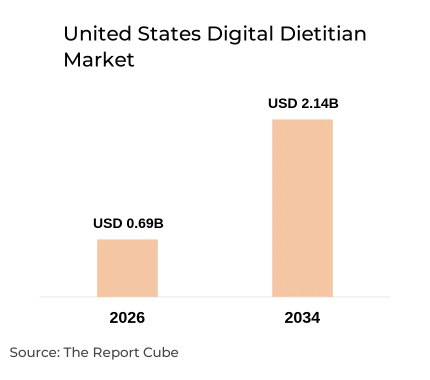
- The United States Digital Dietitian Market was valued at USD 0.69 billion in 2026 and is projected to reach USD 2.14 billion by 2034, expanding at a 15.20% CAGR during 2026–2034.
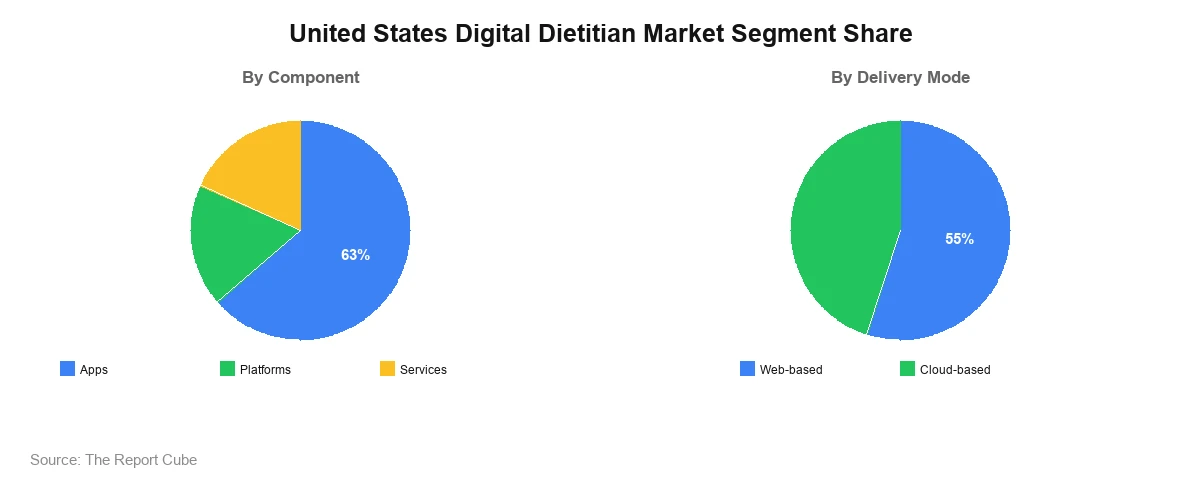
- Apps led the market by component, accounting for approximately 63% of the market in 2026, supported by increasing use of mobile-based nutrition management.
- Web-based delivery represented the leading delivery mode, with an estimated 55% share in 2026, reflecting continued adoption of browser-based virtual nutrition services.
- The South accounted for the largest regional share at approximately 38% in 2026, supported by high obesity prevalence and substantial demand for weight-management and nutrition interventions.
- Rising demand for nutrition-based chronic-disease management is strengthening the need for digital dietitian and tele-nutrition services across the United States.
- Integration of mobile applications, wearable devices, smart scales, blood-glucose meters, and remote patient monitoring is expanding the functionality of digital dietitian platforms.
- Technology access, broadband availability, HIPAA compliance, cybersecurity requirements, and reimbursement complexity remain important barriers to market expansion.
- The United States Digital Dietitian Market is moving from basic virtual consultations toward personalized, technology-enabled, and hybrid nutrition care models.
Market Overview
The United States Digital Dietitian Market is projected to expand at a 15.20% CAGR during 2026–2034, increasing from USD 0.69 billion in 2026 to USD 2.14 billion by 2034. Growing demand for digitally delivered nutrition care is being supported by the increasing need for weight management, dietary intervention, lifestyle management, and chronic-disease-related nutrition services. Telehealth is enabling registered dietitians to provide personalized nutrition plans, medical nutrition therapy, follow-up counseling, and remote monitoring through digital channels, broadening access beyond conventional physical healthcare settings.
The market is also benefiting from the integration of digital monitoring technologies into nutrition care. Mobile health applications, wearable devices, smart scales, blood-glucose meters, and other connected technologies allow dietitians to receive patient-generated information and monitor dietary, physical-activity, and health outcomes remotely. This is shifting digital dietitian services beyond basic video consultations toward more continuous and personalized nutrition-management models.
Regional demand is particularly significant in the South, which accounted for approximately 38% of the market in 2026. High obesity prevalence across major U.S. regions creates a substantial addressable population for weight-management and lifestyle-intervention services. At the same time, tele-nutrition can expand access to dietitians in rural and underserved areas where conventional nutrition-care infrastructure may be limited.
Market Dynamics
The United States Digital Dietitian Market is undergoing structural transformation as nutrition care increasingly shifts toward digital delivery, remote monitoring, personalized interventions, and connected health technologies. Rising chronic-disease management needs and telehealth accessibility are supporting market expansion, while technology barriers, cybersecurity requirements, and reimbursement complexity continue to influence adoption and provider participation.
|
Factor |
Type |
Specific Impact on Market |
Magnitude |
|
Rising need for nutrition-based chronic-disease management |
Driver |
Expands demand for weight-management, dietary intervention, and lifestyle-management services |
High |
|
Growing accessibility of nutrition care through telehealth |
Driver |
Enables registered dietitians to deliver personalized nutrition plans, counseling, and follow-up remotely |
High |
|
Expansion of digital monitoring in nutrition care |
Driver |
Increases platform functionality through apps, wearables, smart scales, and remote monitoring |
High |
|
Technology and broadband barriers |
Challenge |
Limits adoption among patients with insufficient connectivity, devices, or technology skills |
Medium |
|
Privacy and cybersecurity requirements |
Challenge |
Increases compliance, technology, and operational requirements for providers |
Medium |
|
Reimbursement and coverage complexity |
Restraint |
Changes in Medicare, Medicaid, and private-insurance policies can affect provider participation and patient access |
Medium |
|
Technology-enabled personalized nutrition |
Trend |
Moves digital dietitian services from basic consultations toward continuous, data-driven care |
High |
|
AI and mobile nutrition applications |
Trend |
Expands automated tracking, nutrition guidance, and digitally delivered behavioral support |
High |
|
Rural and underserved populations |
Opportunity |
Enables providers to reach patients without requiring physical clinic expansion |
High |
|
Chronic-condition-specific nutrition programs |
Opportunity |
Creates specialized digital programs for diabetes, heart disease, cancer, and other conditions |
High |
|
Connected nutrition ecosystems |
Opportunity |
Enables integration of consultations with patient-generated health and activity data |
High |
|
Weight-management services |
Opportunity |
Creates a significant application area supported by widespread obesity and demand for personalized interventions |
High |
United States Digital Dietitian Market Drivers
Rising Need for Nutrition-Based Chronic-Disease Management
The rising prevalence of obesity and related health-management needs is strengthening demand for nutrition-based interventions in the United States. According to the U.S. Centers for Disease Control and Prevention (CDC), 2025 data showed obesity prevalence of 35.5% in the Midwest and 34.8% in the South, followed by 30.7% in the West and 29.6% in the Northeast. This creates a substantial population requiring weight-management, dietary intervention, and lifestyle-management services.
Digital dietitian platforms can address this demand by providing personalized nutrition guidance remotely. The combination of dietary counseling, behavioral support, and ongoing digital monitoring enables nutrition professionals to engage with patients beyond traditional clinic visits. As a result, the prevalence of obesity across major U.S. regions provides a broad demand base for digital nutrition and tele-dietitian services.
Growing Accessibility of Nutrition Care Through Telehealth
Telehealth is expanding access to registered dietitians by allowing nutrition care to be delivered through video, telephone, and secure messaging. According to the U.S. Department of Health and Human Services (HHS), tele-nutrition applications include personalized nutrition plans, medical nutrition therapy, follow-up counseling, and remote monitoring.
This delivery model reduces the dependence on physical clinic locations and enables patients to receive nutrition services from providers located outside their immediate geographic area. The resulting improvement in accessibility supports wider adoption of digital dietitian services, particularly among patients who face transportation, geographic, or scheduling barriers to conventional nutrition care.
Expansion of Digital Monitoring in Nutrition Care
The integration of remote-monitoring technologies is increasing the functionality of digital dietitian platforms. According to HHS, tele-nutrition can incorporate mobile health applications, wearable devices, smart scales, blood-glucose meters, and other remote-monitoring technologies. These tools allow nutrition professionals to receive patient-generated data and monitor dietary, physical-activity, and health outcomes remotely.
This capability allows digital dietitian services to evolve from periodic consultations into more continuous nutrition-management models. By connecting patient data with professional guidance, platforms can support more personalized care plans and enable dietitians to track changes between consultations.
United States Digital Dietitian Market Challenges
Technology and Broadband Barriers
Technology access remains an important limitation to digital dietitian adoption. According to HHS, patients using tele-nutrition services require reliable internet connectivity, compatible devices, and sufficient technological skills to participate effectively in virtual care. Inconsistent high-speed internet, limited device access, and limited technology experience can therefore prevent some populations from fully participating in digital nutrition programs.
These barriers are particularly relevant when providers attempt to expand services into digitally underserved populations. Although digital delivery can remove geographic barriers to nutrition care, inadequate connectivity or device availability can create a separate access barrier and restrict the effective addressable market.
Privacy and Cybersecurity Requirements
Digital dietitian providers must maintain strong privacy and cybersecurity controls because nutrition-care platforms handle sensitive patient information. According to HHS, telehealth platforms should comply with federal HIPAA privacy and security requirements and incorporate safeguards such as secure video, encrypted messaging, and user authentication.
These requirements increase the technological and operational complexity of digital nutrition platforms. Providers must therefore invest in secure infrastructure, compliance processes, and appropriate authentication and data-protection mechanisms, which can increase implementation and operating costs.
Reimbursement and Coverage Complexity
Reimbursement policies represent another important challenge for digital dietitian services. According to HHS, Medicare, Medicaid, and private-insurance policies influence billing for tele-nutrition services, while Medicare coverage and telehealth policies continue to evolve. HHS also identifies medical nutrition therapy billing codes including CPT 97802, 97803, and 97804.
Changes in reimbursement structures can influence both provider participation and patient access. Digital dietitian companies therefore need to operate within an evolving reimbursement environment while ensuring that eligible services are appropriately documented and billed.
Need Specific Data, Let’s Customize the Report for You
Request CustomizationUnited States Digital Dietitian Market Trends
Shift Toward Technology-Enabled Personalized Nutrition
Tele-nutrition is increasingly combining virtual consultations with remote patient monitoring, mobile applications, and wearable technologies. According to HHS, these tools allow nutrition professionals to collect patient-generated information and use it alongside professional consultations.
This represents a shift from simple video-based dietitian consultations toward technology-enabled personalized nutrition management. Continuous access to patient data can allow dietitians to adjust nutrition plans more effectively and maintain engagement between formal consultations.
Integration of AI and Mobile Nutrition Applications
Mobile nutrition applications are becoming an important component of digitally delivered nutrition management. According to HHS, mobile health applications used in tele-nutrition can track food choices, exercise, and patient progress, while some applications incorporate artificial intelligence and chatbots for nutrition-related guidance.
The integration of these technologies supports a broader movement toward AI-assisted nutrition monitoring and digitally delivered behavioral support. Digital dietitian platforms can therefore combine professional dietitian expertise with automated tracking and technology-enabled engagement.
Growth of Hybrid Nutrition Care
The digital dietitian market is also moving toward hybrid models that combine virtual and conventional nutrition care. According to HHS, patients can receive nutrition services through video calls, telephone calls, and secure messaging alongside in-person care.
Rather than replacing physical consultations completely, hybrid care allows providers to select the appropriate delivery method based on patient needs. This approach can improve continuity of care while giving patients greater flexibility in how and when they interact with nutrition professionals.
United States Digital Dietitian Market Opportunities
Rural and Underserved Patient Populations
Tele-nutrition creates an opportunity to expand dietitian access among rural and underserved populations. According to HHS, digital nutrition services can increase access to dietitians and nutritionists in areas where health professionals are limited while reducing transportation and geographic barriers.
This allows digital dietitian providers to reach patients without establishing physical clinics in every service area. Expansion into underserved regions could therefore broaden the market's geographic coverage while improving access to professional nutrition services.
Chronic-Condition-Specific Digital Nutrition Programs
Digital dietitian platforms can develop specialized programs targeting specific chronic conditions. According to HHS, tele-nutrition can support medical nutrition therapy for conditions including diabetes, heart disease, and cancer, while remote monitoring can be used to evaluate patient progress.
Disease-specific programs can provide a more targeted alternative to generic diet advice. Providers can design digital nutrition pathways around specific clinical requirements, monitoring needs, and long-term lifestyle-management objectives.
Connected Nutrition Ecosystems
Integration between dietitian consultations and connected health technologies represents another significant opportunity. HHS identifies the potential combination of nutrition services with mobile applications, smart scales, blood-glucose monitors, activity trackers, and patient portals.
This creates opportunities for integrated platforms that connect nutrition professionals with patient-generated health data. Such ecosystems can support ongoing monitoring and engagement rather than relying exclusively on one-time or periodic consultations.
Weight-Management Services
Weight management represents a particularly relevant application area for digital dietitian services. According to HHS, telehealth can support nutritional and behavioral interventions designed to help individuals achieve and maintain a healthy weight through personalized nutrition plans, remote monitoring, and online support.
The opportunity is reinforced by the high obesity prevalence reported across major U.S. regions by the CDC. Digital dietitian providers can therefore target weight-management programs that combine professional nutrition counseling with continuous digital engagement and monitoring.
United States Digital Dietitian Market Segmentation Analysis
The United States Digital Dietitian Market is segmented by component, delivery mode, and region. Demand across these segments reflects differences in digital nutrition functionality, technology infrastructure, patient access, and regional healthcare requirements.
By Component
- Apps
- Platforms
- Services
Apps accounted for approximately 63% of the United States Digital Dietitian Market in 2026, making them the leading component segment. The strong position of applications is consistent with the increasing use of mobile health technologies for nutrition tracking, dietary management, exercise monitoring, and patient engagement.
Mobile applications also provide an effective interface for integrating additional technologies such as wearable devices, smart scales, and other remote-monitoring tools. Their ability to support continuous patient interaction makes apps an important foundation for personalized digital nutrition management.
By Delivery Mode
- Web-based
- Cloud-based
Web-based delivery accounted for approximately 55% of the U.S. Digital Dietitian Market in 2026, making it the leading delivery mode. Browser-based platforms can provide patients with access to nutrition consultations, patient portals, nutrition plans, and digital monitoring services without requiring dedicated physical infrastructure.
Cloud-based delivery also represents an important part of the market as providers seek scalable digital infrastructure and connected patient-data management. The coexistence of web-based and cloud-based models reflects the broader transition toward digitally accessible nutrition-care services.
Regional Analysis
The United States Digital Dietitian Market is geographically segmented across the Northeast, Midwest, South, and West. Regional demand is influenced by obesity prevalence, healthcare accessibility, digital-health adoption, and the need for nutrition-based interventions. Among the regions provided, the South represents the largest market with a 38% share in 2026.
|
Region |
Estimated Market Share |
Key Growth Factors |
Consumer / Patient Trends |
|
South |
38% |
High obesity prevalence and substantial need for weight-management and nutrition interventions |
Strong demand for dietary and lifestyle-management services |
|
Northeast |
— |
Established healthcare infrastructure and access to digital health services |
Growing adoption of technology-enabled nutrition care |
|
Midwest |
— |
Highest obesity prevalence among major U.S. regions, creating substantial nutrition-management needs |
Increasing need for weight-management and chronic-disease nutrition services |
|
West |
— |
Expanding digital-health adoption and significant obesity-related nutrition needs |
Growing use of mobile and technology-enabled nutrition services |
South
The South represents the largest regional market, accounting for approximately 38% of total demand in 2026. The region's significant market position is supported by its high obesity prevalence, which reached 34.8% in 2025 according to CDC data. The resulting demand for weight-management, dietary intervention, and lifestyle-management services creates a substantial addressable population for digital dietitian providers.
United States Digital Dietitian Market Competitive Landscape
The United States Digital Dietitian Market includes digital health, telehealth, nutrition application, and connected wellness companies. Competition is shaped by digital accessibility, nutrition-management functionality, remote consultation capabilities, patient engagement, and integration with connected health technologies.
|
Company |
Competitive Strength |
Primary Segment Served |
|
Teladoc Health Inc. |
Broad telehealth infrastructure and virtual-care capabilities |
Digital/virtual nutrition and healthcare |
|
Fitbit |
Wearable-device ecosystem and health/activity tracking |
Digital monitoring and consumer health |
|
American Well Corp |
Telehealth platform capabilities and virtual healthcare delivery |
Digital healthcare and telehealth |
|
Practo |
Digital healthcare access and provider-patient connectivity |
Online healthcare services |
|
Healthier Choices Management Corp |
Health and wellness-oriented portfolio |
Consumer health and wellness |
|
MyFitnessPal |
Nutrition, food, calorie, and activity tracking capabilities |
Digital nutrition management |
Key Companies in the U.S. Digital Dietitian Market
Teladoc Health Inc.
Teladoc Health Inc. participates in the digital healthcare ecosystem through virtual healthcare delivery capabilities. Its digital infrastructure is relevant to the U.S. Digital Dietitian Market because virtual-care models enable healthcare professionals to interact with patients remotely. The company's broader telehealth positioning provides a platform through which digitally delivered healthcare services can be integrated with nutrition and lifestyle-management programs.
MyFitnessPal
MyFitnessPal is positioned around digital nutrition and fitness tracking, making it particularly relevant to the United States Digital Dietitian Market. Its functionality around food, nutrition, calorie, and activity tracking supports the market's movement toward continuous digital monitoring. Such platforms can complement professional dietitian services by providing structured patient-generated nutrition and activity information.
Market Future Outlook
The United States Digital Dietitian Market is projected to increase from USD 0.69 billion in 2026 to USD 2.14 billion by 2034, representing a 15.20% CAGR during the forecast period. Growth is expected to be supported by increasing demand for nutrition-based chronic-disease management, wider telehealth accessibility, and greater use of mobile applications and remote-monitoring technologies.
The market is expected to increasingly move toward personalized and connected nutrition care. Integration of wearable devices, smart scales, blood-glucose meters, mobile applications, and patient-generated data can allow dietitians to provide more continuous monitoring and individualized interventions. AI-assisted applications and chatbots are also supporting the development of more technology-enabled nutrition-management models.
At the same time, technology access, broadband availability, cybersecurity, HIPAA compliance, and reimbursement policies will remain important considerations for market participants. Providers that can combine accessible virtual care with secure infrastructure, connected monitoring, chronic-condition-specific programs, and effective reimbursement models should be better positioned to capture future demand.
United States Digital Dietitian Market Report Coverage
|
Report Attribute |
Details |
|
Market Name |
United States Digital Dietitian Market |
|
Market Size (2026) |
USD 0.69 Billion |
|
Market Size (2034) |
USD 2.14 Billion |
|
Forecast Period |
2026–2034 |
|
CAGR |
15.20% |
|
Base Year |
2026 |
|
Forecast Years |
2026–2034 |
|
Segments Covered |
By Component, By Delivery Mode, By Region |
|
Component Segments |
Apps, Platforms, Services |
|
Delivery Mode Segments |
Web-based, Cloud-based |
|
Regions Covered |
Northeast, Midwest, South, West |
|
Leading Component |
Apps - 63% in 2026 |
|
Leading Delivery Mode |
Web-based - 55% in 2026 |
|
Leading Region |
South - 38% in 2026 |
|
Key Companies |
Teladoc Health Inc., Fitbit, American Well Corp, Practo, Healthier Choices Management Corp, MyFitnessPal |
Why Choose This United States Digital Dietitian Market Report?
- Comprehensive analysis of the rapidly expanding U.S. digital dietitian and tele-nutrition ecosystem.
- Market sizing from USD 0.69 billion in 2026 to USD 2.14 billion by 2034.
- Detailed assessment of the 15.20% market CAGR during the forecast period.
- Segmentation analysis by component, delivery mode, and region.
- Assessment of major demand drivers including chronic-disease management, telehealth accessibility, and remote monitoring.
- Analysis of technology, broadband, cybersecurity, and reimbursement challenges affecting market expansion.
- Evaluation of AI-enabled nutrition applications, hybrid care, connected nutrition ecosystems, and weight-management opportunities.
- Competitive profiling of major digital health, telehealth, wearable, and nutrition-management companies.
Table of Contents
- Introduction
- Objective of the Study
- Product Definition
- Market Segmentation
- Study Variables
- Research Methodology
- Secondary Data Points
- Companies Interviewed
- Primary Data Points
- Breakdown of Primary Interviews
- Secondary Data Points
- Executive Summary
- Market Dynamics
- Drivers
- Challenges
- Opportunity Assessment
- Recent Trends and Developments
- Policy and Regulatory Landscape
- United States Digital Dietitian Market Overview and Forecast Analysis (2021-2034)
- Market Size, By Value, By Growth Rate (CAGR/USD Billions)
- Demand – Supply Trends
- Market Share, By Component
- Apps
- Platforms
- Services
- Market Share, By Delivery Mode
- Web-based
- Cloud-based
- Market Share, By Region
- Northeast
- Midwest
- South
- West
- Market Share, By Competitors
- Competition Characteristics
- Revenue Shares
- Apps United States Digital Dietitian Market Overview, 2021-2034F
- By Value (USD Million)
- By Delivery Mode – Market Size & Forecast 2021-2034, USD Million
- Web-based
- Cloud-based
- Platforms United States Digital Dietitian Market Overview, 2021-2034F
- By Value (USD Million)
- By Delivery Mode – Market Size & Forecast 2021-2034, USD Million
- Web-based
- Cloud-based
- Services United States Digital Dietitian Market Overview, 2021-2034F
- By Value (USD Million)
- By Delivery Mode – Market Size & Forecast 2021-2034, USD Million
- Web-based
- Cloud-based
- Competitive Outlook (Company Profile – Partial List)
- Teladoc Health Inc
- Company Overview
- Business Segments
- Strategic Alliances/Partnerships
- Recent Developments
- Fitbit
- Company Overview
- Business Segments
- Strategic Alliances/Partnerships
- Recent Developments
- American Well Corp Ordinary Shares - Class A
- Company Overview
- Business Segments
- Strategic Alliances/Partnerships
- Recent Developments
- Practo
- Company Overview
- Business Segments
- Strategic Alliances/Partnerships
- Recent Developments
- Healthier Choices Management Corp
- Company Overview
- Business Segments
- Strategic Alliances/Partnerships
- Recent Developments
- MyFitnessPal
- Company Overview
- Business Segments
- Strategic Alliances/Partnerships
- Recent Developments
- Others
- Teladoc Health Inc
- Contact Us & Disclaimer
Top Key Players & Market Share Outlook
- Teladoc Health Inc
- Fitbit
- American Well Corp Ordinary Shares - Class A
- Practo
- Healthier Choices Management Corp
- MyFitnessPal
Frequently Asked Questions






