



Build Your Custom Market Intelligence Report
Customize Your ReportEurope Digital Health Market Insights & Analysis
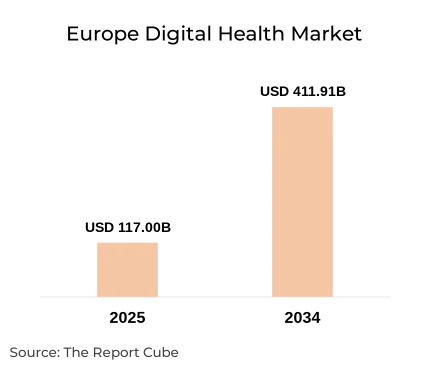
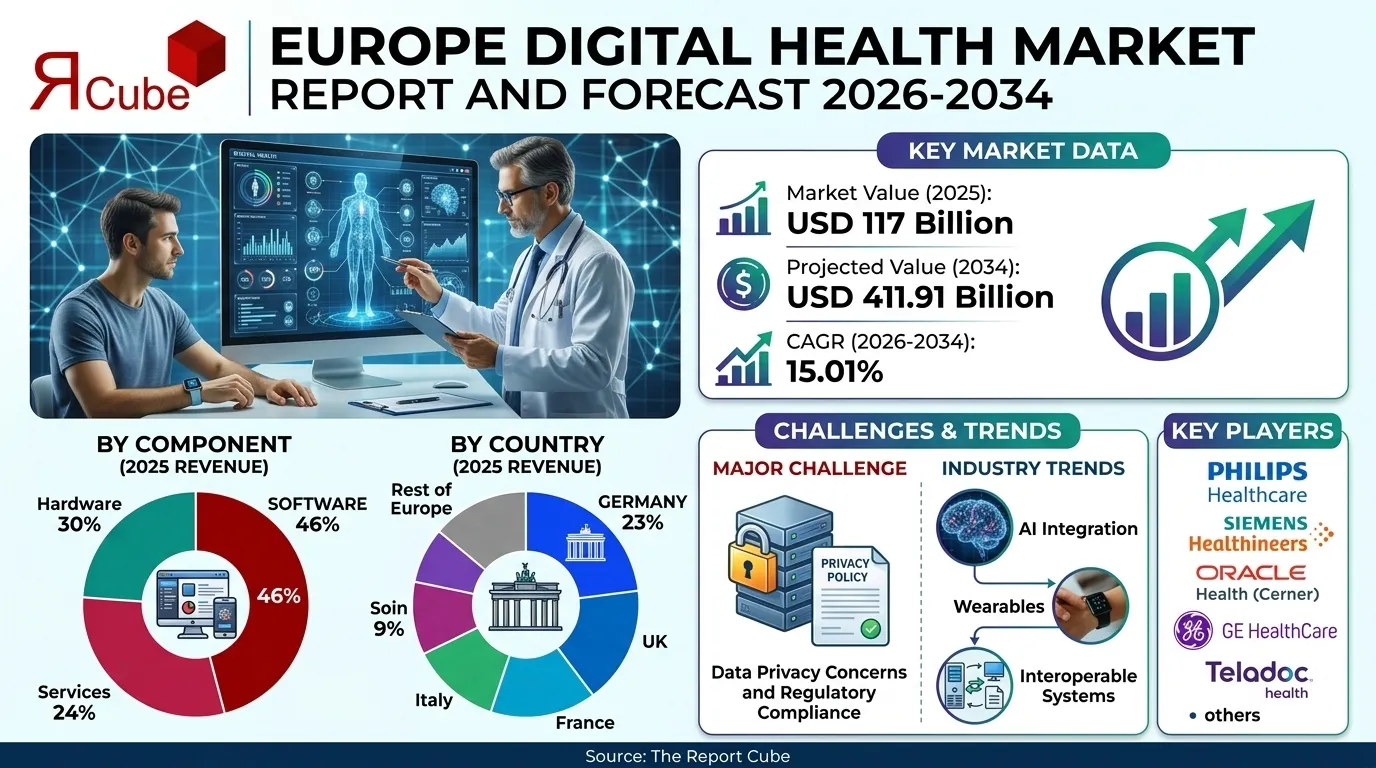
The Europe Digital Health Market is anticipated to register a CAGR of 15.01% during 2026-2034. The market size was valued at USD 117 Billion in 2025 and is projected to reach USD 411.91 Billion by 2034.The Europe Digital Health Market is undergoing rapid expansion, driven by healthcare system modernization, aging demographics, and widespread digital transformation across public and private sectors. Europe faces a growing burden of chronic diseases, with nearly 60% of adults living with at least one long-term condition. Healthcare providers are increasingly adopting digital solutions such as telemedicine platforms, electronic health records (EHRs), remote patient monitoring systems, and AI-driven diagnostics to enhance efficiency and patient outcomes. Governments across Germany, the United Kingdom, and France are investing heavily in digital health infrastructure to reduce hospital congestion and improve care accessibility.
The COVID-19 pandemic accelerated digital adoption, with telehealth consultations in several European countries increasing by over 200% between 2020 and 2023. Investments in artificial intelligence, wearable health devices, and predictive analytics are strengthening preventive healthcare models. Public-private partnerships and venture capital funding in European health-tech startups have also surged, supporting innovation and market competitiveness. As regulatory frameworks mature and interoperability standards improve, the Europe Digital Health Market is positioned for strong double-digit growth through 2034.
Europe Digital Health Market Recent Developments
- 2025: Siemens Healthineers launched an AI-enabled imaging workflow platform across major EU hospitals.
- 2025: Philips Healthcare expanded its remote cardiac monitoring services in Germany and France.
Government Initiatives & Policies
- EU Digital Health Strategy: Promotes cross-border health data exchange and interoperability.
- Germany Digital Healthcare Act (DVG): Supports reimbursement for digital health applications.
Europe Digital Health Market Dynamics
Key Driver: Increasing Chronic Disease Burden and Aging Population
Europe’s rapidly aging population is a major catalyst for digital health adoption. By 2030, nearly 25% of Europe’s population is projected to be over 65 years old. This demographic shift increases demand for chronic disease management, remote monitoring, and home-based healthcare solutions. Digital health platforms enable continuous monitoring of cardiovascular conditions, diabetes, and respiratory disorders, reducing hospital readmissions by up to 18% in certain pilot programs.
Healthcare systems are under financial pressure due to rising treatment costs. Digital tools such as AI-driven diagnostics and predictive analytics improve early detection and optimize resource allocation. Governments are promoting e-prescriptions, virtual consultations, and interoperable health records to enhance care efficiency. Remote patient monitoring devices have shown measurable reductions in emergency visits among elderly populations. These factors collectively drive consistent adoption of digital health technologies across Europe.
Industry Trends: Integration of AI, Wearables, and Interoperable Health Systems
The integration of artificial intelligence and advanced analytics is transforming clinical decision-making. AI-powered imaging tools assist radiologists in detecting anomalies with improved accuracy and reduced turnaround time. Health analytics platforms are enabling population-level health insights, supporting preventive strategies and public health planning.
Wearable devices and mHealth applications are gaining popularity among consumers focused on fitness and preventive care. Over 40% of European adults now use at least one health tracking application or wearable device. Interoperability initiatives across EU member states are facilitating seamless data exchange between healthcare providers. Digital therapeutics and app-based treatment programs are also receiving regulatory approval in markets like Germany and France. These advancements are strengthening innovation pipelines and enhancing market scalability.
Major Challenge: Data Privacy Concerns and Regulatory Compliance
Data privacy remains a significant challenge in the Europe Digital Health Market. Strict regulations under the General Data Protection Regulation (GDPR) impose stringent data handling and storage requirements. Compliance costs can be substantial, particularly for small and mid-sized technology providers.
Cybersecurity threats and data breaches pose reputational and operational risks. Healthcare institutions must invest heavily in secure IT infrastructure and encryption technologies. Additionally, fragmented healthcare systems across European countries create interoperability complexities. Variations in reimbursement frameworks and approval processes can delay digital solution implementation. Addressing privacy, security, and cross-border standardization issues is critical for sustained growth.
Opportunity: Expansion of Home Healthcare and Value-Based Care Models
Home healthcare services represent a significant growth opportunity within the Europe Digital Health Market. Remote monitoring technologies enable patients to manage chronic conditions from home, reducing hospitalization costs. The value-based care model, focused on outcomes rather than volume, is encouraging providers to adopt digital tools that enhance efficiency and measurable patient improvements.
Pharmaceutical and biotechnology companies are leveraging digital platforms for patient engagement and real-world evidence collection. Insurance providers are integrating digital health tools into reimbursement models to encourage preventive care. Startups specializing in AI diagnostics, telepsychiatry, and personalized medicine are attracting increasing investment. These opportunities collectively position digital health as a cornerstone of Europe’s future healthcare ecosystem.
Europe Digital Health Market Segment-wise Analysis
By Component:
- Software
- Hardware
- Services
Software dominates the component segment, accounting for approximately 46% of market revenue in 2025. Electronic health records, telemedicine platforms, and health analytics systems are driving software demand. Services, including implementation and maintenance, contribute significantly due to increasing system integration requirements. Hardware, such as wearable devices and remote monitoring equipment, continues to expand steadily. The leadership of software reflects the central role of digital platforms in transforming healthcare delivery models.
By Application:
- Chronic Disease Management
- Remote Patient Monitoring
- Fitness & Wellness
- Diagnosis & Treatment
Chronic disease management leads the application segment with nearly 29% market share in 2025, driven by rising diabetes, cardiovascular, and respiratory conditions. Remote patient monitoring follows closely, supported by aging demographics and home-based care expansion. Fitness & wellness applications maintain strong consumer adoption, particularly among younger populations. Diagnosis & treatment solutions, powered by AI and imaging analytics, are gaining traction in hospital settings. The dominance of chronic disease management underscores the region’s healthcare priorities and long-term digital investment strategies.
Regional Projection of Europe Digital Health Industry
- Germany
- United Kingdom
- France
- Italy
- Spain
- Rest of Europe
Germany leads the Europe Digital Health Market, accounting for approximately 23% of total regional revenue in 2025. The country’s Digital Healthcare Act (DVG) has accelerated reimbursement approvals for digital health applications, encouraging rapid adoption. The United Kingdom follows, supported by NHS digital transformation initiatives and telehealth integration. France and Italy are investing heavily in e-health infrastructure modernization. Spain and other European nations are expanding remote monitoring programs to address rural healthcare gaps. While Germany maintains leadership due to policy-driven adoption and strong healthcare funding, other European markets are rapidly closing the gap through digital innovation and regulatory alignment.
Why Choose This Report?
- Provides a comprehensive overview of the overall market analysis, encompassing key trends, consumer behavior analysis, and risk assessment to support strategic decision-making.
- Provides accurate, up-to-date insights into market size, segmentation, and emerging opportunities, helping to minimize risk & capitalizing on growth.
- Gives deep understanding of target audience preferences, investment habits, and communication channels for enhanced product development & marketing effectiveness.
- Delivers competitive analysis & benchmarking, uncovering the strengths & weaknesses of market competitors to guide strategies.
- Consolidate comprehensive market intelligence, reducing reasoning & streamlining research efforts.
- Facilitates customized market segmentation & risk mitigation strategies, fine-tuned to the business objectives.
- Aids in identifying both market challenges & untapped opportunities within the industry to drive long-term business growth.
- Provides valuable information based on actual customer data & search trends.
Table of Contents
- Introduction
- Objective of the Study
- Digital Health Definition
- Market Segmentation
- Study Variables
- Research Methodology
- Secondary Data Points
- Breakdown of Secondary Sources
- Primary Data Points
- Breakdown of Primary Interviews
- Secondary Data Points
- Executive Summary
- Market Dynamics
- Drivers
- Challenges
- Opportunity Assessment
- Recent Trends and Developments
- Regulatory and Policy Landscape
- Europe Digital Health Market Overview (2021–2034)
- Market Size, By Value (USD Billion)
- Market Share, By Component
- Software
- Hardware
- Services
- Market Share, By Technology
- Telehealth & Telemedicine
- mHealth
- Health Analytics
- Artificial Intelligence in Healthcare
- Wearable Devices
- Digital Therapeutics
- Others
- Market Share, By Application
- Chronic Disease Management
- Remote Patient Monitoring
- Fitness & Wellness
- Diagnosis & Treatment
- Medication Management
- Others
- Market Share, By End User
- Hospitals & Clinics
- Home Healthcare
- Pharmaceutical & Biotechnology Companies
- Health Insurance Providers
- Patients & Consumers
- Market Share, By Company
- Competition Characteristics
- Revenue Shares & Analysis
- Market Share, By Country
- Germany Digital Health Market
- Market Size, By Value
- Market Share, By Technology
- Market Share, By Application
- United Kingdom Digital Health Market
- Market Size, By Value
- Market Share, By Technology
- Market Share, By Application
- France Digital Health Market
- Market Size, By Value
- Market Share, By Technology
- Market Share, By Application
- Italy Digital Health Market
- Market Size, By Value
- Market Share, By Technology
- Market Share, By Application
- Spain Digital Health Market
- Market Size, By Value
- Market Share, By Technology
- Market Share, By Application
- Rest of Europe Digital Health Market
- Market Size, By Value
- Market Share, By Technology
- Market Share, By Application
- Germany Digital Health Market
- Competitive Outlook and Company Profiles
- Philips Healthcare
- Company Overview
- Digital Health Portfolio
- Strategic Alliances/Partnerships
- Recent Developments
- Siemens Healthineers
- Company Overview
- Digital Health Solutions
- Strategic Alliances/Partnerships
- Recent Developments
- Oracle Health (Cerner)
- Company Overview
- Healthcare IT Portfolio
- Strategic Alliances/Partnerships
- Recent Developments
- GE HealthCare
- Company Overview
- Digital & Imaging Solutions
- Strategic Alliances/Partnerships
- Recent Developments
- Teladoc Health
- Company Overview
- Telehealth Solutions
- Strategic Alliances/Partnerships
- Recent Developments
- Others
- Company Overview
- Business Segments
- Strategic Alliances/Partnerships
- Recent Developments
- Philips Healthcare
- Contact Us / Disclaimer
Top Key Players & Market Share Outlook
- Philips Healthcare
- Siemens Healthineers
- Oracle Health (Cerner)
- GE HealthCare
- Teladoc Health
Frequently Asked Questions






