


Build Your Custom Market Intelligence Report
Customize Your ReportKey Highlights
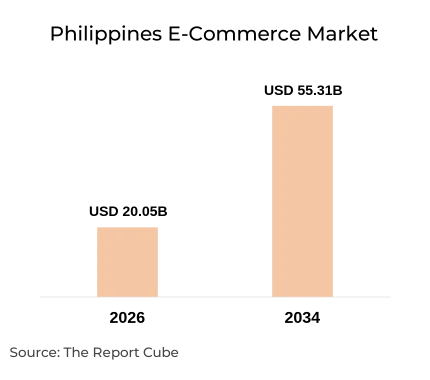
- The Philippines E-Commerce Market was valued at USD 20.05 billion in 2026, based on supplied estimates.
- Market size is projected to reach USD 55.31 billion by 2034, based on supplied forecast values.
- The market is forecast to expand at a CAGR of 13.52% during 2026-2034.
- By business model, B2C led with a 91.64% share in 2026, while B2B is identified as the key growth opportunity.
- By device, smartphones led with a 78.90% share in 2026, reflecting the mobile-first nature of online shopping.
- Mobile internet access, digital payment adoption and social commerce are the major growth drivers.
- Shopee, Lazada and TikTok Shop are among the major platforms, supported by payment and logistics providers such as GCash, Maya and J&T Express.
Market Outlook
The Philippines E-Commerce Market covers goods and services transacted through online channels, including marketplaces, brand-owned websites, social commerce and mobile applications. It matters commercially because it connects consumers and merchants across a dispersed archipelago, lowers entry barriers for small businesses and widens access to products beyond major urban centres. It is also an increasingly important part of the national digital economy.
Demand comes from mobile-first consumers who buy electronics, fashion, food, personal care and household products through marketplace apps and social platforms. Digital wallets, card and cash-on-delivery options, along with growing logistics networks, support checkout and delivery. Businesses of all sizes are adding online storefronts and social selling, and the Philippines E-Commerce Industry is widening beyond large platforms into brand-owned and creator-led channels.
The Philippines E-Commerce Market is estimated at USD 20.05 billion in 2026 and projected to reach USD 55.31 billion by 2034 at a CAGR of 13.52%. Growth is expected to rely on smartphone commerce, digital payments, social commerce and regional fulfilment. Competition among marketplaces, social platforms, payment providers and logistics operators is likely to shape opportunities, while trust, cost and compliance remain issues.
Government Regulations
The Philippines E-Commerce Market is shaped by consumer protection, taxation, data privacy and digital economy measures. Republic Act No. 11967, the Internet Transactions Act of 2023, was enacted on December 5, 2023, with implementing rules issued on May 24, 2024 under the Department of Trade and Industry. It strengthens merchant and platform accountability, consumer protection and dispute resolution for online transactions. Republic Act No. 12023, enacted in October 2024, applies a 12% value-added tax framework to digital services supplied by non-resident providers. Data handling is governed by the Data Privacy Act of 2012 and overseen by the National Privacy Commission, while the Bangko Sentral ng Pilipinas supervises payment and e-money services. The Philippine Statistics Authority publishes digital economy and household survey data used for market monitoring. These measures raise compliance expectations for platforms, sellers and payment providers, and favour operators with transparent governance and secure payment and data practices.
Philippines E-Commerce Market Dynamics
Demand in the Philippines E-Commerce Market is shaped by internet access, mobile shopping habits, payment convenience, merchant participation and logistics capability. Official survey data show rising home internet access and growing online selling, which supports Philippines E-Commerce Market Growth. Consumer trust, delivery costs outside major cities and regulatory compliance continue to influence how platforms and sellers compete and expand.
|
Factor |
Type |
Specific Impact on Market |
Magnitude |
|---|---|---|---|
|
Mobile internet and smartphone adoption |
Driver |
Expands the online-shopping population and supports mobile-first purchasing |
High |
|
Expansion of digital payments |
Driver |
Improves checkout convenience and reduces reliance on cash-based transactions |
Medium–High |
|
SME and regional fulfilment enablement |
Opportunity |
Opens demand for storefront, inventory, payment and last-mile delivery solutions outside Metro Manila |
Medium–High |
|
Consumer trust, cybersecurity and logistics costs |
Challenge |
Fraud, counterfeit concerns and delivery costs can restrain online purchasing |
Medium–High |
|
Social commerce and omnichannel retail |
Trend |
Content-led discovery and brand-owned online stores are shifting how consumers find and buy products |
High |
Growth Drivers: Mobile Internet and Digital Payment Adoption
The Philippine Statistics Authority reports that 48.8% of households had home internet access in 2024, up from 17.7% in 2019. This enlarges the population able to shop online and supports smartphone-led purchasing. The U.S. International Trade Administration reports that digital payments accounted for 54% of Philippine retail payment transactions in 2024. Wider wallet and electronic payment acceptance improves checkout convenience and supports repeat purchasing across marketplaces, social platforms and brand-owned stores.
Market Opportunities: SME Digital Commerce and Regional Fulfilment Enablement
Small and medium-sized businesses are moving online, creating demand for affordable storefronts, payment integration, inventory management, advertising tools and order-processing software. Improved warehousing and last-mile delivery outside Metro Manila can widen access to a more dispersed consumer base. Logistics operators, payment providers, software firms and marketplace service providers are positioned to benefit. These opportunities are qualitative assessments, and their scale depends on logistics investment, merchant readiness and the pace of digital adoption outside major urban areas.
Industry Challenges: Consumer Trust, Cybersecurity and Logistics Constraints
The Philippine Statistics Authority’s 2024 ICT Household Survey found that security concerns remained a major reason consumers avoided electronic payments. Fraudulent transactions, counterfeit goods and data security risks can discourage online purchases. The U.S. International Trade Administration identifies logistics and last-mile delivery as important challenges for Philippine e-commerce. Geographic dispersion and delivery costs raise operating requirements, especially outside major urban centres, and put pressure on seller margins and fulfilment reliability.
Need Specific Data, Let’s Customize the Report for You
Request CustomizationMarket Trends: Social Commerce and Brand-Owned Online Selling
Among Philippines E-Commerce Market Trends, social platforms increasingly combine product discovery, creator recommendations and direct purchasing. The Philippine Statistics Authority’s 2024 ICT Household Survey reports that social-media-based selling rose from 10.9% in 2019 to 25.3% in 2024, while official-store website selling rose from 1.0% to 22.7%. These shifts show merchants diversifying beyond marketplaces, and they point to growing omnichannel and direct-to-consumer retail models across the market.
Philippines E-Commerce Market Segment Analysis
The Philippines E-Commerce Market is segmented by business model, product category, payment method, device and sales channel, reflecting how transactions are initiated, paid for and fulfilled. Leading-segment shares below are the supplied 2026 estimates.
By Business Model
- Business-to-Consumer (B2C)
- Business-to-Business (B2B)
- Consumer-to-Consumer (C2C)
- Direct-to-Consumer (D2C)
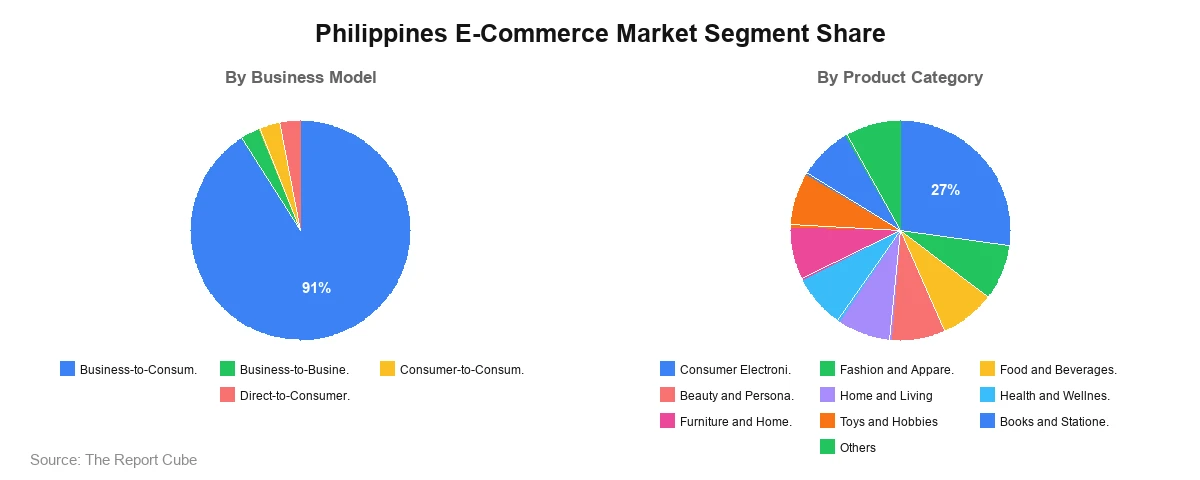
B2C leads the business model segment with an estimated 91% share in 2026, supported by a large consumer base, marketplace adoption and a broad range of retail products. B2B is the second area of focus and is identified as the fastest-growing business model as companies digitise procurement and supplier transactions. C2C and D2C complement these models, with C2C centred on peer-to-peer and second-hand trade and D2C on brand-owned online stores.
By Product Category
- Consumer Electronics
- Fashion and Apparel
- Food and Beverages
- Beauty and Personal Care
- Home and Living
- Health and Wellness
- Furniture and Home Appliances
- Toys and Hobbies
- Books and Stationery
- Others
Consumer electronics leads the product segment with an estimated 27% share in 2026, as buyers can compare prices, specifications, warranties and reviews online. Food and beverages is the second segment of focus and is identified as the fastest-growing category, supported by wider online grocery and meal ordering. Fashion, beauty, home, health, toys and stationery categories serve additional discretionary and household needs, though no supplied ranking is available for them.
Philippines E-Commerce Market Regional Analysis
The Philippines E-Commerce Market is assessed across the National Capital Region and major regional economies of Luzon, the Visayas and Mindanao. Regional market shares were not supplied for this report and have not been estimated. The table therefore describes qualitative regional characteristics only.
|
Region |
Key Growth Factors |
Industry Trends |
|---|---|---|
|
National Capital Region (NCR) |
Dense urban consumer base and established delivery coverage |
Marketplace, social commerce and omnichannel retail |
|
Central Luzon |
Proximity to Metro Manila and logistics connectivity |
Growing regional fulfilment demand |
|
CALABARZON |
Industrial and residential areas near the capital |
Expanding online shopping and delivery access |
|
Central Visayas |
Urban centres with growing digital participation |
Mobile shopping and local seller adoption |
|
Western Visayas |
Regional urban hubs and merchant participation |
Social selling and last-mile delivery development |
|
Davao Region |
Major urban centre in Mindanao |
Mobile commerce and wider payment acceptance |
|
Northern Mindanao |
Regional trade and service centres |
Growing online access outside major cities |
|
Other Regions |
Expanding connectivity and merchant outreach |
Fulfilment and delivery constraints remain important |
No regional leader can be identified without supplied or verified shares. Regional differences are expected to reflect internet access, payment adoption, logistics coverage and merchant participation, with delivery cost and infrastructure constraints most visible outside major urban centres.
Competitive Landscape
The Philippines E-Commerce Market includes marketplace operators, social commerce platforms, specialised retailers, payment providers and logistics companies. The table summarises relevant participants by general capability and role. It does not represent numerical market share or verified ranking, and company details should be validated before publication.
|
Company |
Competitive Strength |
Primary Segment Served |
|---|---|---|
|
Shopee Philippines (Sea Limited) |
Mobile marketplace with broad seller participation and promotions |
General merchandise, electronics, fashion and beauty |
|
Lazada Philippines (Alibaba Group) |
Marketplace with a focus on branded products and official stores |
General merchandise and brand stores |
|
TikTok Shop (ByteDance) |
Creator-led discovery and livestream selling |
Social commerce, beauty and fashion |
|
ZALORA (Global Fashion Group) |
Fashion-focused merchandising and brand positioning |
Apparel, footwear and accessories |
|
Carousell |
Consumer-to-consumer and second-hand marketplace |
C2C, used electronics and collectibles |
|
GCash |
Mobile wallet ecosystem |
Digital payments |
|
Maya |
Wallet and merchant payment acceptance |
Digital payments |
|
LBC Express |
Delivery and parcel network |
Logistics |
|
J&T Express Philippines |
E-commerce parcel fulfilment |
Logistics |
|
Ninja Van Philippines |
Last-mile delivery |
Logistics |
|
Amazon |
International product access |
Cross-border commerce |
Shopee Philippines: Shopee is the marketplace operated by Sea Limited. It offers general merchandise across electronics, fashion, beauty and household products, with seller participation and a mobile shopping interface. Its competitive strength lies in promotions, seller ecosystem depth and app-based convenience. It competes directly with Lazada and TikTok Shop for shoppers and sellers.
Lazada Philippines: Lazada is a general merchandise marketplace owned by Alibaba Group. It emphasises branded products and official stores, supported by marketplace technology and logistics infrastructure. Its competitive strength lies in brand-store participation and fulfilment capability, which appeals to shoppers seeking authenticity. It competes with Shopee and TikTok Shop across general merchandise, fashion and electronics.
Recent Developments and Updates
- April 2026: The Philippine Statistics Authority released its Digital Economy Satellite Account results on April 30, 2026. Digital economy gross value added reached PHP 2.74 trillion in 2025, while total e-commerce gross value added reached PHP 880.46 billion, up from PHP 822.10 billion in 2024.
Philippines E-Commerce Market Future Outlook
The Philippines E-Commerce Market Forecast indicates expansion from USD 20.05 billion in 2026 to USD 55.31 billion by 2034 at a CAGR of 13.52%, based on supplied estimates. Growth is expected to rely on smartphone commerce, digital payments, social commerce and wider participation from small businesses. Opportunities include regional fulfilment, creator-led selling tools and omnichannel retail. These values are projections rather than verified outcomes, and 2033-2034 values are analyst assumptions.
Competition is likely to centre on marketplaces, social platforms, brand-owned stores, payment providers and logistics operators, with investment directed at fulfilment and checkout. Risks include consumer trust, cybersecurity, delivery costs, promotional pressure on seller margins and compliance under digital commerce and taxation rules. Official statistics on e-commerce value added offer a useful cross-check, but they measure a different concept from transaction value, so outcomes will depend on execution and policy.
Philippines E-Commerce Market Report Coverage
This Philippines E-Commerce Market Report summarises the supplied valuation, forecast assumptions, segmentation, regional framework and competitive ecosystem.
|
Parameter |
Details |
|---|---|
|
Market Name |
Philippines E-Commerce Market |
|
Market Size (Base Year) |
USD 20.05 billion (2026) |
|
Market Size (Forecast Year) |
USD 55.31 billion (2034) |
|
CAGR |
13.52% (2026-2034) |
|
Base Year |
2026 |
|
Historical Period |
2021-2025 |
|
Forecast Period |
2026-2034 |
|
Geographic Scope |
Philippines |
|
Segmentation |
By Business Model; By Product Category; By Payment Method; By Device; By Sales Channel; By Region |
|
Regions Covered |
NCR, Central Luzon, CALABARZON, Central Visayas, Western Visayas, Davao Region, Northern Mindanao, Other Regions |
|
Key Companies |
Shopee, Lazada, TikTok Shop, ZALORA, Carousell, GCash, Maya, LBC Express, J&T Express, Ninja Van, Amazon |
|
Customization |
Available as per requirement |
Why Choose This Philippines E-Commerce Market Report?
- Presents the supplied 2026 valuation, 2034 forecast and 13.52% CAGR with stated assumptions.
- Segments the market by business model, product, payment method, device and sales channel.
- Reviews drivers, opportunities, challenges and trends supported by official Philippine and U.S. government data.
- Provides regional context across the National Capital Region, Luzon, the Visayas and Mindanao, with unsupplied shares identified.
- Profiles key marketplaces, payment providers and logistics operators by capability and role.
- Highlights social commerce, SME enablement and regional fulfilment opportunities and trends.
- Summarises Philippine consumer protection, taxation and data privacy context relevant to strategic decisions.
Table of Contents
- Introduction
- Objective of the Study
- Product Definition
- Market Segmentation
- Study Variables
- Research Methodology
- Secondary Data Points
- Companies Interviewed
- Primary Data Points
- Breakdown of Primary Interviews
- Secondary Data Points
- Executive Summary
- Market Dynamics
- Drivers
- Challenges
- Opportunity Assessment
- Recent Trends and Developments
- Policy and Regulatory Landscape
- Philippines E-Commerce Market Overview and Forecast Analysis (2021-2034)
- Market Size, By Value, By Growth Rate (CAGR/USD Billions)
- Demand – Supply Trends
- Market Share, By Business Model
- Business-to-Consumer (B2C)
- Business-to-Business (B2B)
- Consumer-to-Consumer (C2C)
- Direct-to-Consumer (D2C)
- Market Share, By Product Category
- Consumer Electronics
- Fashion and Apparel
- Food and Beverages
- Beauty and Personal Care
- Home and Living
- Health and Wellness
- Furniture and Home Appliances
- Toys and Hobbies
- Books and Stationery
- Others
- Market Share, By Payment Method
- Digital Wallets
- Credit and Debit Cards
- Cash on Delivery (COD)
- Bank Transfers
- Buy Now, Pay Later (BNPL)
- Other Payment Methods
- Market Share, By Device
- Smartphones
- Desktop and Laptops
- Tablets
- Other Connected Devices
- Market Share, By Sales Channel
- Online Marketplaces
- Brand-Owned Websites
- Social Commerce
- Mobile Commerce Applications
- Other Online Channels
- Market Share, By Region
- National Capital Region (NCR)
- Central Luzon
- CALABARZON
- Central Visayas
- Western Visayas
- Davao Region
- Northern Mindanao
- Other Regions
- Market Share, By Competitors
- Competition Characteristics
- Revenue Shares
- Business-to-Consumer (B2C) Philippines E-Commerce Market Overview, 2021-2034F
- By Value (USD Million)
- By Product Category – Market Size & Forecast 2021-2034, USD Million
- Consumer Electronics
- Fashion and Apparel
- Food and Beverages
- Beauty and Personal Care
- Home and Living
- Health and Wellness
- Furniture and Home Appliances
- Toys and Hobbies
- Books and Stationery
- Others
- Business-to-Business (B2B) Philippines E-Commerce Market Overview, 2021-2034F
- By Value (USD Million)
- By Product Category – Market Size & Forecast 2021-2034, USD Million
- Consumer Electronics
- Fashion and Apparel
- Food and Beverages
- Beauty and Personal Care
- Home and Living
- Health and Wellness
- Furniture and Home Appliances
- Toys and Hobbies
- Books and Stationery
- Others
- Consumer-to-Consumer (C2C) Philippines E-Commerce Market Overview, 2021-2034F
- By Value (USD Million)
- By Product Category – Market Size & Forecast 2021-2034, USD Million
- Consumer Electronics
- Fashion and Apparel
- Food and Beverages
- Beauty and Personal Care
- Home and Living
- Health and Wellness
- Furniture and Home Appliances
- Toys and Hobbies
- Books and Stationery
- Others
- Direct-to-Consumer (D2C) Philippines E-Commerce Market Overview, 2021-2034F
- By Value (USD Million)
- By Product Category – Market Size & Forecast 2021-2034, USD Million
- Consumer Electronics
- Fashion and Apparel
- Food and Beverages
- Beauty and Personal Care
- Home and Living
- Health and Wellness
- Furniture and Home Appliances
- Toys and Hobbies
- Books and Stationery
- Others
- Competitive Outlook (Company Profile – Partial List)
- Shopee Philippines
- Company Overview
- Business Segments
- Strategic Alliances/Partnerships
- Recent Developments
- Lazada Philippines
- Company Overview
- Business Segments
- Strategic Alliances/Partnerships
- Recent Developments
- TikTok Shop
- Company Overview
- Business Segments
- Strategic Alliances/Partnerships
- Recent Developments
- ZALORA
- Company Overview
- Business Segments
- Strategic Alliances/Partnerships
- Recent Developments
- Carousell
- Company Overview
- Business Segments
- Strategic Alliances/Partnerships
- Recent Developments
- Shopee Philippines
- Contact Us & Disclaimer
Top Key Players & Market Share Outlook
- Shopee Philippines
- Lazada Philippines
- TikTok Shop
- ZALORA
- Carousell
Frequently Asked Questions