



Build Your Custom Market Intelligence Report
Customize Your ReportAustralia Electric Vehicle Charging Market Key Takeaways
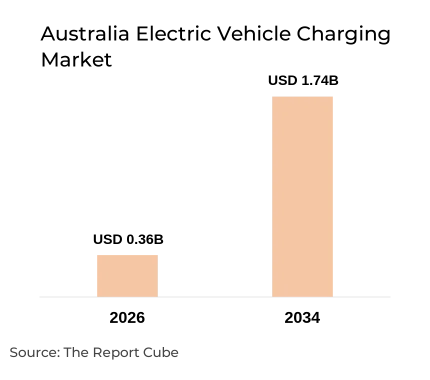
- Australia Electric Vehicle Charging Market valued at USD 0.36 billion in 2026, reflecting accelerating infrastructure deployment.
- Market projected to reach USD 1.74 billion by 2034, growing at a robust 21.76% CAGR.
- Smart Charging Platforms lead the By Platform Type segment, driven by grid-integration and demand-response capabilities.
- BEVs dominate the By Vehicle Type Supported segment across public and private charging infrastructure nationwide.
- New South Wales holds the largest regional share, anchored by Sydney's dense urban EV corridor expansion.
- Evie Networks, Tesla, and JOLT Charge lead charging network deployment and infrastructure rollout across Australia.
- Federal and state government investment programs are accelerating highway charging corridor development substantially.
- Premiumization of smart charging software and energy management platforms is reshaping procurement decisions by fleet operators.
Australia Electric Vehicle Charging Market Overview
The Australia Electric Vehicle Charging Market is projected to expand at a 21.76% CAGR through 2026–2034, rising from USD 0.36 billion in 2026 to USD 1.74 billion by 2034. Australia's National Electric Vehicle Strategy, released in 2023 and progressively implemented through state-level action plans, has provided a structured policy framework accelerating public charging infrastructure investment. Federal funding commitments under the Driving the Nation Fund - allocating AUD 500 million toward EV charging and hydrogen refueling infrastructure - are directly supporting corridor development across interstate highways and urban centers. Evie Networks, Tesla Supercharger, and JOLT Charge are actively expanding charging point density in New South Wales, Victoria, and Queensland, with platform operators integrating smart charging and network management systems to serve both consumer and fleet segments.
Australia's strategic transition away from internal combustion vehicles, supported by updated Fuel Efficiency Standards taking effect from 2025, is generating sustained procurement demand across all charging platform categories. The Australia EV charging infrastructure ecosystem is maturing rapidly as charging-as-a-service models attract private investment alongside government grants. BP Pulse and EVX Australia are broadening accessibility through retail fuel station integration and workplace charging partnerships. Growing fleet electrification commitments from logistics operators, government vehicle pools, and corporate sustainability programs are expanding demand for networked Smart Charging Platforms with telematics, load management, and real-time grid-response functionality across commercial and industrial charging applications through 2034.
Australia Electric Vehicle Charging Market Size & Forecast
|
Metric |
Details |
|---|---|
|
Market Size (2026) |
USD 0.36 Billion |
|
Market Size (2034) |
USD 1.74 Billion |
|
CAGR (2026–2034) |
21.76% |
|
Base Year |
2026 |
|
Historical Years |
2021–2025 |
|
Forecast Years |
2026–2034 |
This Australia Electric Vehicle Charging Market Size study values the industry at USD 0.36 billion in 2026 and projects expansion to USD 1.74 billion by 2034 at a 21.76% CAGR, significantly outpacing the broader Asia-Pacific average, driven by government-backed highway corridor programs, fleet electrification mandates, and rapid Smart Charging Platform adoption across metropolitan and regional commercial zones.
Australia Electric Vehicle Charging Market Dynamics
Australia's EV charging market is transitioning from early-adopter infrastructure buildout toward scaled network deployment, with policy incentives, rising EV sales penetration, and energy grid modernization collectively sustaining long-term demand. The Australia Electric Vehicle Charging Market Growth is primarily driven by government funding certainty, utility partnerships, and increasing fleet electrification commitments from both public and private sector organizations operating nationally.
|
Factor |
Type |
Specific Impact on Market |
Magnitude |
|---|---|---|---|
|
Federal Driving the Nation Fund investment |
Driver |
Directly funds public charging corridor expansion across highways and urban centers |
High |
|
Rising EV sales penetration and BEV adoption |
Driver |
Generates recurring demand for expanded public and private charging point infrastructure |
High |
|
High upfront infrastructure deployment costs |
Restraint |
Limits private operator margins in low-traffic regional zones with limited utilization |
Medium |
|
Fleet electrification commitments by corporates |
Opportunity |
Creates large-scale Smart Charging Platform procurement demand across commercial applications |
High |
|
Grid integration complexity and capacity constraints |
Challenge |
Slows smart charging rollout in areas requiring network augmentation and utility coordination |
Medium |
Growth Drivers - Federal Policy Investment and EV Sales Surge
Australia's National EV Strategy and Driving the Nation Fund have established AUD 500 million in committed federal funding for public charging infrastructure. EV registrations in Australia surpassed 100,000 units annually by 2024, generating direct and sustained demand for expanded charging network capacity across metropolitan, highway, and workplace charging environments. Evie Networks and Tesla Supercharger have scaled deployments significantly, with Evie committing to over 1,000 charging bays nationally by 2026 under federal partnership programs.
Market Opportunities - Fleet Electrification and Charging-as-a-Service Models
Australia's corporate fleet sector - encompassing government vehicle pools, logistics operators, and large enterprise car fleets - represents the largest near-term procurement opportunity for managed Smart Charging Platforms. Charging-as-a-service models offered by AmpCharge and BP Pulse eliminate upfront capital requirements for fleet operators, enabling faster site deployment. This model is projected to capture over 35% of B2B charging infrastructure contracts by 2030 as subscription-based energy management gains traction.
Industry Challenges - Grid Capacity and Permitting Complexity
Distribution network capacity constraints present a systemic challenge for high-power charging deployment in dense urban precincts and industrial zones. Council-level permitting processes vary significantly across local government areas, adding months to site approval timelines. EUDR-equivalent supply chain transparency requirements and evolving Australian Energy Regulator guidelines on demand management are increasing compliance complexity for charging network operators and grid-connected platform providers.
Need Specific Data, Let’s Customize the Report for You
Request CustomizationAustralia Electric Vehicle Charging Market Trends
Among the most significant Australia Electric Vehicle Charging Market Trends is the accelerating convergence of smart charging software, vehicle-to-grid (V2G) capability, and renewable energy integration into unified energy management platforms, reshaping how operators and fleet managers approach charging infrastructure procurement.
- Emerging Trends: Australia's EV charging landscape is evolving toward integrated energy ecosystems combining solar generation, battery storage, and smart charging orchestration at the site level. Workplace and residential charging deployments are growing rapidly as employers and property developers recognize EV charging infrastructure as a competitive tenant amenity and sustainability compliance requirement under NABERS energy rating frameworks.
- Technology Trends: Vehicle-to-grid (V2G) technology pilots are advancing across South Australia and the ACT, with AGL Energy and Evie Networks partnering on bidirectional charging trials. AI-powered load management platforms, dynamic pricing algorithms, and predictive maintenance diagnostics are being integrated into Network Operations Systems by EVX Australia and AmpCharge, enabling real-time grid-responsive charging optimization across multi-site commercial deployments.
- Consumer / Buyer Trends: Australian EV drivers increasingly prioritize charging network reliability, payment simplicity, and roaming interoperability across competing networks when selecting vehicles and home charging equipment. Plug-and-charge authentication, OCPP 2.0.1 protocol compliance, and real-time availability visibility via mobile applications have become baseline expectations. Fleet procurement managers evaluate charging platforms on total cost of ownership, uptime SLAs, and carbon reporting integration aligned with corporate ESG disclosure obligations.
Australia Electric Vehicle Charging Market Segment Analysis
Australia's EV charging market serves distinct operator, fleet, and consumer needs across platform technology categories and vehicle type requirements. The Australia Electric Vehicle Charging Market Share distribution reflects differentiated growth trajectories across Smart Charging Platforms, Network Operations Systems, and standalone mobile solutions, each driven by distinct procurement drivers, deployment scales, and connectivity standards. Segment performance is shaped by fleet electrification timelines, grid integration requirements, and the relative maturity of BEV versus PHEV vehicle populations across different geographic and commercial contexts.
By Platform Type
|
Platform Type |
Estimated Share (2026) |
Key Characteristics |
|---|---|---|
|
Smart Charging Platforms |
52% |
Grid-integrated, AI-optimized, demand-response capable; preferred by fleet operators and utilities |
|
Network Operations Systems |
31% |
Multi-site management, OCPP compliance, roaming interoperability; used by CPOs and public networks |
|
Mobile / Standalone Platforms |
17% |
App-based payment, session monitoring; low deployment cost; serves individual consumer segments |
Smart Charging Platforms lead the By Platform Type segment with an estimated 52% share in 2026. Evie Networks and AmpCharge deploy AI-driven load management and demand-response software as core features of their commercial and fleet charging offerings, enabling real-time grid optimization aligned with AEMO requirements. Network Operations Systems, capturing approximately 31% of platform-type demand, are deployed by BP Pulse and EVX Australia to manage multi-site public charging networks with OCPP 2.0.1 compliance and cross-network roaming interoperability. Mobile and Standalone Platforms, representing 17%, serve consumer-facing charging applications and low-volume residential deployments, with JOLT Charge operating a distinctive zero-cost model funded by advertising revenue at retail and commercial locations.
By Vehicle Type Supported
|
Vehicle Type Supported |
Estimated Share (2026) |
Growth Outlook |
|---|---|---|
|
Battery Electric Vehicles (BEVs) |
74% |
Dominant and fastest-growing; driven by full-EV fleet mandates and increasing BEV model availability |
|
Plug-in Hybrid Electric Vehicles (PHEVs) |
26% |
Stable; supported by mixed-fleet operator demand and transitional fleet electrification programs |
Battery Electric Vehicles dominate the By Vehicle Type Supported segment at an estimated 74% market share in 2026, reflecting Australia's accelerating BEV registration growth and fleet electrification mandates within federal and state government vehicle pools. Tesla Supercharger and Evie Networks anchor BEV-focused fast charging with DC infrastructure operating at up to 350 kW for ultra-fast corridor charging. PHEVs, accounting for approximately 26%, are served through AC Level 2 charging deployments by AmpCharge and BP Pulse, particularly in workplace and residential charging environments where overnight or partial charging sessions align with PHEV battery capacity requirements and mixed-fleet operator procurement strategies through 2034.
Australia Electric Vehicle Charging Market Regional Analysis
|
Region |
Estimated Market Share |
Key Growth Factors |
Consumer Trends |
|---|---|---|---|
|
New South Wales |
35% |
Sydney metropolitan density, M1 and Pacific Highway corridor funding, fleet electrification |
High BEV adoption, smart charging platform demand from corporate fleet operators |
|
Victoria |
27% |
Melbourne urban network expansion, state EV Action Plan incentives, workplace charging mandates |
Growing residential smart charger adoption, PHEV fleet integration in Melbourne CBD |
|
Queensland |
18% |
SEQ corridor deployment, tourism and logistics fleet electrification, state charging fund |
Highway fast charging demand, BEV tourism infrastructure across Gold Coast and Sunshine Coast |
|
Western Australia |
12% |
Perth metropolitan network growth, mining sector fleet electrification trials |
BEV adoption in corporate mining fleets, remote area charging infrastructure investment |
|
Rest of Australia |
8% |
Regional highway corridor funding, ACT and SA policy leadership, interstate travel charging |
Rural fast charging demand, V2G trial participation in South Australia and ACT |
- New South Wales - Holding approximately 35% of national market demand, New South Wales anchors Australia's EV charging market through Sydney's dense BEV population, federal Driving the Nation Fund investment along the M1 Pacific Motorway, and corporate fleet electrification commitments from financial services, government agencies, and logistics operators. Evie Networks and Tesla Supercharger have deployed the highest concentration of DC fast charging infrastructure across metropolitan Sydney and the Hunter Region.
- Victoria - Capturing approximately 27% of national charging infrastructure demand, Victoria's EV Action Plan provides direct procurement subsidies for workplace charger installations and mandates minimum EV-ready parking provisions in new commercial developments. Melbourne's inner-city charging network is expanding rapidly, with BP Pulse and AmpCharge active across retail and commercial site deployments supporting both BEV and PHEV fleet operators.
- Queensland - Accounting for approximately 18% of market demand, Queensland's South East Queensland (SEQ) EV Corridor and state charging fund are enabling significant fast charging deployment between Brisbane, the Gold Coast, and the Sunshine Coast. Tourism-related vehicle electrification and the 2032 Brisbane Olympics infrastructure legacy program are generating long-term demand for expanded public and hospitality-sector charging deployments.
- Western Australia - Representing approximately 12% of market share, Western Australia's EV charging market is underpinned by Perth's growing BEV population and the resources sector's early-stage mining vehicle electrification trials. EVX Australia and Evie Networks are extending infrastructure into regional mining corridors, with government co-investment supporting charging point deployment along the Great Eastern Highway and primary resource transport routes.
- Rest of Australia - Comprising approximately 8% of national market demand, this segment includes the ACT, South Australia, Tasmania, and the Northern Territory. South Australia and the ACT are policy leaders in V2G trialing and renewable-integrated charging, with AGL Energy and JOLT Charge participating in grid-interactive charging pilots that are expected to generate replicable models for broader national deployment through 2034.
Australia Electric Vehicle Charging Market Share & Competitive Landscape
The Australia Electric Vehicle Charging Market is characterized by a competitive mix of domestic network operators, global charging technology providers, and energy retail incumbents expanding into EV infrastructure. Key players compete across charging speed capability, network coverage density, software platform sophistication, and pricing model innovation - with government tender eligibility and sustainability credentials increasingly differentiating competitive positioning for major public infrastructure contracts.
|
Company |
Competitive Strength |
Primary Segment Served |
|---|---|---|
|
Evie Networks |
Largest domestic public charging network; federal grant recipient; DC ultra-fast focus |
Public highway and urban BEV fast charging |
|
Tesla |
Supercharger brand recognition; dense urban network; V4 Supercharger rollout |
BEV fast charging; Tesla and open-access segments |
|
JOLT Charge |
Zero-cost consumer model; retail location integration; advertising-funded revenue structure |
Consumer BEV; retail and commercial AC charging |
|
EVX Australia |
Fleet management software; OCPP-compliant network operations; multi-site deployment |
Fleet operators; Network Operations Systems |
|
AmpCharge |
Charging-as-a-service; workplace and residential platform; subscription B2B model |
Corporate fleets; smart charging platforms |
|
BP Pulse |
Retail fuel station integration; global brand; Level 2 and DC fast charging mix |
Public and commercial BEV/PHEV mixed segments |
|
Others |
Regional operators, utility-backed deployments, government-funded rural infrastructure |
Regional public and residential segments |
Key Companies in the Australia Electric Vehicle Charging Market
Evie Networks
Evie Networks, headquartered in Sydney, Australia, operates the country's largest proprietary public EV fast charging network and has received federal Driving the Nation Fund co-investment for national highway corridor deployment. In 2025, Evie Networks expanded its ultra-fast 350 kW charging capability to more than 50 new highway sites across New South Wales, Victoria, and Queensland, reinforcing its market-leading position in public corridor infrastructure. Its Smart Charging Platform integrates real-time network management, OCPP 2.0.1 compliance, and roaming interoperability with competing networks, establishing Evie as a structurally critical player in Australia's national charging infrastructure ecosystem through 2034.
Tesla
Tesla, headquartered in Austin, Texas, USA, operates the globally recognized Supercharger network and has progressively opened its Australian infrastructure to non-Tesla BEV drivers as part of its open-access strategy. In 2025, Tesla expanded its V4 Supercharger rollout across major Australian metropolitan centers and key tourism corridors, delivering charging speeds of up to 250 kW per vehicle. Tesla's vertically integrated approach - combining vehicle manufacturing, energy storage, and charging infrastructure - provides a structurally differentiated competitive position in Australia's premium BEV charging segment, supporting both consumer convenience and fleet charging use cases at scale.
Australia Electric Vehicle Charging Market Recent Developments
|
Year |
Company |
Development |
|---|---|---|
|
2025 |
Evie Networks |
Expanded ultra-fast 350 kW charging to 50+ new highway sites across NSW, VIC, and QLD under Driving the Nation Fund |
|
2025 |
Tesla |
Rolled out V4 Supercharger stations across major Australian cities and tourism corridors, opening access to non-Tesla BEVs |
|
2025 |
JOLT Charge |
Extended zero-cost charging network to additional retail and commercial sites across South East Queensland |
|
2025 |
BP Pulse |
Partnered with major Australian fuel retail sites to integrate DC fast charging bays alongside existing fuel forecourt infrastructure |
Australia Electric Vehicle Charging Market Future Outlook
The Australia Electric Vehicle Charging Market Forecast projects a 21.76% CAGR through 2034, with the market expanding from USD 0.36 billion in 2026 to USD 1.74 billion by 2034. Continued federal and state government investment in highway corridor charging, accelerating BEV fleet adoption across corporate and government vehicle pools, and the maturation of Smart Charging Platform capabilities will sustain infrastructure demand. Evie Networks, Tesla, and BP Pulse are expected to deepen geographic coverage and platform sophistication, competing for large-scale government charging tenders and fleet management contracts through the forecast period.
Technological advancement will reshape competitive dynamics as V2G-capable charging systems, AI-optimized load management, and solar-integrated charging hubs transition from pilot programs to commercial-scale deployments. Sustainable charging infrastructure requirements - including carbon reporting integration, renewable energy sourcing, and grid-responsive demand management aligned with AEMO frameworks - will become standard procurement specifications for public and corporate charging contracts. The EV fleet management software ecosystem will converge with charging platform capabilities, enabling unified energy, compliance, and operational management across national fleet portfolios through 2034.
Australia Electric Vehicle Charging Market Report Coverage
This Australia Electric Vehicle Charging Market Report covers the full forecast period from 2026 through 2034, providing comprehensive sizing, segmentation, competitive intelligence, and regional analysis for strategic planning and investment decision-making.
|
Report Attribute |
Details |
|---|---|
|
Market Name |
Australia Electric Vehicle Charging Market |
|
Market Size (2026) |
USD 0.36 Billion |
|
Market Size (2034) |
USD 1.74 Billion |
|
Forecast Period |
2026–2034 |
|
CAGR |
21.76% |
|
Base Year |
2026 |
|
Historical Years |
2021–2025 |
|
Forecast Years |
2026–2034 |
|
Segments Covered |
By Charger Type, By Connector Type, By Deployment Location, By Platform Type, By Vehicle Type Supported |
|
Regions Covered |
New South Wales, Victoria, Queensland, Western Australia, Rest of Australia |
|
Key Companies |
Evie Networks, Tesla, JOLT Charge, EVX Australia, AmpCharge, BP Pulse, Others |
|
Report Format |
PDF, Excel, PPT |
|
Customization |
Available as per client requirements |
Why Choose This Australia Electric Vehicle Charging Market Report?
- Comprehensive sizing of the Australia Electric Vehicle Charging Market from USD 0.36 billion in 2026 through 2034 forecast.
- Detailed segmentation by platform type (Smart Charging, Network Operations, Mobile/Standalone) and vehicle type (BEV vs. PHEV).
- State-level regional analysis covering New South Wales, Victoria, Queensland, Western Australia, and Rest of Australia with share estimates.
- Competitive profiling of 6 leading EV charging operators and infrastructure providers active in the Australian market.
- Analysis of government funding programs, Fuel Efficiency Standards, and AEMO grid-integration policy impacts on market growth.
- Coverage of emerging V2G, charging-as-a-service, and AI-driven load management technology trends reshaping platform procurement.
- Forecast data and segmentation insights supporting infrastructure investment, network expansion, and fleet electrification planning decisions.
- Research aligned with Australia's National Electric Vehicle Strategy and state-level EV Action Plan objectives through 2034.
Table of Contents
- Introduction
- Objective of the Study
- Product Definition
- Market Segmentation
- Study Variables
- Research Methodology
- Secondary Data Points
- Companies Interviewed
- Primary Data Points
- Breakdown of Primary Interviews
- Secondary Data Points
- Executive Summary
- Market Dynamics
- Drivers
- Challenges
- Opportunity Assessment
- Recent Trends and Developments
- Policy and Regulatory Landscape
- Australia Electric Vehicle Charging Market Overview and Forecast Analysis (2021-2034)
- Market Size, By Value, By Growth Rate (CAGR/USD Billions)
- Demand – Supply Trends
- Market Share, By Charger Type
- AC Chargers
- DC Chargers
- Market Share, By Deployment Location
- Residential
- Commercial Public
- Commercial Private
- Market Share, By Connector Type
- CCS
- Type 2
- Type 1
- CHAdeMO
- Market Share, By Platform Type
- Smart Charging Platforms
- Network Operations Systems
- Mobile / Standalone Platforms
- Market Share, By Vehicle Type Supported
- BEVs
- PHEV
- Market Share, By Region
- New South Wales
- Victoria
- Queensland
- Western Australia
- Rest of Australia
- Market Share, By Competitors
- Competition Characteristics
- Revenue Shares
- AC Chargers Australia Electric Vehicle Charging Market Overview, 2021-2034F
- By Value (USD Million)
- By Deployment Location – Market Size & Forecast 2021-2034, USD Million
- Residential
- Commercial Public
- Commercial Private
- DC Chargers Australia Electric Vehicle Charging Market Overview, 2021-2034F
- By Value (USD Million)
- By Deployment Location – Market Size & Forecast 2021-2034, USD Million
- Residential
- Commercial Public
- Commercial Private
- Competitive Outlook (Company Profile - Partial List)
- Evie Networks
- Company Overview
- Business Segments
- Strategic Alliances/Partnerships
- Recent Developments
- Tesla
- Company Overview
- Business Segments
- Strategic Alliances/Partnerships
- Recent Developments
- JOLT Charge
- Company Overview
- Business Segments
- Strategic Alliances/Partnerships
- Recent Developments
- EVX Australia
- Company Overview
- Business Segments
- Strategic Alliances/Partnerships
- Recent Developments
- AmpCharge
- Company Overview
- Business Segments
- Strategic Alliances/Partnerships
- Recent Developments
- BP Pulse
- Company Overview
- Business Segments
- Strategic Alliances/Partnerships
- Recent Developments
- Others
- Evie Networks
- Contact Us & Disclaimer
Top Key Players & Market Share Outlook
- Evie Networks
- Tesla
- JOLT Charge
- EVX Australia
- AmpCharge
- BP Pulse
- Others
Frequently Asked Questions






