



Build Your Custom Market Intelligence Report
Customize Your ReportSaudi Arabia Emulsion Polymers Market Key Highlights
By Type:
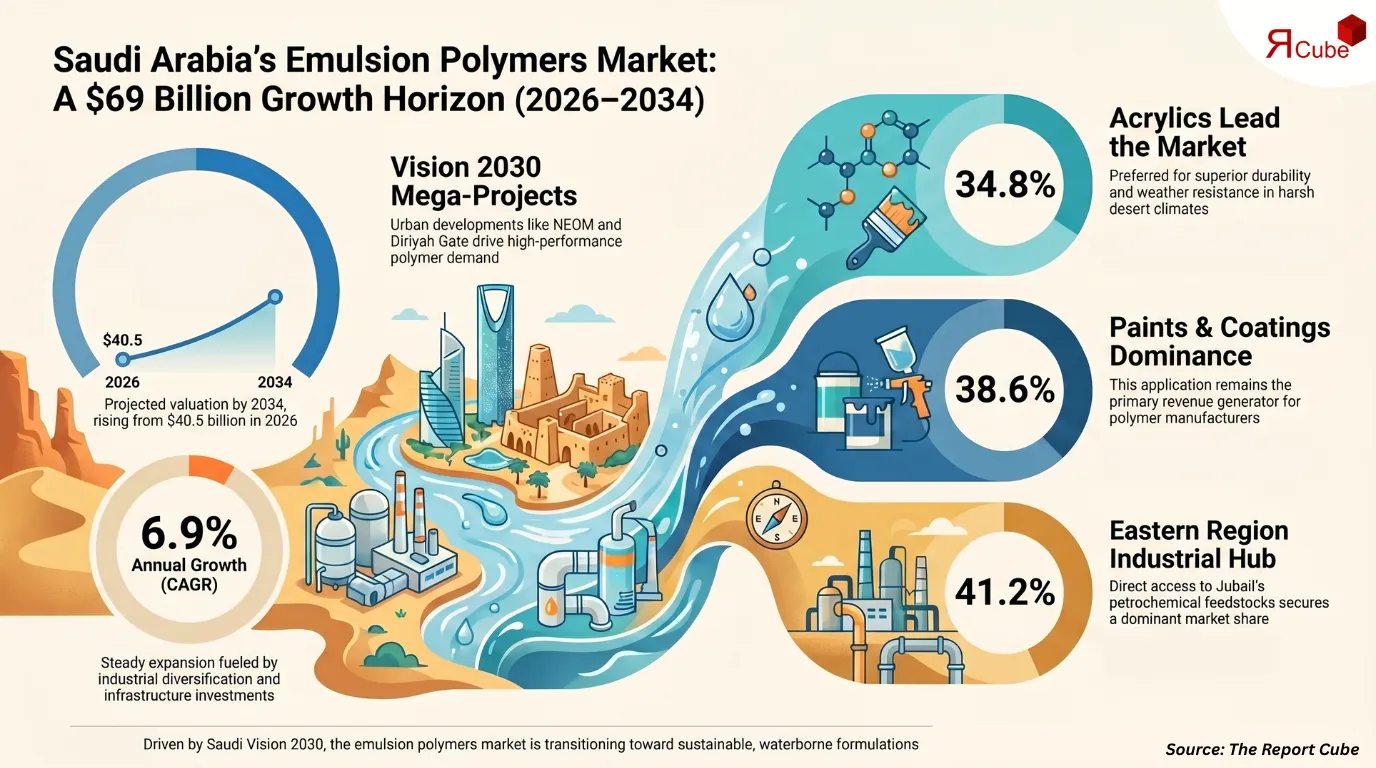
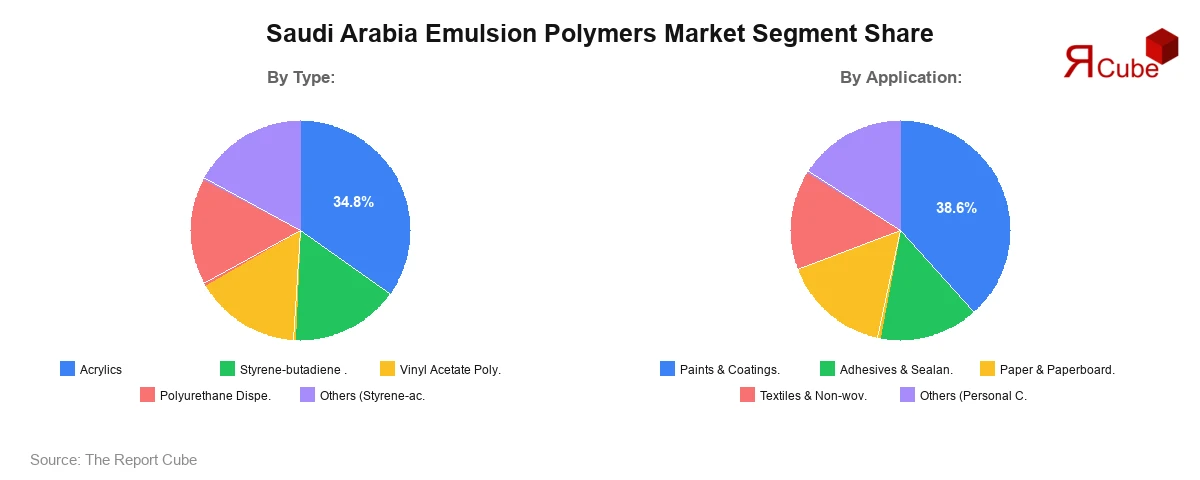
Acrylics segment leads the market with nearly 34.8% share.
By Application:
Paints & Coatings segment dominates the market with approximately 38.6% of revenue.
Regional Outlook:
Eastern region dominates the Saudi Arabia Emulsion Polymers market with around 41.2% share.
Saudi Arabia Emulsion Polymers Market Insights & Analysis
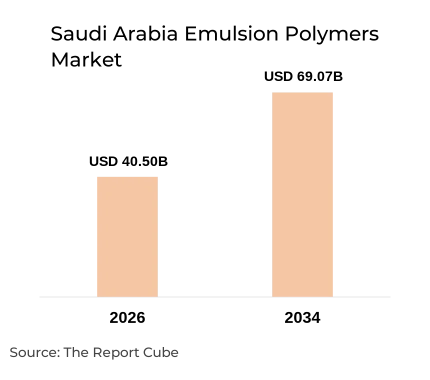
The Saudi Arabia Emulsion Polymers Market is anticipated to register a CAGR of around 6.9% during the forecast period 2026-2034. The market size is valued at USD 40.50 billion in 2026 and is projected to reach USD 69.07 billion by 2034. The growth of the market is closely tied to Saudi Arabia's industrial diversification agenda and sustained investments in construction, manufacturing, and specialty chemicals. Emulsion polymers have become essential raw materials for paints, coatings, adhesives, textiles, and packaging applications due to their durability, low environmental impact, and compatibility with water-based formulations. Rising adoption of sustainable building materials across major urban developments, including NEOM, Diriyah Gate, and Red Sea projects, is creating steady demand for high-performance polymer emulsions throughout the Kingdom.
The Emulsion Polymers industry in KSA is also benefiting from the country's well-established petrochemical value chain and increasing focus on local manufacturing. Major industrial hubs such as Jubail and Yanbu continue to attract investments in downstream chemical production, enabling stronger domestic supply capabilities. Manufacturers are increasingly introducing advanced acrylic and vinyl acetate technologies that meet evolving performance and environmental requirements. At the same time, growing consumption of decorative coatings, industrial adhesives, and specialty packaging materials is supporting broader market expansion. The sector's long-term outlook remains favorable as Saudi Arabia strengthens its position as a regional center for specialty chemicals and advanced materials manufacturing.
Saudi Arabia Emulsion Polymers Market Impact Analysis
| Factor | Type | Specific Impact on Market | Magnitude | Business Implication |
|---|---|---|---|---|
| Vision 2030 Construction Pipeline | Market | Large projects lift demand for coatings, sealants, and binders | High | Supports long term volume growth in acrylic based emulsions |
| Shift to Waterborne Coatings | Technological | End users replace solvent systems with water based polymers | High | Drives capacity for low VOC and high solids emulsion grades |
| Environmental Compliance Pressure | Regulatory | Stricter rules favor low emission and eco aligned chemistries | Medium | Encourages R&D into sustainable and bio based emulsion lines |
| Dependence on Construction Segment | Market | High share of demand tied to building and infrastructure cycles | High | Makes sales sensitive to delays in real estate and mega plans |
| Raw Material Price Volatility | Environmental | Feedstock swings impact margins for styrene and acrylic chains | Medium | Requires hedging, index linked contracts, and cost control focus |
| Global and Regional Player Presence | Competitive | Multinationals intensify pricing rivalry and technology race | Medium | Pushes producers to differentiate on service and application support |
| Diversifying End Use Industries | Market | Packaging, textiles and automotive steadily widen consumption base | Medium | Reduces dependence on any single sector and supports resilience |
Saudi Arabia Emulsion Polymers Market Dynamics
Key Driver: Infrastructure Expansion Accelerating Polymer Demand
Large-scale infrastructure development remains the strongest growth catalyst for the Saudi Arabia Emulsion Polymers Market. The Kingdom continues to allocate significant capital toward transportation networks, tourism destinations, industrial zones, housing developments, and smart city projects. These investments generate substantial demand for architectural coatings, waterproofing systems, construction adhesives, and sealants where emulsion polymers serve as critical performance-enhancing ingredients. Water-based acrylic emulsions are particularly preferred because they provide durability, weather resistance, and compliance with modern environmental standards.
The construction sector's increasing emphasis on quality, longevity, and sustainability is further boosting demand for advanced polymer technologies. New residential communities, commercial facilities, and public infrastructure projects require coating systems capable of withstanding extreme temperatures, sand exposure, and ultraviolet radiation. As project pipelines continue to expand under Vision 2030, consumption of emulsion polymers across building and construction applications is expected to maintain a strong upward trajectory throughout the forecast period.
Industry Trends: Shift Toward Sustainable and High-Performance Formulations
A major trend shaping the Emulsion Polymers industry in KSA is the growing preference for environmentally responsible formulations. End users increasingly favor low-VOC coatings, water-based adhesives, and sustainable polymer technologies that align with international environmental standards. This transition is encouraging manufacturers to invest in innovative emulsion systems that offer improved performance while reducing environmental impact. Acrylic emulsions and polyurethane dispersions continue gaining market acceptance across industrial and decorative applications.
Another notable trend involves the development of specialty polymers designed for demanding operating environments. Saudi Arabia's climate creates unique performance requirements for coatings and construction materials, prompting suppliers to focus on enhanced heat resistance, UV stability, and long-term durability. Manufacturers are also strengthening technical support capabilities and application-specific product development to address evolving customer needs across construction, packaging, automotive, and textile sectors. These innovations are expected to create new growth opportunities across the market over the coming decade.
Book your FREE 30-minute expert consultation today
Contact UsMajor Challenge: Supply Chain Disruptions and Feedstock Availability
Although market fundamentals remain positive, the Saudi Arabia Emulsion Polymers Market faces challenges related to feedstock availability and raw material pricing. Emulsion polymer production depends heavily on petrochemical derivatives such as acrylic monomers, styrene, and vinyl acetate. Price fluctuations across global energy and petrochemical markets can directly affect manufacturing costs and profitability. Market participants must continuously manage procurement strategies to maintain operational efficiency and competitive pricing.
The reported suspension of operations at the Sadara Chemical Complex during 2026 has further highlighted the industry's dependence on regional petrochemical infrastructure. As one of the region's major producers of specialty chemical intermediates, Sadara plays an important role in supporting downstream coatings, adhesives, and sealant production. Temporary supply constraints have encouraged manufacturers to diversify sourcing channels and strengthen inventory planning. While the disruption is expected to have a short-term impact, it underscores the importance of supply chain resilience across the Emulsion Polymers industry in KSA.
Opportunity: Localization of Specialty Chemical Manufacturing
Saudi Arabia's commitment to developing domestic manufacturing capabilities presents significant opportunities for emulsion polymer producers. Government initiatives aimed at increasing industrial self-sufficiency and attracting foreign investment are encouraging the expansion of local specialty chemical production. As manufacturers seek to reduce reliance on imported materials, demand for locally produced polymer emulsions is expected to rise steadily across multiple end-use industries.
Additional opportunities are emerging from the growth of advanced packaging, automotive coatings, industrial maintenance coatings, and technical textile applications. The Kingdom's strategic location, access to petrochemical feedstocks, and expanding industrial infrastructure provide a strong foundation for future capacity additions. Companies that invest in product innovation, regional distribution networks, and sustainable technologies are expected to gain a competitive advantage as the Saudi Arabia Emulsion Polymers Market continues its long-term growth journey through 2034.
Saudi Arabia Emulsion Polymers Market Segment-wise Analysis
By Type:
- Acrylics
- Styrene-butadiene Latex
- Vinyl Acetate Polymers
- Polyurethane Dispersions
- Others (Styrene-acrylics, Nitriles, etc.)
Acrylics account for the largest share of the Saudi Arabia Emulsion Polymers Market, representing approximately 34.8% of total industry revenue in 2026. Their dominant position is supported by widespread adoption across decorative paints, industrial coatings, waterproofing products, and construction materials. Acrylic emulsions deliver excellent color retention, weather resistance, and durability, making them particularly suitable for Saudi Arabia's harsh climatic conditions. These characteristics have increased their utilization in both residential and commercial construction projects throughout the Kingdom.
Demand for acrylic-based emulsions has also strengthened as contractors and coating manufacturers transition toward water-based technologies. Industry estimates indicate that acrylic consumption within Saudi Arabia's coatings sector continues to outpace several competing polymer categories due to superior performance characteristics and regulatory alignment. Continued investment in infrastructure and real estate development is expected to reinforce the segment's leadership position over the forecast period.
By Application:
- Paints & Coatings
- Adhesives & Sealants
- Paper & Paperboard
- Textiles & Non-woven Fabrics
- Others (Personal Care Products, Print & Packaging, etc.)
Paints and coatings remain the largest application segment within the Saudi Arabia Emulsion Polymers Market, accounting for nearly 38.6% of total market revenue. The segment benefits from robust demand generated by residential construction, industrial facilities, commercial developments, transportation infrastructure, and tourism-related projects. Emulsion polymers function as critical binders that improve coating adhesion, flexibility, durability, and environmental performance.
The Kingdom's growing focus on sustainable construction practices has accelerated demand for water-based coating systems that contain lower levels of volatile organic compounds. Additionally, increasing renovation activity across existing infrastructure assets is contributing to steady consumption of decorative and protective coatings. As Saudi Arabia continues investing in large-scale development projects, paints and coatings are expected to remain the primary revenue-generating application for emulsion polymer manufacturers.
Regional Projection of Saudi Arabia Emulsion Polymers Industry
- East
- West
- South
- Central
The Eastern region represents the largest market for emulsion polymers in Saudi Arabia, accounting for approximately 41.2% of national demand. The region's leadership is closely linked to its concentration of petrochemical facilities, industrial complexes, logistics infrastructure, and manufacturing operations. Jubail Industrial City serves as one of the Middle East's most important chemical production hubs, providing direct access to feedstocks and downstream processing capabilities.
In addition to its industrial strength, the Eastern region benefits from ongoing investments in energy, infrastructure, commercial construction, and export-oriented manufacturing. The presence of major chemical producers, integrated supply chains, and established transportation networks creates favorable conditions for polymer production and distribution. These advantages are expected to sustain the region's dominant position within the Saudi Arabia Emulsion Polymers Market throughout the forecast period.
Need insights for a specific region within this market?
Request Regional DataSaudi Arabia Emulsion Polymers Market Regional Analysis
The Saudi emulsion polymers market is shaped by Vision 2030 construction, petrochemicals, and regional megaproject activity.
| Cluster | Demand Level | Key Areas | System Dominance | Core Demand Logic | Growth Nature |
|---|---|---|---|---|---|
| East Region | Very High | Jubail, Dammam, Khobar | Acrylic & SB emulsions | Petrochem, coatings, marine | Capacity-led expansion |
| West Region | Very High | Jeddah, Makkah, Madinah | Acrylic & VAE emulsions | Construction and packaging | Mega project driven |
| Central Region | High | Riyadh, Sudair zone | Acrylic & adhesive grades | Real estate, paints, inks | Steady urban expansion |
| South Region | Medium | Abha, Jazan, Najran | General purpose emulsions | Infra and agro processing | Catch up development |
| Vision 2030 Corridors | Extremely High | NEOM, Red Sea zone | Low VOC, green emulsions | Sustainable premium projects | Fastest growing demand |
Government Initiatives & Policies
- Saudi Vision 2030 Industrial Development Program: The program continues to support chemical manufacturing localization, industrial diversification, and investment attraction through incentives, infrastructure expansion, and technology development initiatives that strengthen the specialty chemicals and polymer industries.
- National Industrial Strategy 2025-2035: Saudi Arabia is accelerating advanced manufacturing investments and encouraging domestic production capabilities across specialty chemicals, coatings, and industrial materials to reduce import dependence and enhance industrial competitiveness.
Saudi Arabia Emulsion Polymers Industry Recent Developments
- 2026: Sadara Chemical Complex reportedly suspended production operations due to regional supply chain and geopolitical disruptions. The temporary shutdown has created constraints in the availability of key petrochemical intermediates used in coatings, adhesives, sealants, and polyurethane applications. Industry participants are increasingly exploring alternative sourcing channels and imports to maintain production continuity while awaiting operational normalization.
Why Choose This Report?
- Provides a comprehensive overview of the overall market analysis, encompassing key trends, consumer behavior analysis, and risk assessment to support strategic decision-making.
- Provides accurate, up-to-date insights into market size, segmentation, and emerging opportunities, helping to minimize risk & capitalizing on growth.
- Gives deep understanding of target audience preferences, investment habits, and communication channels for enhanced product development & marketing effectiveness.
- Delivers competitive analysis & benchmarking, uncovering the strengths & weaknesses of market competitors to guide strategies.
- Consolidate comprehensive market intelligence, reducing reasoning & streamlining research efforts.
- Facilitates customized market segmentation & risk mitigation strategies, fine-tuned to the business objectives.
- Aids in identifying both market challenges & untapped opportunities within the industry to drive long-term business growth.
- Provides valuable information based on actual customer data & search trends.
Table of Contents
- Introduction
- Objective of the Study
- Product and Category Definition
- Market Segmentation
- Study Variables
- Research Methodology
- Secondary Data Points
- Breakdown of Secondary Sources
- Primary Data Points
- Breakdown of Primary Interviews
- Secondary Data Points
- Executive Summary
- Market Dynamics
- Emerging Opportunities
- Adoption Trends
- Demand Drivers
- Disruption Analysis (Challenges)
- Industry Analysis & Strategic Insights
- Supply/Value Chain Analysis
- Pricing Analysis
- Go-To-Market (GTM) Strategy
- BCG Matrix
- Recent Trends and Developments
- Import and Export Analysis
- Regulatory and Policy Landscape
- Region-wise policies
- Government Initiatives
- Saudi Arabia Emulsion Polymers Market Overview and Forecast Analysis (2021-2034)
- Market Size, By Value, By Growth Rate (CAGR/USD Billion)
- Market Share, By Type
- Acrylics
- Styrene-butadiene latex
- Vinyl acetate polymers
- Polyurethane dispersions
- Others (Styrene-acrylics, Nitriles, etc.)
- Market Share, By Application
- Paints & Coatings
- Adhesives & Sealants
- Paper & Paperboard
- Textiles & Non-woven fabrics
- Others (Personal care products, Print & Packaging, etc.)
- Market Share, By End User
- Building & Construction
- Automotive
- Textiles & Coatings
- Chemicals
- Others (Retail & E-Commerce, etc.)
- Market Share, By Region
- East
- West
- South
- Central
- Market Share, By Company
- Revenue Shares & Analysis
- Competitive Landscape
- East Saudi Arabia Emulsion Polymers Market Overview and Forecast Analysis (2021-2034)
- Market Size, By Value, By Growth Rate (CAGR/USD Billion/Million)
- Market Share, By Type
- Market Share, By Application
- Market Share, By End User
- West Saudi Arabia Emulsion Polymers Market Overview and Forecast Analysis (2021-2034)
- Market Size, By Value, By Growth Rate (CAGR/USD Billion/Million)
- Market Share, By Type
- Market Share, By Application
- Market Share, By End User
- South Saudi Arabia Emulsion Polymers Market Overview and Forecast Analysis (2021-2034)
- Market Size, By Value, By Growth Rate (CAGR/USD Billion/Million)
- Market Share, By Type
- Market Share, By Application
- Market Share, By End User
- Central Saudi Arabia Emulsion Polymers Market Overview and Forecast Analysis (2021-2034)
- Market Size, By Value, By Growth Rate (CAGR/USD Billion/Million)
- Market Share, By Type
- Market Share, By Application
- Market Share, By End User
- Competitive Analysis, 2026
- Market Share of Key Players
- Competitive Mapping for Each Segment and Companies Operating Regionally
- East Saudi Arabia Emulsion Polymers Companies Share & Competitive Analysis, 2026
- West Saudi Arabia Emulsion Polymers Companies Share & Competitive Analysis, 2026
- South Saudi Arabia Emulsion Polymers Companies Share & Competitive Analysis, 2026
- Central Saudi Arabia Emulsion Polymers Companies Share & Competitive Analysis, 2026
- Company Profile (Partial List)
- Wacker Chemie AG
- Company Overview
- Product Portfolio
- Strategic Alliances/Partnerships
- Recent Developments
- JIFTEX Polymers
- Company Overview
- Product Portfolio
- Strategic Alliances/Partnerships
- Recent Developments
- Celanese Corporation
- Company Overview
- Product Portfolio
- Strategic Alliances/Partnerships
- Recent Developments
- Arkema Group
- Company Overview
- Product Portfolio
- Strategic Alliances/Partnerships
- Recent Developments
- SNF Group
- Company Overview
- Product Portfolio
- Strategic Alliances/Partnerships
- Recent Developments
- DIC Corporation
- Company Overview
- Product Portfolio
- Strategic Alliances/Partnerships
- Recent Developments
- BASF Saudi Arabia Co. Ltd.
- Company Overview
- Product Portfolio
- Strategic Alliances/Partnerships
- Recent Developments
- Biolab Arabia LTD. Co.
- Company Overview
- Product Portfolio
- Strategic Alliances/Partnerships
- Recent Developments
- Dow Materials Science Saudi Arabia Limited
- Company Overview
- Product Portfolio
- Strategic Alliances/Partnerships
- Recent Developments
- Obegi Chemicals Group
- Company Overview
- Product Portfolio
- Strategic Alliances/Partnerships
- Recent Developments
- Others (Partial List)
- Wacker Chemie AG
- Contact Us and Disclaimer
Top Key Players & Market Share Outlook
- Wacker Chemie AG
- JIFTEX Polymers
- Celanese Corporation
- Arkema Group
- SNF Group
- DIC Corporation
- BASF Saudi Arabia Co. Ltd.
- Biolab Arabia LTD. Co.
- Dow Materials Science Saudi Arabia Limited
- Obegi Chemicals Group
Frequently Asked Questions






