



Build Your Custom Market Intelligence Report
Customize Your ReportTurkey EV Battery Market Key Takeaways
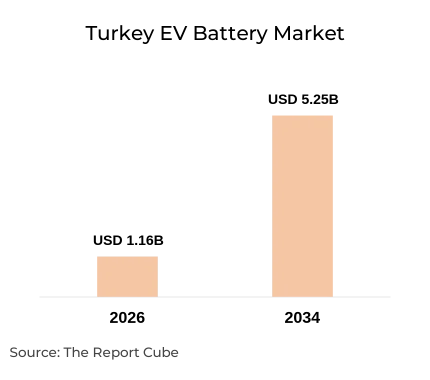
- Market size reached USD 1.16 billion in 2026.
- Revenue is projected to reach USD 5.25 billion by 2034.
- The market is expanding at a 20.78% CAGR through 2034.
- Siemens, ABB, Schneider Electric, and Honeywell anchor the competitive landscape.
- Battery electric vehicles lead propulsion demand with nearly 48% share.
- Marmara leads regionally, supported by dense automotive manufacturing clusters.
- Central Anatolia is the fastest-growing region through 2034.
- Domestic gigafactory localization is reshaping battery supply chains.
Turkey EV Battery Market Insights & Analysis
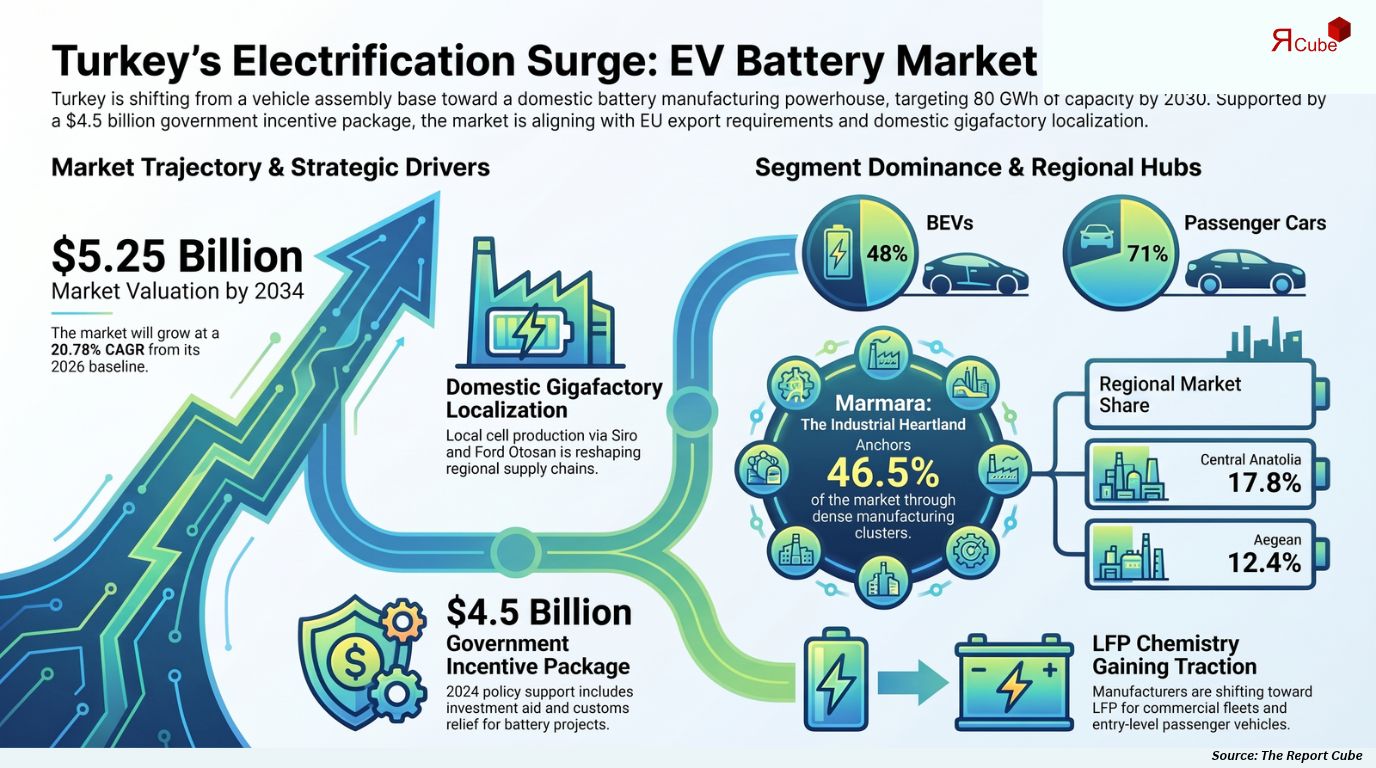
The Turkey EV Battery Market is anticipated to register a 20.78% CAGR during 2026–2034. The market size was valued at USD 1.16 billion in 2026 and is projected to reach USD 5.25 billion by 2034. Growth reflects Türkiye's shift from vehicle assembly toward domestic cell, module, and pack production. The Togg–Farasis joint venture Siro in Gemlik began pack production in 2023 with 3 GWh capacity and targets 20 GWh by 2031, while the government's 2024 incentive package of roughly USD 4.5 billion supports battery and EV projects.
Demand is also shaped by regulation and trade. Reduced special consumption tax brackets have improved EV affordability, and Togg sales reached nearly 39,000 units in 2025. Because European export demand for localized battery supply is rising, manufacturers are aligning Turkish plants with EU content and carbon-footprint requirements. Parallel growth in electric vehicle charging infrastructure is easing range concerns and lifting pack volumes per vehicle. National policy now targets 80 GWh of domestic battery capacity by 2030, positioning the country as a regional supply hub.
Turkey EV Battery Market Dynamics
Türkiye's electrification trajectory is gaining momentum as domestic automakers, global OEM plants, and component suppliers converge around battery localization. Export-oriented factories in Bursa, Kocaeli, and Sakarya are adapting production lines for electrified models, while policy support lowers investment barriers. Industrial automation, energy management, and digital manufacturing providers are becoming essential partners as battery output scales toward multi-gigawatt-hour levels. These forces are creating a dense, interdependent ecosystem across cells, packs, and charging.
|
Factor |
Type |
Specific Impact on Market |
Magnitude |
|---|---|---|---|
|
Domestic battery localization |
Driver |
Expands cell, module, and pack capacity near OEM plants |
Very High |
|
EU export alignment |
Opportunity |
Raises demand for compliant, traceable battery supply |
High |
|
Critical mineral imports |
Challenge |
Exposes producers to supply disruptions and lead-time volatility |
High |
|
Tax incentives on EVs |
Driver |
Lifts BEV adoption and battery pack volumes |
High |
|
LFP chemistry adoption |
Trend |
Diversifies chemistries and improves thermal safety performance |
Medium |
Key Market Driver: Domestic Gigafactory Localization Drives Demand
Domestic gigafactory build-out is the strongest demand catalyst. Siro's Gemlik complex, designed to scale toward 20 GWh, ties cell production directly to Togg assembly, while Ford Otosan's Kocaeli operations and Hyundai's planned İzmit production add further local pull. The 2024 incentive package, including investment support, customs relief, and land allocation, shortens project timelines. Because lithium-ion battery cell localization cuts logistics lead times and supports EU rules of origin, OEMs are signing multi-year supply agreements. Automation and energy-management partners benefit as production lines require precision control, traceability, and grid-ready power.
Major Industry Challenge: Critical Mineral Import Dependence Risks
Türkiye imports nearly all lithium, nickel, cobalt, and graphite feedstock, leaving cell production exposed to price swings and shipping disruptions. Reliance on Asian refiners lengthens qualification cycles, and upstream lithium and nickel import dependence complicates compliance with the EU Battery Regulation's recycled-content and carbon-footprint disclosure rules. Limited domestic cathode and electrolyte capacity also forces manufacturers to hold larger inventories. Producers are responding with long-term offtake contracts, supplier diversification, and early recycling partnerships, yet full value-chain localization will take years to mature.
Emerging Trend Shaping Outlook: LFP Chemistry Gains Production Traction
Manufacturers are broadening chemistry portfolios beyond nickel-manganese-cobalt cells toward lithium iron phosphate (LFP) for entry-level passenger cars, commercial fleets, and two-wheelers. LFP offers longer cycle life, stronger thermal stability, and lower reliance on nickel and cobalt. Pack designs are also shifting toward cell-to-pack architectures, advanced battery management software, and digital twins for quality control. Meanwhile, stationary energy storage integration is creating second-life and shared-production opportunities, as renewable capacity additions push utilities to procure grid-scale battery systems alongside automotive volumes.
Need Specific Data, Let’s Customize the Report for You
Request CustomizationTurkey EV Battery Market Segment-wise Analysis
Türkiye's battery demand is shaped by how vehicles are powered and used. Propulsion architecture determines pack size and revenue per unit, while vehicle category influences chemistry choice, charging behavior, and procurement cycles. Together, these dimensions show where manufacturers should prioritize capacity, partnerships, and product development through 2034.
By Propulsion Type
- Battery Electric Vehicles
- Plug-in Hybrid Electric Vehicles
- Hybrid Electric Vehicles
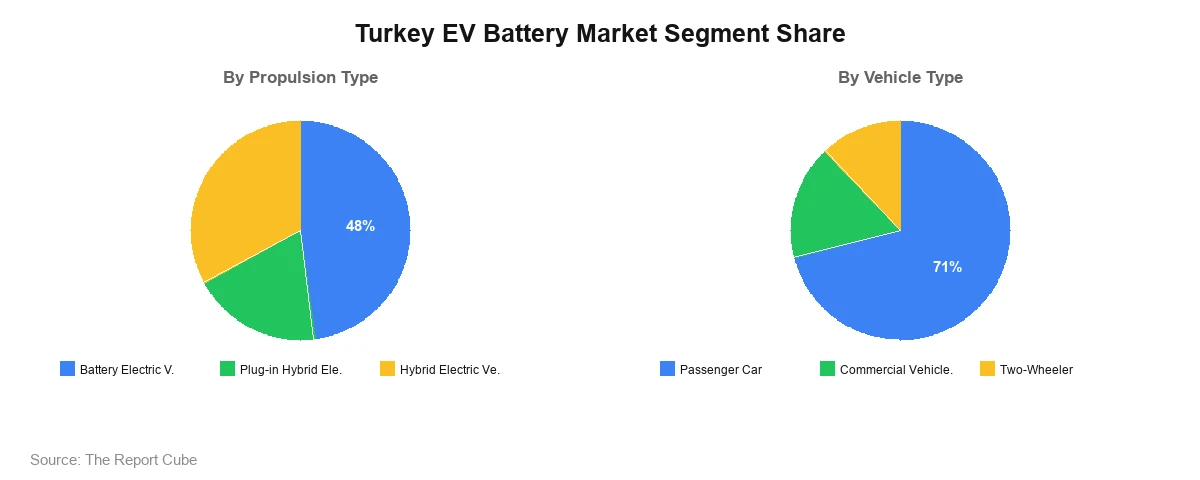
Battery electric vehicles lead with an estimated 48% market share because they carry the largest packs, typically 50 to 90 kWh, and therefore generate the highest battery revenue per vehicle. Togg's T10X and T10F, plus imported and newly localized models, anchor volumes. Preferential special consumption tax treatment, expanding fast-charging corridors, and fleet electrification programs reinforce adoption, while Siro's pack output directly serves this segment. Metropolitan buyers increasingly prioritize range above 400 km, supporting higher-capacity NMC and emerging LFP formats.
Hybrid electric vehicles hold roughly 33% share, benefiting from Türkiye's long-standing hybrid sales base and lower upfront prices, though their small packs limit revenue per unit. Plug-in hybrid electric vehicles account for about 19% and are the fastest-growing sub-segment, supported by mid-sized SUV launches and flexible daily-use economics. Adoption is driven by incentives, charging access, and consumer demand for extended range without full dependence on public infrastructure. As OEMs electrify platforms across price tiers, demand for modular battery architectures is expected to widen across all three propulsion categories.
By Vehicle Type
- Passenger Car
- Commercial Vehicles
- Two-Wheeler
Passenger cars dominate with an estimated 71% market share, supported by Togg's domestic production, rising imports from Asian and European brands, and strong metropolitan charging deployment. Larger packs, wider model availability, and lower special consumption tax rates on electrified models reinforce purchase decisions among urban households and corporate buyers. Passenger platforms also absorb most gigafactory output, since pack standardization across crossover and SUV formats improves utilization and supplier scale. Export-oriented production of Turkish-built passenger EVs for European markets further expands battery volumes.
Commercial vehicles contribute about 17% and are the fastest-growing category, as logistics operators, municipalities, and last-mile delivery fleets electrify buses, vans, and light trucks to meet urban emission rules. Two-wheelers hold roughly 12%, with electric two-wheeler battery demand rising from delivery platforms and urban micromobility users who favor compact LFP packs. Fleet buyers prioritize cycle life, uptime, and ownership economics, which favors durable chemistries and swappable pack designs. Government-backed public transport procurement is expected to widen commercial demand further.
Turkey EV Battery Market Country Insights
Regional demand in Türkiye follows industrial geography, charging availability, and vehicle ownership density. Marmara's automotive manufacturing corridor dominates cell, pack, and vehicle output, while Central Anatolia gains from new investments near Ankara and Eskişehir. Coastal and southeastern regions are expanding more gradually through fleet electrification and tourism-led mobility.
|
Region |
Estimated Market Share |
Key Growth Factors |
Consumer Trends |
|---|---|---|---|
|
Marmara |
46.5% |
Togg, Siro, and Ford Otosan manufacturing clusters |
High BEV adoption and premium charging demand |
|
Central Anatolia |
17.8% |
Ankara-led investments and supplier networks |
Rising public-fleet and corporate EV purchases |
|
Aegean |
12.4% |
İzmir port logistics and expanding charging grid |
Growing commercial and two-wheeler electrification |
|
Mediterranean |
8.9% |
Tourism mobility and Mersin and Antalya deployments |
Rental fleet and urban EV uptake |
|
Black Sea |
5.6% |
Renewable energy projects and distribution fleets |
Gradual hybrid-to-EV transition |
|
Southeastern Anatolia |
5.2% |
Gaziantep industrial zones and municipal buses |
Early commercial fleet adoption |
|
Eastern Anatolia |
3.6% |
Government incentives and cold-climate testing |
Hybrid preference, limited charging access |
- Marmara: Marmara leads with about 46.5% share, anchored by Bursa, Kocaeli, Sakarya, and Istanbul, where Togg, Siro, Ford Otosan, and component suppliers concentrate electrified production.
- Central Anatolia: Central Anatolia is the fastest-growing region, supported by Ankara's government-backed projects, Eskişehir and Konya supplier networks, and rising public-fleet electrification.
- Aegean: The Aegean benefits from İzmir's port logistics, expanding charging networks, and growing demand for electric commercial vehicles and urban two-wheeler fleets.
- Mediterranean: The Mediterranean region is steadily advancing through tourism-led electric mobility, Mersin and Antalya charging deployments, and growing port-linked logistics electrification.
- Black Sea: The Black Sea region shows steady uptake, driven by renewable energy projects, regional distribution fleets, and gradual charging expansion along coastal highways.
- Southeastern Anatolia: Southeastern Anatolia is emerging through municipal bus electrification, industrial zones in Gaziantep, and solar-linked storage deployments supporting future electric vehicle charging.
- Eastern Anatolia: Eastern Anatolia remains early-stage, with adoption limited by sparse charging access, though government incentives and cold-climate battery testing create long-term potential.
Turkey EV Battery Market: Recent Development (2025)
- Siemens expanded manufacturing automation and digital twin tools supporting gigafactory ramp-ups across Türkiye's automotive clusters.
- ABB strengthened EV charging power electronics portfolios, supporting Turkish fast-charging corridors and battery plant electrification.
- Schneider Electric advanced energy management solutions for battery factories, targeting lower-carbon cell production across Türkiye.
- Honeywell introduced battery process control technologies supporting safer, traceable lithium-ion production for European-bound electric vehicles.
Turkey EV Battery Market Future Outlook (2034)
The Turkey EV Battery Market is projected to expand at a 20.78% CAGR, reaching USD 5.25 billion by 2034. Growth opportunities will center on cell-level localization, EU-compliant exports, commercial fleet electrification, and grid-scale storage built on shared manufacturing lines. National targets of 80 GWh domestic capacity by 2030 and continued investment from Togg, Ford Otosan, and Asian partners should lift utilization and attract upstream material suppliers. Growing two-wheeler and light commercial electrification will broaden demand beyond passenger cars.
Technology advancement will define competitive positioning. AI-driven battery management, predictive maintenance, and digital twin simulation are expected to improve cell yield, extend pack life, and shorten validation cycles. Cell-to-pack designs, LFP scale-up, and early solid-state pilots will diversify chemistry options. Meanwhile, end-of-life battery recycling and material recovery will gain importance as first-generation EV packs approach retirement and EU rules mandate recycled content. Suppliers integrating software, automation, and analytics will capture disproportionate value.
Turkey EV Battery Market Report Coverage
|
Report Attribute |
Details |
|---|---|
|
Market Name |
Turkey EV Battery Market |
|
Market Size (2026) |
USD 1.16 Billion |
|
Market Size (2034) |
USD 5.25 Billion |
|
Forecast Period |
2026–2034 |
|
CAGR |
20.78% |
|
Base Year |
2026 |
|
Historical Years |
2021–2025 |
|
Forecast Years |
2026–2034 |
|
Segments Covered |
By Propulsion Type, By Vehicle Type, Battery Type |
|
Regions Covered |
Marmara, Central Anatolia, Mediterranean, Aegean, Southeastern Anatolia, Black Sea, Eastern Anatolia |
|
Key Companies |
Siemens AG, IBM Corporation, Microsoft Corporation, Oracle Corporation, SAP SE, Schneider Electric, Honeywell International, ABB Ltd, Cisco Systems, Intel Corporation |
|
Report Format |
PDF, Excel, PPT |
|
Customization |
Available as per client requirements |
Why Choose This Report?
- Detailed coverage of Türkiye's battery localization and gigafactory developments.
- Reliable market sizing with transparent forecasts through 2034.
- Granular segmentation by propulsion type, vehicle type, and region.
- Seven-region analysis highlights where battery demand is accelerating fastest.
- Competitive profiling of leading automation, energy, and technology suppliers.
- Insights into EU regulation, incentives, and export alignment.
- Strategic guidance supporting investment, partnership, and sourcing decisions.
- Data-led research reflecting current industry developments and trends.
Table of Contents
- Introduction
- Objective of the Study
- Product Definition
- Market Segmentation
- Study Variables
- Research Methodology
- Secondary Data Points
- Companies Interviewed
- Primary Data Points
- Breakdown of Primary Interviews
- Secondary Data Points
- Executive Summary
- Market Dynamics
- Drivers
- Challenges
- Opportunity Assessment
- Recent Trends and Developments
- Policy and Regulatory Landscape
- Turkey EV Battery Market Overview and Forecast Analysis (2021-2034)
- Market Size, By Value, By Growth Rate (CAGR/USD Billions)
- Demand – Supply Trends
- Market Share, By Propulsion Type
- Battery Electric Vehicles
- Plug-in Hybrid Electric Vehicles
- Hybrid Electric Vehicles
- Market Share, By Vehicle Type
- Passenger Car
- Commercial Vehicles
- Two-Wheeler
- Market Share, By Region
- Marmara
- Central Anatolia
- Mediterranean
- Aegean
- Southeastern Anatolia
- Black Sea
- Eastern Anatolia
- Market Share, By Competitors
- Competition Characteristics
- Revenue Shares
- Battery Electric Vehicles Turkey EV Battery Market Overview, 2021-2034F
- By Value (USD Million)
- By Vehicle Type – Market Size & Forecast 2021-2034, USD Million
- Passenger Car
- Commercial Vehicles
- Two-Wheeler
- Plug-in Hybrid Electric Vehicles Turkey EV Battery Market Overview, 2021-2034F
- By Value (USD Million)
- By Vehicle Type – Market Size & Forecast 2021-2034, USD Million
- Passenger Car
- Commercial Vehicles
- Two-Wheeler
- Hybrid Electric Vehicles Turkey EV Battery Market Overview, 2021-2034F
- By Value (USD Million)
- By Vehicle Type – Market Size & Forecast 2021-2034, USD Million
- Passenger Car
- Commercial Vehicles
- Two-Wheeler
- Competitive Outlook (Company Profile - Partial List)
- Siemens AG
- Company Overview
- Business Segments
- Strategic Alliances/Partnerships
- Recent Developments
- IBM Corporation
- Company Overview
- Business Segments
- Strategic Alliances/Partnerships
- Recent Developments
- Microsoft Corporation
- Company Overview
- Business Segments
- Strategic Alliances/Partnerships
- Recent Developments
- Oracle Corporation
- Company Overview
- Business Segments
- Strategic Alliances/Partnerships
- Recent Developments
- SAP SE
- Company Overview
- Business Segments
- Strategic Alliances/Partnerships
- Recent Developments
- Schneider Electric
- Company Overview
- Business Segments
- Strategic Alliances/Partnerships
- Recent Developments
- Honeywell International
- Company Overview
- Business Segments
- Strategic Alliances/Partnerships
- Recent Developments
- ABB Ltd
- Company Overview
- Business Segments
- Strategic Alliances/Partnerships
- Recent Developments
- Cisco Systems
- Company Overview
- Business Segments
- Strategic Alliances/Partnerships
- Recent Developments
- Intel Corporation
- Company Overview
- Business Segments
- Strategic Alliances/Partnerships
- Recent Developments
- Siemens AG
- Contact Us & Disclaimer
Top Key Players & Market Share Outlook
- Siemens AG
- IBM Corporation
- Microsoft Corporation
- Oracle Corporation
- SAP SE
- Schneider Electric
- Honeywell International
- ABB Ltd
- Cisco Systems
- Intel Corporation
Frequently Asked Questions






