


Build Your Custom Market Intelligence Report
Customize Your ReportKey Takeaways
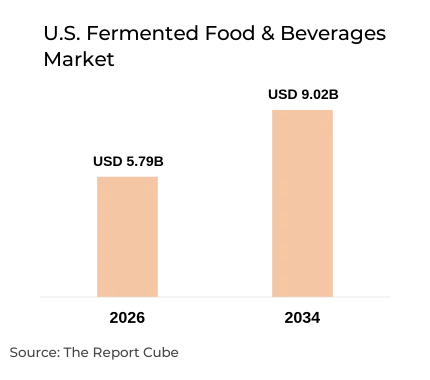
- The U.S. fermented food and beverages market is valued at USD 5.79 billion in 2026.
- The market is projected to reach USD 9.02 billion by 2034 at a 5.70% CAGR.
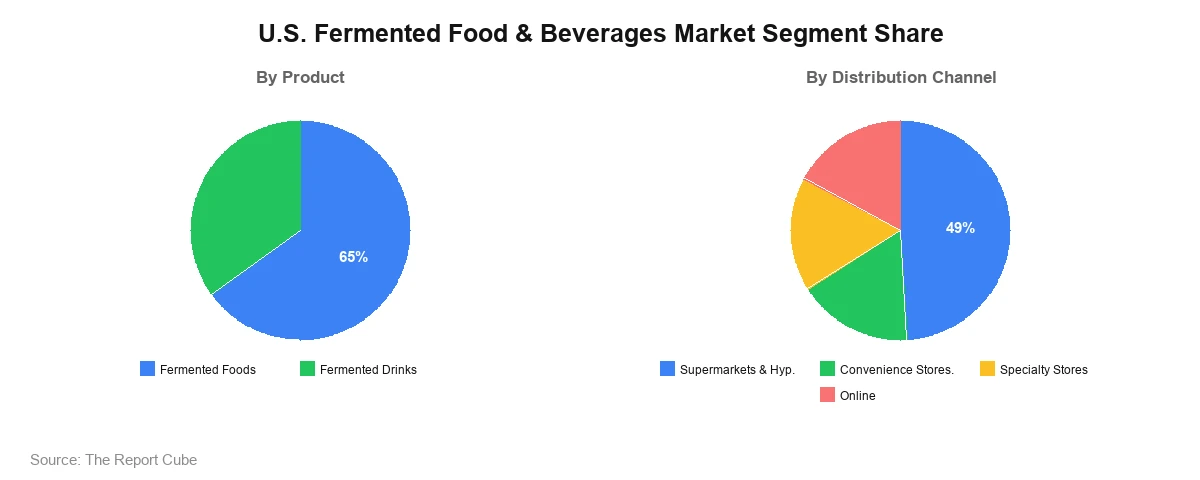
- Fermented foods lead the product segment with an estimated 65% share in 2026.
- Supermarkets and hypermarkets lead distribution channels with an estimated 49% share in 2026.
- West leads the regional landscape with an estimated 28% share in 2026.
- Danone, Lactalis, Yakult Honsha, PepsiCo, Chobani and Lifeway Foods are among the supplied key players.
- Documented food-safety controls and evidence-based product claims are important themes shaping production and marketing.
Market Overview
Fermented foods and beverages are products transformed by controlled microbial activity, producing acids, flavors, and, in some cases, live cultures. Categories include yogurt, kefir, kombucha, fermented tea, and fermented vegetables, sold through grocery, convenience, specialty, and online channels for everyday consumption and functional nutrition. Manufacturers range from multinational dairy groups to specialty brewers.
This U.S. Fermented Food & Beverages Market Analysis shows a market valued at USD 5.79 billion in 2026, shaped by established grocery distribution, expanding online retail, and manufacturing controls. The U.S. Census Bureau reported retail e-commerce sales of USD 340.2 billion in Q2 2026, 17.1% of total retail sales, though the figure is not specific to fermented products.
Consumer interest in digestive health, protein, and functional beverages supports consumption, while food-safety documentation and substantiated health claims shape product development. Reported trends include kombucha and kefir line extensions, plant-based fermented options, and online subscription models across grocery and specialty channels. The market is projected to grow at a CAGR of 5.70% during 2026–2034.
U.S. Fermented Food & Beverages Market Dynamics
The U.S. Fermented Food & Beverages Market Growth is influenced by retail distribution, online sales, manufacturing compliance, and consumer interest in fermented products. Food-safety obligations and health-claim substantiation affect production costs and marketing, while competition spans multinational dairy groups, beverage companies, and specialty fermented brands.
|
Factor |
Type |
Specific Impact on Market |
Magnitude |
|---|---|---|---|
|
Retail and e-commerce channel scale |
Driver |
Online retail reached 17.1% of U.S. retail sales in Q2 2026, indicating channel scale but not product-specific demand |
Medium (qualitative) |
|
Versatility of fermentation |
Driver |
Established process supports a broad range of fermented food products without quantifying demand |
Medium (qualitative) |
|
Digital routes to market |
Opportunity |
Subscription and multipack models offer distribution options requiring product-level validation |
Medium (qualitative) |
|
Validated processes and product information |
Opportunity |
Documented controls and clear labeling can differentiate offerings |
Medium (qualitative) |
|
Food-safety compliance |
Challenge |
Written food-safety plans and preventive controls add documentation and verification responsibilities |
Medium–High (qualitative) |
|
Health-claim substantiation |
Challenge |
Variable scientific evidence requires product-specific support for claims |
Medium–High (qualitative) |
|
Documented food-safety management |
Trend |
Structured quality systems become a standard part of production |
Medium (qualitative) |
|
Expanding product formats |
Trend |
Fermentation techniques extend across foods and drinks, though adoption pace is not quantified |
Medium (qualitative) |
U.S. Fermented Food & Beverages Market Growth Drivers
Retail distribution infrastructure supports availability of packaged fermented products. According to the U.S. Census Bureau, retail e-commerce sales reached USD 340.2 billion in Q2 2026, representing 17.1% of total U.S. retail sales. The figure covers all retail categories, so it indicates channel scale for fermented foods and drinks rather than product-specific demand.
Fermentation supports a wide range of product formats. The USDA Agricultural Research Service explains that fermenting vegetables converts sugars into organic acids, and the resulting acidity helps control microbial growth. This established, widely used process underpins varied fermented foods across product categories, though it does not quantify commercial demand or market growth.
U.S. Fermented Food & Beverages Market Opportunities
Digital routes to market offer an identifiable expansion path for fermented food and beverage brands. Census Bureau data show online retail represents a significant share of U.S. sales, and brands can evaluate subscription models and multipack offerings. These data do not measure demand for fermented products specifically, so channel economics require product-level validation.
Process documentation and clear product information can differentiate offerings. USDA research identifies controlled microbial growth and appropriate acidity as central to fermented vegetables, and producers can pair consistent quality with transparent labeling while meeting applicable food-safety requirements. Differentiation based on validated processes may also help brands address scrutiny of broad health claims.
U.S. Fermented Food & Beverages Industry Challenges
Food-safety compliance adds operational responsibilities. Under the FDA’s FSMA Preventive Controls for Human Food rule, covered facilities generally need a written food-safety plan with hazard analysis and risk-based preventive controls, unless an exemption applies. These requirements create documentation, monitoring, and verification tasks that can increase costs, particularly for smaller producers.
Health-related positioning requires evidence. Scientific reviews indexed by the U.S. National Library of Medicine report that evidence for health effects varies across fermented food types and that many proposed benefits need higher-quality human studies. Manufacturers therefore need to substantiate product-specific claims rather than assume all fermented products provide equivalent benefits.
Need Specific Data, Let’s Customize the Report for You
Request CustomizationU.S. Fermented Food & Beverages Market Trends
U.S. Fermented Food & Beverages Market Trends point toward broader product formats built on established fermentation techniques. USDA research describes fermentation applications in foods such as vegetables, illustrating versatility across categories. Brand activity in kefir, kombucha, and fermented dairy reflects this breadth, although available evidence does not establish the pace of commercial innovation or consumer adoption.
Documented food-safety management is an important consideration in production. FDA preventive-control requirements specify hazard analysis, process controls, sanitation controls, monitoring, verification, and documentation for covered facilities. Structured quality systems therefore form a practical part of day-to-day manufacturing and compliance for fermented food and beverage producers serving national retail and online channels.
U.S. Fermented Food & Beverages Market Segment Analysis
U.S. Fermented Food & Beverages Market Share is distributed across product types and distribution channels, reflecting differences in product format, storage requirements, and retail access. Shares below are supplied 2026 estimates for the leading segment in each category.
By Product
- Fermented Foods
- Fermented Drinks
- Kombucha
- Kefir
- Fermented Tea
- Others
Fermented foods lead the By Product segment with an estimated 65% share in 2026, supported by established consumption of fermented dairy and vegetable-based items and broad supermarket availability, with Danone, Lactalis and Chobani active in cultured dairy. Fermented drinks follow, spanning kombucha, kefir, fermented tea, and other beverages. Kombucha is associated with GT’s Living Foods, Brew Dr. Kombucha and PepsiCo’s KeVita brand, while Lifeway Foods is a prominent kefir supplier and Yakult Honsha supplies probiotic fermented milk drinks. Demand for these drinks is linked to consumer interest in functional beverages and digestive wellness, although sub-category growth rates are not supplied and require validation.
By Distribution Channel
- Supermarkets & Hypermarkets
- Convenience Stores
- Specialty Stores
- Online
Supermarkets and hypermarkets lead the By Distribution Channel segment with an estimated 49% share in 2026, supported by broad refrigerated assortments, national brand presence, and high household traffic. The remaining channels address different needs: convenience stores serve single-serve drinks and impulse consumption, while specialty stores support premium, small-batch and natural-positioned brands. Online channels benefit from the scale of U.S. retail e-commerce, which the Census Bureau reported at USD 340.2 billion in Q2 2026, although this figure covers all retail categories rather than fermented products specifically. Channel-level growth rates are not supplied and require validation.
Regional Analysis
The U.S. Fermented Food & Beverages Market is assessed across West, Southwest, North, and Midwest. Only the West share was supplied; other regional shares are not estimated here.
|
Region |
Estimated Market Share |
Key Growth Factors |
Industry Trends |
|---|---|---|---|
|
West |
28% (supplied estimate) |
Retail networks and fermented beverage brands with California roots |
Brand activity in kombucha and kefir (qualitative) |
|
Southwest |
- |
Regional retail and distribution reach (qualitative) |
- |
|
North |
- |
Retail concentration and local manufacturing (qualitative) |
- |
|
Midwest |
- |
Dairy and food manufacturing base (qualitative) |
- |
West leads the regional landscape with an estimated 28% share in 2026, based on supplied estimates. Regional activity reflects retail networks and fermented beverage brands with California roots, including GT’s Living Foods in Los Angeles and KeVita, formerly based in Oxnard, though supporting regional sales data were not provided. Federal food-safety requirements apply across all regions.
Southwest, North and Midwest shares were not supplied and are not estimated here to avoid unsupported figures. Differences across these regions may reflect retail concentration, distribution reach, and local manufacturing, which require validation. Together, the three regions account for the remaining share of the market after the West’s estimated 28%.
Market Share & Competitive Landscape
The U.S. Fermented Food & Beverages Market includes multinational dairy groups, beverage companies, and specialty fermented brands. The table summarizes the supplied companies by general capability and relevant segment. It does not represent numerical market share, and company-level U.S. sales should be validated.
|
Company |
Competitive Strength |
Primary Segment Served |
|---|---|---|
|
Danone S.A. |
Fermented dairy portfolio, including Activia, with global scale |
Fermented foods (cultured dairy) |
|
Lactalis |
Large dairy group with yogurt and cultured dairy offerings |
Fermented foods |
|
Yakult Honsha Co. Ltd. |
Specialist in probiotic fermented milk drinks |
Fermented drinks |
|
Brew Dr. Kombucha |
Kombucha-focused beverage brand |
Fermented drinks (kombucha) |
|
PepsiCo Inc. |
Beverage distribution scale and ownership of the KeVita probiotic and kombucha line |
Fermented drinks |
|
GT’s Living Foods Ingredients |
Kombucha pioneer with water kefir and coconut yogurt offerings |
Fermented drinks and dairy-free fermented foods |
|
General Mills Inc. |
Large packaged-food manufacturer with national retail distribution |
Packaged foods (product-level scope requires verification) |
|
Lifeway Foods Inc. |
Kefir and probiotic fermented dairy specialist |
Kefir and fermented dairy drinks |
|
Generous Brands |
Supplied company; product-level details require verification |
Fermented foods and drinks (verification pending) |
|
Chobani LLC |
Greek yogurt leader with a high-protein product range |
Fermented foods (cultured dairy) |
Key Companies in the U.S. Fermented Food & Beverages Market
Lifeway Foods Inc.: Lifeway Foods is headquartered in Morton Grove, Illinois, and supplies kefir and other fermented probiotic products. The company reported 2025 net sales of USD 212.4 million, up 13.7%, and Q1 2026 net sales rose 36.7% to USD 63 million. Its kefir specialization is its principal competitive strength.
Danone S.A.: Danone S.A. is headquartered in Paris, France, and operates a fermented dairy portfolio including Activia. In 2024 it proposed acquiring Lifeway Foods at USD 25, then USD 27 per share; Lifeway rejected both, and Danone agreed to sell its 22.7% stake in 2026. Brand scale in cultured dairy is its strength.
Recent Developments
|
Year / Month |
Company |
Development |
|---|---|---|
|
March 2025 |
Danone S.A. / Lifeway Foods |
Danone initiated legal action over Lifeway’s decision to award shares to its chief executive; Lifeway later announced plans for a counterclaim. |
|
September 2025 |
Danone S.A. |
Confirmed it would not submit another offer for Lifeway and began exploring alternatives for its minority holding. |
|
May 2026 |
Danone S.A. / Lifeway Foods |
Danone priced a secondary offering of 3.45 million Lifeway shares at USD 19.50, exiting its stake; Lifeway agreed to repurchase about USD 5 million of shares. |
U.S. Fermented Food & Beverages Market Future Outlook
The U.S. Fermented Food & Beverages Market Forecast indicates expansion from USD 5.79 billion in 2026 to USD 9.02 billion by 2034 at a CAGR of 5.70%, based on supplied estimates. Growth is expected to depend on retail distribution, online sales development, product innovation across foods and drinks, and the ability of manufacturers to maintain consistent quality and compliance throughout the forecast period.
Investment may concentrate on documented process controls, product differentiation, and distribution reach, while evidence-based product information may become more important as scrutiny of health claims continues across the category. Risks include compliance costs, uneven scientific support for health benefits, and competition among multinational dairy groups, beverage companies, and specialty brands. The projected values remain supplied assumptions rather than guaranteed outcomes.
U.S. Fermented Food & Beverages Market Report Coverage
This U.S. Fermented Food & Beverages Market Report summarizes the supplied valuation, forecast assumptions, segmentation, regional framework, and competitive ecosystem.
|
Parameter |
Details |
|---|---|
|
Market Name |
U.S. Fermented Food & Beverages Market |
|
Market Size 2026 |
USD 5.79 billion |
|
Market Size 2034 |
USD 9.02 billion |
|
Forecast Period |
2026–2034 |
|
CAGR |
5.70% |
|
Base Year |
2026 |
|
Historical Years |
2021-2025 |
|
Forecast Years |
2026–2034 |
|
Segments Covered |
By Product; By Distribution Channel |
|
Regions Covered |
West, Southwest, North, Midwest |
|
Key Companies |
Danone S.A., Lactalis, Yakult Honsha Co. Ltd., Brew Dr. Kombucha, PepsiCo Inc., GT’s Living Foods Ingredients, General Mills Inc., Lifeway Foods Inc., Generous Brands, Chobani LLC |
|
Customization |
Available as per client requirements |
Why Choose This U.S. Fermented Food & Beverages Market Report?
- Market coverage of fermented foods and drinks across supermarkets, convenience stores, specialty stores, and online channels.
- Clear presentation of the supplied 2026 valuation, 2034 forecast, and 5.70% CAGR.
- Segmentation by product and distribution channel, including supplied leading-segment shares.
- Regional framework covering West, Southwest, North, and Midwest, with the supplied West share.
- Competitive profiling of ten supplied dairy, beverage, and fermented-product companies.
- Evidence-based context on food-safety requirements, health-claim substantiation, and retail channel scale.
- Trend and forecast insights to support product planning, distribution strategy, and market-entry evaluation.
Table of Contents
- Introduction
- Objective of the Study
- Product Definition
- Market Segmentation
- Study Variables
- Research Methodology
- Secondary Data Points
- Companies Interviewed
- Primary Data Points
- Breakdown of Primary Interviews
- Secondary Data Points
- Executive Summary
- Market Dynamics
- Drivers
- Challenges
- Opportunity Assessment
- Recent Trends and Developments
- Policy and Regulatory Landscape
- U.S. Fermented Food & Beverages Market Overview and Forecast Analysis (2021-2034)
- Market Size, By Value, By Growth Rate (CAGR/USD Billions)
- Demand – Supply Trends
- Market Share, By Product
- Fermented Foods
- Fermented Drinks
- Kombucha
- Kefir
- Fermented Tea
- Others
- Market Share, By Distribution Channel
- Supermarkets & Hypermarkets
- Convenience Stores
- Specialty Stores
- Online
- Market Share, By Region
- West
- Southwest
- North
- Midwest
- Market Share, By Competitors
- Competition Characteristics
- Revenue Shares
- Fermented Foods U.S. Fermented Food & Beverages Market Overview, 2021-2034F
- By Value (USD Million)
- By Distribution Channel – Market Size & Forecast 2021-2034, USD Million
- Supermarkets & Hypermarkets
- Convenience Stores
- Specialty Stores
- Online
- Fermented Drinks (Kombucha, Kefir, Fermented Tea, Others) U.S. Fermented Food & Beverages Market Overview, 2021-2034F
- By Value (USD Million)
- By Distribution Channel – Market Size & Forecast 2021-2034, USD Million
- Supermarkets & Hypermarkets
- Convenience Stores
- Specialty Stores
- Online
- Competitive Outlook (Company Profile – Partial List)
- Danone S.A.
- Company Overview
- Business Segments
- Strategic Alliances/Partnerships
- Recent Developments
- Lactalis
- Company Overview
- Business Segments
- Strategic Alliances/Partnerships
- Recent Developments
- Yakult Honsha Co. Ltd.
- Company Overview
- Business Segments
- Strategic Alliances/Partnerships
- Recent Developments
- Brew Dr. Kombucha
- Company Overview
- Business Segments
- Strategic Alliances/Partnerships
- Recent Developments
- PepsiCo Inc.
- Company Overview
- Business Segments
- Strategic Alliances/Partnerships
- Recent Developments
- GT’s Living Foods Ingredients
- Company Overview
- Business Segments
- Strategic Alliances/Partnerships
- Recent Developments
- General Mills Inc.
- Company Overview
- Business Segments
- Strategic Alliances/Partnerships
- Recent Developments
- Lifeway Foods Inc.
- Company Overview
- Business Segments
- Strategic Alliances/Partnerships
- Recent Developments
- Generous Brands
- Company Overview
- Business Segments
- Strategic Alliances/Partnerships
- Recent Developments
- Chobani LLC
- Company Overview
- Business Segments
- Strategic Alliances/Partnerships
- Recent Developments
- Danone S.A.
- Contact Us & Disclaimer
Top Key Players & Market Share Outlook
- Danone S.A.
- Lactalis
- Yakult Honsha Co. Ltd.
- Brew Dr. Kombucha
- PepsiCo Inc.
- GT’s Living Foods Ingredients
- General Mills Inc.
- Lifeway Foods Inc.
- Generous Brands
- Chobani LLC
Frequently Asked Questions