




Build Your Custom Market Intelligence Report
Customize Your ReportBrazil Fertility Services Market Key Takeaways
- Brazil Fertility Services Market was valued at USD 1.26 billion in 2026.
- Market is projected to reach USD 3.29 billion by 2034, growing significantly.
- Industry is anticipated to register a robust 12.76% CAGR during 2026–2034.
- Fertility clinics dominate end-user segment due to specialized reproductive care delivery.
- Fresh Non-Donor procedures lead service type owing to widespread clinical preference.
- Southeast Brazil holds the largest regional share driven by infrastructure concentration.
- Northeast region is emerging as the fastest-growing market across Brazilian states.
- Leading players include Huntington Medicina Reprodutiva, Fertility Medical Group, and Clinica Origem.
Brazil Fertility Services Market Insights & Analysis
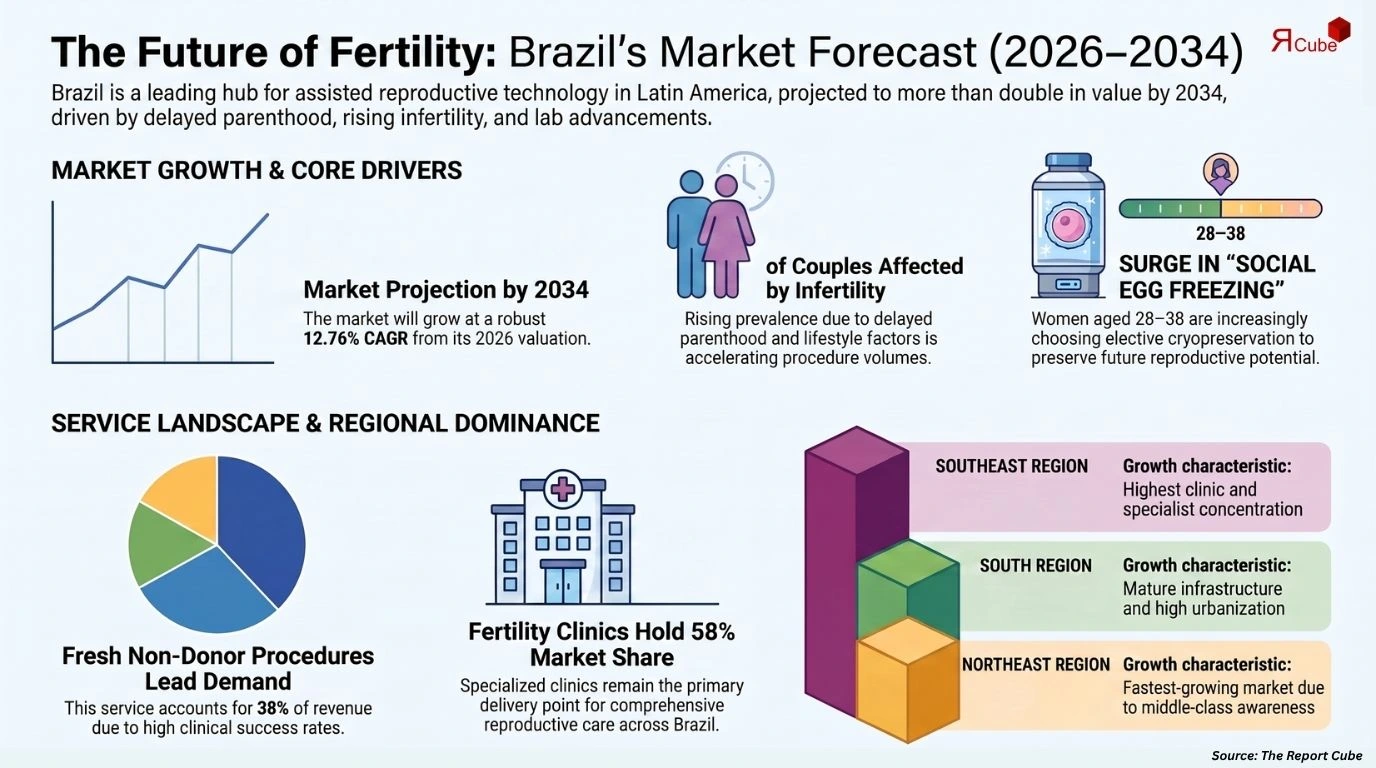
The Brazil Fertility Services Market is anticipated to register a 12.76% CAGR during 2026–2034. The market size was valued at USD 1.26 billion in 2026 and is projected to reach USD 3.29 billion by 2034. Brazil ranks among Latin America's largest assisted reproductive technology (ART) ecosystems, supported by a dense network of specialized fertility clinics, progressive regulatory frameworks under the Federal Council of Medicine, and rising patient awareness across urban and semi-urban centers. Increasing infertility prevalence driven by delayed parenthood, lifestyle-related reproductive disorders, and expanded health insurance coverage for ART procedures continues accelerating service adoption nationwide.
Private sector investment in reproductive medicine infrastructure, laboratory automation, and cryopreservation technology has intensified substantially in recent years. Brazil's Agência Nacional de Vigilância Sanitária (ANVISA) has progressively modernized embryo handling and donor gamete regulations, reinforcing clinical confidence among providers and patients alike. Government-backed health programs targeting reproductive health in underserved states, combined with the Latin America fertility treatment landscape, are collectively expanding patient access beyond historically dominant southeastern metropolitan centers, creating a broader and more diversified market base for service providers throughout the forecast period.
Brazil Fertility Services Market Dynamics
Brazil's fertility services sector continues expanding as demographic shifts, evolving social norms, and clinical advancements converge to increase demand for assisted reproductive technologies. Delayed family formation among urban professionals, rising awareness of reproductive preservation options, and increasing same-sex couples seeking fertility solutions are collectively broadening the consumer base. Improved laboratory standardization and growing private insurance coverage are reinforcing long-term market momentum across all major Brazilian regions.
|
Factor |
Type |
Specific Impact on Market |
Magnitude |
|---|---|---|---|
|
Rising infertility prevalence |
Driver |
Accelerates ART procedure volumes across clinics |
Very High |
|
Insurance coverage expansion |
Opportunity |
Increases patient affordability and treatment uptake |
High |
|
Cryopreservation technology adoption |
Trend |
Boosts embryo and egg banking service demand |
High |
|
ANVISA regulatory updates |
Driver |
Strengthens donor gamete and embryology compliance |
High |
|
Social fertility preservation demand |
Trend |
Expands elective egg freezing among younger demographics |
Very High |
Key Market Driver: Rising Infertility Prevalence Nationally
Infertility affects an estimated 15% to 20% of Brazilian reproductive-age couples, with clinical studies indicating increasing incidence linked to polycystic ovary syndrome, endometriosis, and male-factor infertility conditions. Urbanization, late-marriage trends, and occupational stress further compound reproductive challenges among the working-age population. These compounding epidemiological factors are directly translating into higher consultation volumes, diagnostic testing demand, and ART cycle initiations, making infertility prevalence the most consequential structural driver sustaining long-term growth across Brazil's fertility services market throughout the forecast period.
Major Industry Challenge: Geographic Service Access Disparity
Despite strong market momentum, reproductive medicine infrastructure remains heavily concentrated in Brazil's Southeast and South regions, leaving patients in the North, Northeast, and Central-West with significantly limited access to specialized fertility services. Transportation costs, absence of accredited embryology laboratories outside major cities, and physician shortages in interior states create persistent barriers to treatment uptake. Addressing this geographic disparity in reproductive healthcare access requires coordinated private-sector investment in regional clinic expansion, telemedicine-supported fertility counseling, and state-level public health partnerships to sustainably close the access gap.
Emerging Trend Shaping Outlook: Social Egg Freezing Adoption
Elective oocyte cryopreservation, commonly referred to as social egg freezing, is gaining rapid traction among Brazilian women aged 28 to 38 seeking to delay childbearing without sacrificing reproductive potential. Leading fertility networks including Huntington Medicina Reprodutiva and Fertility Medical Group have expanded dedicated fertility preservation programs, supported by marketing campaigns targeting professional women in São Paulo, Rio de Janeiro, and Belo Horizonte. This trend is directly expanding egg and embryo banking service volumes while creating new revenue streams for clinic operators and cryobank facilities that complement traditional IVF cycle revenue models.
Need Specific Data, Let’s Customize the Report for You
Request CustomizationBrazil Fertility Services Market Segment-wise Analysis
Brazil's fertility services market demonstrates meaningful revenue diversity across service modalities and end-user categories, with demand driven by advancing laboratory technologies, evolving patient demographics, and expanding institutional capacity among specialized reproductive medicine providers across the country.
By Service
- Fresh Non-Donor
- Frozen Non-Donor
- Egg and Embryo Banking
- Fresh Donor
- Frozen Donor
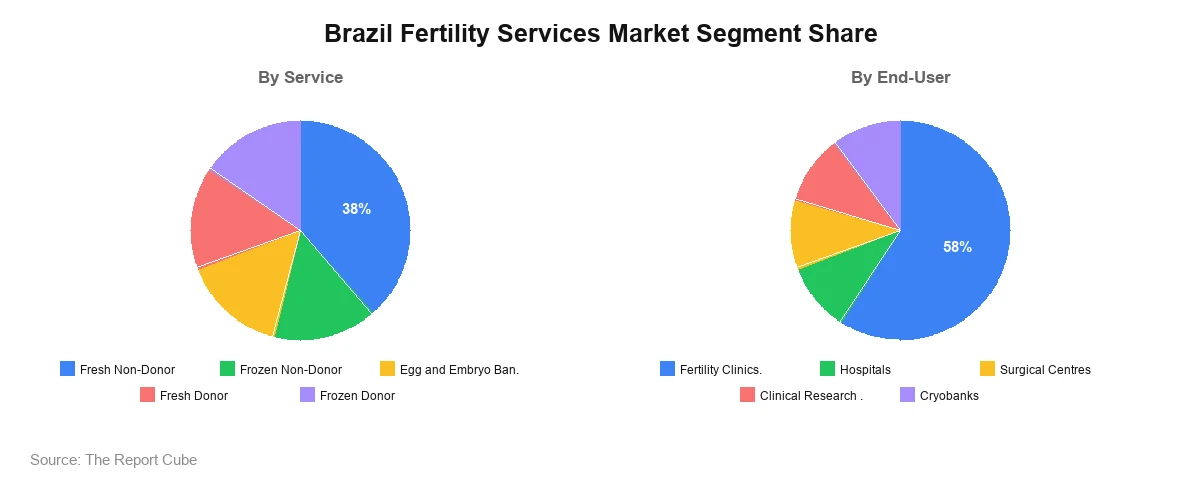
Fresh Non-Donor procedures represent the dominant service category, accounting for an estimated 38% of total Brazil Fertility Services Market revenue in 2026. This segment's leadership reflects strong clinical preference for fresh embryo transfer protocols among reproductive endocrinologists managing first-line IVF cycles, particularly for patients with favorable ovarian reserve and favorable prognostic profiles. Huntington Medicina Reprodutiva and Pro-Criar Medicina Reprodutiva have each invested in high-throughput embryology laboratory infrastructure specifically designed to support fresh cycle efficiency and improve implantation success rates across their clinic networks.
Frozen Non-Donor procedures represent the second-largest segment, benefiting from growing acceptance of freeze-all strategies that improve endometrial receptivity and reduce ovarian hyperstimulation syndrome risk. Egg and Embryo Banking is the fastest-growing service sub-segment, expanding at above-average rates as social fertility preservation awareness increases among younger Brazilian women. Fresh Donor and Frozen Donor categories collectively support patients with diminished ovarian reserve or premature ovarian insufficiency, with donor gamete cycle demand and regulatory compliance continuing to expand across licensed fertility centers in São Paulo and Rio de Janeiro.
By End-User
- Fertility Clinics
- Hospitals
- Surgical Centres
- Clinical Research Institutes
- Cryobanks
Fertility clinics dominate the end-user landscape with an estimated 58% market share, reflecting their role as the primary delivery point for comprehensive ART services including ovarian stimulation, egg retrieval, fertilization, embryo culture, and transfer procedures. Brazil's federal regulatory framework explicitly designates accredited reproductive medicine clinics as the appropriate institutional setting for assisted reproduction, reinforcing their structural advantage over hospital-based programs. Prominent clinic networks such as Clinica Origem, Fertilitat, and Chedid Grieco Medicina Reprodutiva continue expanding multi-branch operations across major urban centers to capture growing patient volumes.
Hospitals and surgical centers manage ART-adjacent procedures including laparoscopic surgical correction of reproductive pathologies and egg retrieval under general anesthesia in cases requiring enhanced monitoring. Cryobanks represent a strategically important and fast-growing end-user category as standalone gamete and embryo storage facilities proliferate in metropolitan areas. Clinical Research Institutes are increasingly partnering with leading fertility clinic networks to advance embryo selection technologies, preimplantation genetic testing protocols, and endometrial receptivity diagnostics, collectively contributing to translational research that directly enhances clinical outcomes across Brazil's reproductive medicine sector.
Regional Projection of Brazil Fertility Services Market
Brazil's fertility services market exhibits pronounced regional variation reflecting differences in healthcare infrastructure density, reproductive specialist availability, private insurance penetration, and patient income distribution across the country's five administrative macro-regions.
|
Region |
Estimated Market Share |
Key Growth Factors |
Consumer Trends |
|---|---|---|---|
|
Southeast |
48.5% |
Dense clinic network, high private insurance uptake, specialist concentration |
Strong demand for IVF and egg freezing services |
|
South |
18.2% |
Mature reproductive medicine infrastructure, high urbanization |
Growing male infertility testing and treatment demand |
|
Northeast |
16.4% |
Expanding clinic footprint, rising middle-class fertility awareness |
Increasing first-time ART consultation volumes |
|
North |
9.1% |
Government reproductive health initiatives, telemedicine expansion |
Early-stage adoption of IVF services in capitals |
|
Central-West |
7.8% |
Agricultural economy growth, Brasília hub services |
Rising demand for fertility preservation among professionals |
- Southeast: The Southeast region commands approximately 48.5% of total market revenue in 2026, driven by São Paulo and Rio de Janeiro's exceptional concentration of accredited fertility clinics, reproductive endocrinologists, and high-complexity embryology laboratories serving diverse patient populations.
- South: The South region sustains mature ART demand centered on Porto Alegre, Curitiba, and Florianópolis, with increasing uptake of male factor infertility diagnostics and advanced sperm selection technologies driving incremental service volume growth.
- Northeast: The Northeast is the fastest-growing regional market, supported by expanded fertility clinic access across Brazil's interior states and rising middle-class reproductive health investment in Salvador, Recife, and Fortaleza.
- North: The North region remains the smallest contributor by revenue but is witnessing gradual growth as telemedicine-facilitated fertility consultations improve initial patient access in Manaus, Belém, and other state capitals previously underserved by specialized reproductive medicine.
- Central-West: The Central-West region, anchored by Brasília's robust service infrastructure, is experiencing steady demand growth among government employees and agribusiness professionals with strong private health plan coverage facilitating fertility treatment access.
Brazil Fertility Services Market: Recent Development (2025)
- Huntington Medicina Reprodutiva expanded its São Paulo embryology laboratory, increasing IVF cycle processing capacity significantly.
- Fertility Medical Group launched a dedicated fertility preservation program targeting professional women across three Brazilian metropolitan cities.
- Clinica Origem partnered with a genetic diagnostics company to integrate preimplantation genetic testing into standard IVF protocols.
- Mater Prime introduced an advanced endometrial receptivity analysis service, improving frozen embryo transfer success rates substantially.
Brazil Fertility Services Market Future Outlook (2034)
The Brazil Fertility Services Market is projected to expand at a 12.76% CAGR, reaching approximately USD 3.29 billion by 2034. Sustained growth will be anchored by increasing infertility prevalence, progressive expansion of private health insurance ART coverage mandates, and continued investment in fertility clinic infrastructure across underserved Brazilian regions. Advances in preimplantation genetic testing, artificial intelligence-assisted embryo selection, and non-invasive endometrial biomarker diagnostics will progressively improve clinical success rates, attracting a broader patient base and reinforcing Brazil's standing as Latin America's leading reproductive medicine destination.
Long-term market expansion will further benefit from demographic and social trends including rising rates of delayed parenthood, growing awareness of fertility preservation among oncology patients undergoing chemotherapy, and legislative evolution supporting same-sex couples' access to donor-assisted reproduction. Investment in advanced cryopreservation technology and storage infrastructure will remain a core strategic priority for Brazil's leading fertility clinic networks as they seek to differentiate on clinical outcomes, laboratory quality, and patient experience throughout the 2026–2034 forecast period.
Brazil Fertility Services Market Report Coverage
|
Report Attribute |
Details |
|---|---|
|
Market Name |
Brazil Fertility Services Market |
|
Market Size (2026) |
USD 1.26 Billion |
|
Market Size (2034) |
USD 3.29 Billion |
|
Forecast Period |
2026–2034 |
|
CAGR |
12.76% |
|
Base Year |
2026 |
|
Historical Years |
2021–2025 |
|
Forecast Years |
2026–2034 |
|
Segments Covered |
By Service, By End-User, By Procedure, By Cause of Infertility |
|
Regions Covered |
Southeast, South, Northeast, North, Central-West |
|
Key Companies |
Huntington Medicina Reprodutiva, Fertility Medical Group, Clinica Origem, Fertilitat, Chedid Grieco Medicina Reprodutiva, Pro-Criar Medicina Reprodutiva, Mater Prime, Clinica Fertibaby, Others |
|
Report Format |
PDF, Excel, PPT |
|
Customization |
Available as per client requirements |
Why Choose This Report?
- Comprehensive analysis of Brazil's ART service landscape across all modalities.
- Accurate market sizing with reliable forecast through 2034.
- Detailed segmentation by service type and end-user institution category.
- Regional insights covering all five Brazilian macro-regions in depth.
- Competitive profiling of leading domestic fertility clinic networks.
- Analysis of social egg freezing and cryopreservation technology adoption trends.
- Strategic insights supporting clinic expansion and investment decisions.
- Data-driven research aligned with ANVISA regulatory and industry standards.
Table of Contents
- Introduction
- Objective of the Study
- Product Definition
- Market Segmentation
- Study Variables
- Research Methodology
- Secondary Data Points
- Companies Interviewed
- Primary Data Points
- Breakdown of Primary Interviews
- Secondary Data Points
- Executive Summary
- Market Dynamics
- Drivers
- Challenges
- Opportunity Assessment
- Recent Trends and Developments
- Policy and Regulatory Landscape
- Brazil Fertility Services Market Overview and Forecast Analysis (2021-2034)
- Market Size, By Value, By Growth Rate (CAGR/USD Billions)
- Demand – Supply Trends
- Market Share, By Cause of Infertility
- Male Infertility
- Female Infertility
- Market Share, By Procedure
- In Vitro Fertilization with Intracytoplasmic Sperm Injection
- Surrogacy
- In Vitro Fertilization Without Intracytoplasmic Sperm Injection
- Intrauterine Insemination (IUI)
- Others
- Market Share, By Service
- Fresh Non-Donor
- Frozen Non-Donor
- Egg and Embryo Banking
- Fresh Donor
- Frozen Donor
- Market Share, By End-User
- Fertility Clinics
- Hospitals
- Surgical Centres
- Clinical Research Institutes
- Cryobanks
- Market Share, By Region
- Southeast
- South
- Northeast
- North
- Central-West
- Market Share, By Competitors
- Competition Characteristics
- Revenue Shares
- Male Infertility Brazil Fertility Services Market Overview, 2021-2034F
- By Value (USD Million)
- By Procedure – Market Size & Forecast 2021-2034, USD Million
- In Vitro Fertilization with Intracytoplasmic Sperm Injection
- Surrogacy
- In Vitro Fertilization Without Intracytoplasmic Sperm Injection
- Intrauterine Insemination (IUI)
- Others
- Female Infertility Brazil Fertility Services Market Overview, 2021-2034F
- By Value (USD Million)
- By Procedure – Market Size & Forecast 2021-2034, USD Million
- In Vitro Fertilization with Intracytoplasmic Sperm Injection
- Surrogacy
- In Vitro Fertilization Without Intracytoplasmic Sperm Injection
- Intrauterine Insemination (IUI)
- Others
- Competitive Outlook (Company Profile – Partial List)
- Huntington Medicina Reprodutiva
- Company Overview
- Business Segments
- Strategic Alliances/Partnerships
- Recent Developments
- Fertility Medical Group
- Company Overview
- Business Segments
- Strategic Alliances/Partnerships
- Recent Developments
- Clinica Origen
- Company Overview
- Business Segments
- Strategic Alliances/Partnerships
- Recent Developments
- Fertilitat
- Company Overview
- Business Segments
- Strategic Alliances/Partnerships
- Recent Developments
- Chedid Grieco Medicina Reprodutiva
- Company Overview
- Business Segments
- Strategic Alliances/Partnerships
- Recent Developments
- Pro-Criar Medicina Reprodutiva
- Company Overview
- Business Segments
- Strategic Alliances/Partnerships
- Recent Developments
- Mater Prime
- Company Overview
- Business Segments
- Strategic Alliances/Partnerships
- Recent Developments
- Clinica Fertibaby
- Company Overview
- Business Segments
- Strategic Alliances/Partnerships
- Recent Developments
- Others
- Company Overview
- Business Segments
- Strategic Alliances/Partnerships
- Recent Developments
- Huntington Medicina Reprodutiva
- Contact Us & Disclaimer
Top Key Players & Market Share Outlook
- Huntington Medicina Reprodutiva
- Fertility Medical Group
- Clinica Origen
- Fertilitat
- Chedid Grieco Medicina Reprodutiva
- Pro-Criar Medicina Reprodutiva
- Mater Prime
- Clinica Fertibaby
- Others
Frequently Asked Questions






