




Build Your Custom Market Intelligence Report
Customize Your ReportUnited States Financial Services Market Key Highlights
By Service Type:
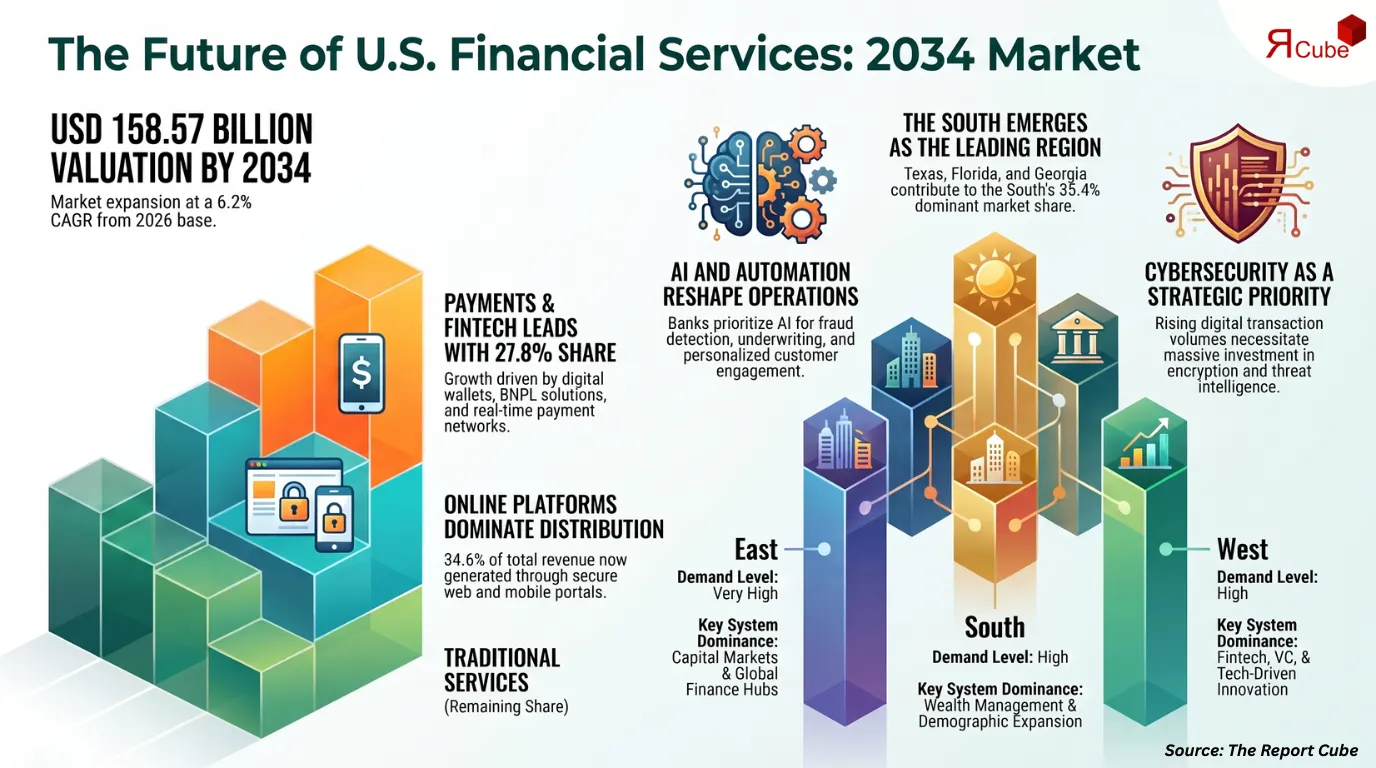
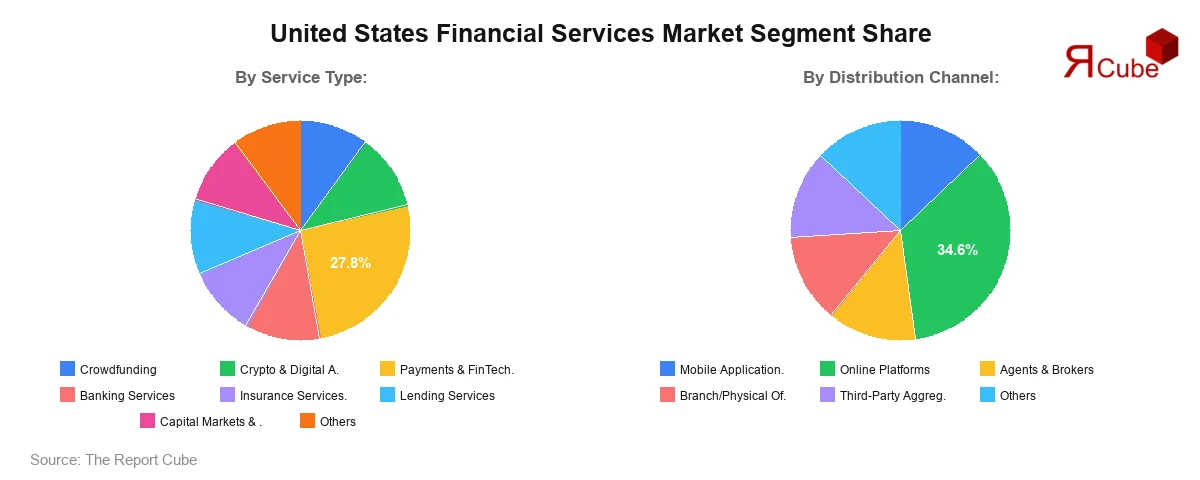
Payments & FinTech segment leads the market with approximately 27.8% share.
By Distribution Channel:
Online Platforms dominate the market with nearly 34.6% of total revenue.
Regional Outlook:
South region dominates the United States Financial Services Market with around 35.4% share.
United States Financial Services Market Insights & Analysis
The United States Financial Services Market is anticipated to register a CAGR of around 6.2% during the forecast period from 2026 to 2034. The market size is valued at USD 98.0 billion in 2026 and is projected to reach USD 158.57 billion by 2034. The United States remains the world's largest financial ecosystem, supported by a mature banking industry, highly developed capital markets, advanced payment infrastructure, and one of the strongest fintech investment environments globally. Financial institutions are directing substantial capital toward cloud modernization, artificial intelligence, cybersecurity, open banking capabilities, and digital payment infrastructure to improve operational resilience and customer engagement. Continued expansion of real-time payments, digital wallets, embedded finance, and blockchain-enabled transaction services is reshaping the competitive landscape while creating new opportunities across banking, lending, insurance, wealth management, and capital markets.
Strategic investments announced during 2026 highlight the industry's focus on next-generation financial infrastructure. Major payment networks expanded regulated stablecoin settlement capabilities, while leading commercial banks accelerated investments in branch modernization alongside digital banking platforms to strengthen omnichannel customer experiences. Wealth managers are broadening digital investment offerings through automated advisory services and alternative investment products, reflecting changing investor preferences. Federal initiatives supporting instant payment systems, cybersecurity resilience, and responsible financial innovation continue to reinforce industry development. At the same time, strong household spending, healthy corporate financing activity, expanding small business credit demand, and increasing adoption of digital financial products are expected to provide a solid foundation for sustainable growth across the Financial Services sector of the United States throughout the forecast period.
US Financial Services Market Impact Analysis
| Factor | Type | Specific Impact on Market | Magnitude | Business Implication |
|---|---|---|---|---|
| Macroeconomic Growth & GDP Share | Market | Sector contributes over seven percent of national output. | High | Supports long term expansion across lending, advisory, and insurance. |
| Digitalisation & Mobile Finance Adoption | Technological | Rapid uptake of mobile platforms reshapes client access and delivery. | High | Requires sustained investment in secure omni channel digital solutions. |
| Regulatory & Compliance Environment | Regulatory | Evolving rules on conduct, capital and data increase compliance needs. | High | Drives demand for robust risk frameworks and RegTech capabilities. |
| Globalisation & Cross Border Capital Flows | Environmental | Large export volumes and inward investment deepen market linkages. | Medium | Creates growth in trade finance and international advisory services. |
| Competitive Landscape & Innovation Pressure | Competitive | Traditional firms face rising competition from fintech and new models. | Medium | Necessitates partnerships and rapid product innovation to retain share. |
| Household Demand for Credit & Insurance | Consumer | Growing need for loans and coverage sustains retail finance volumes. | High | Supports expansion of tailored consumer lending and protection plans. |
| Labour Market & Employment Multiplier | Market | Sector jobs create several additional roles across wider economy. | Medium | Encourages workforce development and regional office diversification. |
United States Financial Services Market Dynamics
Key Driver: Accelerating Adoption of Digital Financial Platforms Across Consumers and Businesses
Digital financial services have become an integral part of everyday economic activity across the United States. Consumers increasingly rely on mobile banking applications, digital wallets, online investment platforms, and instant payment solutions for routine financial transactions, while businesses are embedding payment, lending, and treasury services directly into their digital ecosystems. Financial institutions continue expanding digital capabilities to improve service accessibility, reduce transaction costs, and deliver faster decision-making. The combination of secure cloud infrastructure, advanced analytics, and application programming interfaces has enabled banks and fintech providers to introduce highly personalized financial products that improve customer retention and operational efficiency.
Corporate investment in financial technology remains strong as institutions modernize legacy infrastructure and automate critical business functions. Artificial intelligence is improving fraud detection, underwriting, compliance monitoring, customer support, and portfolio management, allowing organizations to scale operations while maintaining regulatory standards. Collaboration between banks, payment companies, fintech firms, and technology providers is also accelerating product innovation across digital lending, embedded finance, wealth management, and commercial banking. These structural developments continue to strengthen long-term demand across the United States Financial Services Market.
Industry Trends: Digital Assets, Intelligent Automation, and Embedded Finance Continue to Reshape the Industry
Technology innovation is redefining how financial products are developed, delivered, and managed throughout the United States. Financial institutions are expanding the use of artificial intelligence to automate customer onboarding, personalize financial advice, strengthen anti-fraud systems, and improve credit assessment. Wealth management companies are integrating robo-advisory capabilities with hybrid advisory models, while insurance providers increasingly depend on predictive analytics to streamline underwriting and claims processing. These investments are improving efficiency without compromising regulatory compliance or customer experience.
Growth in regulated digital assets and embedded financial services is creating additional opportunities across the industry. Payment providers are expanding stablecoin settlement capabilities to support faster domestic and cross-border transactions, while Banking-as-a-Service models enable non-financial businesses to integrate payments, lending, insurance, and financial management tools into their digital platforms. Expansion of real-time payment infrastructure, programmable payments, and digital identity solutions is encouraging financial institutions to develop more flexible and scalable service models that address changing customer expectations.
Book your FREE 30-minute expert consultation today
Contact UsMajor Challenge: Cybersecurity Exposure and Regulatory Compliance Requirements
The increasing volume of digital financial transactions has expanded the industry's exposure to sophisticated cyber threats. Financial institutions manage highly sensitive customer information and process billions of transactions annually, making cybersecurity a strategic priority across every segment of the market. Ransomware attacks, payment fraud, identity theft, account takeover attempts, and data breaches continue to evolve in complexity, requiring continuous investment in security architecture, encryption technologies, threat intelligence, and multi-factor authentication. Maintaining customer confidence depends on the ability to protect financial assets while ensuring uninterrupted digital service delivery.
Regulatory obligations remain equally demanding as financial institutions operate within a highly supervised environment. Compliance with evolving requirements covering anti-money laundering, consumer protection, digital asset governance, privacy regulations, operational resilience, and cybersecurity standards requires continuous investment in governance frameworks and compliance technology. Smaller financial institutions and emerging fintech companies often face greater cost pressures when adapting to regulatory changes, creating operational challenges while maintaining competitive growth.
Opportunity: Financial Innovation Expands Access to Banking, Investment, and Lending Services
Broader access to digital financial products is creating new growth opportunities across the Financial Services sector of the United States. Mobile banking, digital lending platforms, online wealth management services, and cloud-based financial applications have significantly improved access for households, entrepreneurs, and small businesses seeking efficient financial solutions. Financial institutions are increasingly using alternative data models and automated underwriting tools to extend responsible credit access while improving approval speed and customer experience. These developments continue to strengthen financial inclusion across underserved customer groups.
Long-term expansion opportunities are also emerging from increasing participation in retirement planning, alternative investments, private markets, and digital asset ecosystems. Institutional investors and retail clients are allocating capital across a broader range of financial products, encouraging banks, asset managers, and brokerage firms to diversify their service offerings. Continued investment in payment modernization, blockchain infrastructure, embedded finance, and intelligent automation is expected to support sustainable growth while reinforcing the United States as one of the world's most advanced financial services markets.
United States Financial Services Market Segment-wise Analysis
By Service Type:
- Crowdfunding
- Crypto & Digital Assets
- Payments & FinTech
- Buy Now, Pay Later (BNPL)
- Credit Cards
- Mobile Payments
- P2P Payments
- Debit Cards
- Digital Wallets
- Banking Services
- Retail Banking
- Digital/Neo Banking
- Private Banking
- Investment Banking
- Commercial Banking
- Insurance Services
- Auto Insurance
- Life Insurance
- Specialty Insurance
- Health Insurance
- Property & Casualty Insurance
- Lending Services
- Auto Loans
- Student Loans
- Mortgage Lending
- SME Lending
- Consumer Lending
- Capital Markets & Alternative Investments
- Structured Products
- Equity Markets
- Derivatives
- Fixed Income
- Asset & Wealth Management
- Robo-Advisory
- Private Equity
- Mutual Funds
- Hedge Funds
- Pension & Retirement Funds
- Real Estate Finance
Payments & FinTech held the largest share of the United States Financial Services Market, accounting for approximately 27.8% of total revenue in 2026. The segment has experienced sustained expansion as consumers and businesses increasingly adopt digital wallets, mobile payments, Buy Now, Pay Later (BNPL) solutions, real-time payment networks, and contactless payment technologies. The widespread use of smartphones, rising e-commerce transactions, and continued migration toward cashless payments have accelerated transaction volumes across both retail and commercial sectors. Financial institutions and payment providers are also investing in cloud-native infrastructure, API-enabled payment platforms, fraud analytics, and tokenization technologies to enhance transaction security while improving processing speed.
Competitive activity within the segment remains strong as established payment networks and fintech companies continue introducing AI-enabled payment capabilities, regulated stablecoin settlement services, and embedded finance solutions. Businesses across retail, healthcare, travel, and digital commerce are integrating financial services directly into customer journeys, creating additional demand for payment processing and digital financial infrastructure. Cross-border commerce, subscription-based digital services, and increasing merchant acceptance of digital payment solutions are expected to support long-term expansion, positioning Payments & FinTech as the leading contributor to revenue growth in the United States Financial Services Market.
By Distribution Channel:
- Mobile Applications
- Online Platforms
- Agents & Brokers
- Branch/Physical Offices
- Third-Party Aggregators/Marketplaces
- Others
Online Platforms represented the leading distribution channel with nearly 34.6% of market revenue. Consumers increasingly prefer managing banking, lending, insurance, investments, and payment activities through secure web portals and digital platforms that provide uninterrupted access across multiple devices. Financial institutions have significantly expanded digital onboarding capabilities, electronic identity verification, remote account management, and self-service financial tools, reducing dependency on physical branches while improving customer convenience. These platforms also enable faster product delivery, lower operating costs, and broader geographic reach, making them an essential component of modern financial service distribution.
Continuous investments in artificial intelligence, cybersecurity, biometric authentication, and personalized financial dashboards are further enhancing customer engagement across online platforms. Banks, insurers, wealth managers, and fintech providers are leveraging advanced data analytics to recommend customized financial products based on customer preferences and financial behavior. The increasing popularity of digital-first banking, online investment platforms, and cloud-based financial services among younger demographics and small businesses is expected to reinforce the dominance of online platforms throughout the forecast period.
Regional Projection of United States Financial Services Industry
- West
- East
- South
- Midwest
- Others
The South accounted for the largest regional share of the United States Financial Services Market, contributing approximately 35.4% of total revenue in 2026. Economic expansion across states such as Texas, Florida, Georgia, North Carolina, and Tennessee has strengthened demand for banking, lending, insurance, wealth management, and digital payment services. Rapid population growth, increasing business formation, rising household income, and strong residential development continue to generate substantial demand for mortgages, commercial lending, payment processing, and investment products. The region has also attracted considerable investment from financial institutions seeking to expand operations in high-growth metropolitan areas.
Regional leadership is further supported by the presence of major banking headquarters, expanding fintech ecosystems, and ongoing investments in digital financial infrastructure. Financial institutions continue opening new branches while enhancing omnichannel service models that combine physical banking with advanced digital capabilities. Small business financing, commercial real estate activity, healthcare expansion, and strong consumer spending are creating favorable conditions for sustained financial services demand across the South. These structural advantages are expected to help the region maintain its leading position in the United States Financial Services Market during the forecast period.
Need insights for a specific region within this market?
Request Regional DataUS Financial Services Market Regional Analysis
The US financial services market shows strong regional clustering across major hubs and emerging corridors in 2026.
| Cluster | Demand Level | Key Areas | System Dominance | Core Demand Logic | Growth Nature |
|---|---|---|---|---|---|
| East | Very High | New York, Boston, DC | Capital markets & big banks | Global finance and policy hubs | Mature, tech-led expansion |
| West | High | San Francisco, LA, Seattle | Fintech, VC, digital banks | Tech-driven innovation focus | Fast innovation-led growth |
| South | High | Miami, Atlanta, Dallas | Wealth, payments, insurance | Migration and wealth inflows | Sunbelt demographic expansion |
| Midwest | Medium | Chicago, Minneapolis, Columbus | Regional banks & processors | Corporate banking and payroll | Steady modernization-driven |
| Others | Emerging | Austin, Charlotte, Denver | Hybrid fintech and banking | Talent hubs and lower costs | Fastest-growing new nodes |
Government Initiatives & Policies
- Federal Reserve FedNow Service Expansion (2025-2026): The Federal Reserve continues expanding the FedNow® Service, enabling financial institutions across the United States to offer secure real-time payment capabilities that support instant fund transfers, improved liquidity management, and faster consumer and business transactions.
- U.S. Department of the Treasury National Strategy for Financial Inclusion and Digital Innovation (2025-2026): The U.S. Treasury continues strengthening financial access through initiatives focused on digital payments, financial inclusion, cybersecurity resilience, and responsible innovation across banking and financial technology ecosystems.
United States Financial Services Industry Recent Developments
- 2026: Visa Inc. launched a comprehensive suite of AI-powered commerce solutions, including Agent Scoring, Agentic Registry, enhanced tokenization capabilities, and expanded stablecoin settlement infrastructure. The company's stablecoin settlement network reached an annualized transaction run rate of nearly USD 7 billion by March 2026, supporting programmable payments, autonomous AI-driven transactions, and faster cross-border settlements.
- 2026: Mastercard Incorporated expanded its settlement infrastructure to support regulated stablecoins such as USDC, PYUSD, RLUSD, and other approved digital assets. The upgraded platform enables intraday, weekend, and holiday settlements, providing greater operational flexibility, enhanced liquidity management, and improved transaction efficiency for banks, payment providers, and merchants.
- 2026: PayPal Holdings, Inc. expanded the availability of its PayPal USD (PYUSD) stablecoin across 70 international markets. The initiative allows consumers and merchants to conduct faster, lower-cost cross-border transactions while strengthening PayPal's digital payments ecosystem and accelerating mainstream adoption of regulated blockchain-based payment solutions.
- 2026: JPMorgan Chase & Co. announced plans to open more than 160 new branches across over 30 U.S. states while hiring approximately 1,100 employees. The expansion also includes modernization of nearly 600 existing branch locations, reinforcing the company's omnichannel banking strategy and improving access to financial services in underserved communities.
- 2026: The Charles Schwab Corporation entered the prediction markets segment through a partnership with Cboe Global Markets, introducing binary options linked to the S&P 500 Index. The launch expands Schwab's portfolio of alternative investment products while providing retail investors with simplified event-based trading opportunities.
Why Choose This Report?
- Provides a comprehensive overview of the overall market analysis, encompassing key trends, consumer behavior analysis, and risk assessment to support strategic decision-making.
- Provides accurate, up-to-date insights into market size, segmentation, and emerging opportunities, helping organizations minimize risk while capitalizing on future growth opportunities.
- Gives deep understanding of target audience preferences, investment patterns, technological developments, and communication channels for enhanced product development and marketing effectiveness.
- Delivers competitive analysis and benchmarking, uncovering the strengths, strategic initiatives, and market positioning of leading industry participants.
- Consolidates comprehensive market intelligence, reducing research efforts while supporting informed business planning and investment decisions.
- Facilitates customized market segmentation and risk mitigation strategies that align with evolving business objectives and regional market conditions.
- Helps identify market restraints, growth opportunities, emerging technologies, and investment hotspots to support long-term business expansion.
- Provides valuable information derived from industry trends, customer demand patterns, regulatory developments, and extensive market research.
Table of Contents
- Introduction
- Objective of the Study
- Product and Category Definition
- Market Segmentation
- Study Variables
- Research Methodology
- Secondary Data Points
- Breakdown of Secondary Sources
- Primary Data Points
- Breakdown of Primary Interviews
- Secondary Data Points
- Executive Summary
- Market Dynamics
- Emerging Opportunities
- Adoption Trends
- Demand Drivers
- Disruption Analysis (Challenges)
- Industry Analysis & Strategic Insights
- Supply/Value Chain Analysis
- Pricing Analysis
- Go-To-Market (GTM) Strategy
- BCG Matrix
- Recent Trends and Developments
- Import and Export Analysis
- Regulatory and Policy Landscape
- Region-wise policies
- Government Initiatives
- United States Financial Services Market Overview and Forecast Analysis (2021-2034)
- Market Size, By Value, By Growth Rate (CAGR/USD Billion)
- Market Share, By Service Type
- Crowdfunding
- Crypto & Digital Assets
- Payments & FinTech
- Buy Now, Pay Later (BNPL)
- Credit Cards
- Mobile Payments
- P2P Payments
- Debit Cards
- Digital Wallets
- Banking Services
- Retail Banking
- Digital/Neo Banking
- Private Banking
- Investment Banking
- Commercial Banking
- Insurance Services
- Auto Insurance
- Life Insurance
- Specialty Insurance
- Health Insurance
- Property & Casualty Insurance
- Lending Services
- Auto Loans
- Student Loans
- Mortgage Lending
- SME Lending
- Consumer Lending
- Capital Markets & Alternative Investments
- Structured Products
- Equity Markets
- Derivatives
- Fixed Income
- Asset & Wealth Management
- Robo-Advisory
- Private Equity
- Mutual Funds
- Hedge Funds
- Pension & Retirement Funds
- Real Estate Finance
- Market Share, By Distribution Channel
- Mobile Applications
- Online Platforms
- Agents & Brokers
- Branch/Physical Offices
- Third-Party Aggregators/Marketplaces
- Others
- Market Share, By End User
- SMEs
- Government & Public Sector
- Individuals/Households
- Large Enterprises
- Non-Profit Organizations
- Market Share, By Region
- West
- East
- South
- Midwest
- Others
- Market Share, By Company
- Revenue Shares & Analysis
- Competitive Landscape
- West United States Financial Services Market Overview and Forecast Analysis (2021-2034)
- Market Size, By Value, By Growth Rate (CAGR/USD Billion/Million)
- Market Share, By Service Type
- Market Share, By Distribution Channel
- Market Share, By End User
- East United States Financial Services Market Overview and Forecast Analysis (2021-2034)
- Market Size, By Value, By Growth Rate (CAGR/USD Billion/Million)
- Market Share, By Service Type
- Market Share, By Distribution Channel
- Market Share, By End User
- South United States Financial Services Market Overview and Forecast Analysis (2021-2034)
- Market Size, By Value, By Growth Rate (CAGR/USD Billion/Million)
- Market Share, By Service Type
- Market Share, By Distribution Channel
- Market Share, By End User
- Midwest United States Financial Services Market Overview and Forecast Analysis (2021-2034)
- Market Size, By Value, By Growth Rate (CAGR/USD Billion/Million)
- Market Share, By Service Type
- Market Share, By Distribution Channel
- Market Share, By End User
- Competitive Analysis, 2026
- Market Share of Key Players
- Competitive Mapping for Each Segment and Companies Operating Regionally
- West United States Financial Services Companies Share & Competitive Analysis, 2026
- East United States Financial Services Companies Share & Competitive Analysis, 2026
- South United States Financial Services Companies Share & Competitive Analysis, 2026
- Midwest United States Financial Services Companies Share & Competitive Analysis, 2026
- Company Profile (Partial List)
- Visa Inc.
- Company Overview
- Product Portfolio
- Strategic Alliances/Partnerships
- Recent Developments
- PayPal Holdings, Inc.
- Company Overview
- Product Portfolio
- Strategic Alliances/Partnerships
- Recent Developments
- Citigroup Inc.
- Company Overview
- Product Portfolio
- Strategic Alliances/Partnerships
- Recent Developments
- Bank of America Corporation
- Company Overview
- Product Portfolio
- Strategic Alliances/Partnerships
- Recent Developments
- American Express Company
- Company Overview
- Product Portfolio
- Strategic Alliances/Partnerships
- Recent Developments
- Goldman Sachs Group, Inc.
- Company Overview
- Product Portfolio
- Strategic Alliances/Partnerships
- Recent Developments
- Mastercard Incorporated
- Company Overview
- Product Portfolio
- Strategic Alliances/Partnerships
- Recent Developments
- JPMorgan Chase & Co.
- Company Overview
- Product Portfolio
- Strategic Alliances/Partnerships
- Recent Developments
- Wells Fargo & Company
- Company Overview
- Product Portfolio
- Strategic Alliances/Partnerships
- Recent Developments
- Morgan Stanley
- Company Overview
- Product Portfolio
- Strategic Alliances/Partnerships
- Recent Developments
- Others (Partial List)
- Visa Inc.
- Contact Us and Disclaimer
Top Key Players & Market Share Outlook
- Visa Inc.
- PayPal Holdings, Inc.
- Citigroup Inc.
- Bank of America Corporation
- American Express Company
- Goldman Sachs Group, Inc.
- Mastercard Incorporated
- JPMorgan Chase & Co.
- Wells Fargo & Company
- Morgan Stanley
- Others
Frequently Asked Questions






