



Build Your Custom Market Intelligence Report
Customize Your ReportUS Freight Brokerage Market Key Highlights
By Service Type:
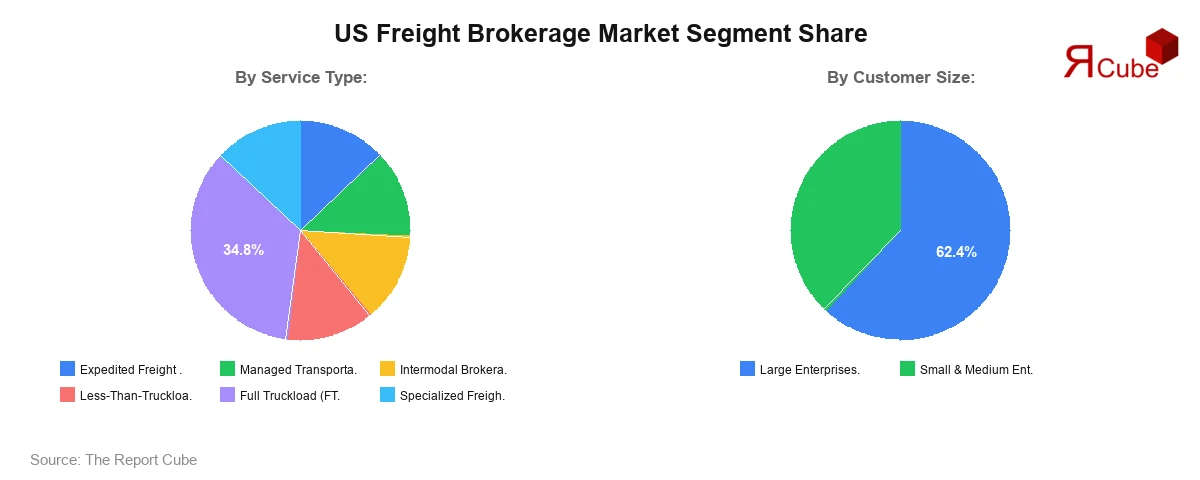
Full Truckload (FTL) Brokerage segment leads the market with approximately 34.8% share.
By Customer Size:
Large Enterprises segment dominates the market with nearly 62.4% of revenue.
Regional Outlook:
South region dominates the US Freight Brokerage market with around 36.7% share.
US Freight Brokerage Market Insights & Analysis
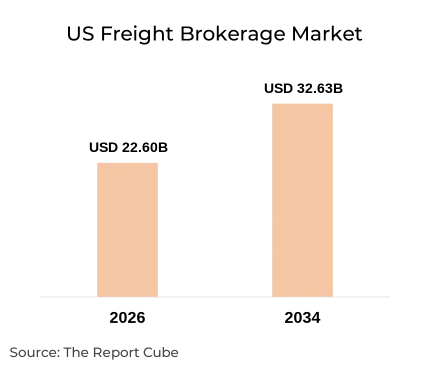
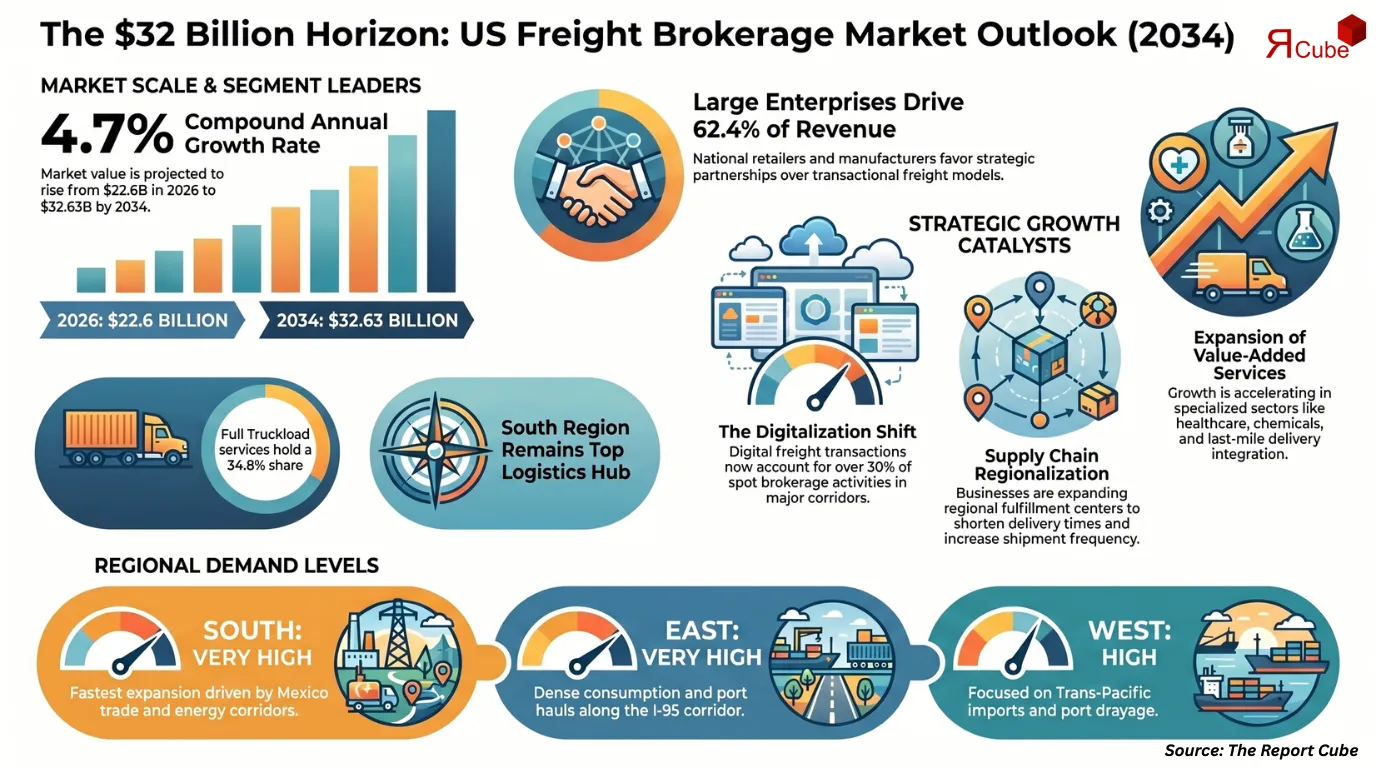
The US Freight Brokerage Market is anticipated to register a CAGR of around 4.7% during the forecast period 2026-2034. The market size is valued at USD 22.6 billion in 2026 and is projected to reach USD 32.63 billion by 2034. Freight brokerage activity in the United States continues to benefit from the country's position as the world's largest freight transportation network, handling more than 20 billion tons of freight annually across truck, rail, air, and maritime modes. Truck transportation remains the dominant freight mode, accounting for nearly 72% of domestic freight value movement, creating sustained demand for brokerage providers that connect shippers with reliable carrier capacity.
- During 2025-2026, freight brokers reported stronger load volumes from retail distribution, industrial manufacturing, food processing, and healthcare supply chains as businesses expanded regional fulfillment operations and diversified sourcing networks. Rising freight complexity has encouraged shippers to outsource transportation procurement and carrier management functions, supporting continued growth in freight brokerage services.
Industry participants are accelerating investments in digital brokerage platforms, transportation management systems, predictive pricing tools, and real-time shipment visibility solutions to improve operational performance. According to logistics industry estimates, digital freight transactions now account for more than 30% of spot brokerage activities in major freight corridors, reflecting the growing preference for automated freight procurement. Market expansion is further supported by ongoing federal investments in freight infrastructure, port modernization projects, interstate highway upgrades, and supply chain resilience programs introduced through recent transportation funding initiatives. Large brokerage providers are also expanding value-added services such as managed transportation, multimodal coordination, freight analytics, and last-mile delivery integration. These developments are strengthening market competitiveness while improving carrier utilization, shipment transparency, and supply chain efficiency across Freight Brokerage in United States operations.
United States Freight Brokerage Market Impact Analysis
| Factor | Type | Specific Impact on Market | Magnitude | Business Implication |
|---|---|---|---|---|
| Expanding Domestic Freight Volumes | Market | Higher truckload and LTL demand supports brokerage growth | High | Enables scale up of carrier networks and customer contracts |
| Shift Toward Digital Freight Platforms | Technological | Automation improves load matching and pricing transparency | High | Drives investment in software, data tools, and integrations |
| Regulatory Oversight on Carrier Safety | Regulatory | Compliance checks tighten carrier qualification processes | Medium | Requires robust vetting systems and risk management policies |
| Freight Rate Volatility and Cyclicality | Market | Spot and contract rate swings affect brokerage margins | High | Necessitates dynamic pricing and diversified customer mix |
| Intensifying Competition Among Brokers | Competitive | Large and niche players compete on price and service | Medium | Encourages differentiation via sector expertise and service |
| Shipper Demand for End to End Visibility | Consumer | Clients expect real time tracking and data rich reporting | High | Promotes adoption of tracking tools and analytics dashboards |
| Rise of Sustainable Transport Expectations | Environmental | Shippers seek lower emission transport and reporting tools | Medium | Creates need for greener carrier options and emissions data |
US Freight Brokerage Market Dynamics
Key Driver: Expansion of Regional Distribution Networks and Transportation Outsourcing
Freight brokerage demand is benefiting from the ongoing restructuring of supply chains across the United States. Manufacturers, retailers, and distributors are expanding regional fulfillment operations to shorten delivery times and improve inventory availability. This shift has increased shipment frequency and transportation complexity, creating a greater need for brokerage providers capable of coordinating freight across extensive carrier networks. Brokerage firms help shippers secure capacity during seasonal peaks while maintaining transportation flexibility without significant investment in private fleets.
Large enterprises are also increasing transportation outsourcing to focus on core business operations. Freight brokers provide access to thousands of carriers, advanced shipment visibility tools, and route optimization capabilities that would otherwise require substantial internal resources. As logistics costs remain a strategic concern for businesses, brokerage services continue to offer an effective solution for balancing service reliability, cost efficiency, and transportation scalability. This trend is expected to remain a primary contributor to US Freight Brokerage market growth throughout the forecast period.
Industry Trends: Digitalization Reshaping Freight Brokerage Operations
Technology adoption is transforming how freight transactions are executed across the United States. Digital freight brokerage platforms now support automated load matching, instant carrier onboarding, dynamic pricing, electronic documentation, and real-time shipment monitoring. These capabilities reduce manual processes while improving transparency for both shippers and carriers. The increasing use of cloud-based transportation management systems is helping brokerage providers manage larger shipment volumes with greater operational accuracy.
Market participants are also integrating advanced analytics into decision-making processes. Historical freight data, route performance metrics, weather intelligence, and carrier reliability scores are being utilized to improve load planning and pricing precision. Digital brokerage models continue to gain traction among enterprise customers seeking faster procurement cycles and improved shipment visibility. As technology becomes more deeply embedded in transportation operations, brokers with strong digital capabilities are expected to capture a larger share of freight spending across the U.S. logistics market.
Book your FREE 30-minute expert consultation today
Contact UsMajor Challenge: Freight Rate Cyclicality and Capacity Imbalances
Market conditions within the freight transportation industry can shift rapidly due to economic activity, consumer spending patterns, fuel prices, and carrier capacity availability. During freight downturns, lower shipment volumes place pressure on brokerage margins as competition intensifies for available loads. Conversely, periods of strong freight demand can lead to capacity shortages and higher transportation costs, creating challenges for maintaining service consistency and customer satisfaction.
Operational risks are further amplified by ongoing driver shortages, rising insurance premiums, equipment costs, and regulatory compliance requirements. Smaller carriers, which form a significant portion of the brokerage ecosystem, often face financial constraints during prolonged market fluctuations. Freight brokers must therefore balance carrier relationships, pricing competitiveness, and service quality while navigating changing market conditions. These factors continue to represent important challenges for long-term profitability within the freight brokerage industry.
Opportunity: Growth of Specialized Logistics and Value-Added Services
Increasing demand for specialized transportation solutions is creating attractive opportunities for freight brokerage providers. Industries such as pharmaceuticals, healthcare, food and beverage, chemicals, and high-value manufacturing require strict shipment handling standards, temperature control, regulatory compliance, and enhanced tracking capabilities. Brokers with expertise in these areas can differentiate their services and command premium pricing structures.
Shippers are also seeking broader logistics support beyond traditional load matching activities. Transportation planning, freight audit services, carrier procurement, supply chain analytics, and last-mile coordination are becoming increasingly important components of brokerage offerings. The growing preference for integrated logistics solutions allows brokerage companies to strengthen customer relationships while generating additional revenue streams. As supply chains become more interconnected and data-driven, value-added freight services are expected to emerge as a significant growth opportunity across the U.S. freight brokerage marketriod.
US Freight Brokerage Market Segment-wise Analysis
By Service Type:
- Managed Transportation Services
- Expedited Freight Brokerage
- Intermodal Brokerage
- Less-Than-Truckload (LTL) Brokerage
- Full Truckload (FTL) Brokerage
- Specialized Freight Brokerage
Full Truckload (FTL) Brokerage accounted for an estimated 34.8% share of the US Freight Brokerage Market in 2026, making it the leading service segment. FTL solutions remain essential for industries that transport high shipment volumes over long distances, including manufacturing, retail distribution, automotive, and industrial equipment sectors. Dedicated truck capacity enables faster transit times, minimizes cargo handling, and reduces the risk of product damage, making FTL services particularly attractive for time-sensitive shipments.
Strong freight activity across major interstate corridors such as I-35, I-40, I-75, and I-95 continues to support demand for FTL brokerage services. Brokerage providers have expanded carrier networks and digital freight matching capabilities to improve truck utilization and reduce empty miles. As distribution networks become more geographically dispersed and inventory replenishment cycles accelerate, FTL brokerage is expected to retain its dominant position within the U.S. freight transportation market.
By Customer Size:
- Large Enterprises
- Small & Medium Enterprises (SMEs)
Large Enterprises represented approximately 62.4% of market revenue, reflecting their extensive transportation requirements and complex logistics operations. National retailers, manufacturers, consumer goods companies, healthcare organizations, and industrial firms depend on brokerage providers to manage large freight volumes across multiple regions and transportation modes. The ability to secure capacity quickly while maintaining shipment visibility is particularly important for enterprises operating nationwide distribution networks.
Many large organizations are adopting strategic transportation partnerships rather than transactional freight procurement models. Brokerage firms offering integrated transportation management, analytics capabilities, and dedicated account support are increasingly preferred by enterprise customers. These relationships help improve supply chain efficiency, strengthen carrier performance, and support cost optimization objectives. As freight networks become more sophisticated, large enterprises are expected to remain the primary revenue contributors to the freight brokerage industry.
Regional Projection of US Freight Brokerage Industry
- West
- East
- South
- Midwest
- Others
The South region held an estimated 36.7% share of the US Freight Brokerage Market, supported by its extensive transportation infrastructure, population growth, and industrial expansion. Texas, Georgia, Florida, Tennessee, and North Carolina have emerged as major logistics hubs due to their strategic locations, strong highway connectivity, and access to key domestic and international trade routes. Significant investments in warehousing, distribution facilities, and manufacturing operations continue to drive freight demand throughout the region.
Port activity along the Gulf Coast and Southeastern United States further strengthens regional freight volumes. The region benefits from growing e-commerce fulfillment operations, automotive manufacturing investments, and rising consumer demand. Large-scale logistics developments around Dallas-Fort Worth, Atlanta, Houston, Memphis, and Jacksonville have enhanced transportation capacity and created substantial opportunities for freight brokerage providers. These structural advantages are expected to support the South's leadership position through 2034.
Need insights for a specific region within this market?
Request Regional DataUS Freight Brokerage Market Regional Analysis
The US freight brokerage market shows distinct regional patterns shaped by trade lanes, industry mix, and port and rail connectivity in 2026.
| Cluster | Demand Level | Key Areas | System Dominance | Core Demand Logic | Growth Nature |
|---|---|---|---|---|---|
| West | High | LA, Oakland, Seattle | Truckload & Intermodal | Trans‑Pacific import and port drayage | Rebound from past port diversion |
| East | Very High | NY-NJ, Savannah, I‑95 | Truckload, LTL, Port haul | Diverse imports and dense consumption | Stable, capacity‑tightened growth |
| South | Very High | Texas, ATL, Gulf ports | Cross‑border and Dry van | Mexico trade and energy corridors | Fastest structural expansion |
| Midwest | High | Chicago, Ohio, I‑80 | Intermodal and Full truckload | Manufacturing and rail hub volumes | Cycle‑linked volume recovery |
| Others | Medium | Mountain, rural corridors | Regional truckload focus | Seasonal, niche and project freight | Incremental, relationship‑led |
Government Initiatives & Policies
- Freight Logistics Optimization Works (FLOW): The U.S. Department of Transportation continues expanding the FLOW data-sharing initiative to improve freight visibility, supply chain forecasting, and logistics coordination among industry participants.
- FY 2025-2026 INFRA Grant Program: The U.S. Department of Transportation continues funding nationally significant freight and highway infrastructure projects through the INFRA program to improve freight efficiency, reliability, and multimodal transportation connectivity.
US Freight Brokerage Industry Recent Developments
- 2025: Uber Freight LLC expanded its partnership with Better Trucks to strengthen last-mile delivery capabilities across North America. The collaboration integrates Better Trucks' delivery network and technology platform with Uber Freight's logistics services, enhancing shipment visibility, transportation efficiency, and service coverage for retail and e-commerce customers. The development reflects growing demand for integrated logistics solutions that combine freight brokerage, transportation management, and final-mile delivery services.
Why Choose This Report?
- Provides a comprehensive overview of the overall market analysis, encompassing key trends, consumer behavior analysis, and risk assessment to support strategic decision-making.
- Provides accurate, up-to-date insights into market size, segmentation, and emerging opportunities, helping to minimize risk & capitalizing on growth.
- Gives deep understanding of target audience preferences, investment habits, and communication channels for enhanced product development & marketing effectiveness.
- Delivers competitive analysis & benchmarking, uncovering the strengths & weaknesses of market competitors to guide strategies.
- Consolidate comprehensive market intelligence, reducing reasoning & streamlining research efforts.
- Facilitates customized market segmentation & risk mitigation strategies, fine-tuned to the business objectives.
- Aids in identifying both market challenges & untapped opportunities within the industry to drive long-term business growth.
- Provides valuable information based on actual customer data & search trends.
Table of Contents
- Introduction
- Objective of the Study
- Product and Category Definition
- Market Segmentation
- Study Variables
- Research Methodology
- Secondary Data Points
- Breakdown of Secondary Sources
- Primary Data Points
- Breakdown of Primary Interviews
- Secondary Data Points
- Executive Summary
- Market Dynamics
- Emerging Opportunities
- Adoption Trends
- Demand Drivers
- Disruption Analysis (Challenges)
- Industry Analysis & Strategic Insights
- Supply/Value Chain Analysis
- Pricing Analysis
- Go-To-Market (GTM) Strategy
- BCG Matrix
- Recent Trends and Developments
- Import and Export Analysis
- Regulatory and Policy Landscape
- Region-wise Policies
- Government Initiatives
- US Freight Brokerage Market Overview and Forecast Analysis (2021-2034)
- Market Size, By Value, By Growth Rate (CAGR/USD Billion)
- Market Share, By Service Type
- Managed Transportation Services
- Expedited Freight Brokerage
- Intermodal Brokerage
- Less-Than-Truckload (LTL) Brokerage
- Full Truckload (FTL) Brokerage
- Specialized Freight Brokerage
- Market Share, By Customer Size
- Large Enterprises
- Small & Medium Enterprises (SMEs)
- Market Share, By End-Use Industry
- Retail & E-commerce
- Manufacturing
- Healthcare & Pharmaceuticals
- Automotive
- Consumer Goods
- Industrial & Heavy Equipment
- Agriculture
- Chemicals
- Food & Beverage
- Others
- Market Share, By Brokerage Model
- Digital Freight Brokerage
- Traditional Freight Brokerage
- Market Share, By Region
- West
- East
- South
- Midwest
- Others
- Market Share, By Company
- Revenue Shares & Analysis
- Competitive Landscape
- West US Freight Brokerage Market Overview and Forecast Analysis (2021-2034)
- Market Size, By Value, By Growth Rate (CAGR/USD Billion/Million)
- Market Share, By Service Type
- Market Share, By Customer Size
- Market Share, By End-Use Industry
- Market Share, By Brokerage Model
- East US Freight Brokerage Market Overview and Forecast Analysis (2021-2034)
- Market Size, By Value, By Growth Rate (CAGR/USD Billion/Million)
- Market Share, By Service Type
- Market Share, By Customer Size
- Market Share, By End-Use Industry
- Market Share, By Brokerage Model
- South US Freight Brokerage Market Overview and Forecast Analysis (2021-2034)
- Market Size, By Value, By Growth Rate (CAGR/USD Billion/Million)
- Market Share, By Service Type
- Market Share, By Customer Size
- Market Share, By End-Use Industry
- Market Share, By Brokerage Model
- Midwest US Freight Brokerage Market Overview and Forecast Analysis (2021-2034)
- Market Size, By Value, By Growth Rate (CAGR/USD Billion/Million)
- Market Share, By Service Type
- Market Share, By Customer Size
- Market Share, By End-Use Industry
- Market Share, By Brokerage Model
- Competitive Analysis, 2026
- Market Share of Key Players
- Competitive Mapping for Each Service Type, Customer Size, End-Use Industry, and Brokerage Model
- West US Freight Brokerage Companies Share & Competitive Analysis, 2026
- East US Freight Brokerage Companies Share & Competitive Analysis, 2026
- South US Freight Brokerage Companies Share & Competitive Analysis, 2026
- Midwest US Freight Brokerage Companies Share & Competitive Analysis, 2026
- Company Profile (Partial List)
- Worldwide Express Operations, LLC
- Company Overview
- Product Portfolio
- Strategic Alliances/Partnerships
- Recent Developments
- RXO, Inc.
- Company Overview
- Product Portfolio
- Strategic Alliances/Partnerships
- Recent Developments
- Schneider Logistics, Inc.
- Company Overview
- Product Portfolio
- Strategic Alliances/Partnerships
- Recent Developments
- Uber Freight LLC
- Company Overview
- Product Portfolio
- Strategic Alliances/Partnerships
- Recent Developments
- Mode Global, LLC
- Company Overview
- Product Portfolio
- Strategic Alliances/Partnerships
- Recent Developments
- BlueGrace Logistics, LLC
- Company Overview
- Product Portfolio
- Strategic Alliances/Partnerships
- Recent Developments
- Total Quality Logistics, LLC
- Company Overview
- Product Portfolio
- Strategic Alliances/Partnerships
- Recent Developments
- Echo Global Logistics, Inc.
- Company Overview
- Product Portfolio
- Strategic Alliances/Partnerships
- Recent Developments
- Nolan Transportation Group, LLC
- Company Overview
- Product Portfolio
- Strategic Alliances/Partnerships
- Recent Developments
- Arrive Logistics, LLC
- Company Overview
- Product Portfolio
- Strategic Alliances/Partnerships
- Recent Developments
- Ryder Integrated Logistics, Inc.
- Company Overview
- Product Portfolio
- Strategic Alliances/Partnerships
- Recent Developments
- C.H. Robinson Worldwide, Inc.
- Company Overview
- Product Portfolio
- Strategic Alliances/Partnerships
- Recent Developments
- Others (Partial List)
- Worldwide Express Operations, LLC
- Contact Us and Disclaimer
Top Key Players & Market Share Outlook
- Worldwide Express Operations, LLC
- RXO, Inc.
- Schneider Logistics, Inc.
- Uber Freight LLC
- Mode Global, LLC
- BlueGrace Logistics, LLC
- Total Quality Logistics, LLC
- Echo Global Logistics, Inc.
- Nolan Transportation Group, LLC
- Arrive Logistics, LLC
- Ryder Integrated Logistics, Inc.
- C.H. Robinson Worldwide, Inc.
- Others
Frequently Asked Questions






