



Build Your Custom Market Intelligence Report
Customize Your ReportUnited States Frozen Yogurt Market Key Takeaways
A comprehensive United States Frozen Yogurt Market Analysis reveals a steadily expanding dessert category gaining ground on shifting health preferences nationwide.
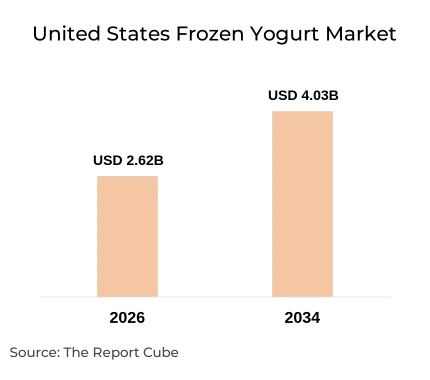
- Market valued at USD 2.62 billion in 2026, reflecting consistent demand across retail and foodservice channels.
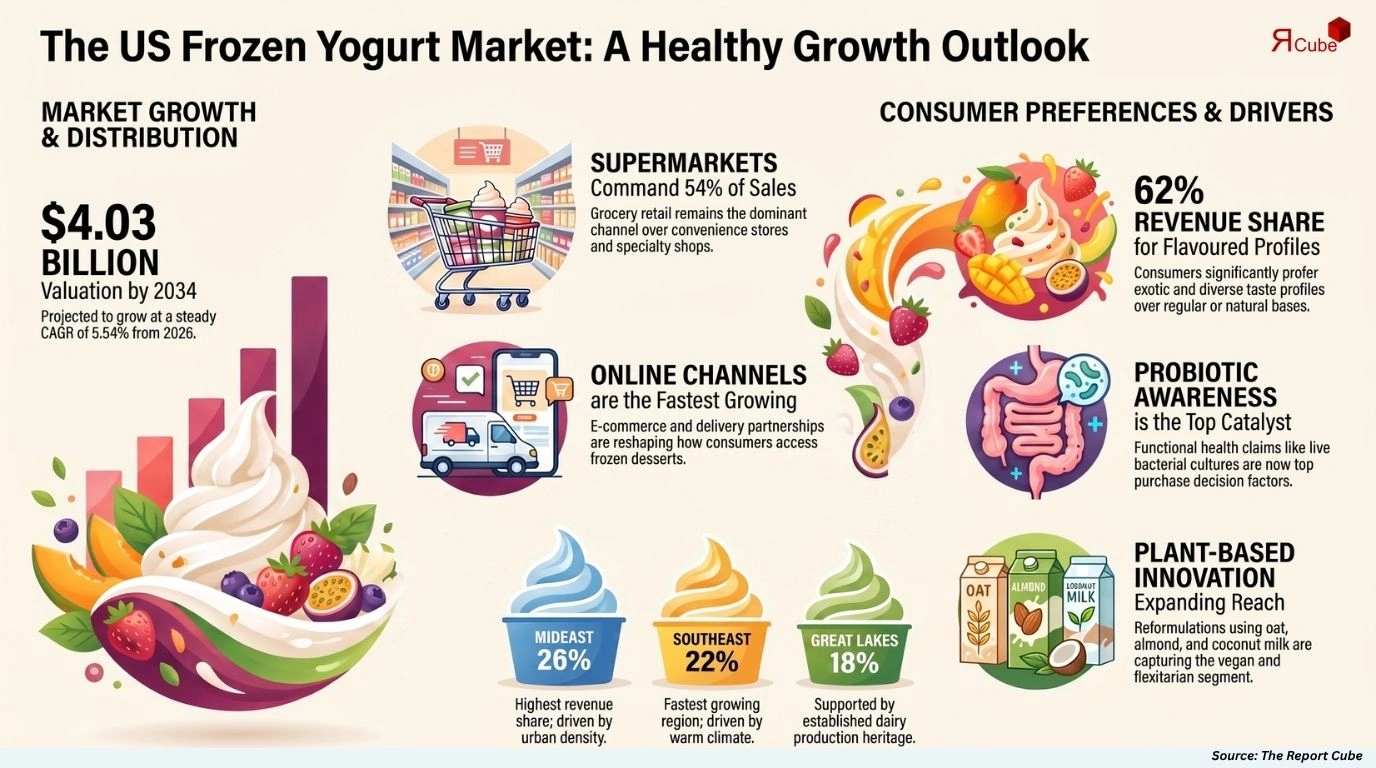
- Industry projected to reach USD 4.03 billion by 2034, expanding at a 5.54% CAGR through the forecast period.
- Flavoured sub-segment leads the By Flavour category due to rising preference for diverse and exotic taste profiles.
- Supermarkets and hypermarkets dominate distribution, accounting for the largest share of total frozen yogurt sales.
- Southeast region represents the fastest-growing geography driven by warm climate and rising urban populations.
- Mideast region holds leading revenue position supported by high-density urban markets and premium positioning.
- Leading companies include Nestle S.A., Unilever Plc, Dairy Farmers of America Inc., and Danone S.A.
- Growing probiotic awareness, low-fat positioning, and clean-label reformulation are the primary demand catalysts.
United States Frozen Yogurt Market Insights & Analysis
The United States Frozen Yogurt Market is anticipated to register a 5.54% CAGR during 2026–2034. The market size was valued at USD 2.62 billion in 2026 and is projected to reach USD 4.03 billion by 2034. This United States Frozen Yogurt Market Size study confirms that growth is underpinned by a consumer base actively seeking low-fat, probiotic-enriched dessert alternatives to traditional ice cream. Domestic frozen yogurt production reached approximately 34.2 million gallons in 2025, with retail expansion and reformulated product lines driving fresh volume across both premium and mainstream price tiers.
Investments by global manufacturers are accelerating product diversification at a meaningful pace. In October 2025, Yasso - operating under Unilever's Magnum Ice Cream division - launched a squeezable 14oz frozen Greek yogurt line, now carried across Target retail locations throughout the United States. Regulatory tailwinds have also emerged: the FDA's updated healthy nutrient content labeling rule, effective February 2025, gives lower-sugar cultured desserts a formal on-pack advantage that standard ice cream products struggle to claim, further strengthening the frozen yogurt value proposition with health-oriented consumers.
United States Frozen Yogurt Market Dynamics
Demand for frozen yogurt in the United States continues to build across both retail grocery and foodservice channels as consumer preferences shift toward desserts that deliver taste without compromising nutritional priorities. Growing per-capita yogurt consumption, rising probiotic awareness, and the expansion of self-serve franchise networks are combining with active product reformulation to sustain category momentum through the forecast period.
|
Factor |
Type |
Specific Impact on Market |
Magnitude |
|---|---|---|---|
|
Health-conscious dessert shift |
Driver |
Accelerates category conversion from ice cream to frozen yogurt |
Very High |
|
Probiotic and live-culture demand |
Driver |
Increases premium SKU adoption and unit price realization |
High |
|
Online distribution channel growth |
Opportunity |
Expands reach via Instacart and delivery platform partnerships |
High |
|
Plant-based and dairy-free innovation |
Trend |
Broadens addressable consumer base to vegan and lactose-intolerant shoppers |
High |
|
Retail shelf space competition |
Challenge |
Pressures smaller brands against established ice cream and gelato categories |
Medium |
Key Market Driver: Probiotic Awareness Fueling Premium Demand
The United States Frozen Yogurt Market Growth is primarily driven by rising consumer understanding of gut health and the functional role of live and active bacterial cultures. Unlike conventional frozen desserts, frozen yogurt products carrying certified probiotic content command shelf premiums and influence repeat purchase decisions among health-conscious millennials and Gen Z shoppers. Nielsen consumer panel data indicates that functional claims - including live cultures, low sugar, and protein fortification - are now among the top three purchase decision factors in the frozen dessert aisle, shifting category competition from pure indulgence positioning toward a hybrid health-and-treat framework.
Major Industry Challenge: Fragmented Self-Serve Franchise Contraction
The rapid contraction of self-serve frozen yogurt chains between 2014 and 2022 created lasting headwinds for foodservice channel revenue. Peak franchise unit counts exceeded 2,500 US locations for brands including TCBY, Yogurtland, and Menchie's during the category's initial growth wave, but ongoing unit consolidation has shifted volume back toward grocery retail and emerging online delivery formats. Operators that have survived consolidation are now relying on digital loyalty programs, mobile order-ahead capabilities, and topping bar diversification to sustain traffic - strategies that require continuous capital reinvestment across a geographically dispersed retail footprint.
Emerging Trend Shaping Outlook: Plant-Based Reformulation Expanding Category Reach
Among the most significant United States Frozen Yogurt Market Trends is the reformulation of core product lines using oat milk, almond milk, and coconut milk bases, allowing brands to address vegan, lactose-intolerant, and flexitarian consumers without requiring separate product lines. Danone S.A. has expanded its plant-based frozen yogurt offerings, while Nestle S.A. introduced non-dairy frozen yogurt options to broaden portfolio reach. With US per-capita frozen yogurt consumption standing at 0.8 pounds annually as of 2023, plant-based innovation offers a credible mechanism to close the consumption gap against adjacent dairy-free frozen dessert segments by tapping into the broader plant-based dairy alternatives market.
Need Specific Data, Let’s Customize the Report for You
Request CustomizationUnited States Frozen Yogurt Market Segment-wise Analysis
The United States Frozen Yogurt Market segments across flavour profile and distribution channel, reflecting the two most commercially decisive variables in retail positioning, franchise menu design, and e-commerce product listing strategy.
By Flavour
- Regular
- Flavoured
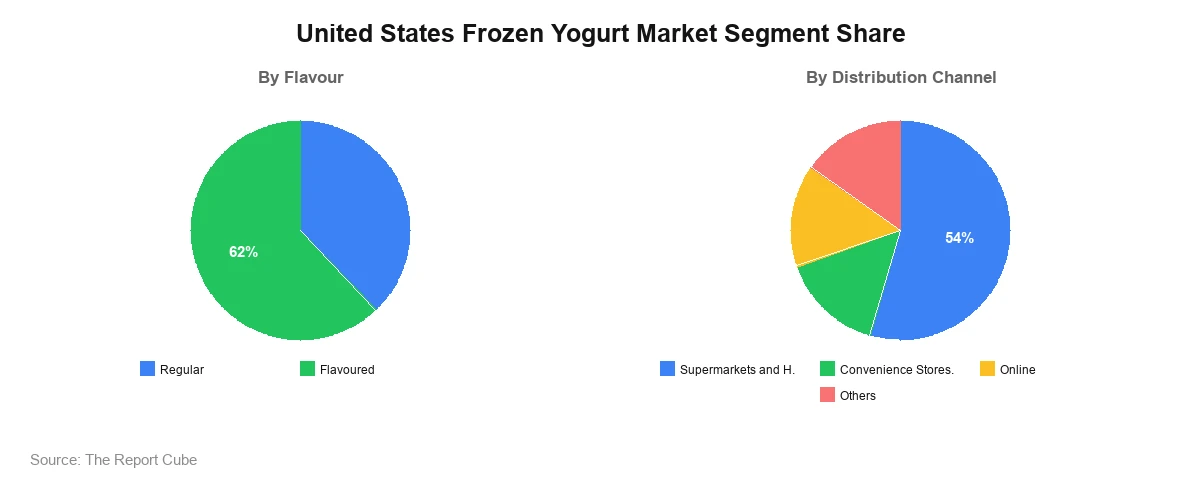
The Flavoured sub-segment commands approximately 62% of total United States frozen yogurt revenue, commanding the largest United States Frozen Yogurt Market Share among all flavour types. Consumer preference for variety-driven indulgence - including fruit blends, dessert-inspired profiles, and exotic combinations such as mango chili and matcha - has significantly outpaced demand for plain or natural base formats. Supermarket buyers increasingly allocate disproportionate freezer-case facings to flavoured SKUs, reflecting scan data demonstrating that flavoured frozen yogurt turns faster and at higher average unit prices than regular counterparts. Brands including Pinkberry, Red Mango, and Yogurtland have built their franchise identities on rotating seasonal flavour programs that sustain customer return visits.
The Regular sub-segment, comprising approximately 38% of market revenue, serves a distinct health-first consumer who prioritizes probiotic content and minimal added sugar over taste complexity. This segment has benefited from FDA labeling clarity around live and active cultures, which allows plain frozen yogurt to carry functional health claims unachievable by most flavoured ice cream alternatives. Regular frozen yogurt also captures institutional volume through university dining programs, hospital cafeteria operators, and meal-prep retail concepts, where clean-ingredient labeling is a non-negotiable procurement criterion. Growth within this segment is additionally supported by the broader Greek yogurt and strained dairy product market as consumers drawn to high-protein dairy formats explore frozen equivalents.
By Distribution Channel
- Supermarkets and Hypermarkets
- Convenience Stores
- Online
- Others
Supermarkets and hypermarkets account for an estimated 54% of total United States frozen yogurt distribution revenue, driven by the scale advantages of established cold-chain grocery infrastructure, national brand shelf agreements, and high foot traffic from routine weekly shopping missions. Retail buyers have responded to consumer demand for premium frozen yogurt by expanding dedicated frozen dessert sections with dedicated brand blocks, multi-serve tubs, and novelty bar formats. Promotional programs including seasonal flavor displays and cross-category pairings with fresh fruit produce sections have further driven impulse conversion rates in this channel.
Convenience stores represent approximately 18% of channel revenue, sustained by single-serve impulse consumption particularly in warm-weather markets. The Online channel is the fastest-growing distribution segment, with delivery partnerships across Instacart, DoorDash, and Amazon Fresh enabling frozen yogurt brands to reach health-conscious consumers outside traditional grocery shopping occasions. This channel's growth aligns with broader patterns observed across the US online food and grocery delivery market, where cold-chain logistics improvements have made frozen dessert delivery commercially viable at scale. Others, including specialty dessert shops, foodservice operators, and institutional buyers, round out the remaining distribution mix.
Regional Projection of United States Frozen Yogurt Market
The United States Frozen Yogurt Market shows distinct regional performance profiles shaped by climate, urban density, per-capita income, and the concentration of self-serve franchise networks across different geographic zones.
|
Region |
Estimated Market Share |
Key Growth Factors |
Consumer Trends |
|---|---|---|---|
|
Mideast |
26% |
High-density urban markets, premium positioning, strong foodservice base |
Premium and probiotic-forward frozen yogurt adoption |
|
Southeast |
22% |
Warm climate driving year-round consumption, expanding urban populations |
Self-serve chain density and retail format growth |
|
Great Lakes |
18% |
Strong dairy production heritage, growing health-focused retail channels |
Clean-label and functional frozen yogurt preference |
|
New England |
14% |
High per-capita income, artisanal and premium dessert culture |
Premiumization and specialty flavor adoption |
|
Plains |
11% |
Agricultural community ties to dairy, growing health awareness |
Regular and natural frozen yogurt demand |
|
Others |
9% |
Southwest, Rocky Mountain, and Far West markets with regional variation |
Diverse format preferences including novelty bars |
- Mideast: The Mideast region, anchored by New York, Pennsylvania, and New Jersey, leads the United States Frozen Yogurt Market with approximately 26% revenue share, supported by the highest concentration of urban foodservice locations, premium grocery chains, and health-oriented specialty dessert brands in the country.
- Southeast: The Southeast is the fastest-growing regional market, with states including Florida, Georgia, and North Carolina generating year-round consumption driven by warm climates and rapidly expanding health-conscious urban millennial populations active in frozen yogurt franchise networks.
- Great Lakes: The Great Lakes region benefits from its established dairy production ecosystem across Wisconsin, Michigan, and Ohio, where close proximity to milk supply chains reduces input costs and supports competitive retail pricing for both regular and flavoured frozen yogurt SKUs.
- New England: New England's high per-capita disposable income and strong artisanal food culture support premium frozen yogurt formats, with consumers across Massachusetts, Connecticut, and Maine demonstrating willingness to pay for organic, locally sourced, or certified probiotic product lines.
- Plains: The Plains region records steady but moderate consumption driven by dairy farming communities and growing health awareness in secondary urban centers, with regular frozen yogurt formats maintaining stronger relative performance compared to more trend-driven coastal markets.
- Others: The Southwest, Rocky Mountain, and Far West sub-regions reflect diverse consumption patterns, with California-driven demand in the Far West supporting strong self-serve franchise density and novelty bar format adoption alongside robust online delivery penetration.
United States Frozen Yogurt Market: Recent Development (2025)
- Nestle S.A. launched new probiotic-infused frozen yogurt flavours targeting health-focused US retail consumers.
- Unilever's Yasso brand introduced a 14oz squeezable frozen Greek yogurt line at Target stores.
- Danone S.A. expanded its plant-based frozen yogurt offerings partnering with bioscience company Chr. Hansen.
- Dairy Farmers of America Inc. received USD 22.8 million from USDA for methane reduction sustainability initiatives.
United States Frozen Yogurt Market Future Outlook (2034)
The United States Frozen Yogurt Market Forecast projects a sustained 5.54% CAGR through 2034, with the market reaching approximately USD 4.03 billion as health-first dessert positioning, probiotic fortification, and plant-based innovation collectively expand the category's addressable consumer base. AI-driven flavor trend forecasting tools are increasingly used by product development teams at Nestle, Danone, and Unilever to identify emerging flavor preferences from social media and retail scanner data, enabling faster product development cycles and more targeted retail launch strategies across regional markets. Digital delivery infrastructure will continue reshaping how frozen yogurt reaches consumers, with cold-chain e-commerce partnerships emerging as a structural revenue contributor.
Long-term expansion will be further supported by clean-label reformulation displacing high-sugar legacy recipes, continued investment in certified live-culture formulations, and the maturation of plant-based frozen yogurt as a mainstream rather than niche product tier. Self-serve franchise operators that invest in digital loyalty programs, mobile ordering platforms, and local sourcing narratives will be better positioned to withstand competitive pressure from premium retail brands. Regional growth opportunities remain strongest in the Southeast and Great Lakes corridors, where population growth, health awareness trends, and distribution network expansion continue outpacing national averages through the 2034 forecast horizon.
United States Frozen Yogurt Market Report Coverage
This United States Frozen Yogurt Market Report covers all key market dimensions from 2021 through 2034, providing historical context and forward-looking analysis across flavour, distribution, and regional segments.
|
Report Attribute |
Details |
|---|---|
|
Market Name |
United States Frozen Yogurt Market |
|
Market Size (2026) |
USD 2.62 Billion |
|
Market Size (2034) |
USD 4.03 Billion |
|
Forecast Period |
2026–2034 |
|
CAGR |
5.54% |
|
Base Year |
2026 |
|
Historical Years |
2021–2025 |
|
Forecast Years |
2026–2034 |
|
Segments Covered |
By Type, By Flavour, By Distribution Channel |
|
Regions Covered |
New England, Mideast, Great Lakes, Plains, Southeast, Others |
|
Key Companies |
Nestle S.A., Unilever Plc, Dairy Farmers of America Inc., Danone S.A., Others |
|
Report Format |
PDF, Excel, PPT |
|
Customization |
Available as per client requirements |
Why Choose This Report?
- Comprehensive analysis of flavour and distribution channel dynamics shaping US market revenue.
- Accurate 2026 market sizing with a data-backed forecast through 2034.
- Regional breakdown across six distinct US geographic zones with growth rationale.
- Detailed coverage of probiotic, plant-based, and clean-label innovation trends.
- Competitive intelligence covering Nestle, Unilever, Danone, and Dairy Farmers of America.
- Analysis of FDA labeling changes and their downstream effect on consumer purchasing.
- Strategic insights into online channel growth and cold-chain e-commerce expansion.
- Research aligned with EEAT principles and suitable for investment and business planning.
Table of Contents
- Introduction
- Objective of the Study
- Product Definition
- Market Segmentation
- Study Variables
- Research Methodology
- Secondary Data Points
- Companies Interviewed
- Primary Data Points
- Breakdown of Primary Interviews
- Secondary Data Points
- Executive Summary
- Market Dynamics
- Drivers
- Challenges
- Opportunity Assessment
- Recent Trends and Developments
- Policy and Regulatory Landscape
- United States Frozen Yogurt Market Overview and Forecast Analysis (2021-2034)
- Market Size, By Value, By Growth Rate (CAGR/USD Billions)
- Demand – Supply Trends
- Market Share, By Type
- Dairy-Based
- Non-Dairy Based
- Market Share, By Flavour
- Regular
- Flavoured
- Market Share, By Distribution Channel
- Supermarkets and Hypermarkets
- Convenience Stores
- Online
- Others
- Market Share, By Region
- New England
- Mideast
- Great Lakes
- Plains
- Southeast
- Others
- Market Share, By Competitors
- Competition Characteristics
- Revenue Shares
- Dairy-Based United States Frozen Yogurt Market Overview, 2021-2034F
- By Value (USD Million)
- By Flavour – Market Size & Forecast 2021-2034, USD Million
- Regular
- Flavoured
- Non-Dairy Based United States Frozen Yogurt Market Overview, 2021-2034F
- By Value (USD Million)
- By Flavour – Market Size & Forecast 2021-2034, USD Million
- Regular
- Flavoured
- Competitive Outlook (Company Profile - Partial List)
- Nestle S.A.
- Company Overview
- Business Segments
- Strategic Alliances/Partnerships
- Recent Developments
- Unilever Plc
- Company Overview
- Business Segments
- Strategic Alliances/Partnerships
- Recent Developments
- Dairy Farmers of America Inc.
- Company Overview
- Business Segments
- Strategic Alliances/Partnerships
- Recent Developments
- Danone S.A.
- Company Overview
- Business Segments
- Strategic Alliances/Partnerships
- Recent Developments
- Others
- Nestle S.A.
- Contact Us & Disclaimer
Top Key Players & Market Share Outlook
- Nestle S.A.
- Unilever Plc
- Dairy Farmers of America Inc.
- Danone S.A.
- Others
Frequently Asked Questions






