



Build Your Custom Market Intelligence Report
Customize Your ReportJapan Gasoline Market Key Takeaways
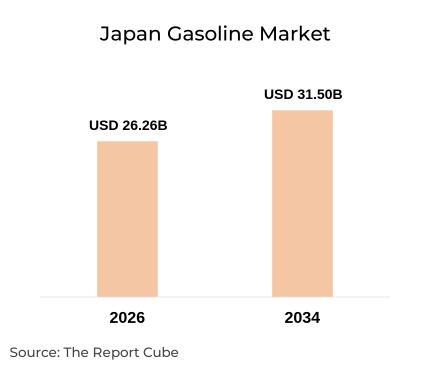
- Japan Gasoline Market was valued at USD 26.26 billion in 2026, reflecting steady domestic fuel demand.
- The industry is projected to reach USD 31.50 billion by 2034, expanding at a 2.30% CAGR.
- Residential end users remain the leading fuel consumption segment across Japan's gasoline demand landscape.
- Commercial property operators and industrial facilities are reinforcing sustained fuel procurement and distribution volumes.
- Fuji Oil Co., Ltd., Taiyo Oil Co., Ltd., and TonenGeneral Sekiyu K.K. lead the competitive landscape.
- Japan's refining industry continues navigating structural consolidation, capacity rationalization, and evolving domestic demand patterns.
- Industrial end users represent the fastest-growing segment driven by manufacturing recovery and logistics sector expansion.
- Digital fuel management platforms and low-carbon blending mandates are progressively reshaping Japan's downstream petroleum industry.
Japan Gasoline Market Insights & Analysis
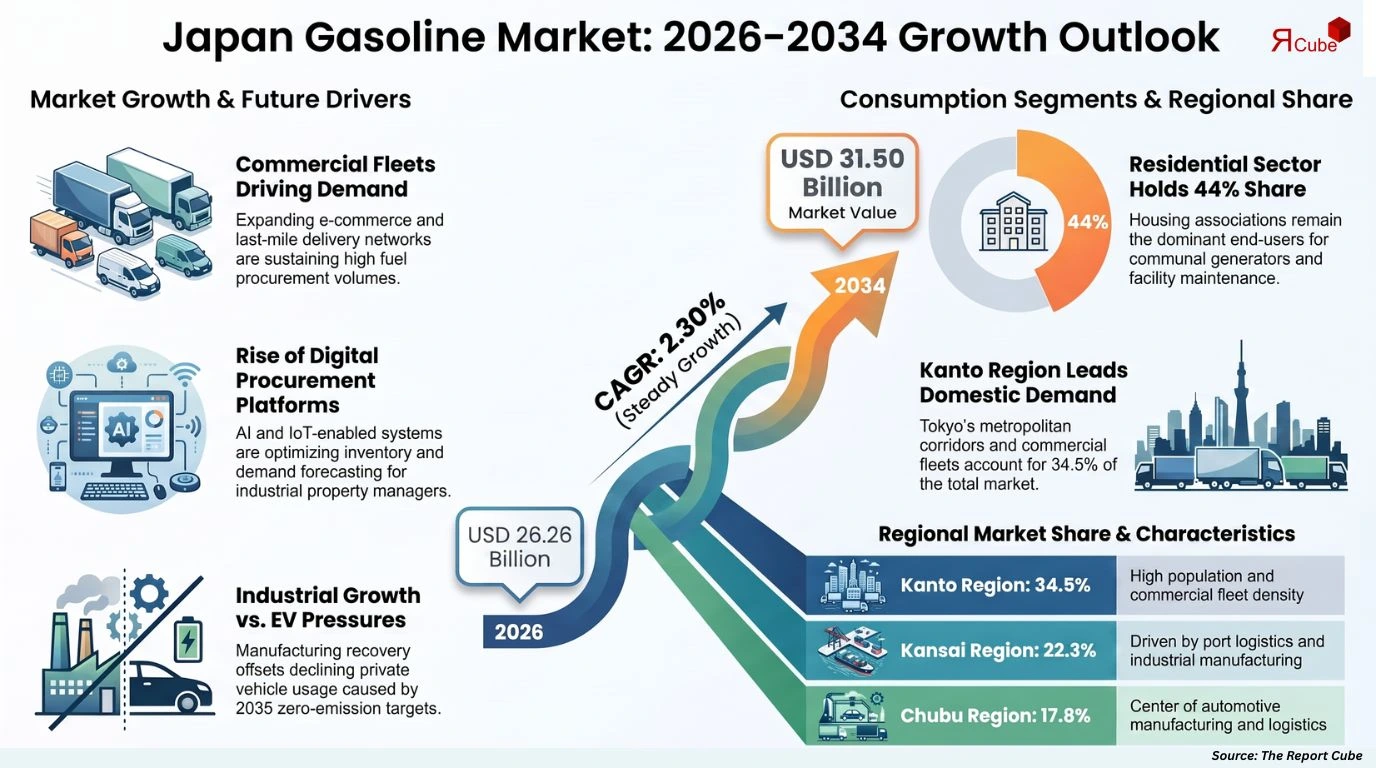
The Japan Gasoline Market is anticipated to register a 2.30% CAGR during 2026–2034. The market size was valued at USD 26.26 billion in 2026 and is projected to reach USD 31.50 billion by 2034. Japan's downstream petroleum sector continues demonstrating structural resilience despite long-term passenger vehicle electrification pressures. Domestic refiners are investing in operational efficiency, clean fuel blending capabilities, and distribution network modernization to sustain competitiveness. Government-backed energy security initiatives and strategic petroleum reserve programs continue supporting stable fuel supply infrastructure across urban and rural distribution channels throughout the country.
Refinery consolidation efforts led by major industry participants, including TonenGeneral Sekiyu K.K. and Kyokuto Petroleum Industries Ltd., have progressively rationalized domestic production capacity while maintaining supply adequacy for priority end-use segments. Japan's Ministry of Economy, Trade and Industry continues reinforcing petroleum security policies through strategic stockpiling mandates and import diversification frameworks. Growing commercial fleet activity, construction sector expansion, and agricultural equipment fuel demand across rural prefectures collectively sustain incremental consumption growth, counterbalancing moderate declines in private passenger vehicle gasoline usage through the forecast period.
Japan Gasoline Market Dynamics
Japan's gasoline sector operates within a tightly regulated, supply-secure downstream environment shaped by refinery consolidation, import dependency management, and gradual demand moderation from electrification trends. Commercial distribution networks, regional petroleum distributors, and import-dependent fuel suppliers continue adapting logistics infrastructure to serve evolving end-use consumption patterns across residential, commercial, and industrial segments. Regulatory frameworks governing fuel quality standards, blending specifications, and environmental compliance continue influencing procurement strategies across all major market participants.
|
Factor |
Type |
Specific Impact on Market |
Magnitude |
|---|---|---|---|
|
Refinery capacity rationalization |
Driver |
Stabilizes domestic supply and supports pricing margins |
High |
|
Commercial fleet fuel demand |
Driver |
Sustains gasoline volumes across logistics and transport operators |
High |
|
Low-carbon blending mandates |
Challenge |
Requires capital investment in fuel reformulation infrastructure |
Medium |
|
Agricultural and rural fuel consumption |
Opportunity |
Expands regional distribution and volumes in rural prefectures |
Medium |
|
Digital fuel management adoption |
Trend |
Improves procurement efficiency and demand forecasting accuracy |
High |
Key Market Driver: Commercial Fleet Fuel Consumption Growth
Japan's logistics, construction, and transportation sectors continue generating substantial gasoline demand from commercial vehicle fleets operating across urban distribution corridors and inter-prefectural supply routes. Property management firms and commercial facility operators managing large-scale vehicle fleets represent consistent procurement volumes that support regional petroleum distributors and fuel retail networks. Expanding last-mile delivery infrastructure, driven by sustained e-commerce growth, has further reinforced fleet fuel consumption, with commercial operators increasingly adopting bulk procurement contracts with Taiyo Oil Co., Ltd. and Nansei Sekiyu K.K. to optimize operational fuel expenditure.
Major Industry Challenge: Accelerating Vehicle Electrification Pressures
Japan's accelerating electric and hybrid vehicle adoption, supported by government subsidies and automaker electrification commitments targeting 2035 zero-emission vehicle sales ratios, progressively reduces private passenger gasoline consumption. The Ministry of the Environment and Ministry of Economy, Trade and Industry have reinforced carbon neutrality roadmaps that introduce structural headwinds for long-term fuel demand growth. Domestic refiners and regional petroleum distributors are consequently diversifying revenue streams through industrial lubricants, aviation fuel, and specialty petroleum product portfolios to offset anticipated volume declines in private vehicle fuel categories through the forecast period.
Emerging Trend Shaping Outlook: Digital Fuel Procurement Platforms
Property investors, commercial estate operators, and industrial facility managers across Japan are increasingly integrating digital fuel management systems that enable real-time consumption monitoring, automated procurement scheduling, and predictive demand analytics. These platforms, deployed by regional petroleum distributors and import-dependent fuel suppliers, reduce procurement inefficiencies, minimize inventory carrying costs, and support regulatory compliance reporting. IoT-enabled fuel monitoring across commercial and industrial properties is progressively linking facility energy management systems with refinery distribution networks, improving supply chain transparency and enabling data-driven fuel budgeting across managed property portfolios throughout Japan.
Need Specific Data, Let’s Customize the Report for You
Request CustomizationJapan Gasoline Market Segment-wise Analysis
Japan's gasoline consumption structure spans a diverse range of end-user categories and property-use classifications, reflecting the country's mature yet evolving downstream petroleum demand environment. Residential, commercial, and industrial segments collectively define the consumption base, while end-user procurement behaviors vary significantly across housing associations, property management firms, institutional investors, and independent fuel buyers.
By End User
- Housing Associations
- Property Managers / Agents
- Property Investors
- Others
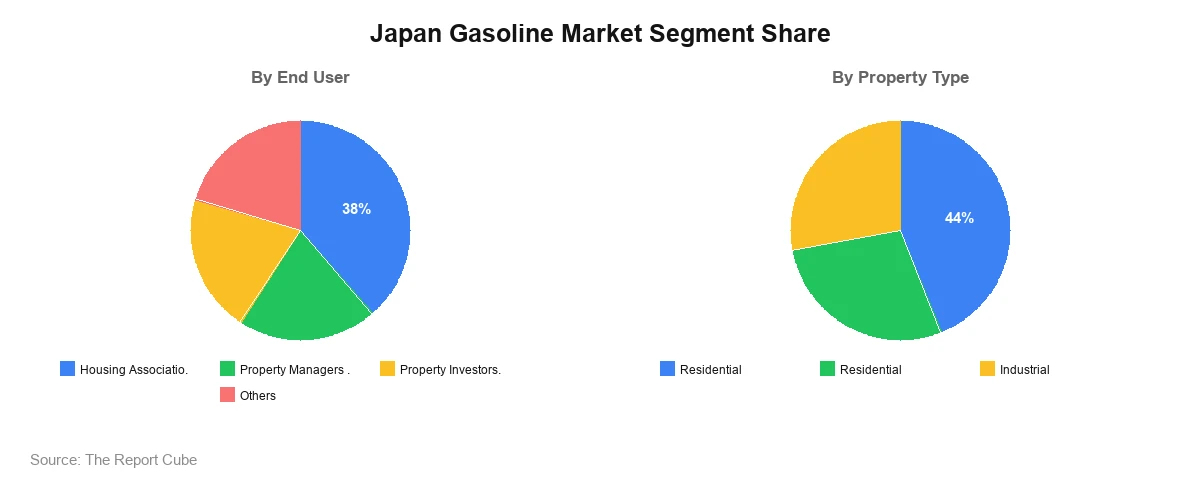
Housing associations represent the dominant end-user segment within Japan's gasoline market, accounting for an estimated 38% market share. Communal residential complexes across metropolitan prefectures including Tokyo, Osaka, and Nagoya maintain centralized fuel procurement arrangements for shared facility generators, communal heating systems, maintenance vehicle fleets, and emergency power backup infrastructure. Japan's aging housing stock and high-density condominium culture sustain consistent fuel demand from organized residential management bodies, with housing associations increasingly entering long-term supply agreements with regional petroleum distributors to secure price stability and assured delivery schedules.
Property managers and agents represent the second-largest end-user category, procuring gasoline for managed commercial and mixed-use properties across Japan's dense urban real estate portfolio. Property investors, comprising institutional real estate funds and individual portfolio holders, contribute incremental gasoline demand through facility maintenance operations, on-site generator requirements, and managed parking infrastructure. The Others category encompasses independent retailers, small-scale commercial operators, and agricultural cooperatives, with this sub-segment recording the fastest growth driven by expanding rural distribution reach and increasing fuel procurement digitization among smaller enterprise customers.
By Property Type
- Residential
- Commercial
- Industrial
Residential properties account for an estimated 44% market share within Japan's gasoline market segmentation by property type, reflecting the country's densely populated urban housing environment and the persistent fuel requirements of single-family homes, multi-unit condominiums, and managed residential complexes. Backup power generation, communal heating maintenance, landscaping equipment, and residential vehicle refueling collectively sustain residential gasoline consumption volumes. Taiyo Oil Co., Ltd. and regional petroleum distributors maintain extensive residential delivery networks across suburban and rural prefectures where retail forecourt access remains limited.
Commercial properties, encompassing office towers, retail complexes, hotels, and mixed-use developments, represent the second-largest consumption segment and are advancing the fastest growth trajectory driven by expanding facility management requirements and intensifying energy security investments. Industrial properties, including manufacturing plants, logistics warehouses, and processing facilities managed by operators aligned with Kyokuto Petroleum Industries Ltd. and TonenGeneral Sekiyu K.K., drive significant bulk fuel procurement volumes. Japan's manufacturing recovery, port logistics expansion, and construction sector activity are collectively reinforcing industrial gasoline and fuel oil demand across major industrial prefectures including Aichi, Kanagawa, and Hyogo.
Regional Projection of Japan Gasoline Market
Japan's gasoline market demonstrates distinct regional consumption patterns influenced by population density, industrial concentration, vehicle ownership rates, agricultural activity, and the degree of electrification penetration across urban and rural prefectures. Metropolitan regions sustain high commercial and residential demand while rural prefectures exhibit resilient consumption driven by agricultural and logistics activity.
|
Region |
Estimated Market Share |
Key Growth Factors |
Consumer Trends |
|---|---|---|---|
|
Kanto Region |
34.5% |
High population density, commercial fleet activity, metropolitan demand |
Digital procurement and bulk supply agreements |
|
Kansai Region |
22.3% |
Industrial manufacturing, port logistics, urban commercial expansion |
Industrial fuel management system adoption |
|
Chubu Region |
17.8% |
Automotive manufacturing, logistics corridors, agricultural activity |
Fleet fuel efficiency and procurement digitization |
|
Tohoku and Hokkaido |
14.2% |
Agricultural fuel demand, rural distribution, cold-climate energy use |
Regional distributor partnerships and rural delivery |
|
Kyushu and Others |
11.2% |
Import terminal proximity, industrial fuel demand, agricultural activity |
Import-linked pricing strategies and distributor consolidation |
- Kanto Region: Kanto dominates Japan's gasoline market with approximately 34.5% share, driven by Tokyo's massive commercial fleet operations, dense residential property management networks, and significant industrial distribution activity sustained by major petroleum companies including Fuji Oil Co., Ltd.
- Kansai Region: Kansai sustains strong gasoline consumption through Osaka's port logistics operations, Hyogo's industrial manufacturing base, and the Kyoto-Osaka-Kobe metropolitan corridor's extensive commercial and residential property management activity.
- Chubu Region: Chubu's dominance in automotive manufacturing, particularly across Aichi Prefecture, underpins consistent industrial and commercial gasoline demand, with logistics operators and component manufacturers maintaining high-volume fuel procurement relationships with regional distributors.
- Tohoku and Hokkaido: Agricultural activity, cold-climate residential heating fuel use, and rural logistics operations sustain stable gasoline demand across Tohoku and Hokkaido, where Kyushu Oil and independent distributors serve sparsely populated but fuel-intensive rural communities.
- Kyushu and Others: Kyushu's import terminal infrastructure, coastal industrial activity, and agricultural sector fuel requirements support incremental market contributions, with import-dependent fuel suppliers playing a significant role in meeting regional demand across southern prefectures.
Japan Gasoline Market: Recent Development (2025)
- Fuji Oil Co., Ltd. expanded its refined fuel distribution network strengthening regional supply chain resilience across Japan.
- Taiyo Oil Co., Ltd. entered a strategic bulk fuel supply agreement with major commercial property management operators nationwide.
- TonenGeneral Sekiyu K.K. launched digital fuel procurement platform improving real-time inventory management for industrial property clients.
- Kyokuto Petroleum Industries Ltd. upgraded its refinery blending infrastructure supporting cleaner gasoline formulations for Japan's commercial sector.
Japan Gasoline Market Future Outlook (2034)
The Japan Gasoline Market is projected to expand at a steady 2.30% CAGR, reaching USD 31.50 billion by 2034. Long-term growth will be underpinned by sustained industrial fuel demand, commercial property sector expansion, and the persistent fuel requirements of Japan's agricultural and rural logistics segments. Refinery operators including Nansei Sekiyu K.K. and regional petroleum distributors are expected to invest in supply chain digitization, clean blending infrastructure, and logistics optimization to strengthen competitive positioning across an increasingly efficiency-driven downstream petroleum environment.
Future market expansion will be shaped by Japan's energy security policy evolution, incremental industrial output recovery, and the growing integration of low-carbon fuel blending technologies across domestic refineries. AI-driven demand forecasting, IoT-enabled fuel monitoring for commercial and industrial properties, and advanced procurement analytics platforms will transform how property managers, housing associations, and industrial operators manage gasoline consumption. Strategic investments in import terminal infrastructure and distribution network modernization will further support market participants in sustaining reliable supply and competitive pricing across all major end-user categories through 2034.
Japan Gasoline Market Report Coverage
|
Report Attribute |
Details |
|---|---|
|
Market Name |
Japan Gasoline Market |
|
Market Size (2026) |
USD 26.26 Billion |
|
Market Size (2034) |
USD 31.50 Billion |
|
Forecast Period |
2026–2034 |
|
CAGR |
2.30% |
|
Base Year |
2026 |
|
Historical Years |
2021–2025 |
|
Forecast Years |
2026–2034 |
|
Segments Covered |
By End User, By Property Type, By Distribution Channel |
|
Regions Covered |
Kanto Region, Kansai Region, Chubu Region, Tohoku and Hokkaido, Kyushu and Others |
|
Key Companies |
Fuji Oil Co., Ltd., Taiyo Oil Co., Ltd., Nansei Sekiyu K.K., Kyokuto Petroleum Industries Ltd., TonenGeneral Sekiyu K.K. (ExxonMobil), Kyushu Oil, regional petroleum distributors, and import-dependent fuel suppliers |
|
Report Format |
PDF, Excel, PPT |
|
Customization |
Available as per client requirements |
Why Choose This Report?
- Comprehensive analysis of Japan's downstream gasoline consumption and distribution landscape.
- Accurate market sizing with a reliable 2026–2034 forecast period outlook.
- Detailed end-user and property-type segmentation identifying revenue-leading growth opportunities.
- Regional insights covering all major Japanese prefectural fuel consumption dynamics.
- Competitive profiling of leading domestic refiners and petroleum distribution companies.
- Analysis of digital fuel management and low-carbon blending transformation trends.
- Strategic insights supporting investment planning across refining and distribution sectors.
- Data-driven research aligned with Japan's evolving energy security and regulatory frameworks.
Table of Contents
- Introduction
- Objective of the Study
- Product Definition
- Market Segmentation
- Study Variables
- Research Methodology
- Secondary Data Points
- Companies Interviewed
- Primary Data Points
- Breakdown of Primary Interviews
- Secondary Data Points
- Executive Summary
- Market Dynamics
- Drivers
- Challenges
- Opportunity Assessment
- Recent Trends and Developments
- Policy and Regulatory Landscape
- Japan Gasoline Market Overview and Forecast Analysis (2021-2034)
- Market Size, By Value, By Growth Rate (CAGR/USD Billions)
- Demand – Supply Trends
- Market Share, By Product Type
- Regular Gasoline
- Premium Gasoline
- Ethanol-Blended Gasoline
- Others
- Market Share, By End-Use Application
- Passenger Vehicles
- Commercial Vehicles
- Two-Wheelers
- Others
- Market Share, By Distribution Channel
- Retail Service Stations
- Direct Industrial Sales
- Others
- Market Share, By Region
- Kanto Region
- Kansai Region
- Chubu Region
- Tohoku and Hokkaido
- Kyushu and Others
- Market Share, By Competitors
- Competition Characteristics
- Revenue Shares
- Regular Gasoline Japan Gasoline Market Overview, 2021-2034F
- By Value (USD Million)
- By End-Use Application – Market Size & Forecast 2021-2034, USD Million
- Passenger Vehicles
- Commercial Vehicles
- Two-Wheelers
- Others
- Premium Gasoline Japan Gasoline Market Overview, 2021-2034F
- By Value (USD Million)
- By End-Use Application – Market Size & Forecast 2021-2034, USD Million
- Passenger Vehicles
- Commercial Vehicles
- Two-Wheelers
- Others
- Ethanol-Blended Gasoline Japan Gasoline Market Overview, 2021-2034F
- By Value (USD Million)
- By End-Use Application – Market Size & Forecast 2021-2034, USD Million
- Passenger Vehicles
- Commercial Vehicles
- Two-Wheelers
- Others
- Others Japan Gasoline Market Overview, 2021-2034F
- By Value (USD Million)
- By End-Use Application – Market Size & Forecast 2021-2034, USD Million
- Passenger Vehicles
- Commercial Vehicles
- Two-Wheelers
- Others
- Competitive Outlook (Company Profile – Partial List)
- Fuji Oil Co.
- Company Overview
- Business Segments
- Strategic Alliances/Partnerships
- Recent Developments
- Ltd.
- Company Overview
- Business Segments
- Strategic Alliances/Partnerships
- Recent Developments
- Taiyo Oil Co.
- Company Overview
- Business Segments
- Strategic Alliances/Partnerships
- Recent Developments
- Ltd.
- Company Overview
- Business Segments
- Strategic Alliances/Partnerships
- Recent Developments
- Nansei Sekiyu K.K.
- Company Overview
- Business Segments
- Strategic Alliances/Partnerships
- Recent Developments
- Kyokuto Petroleum Industries Ltd.
- Company Overview
- Business Segments
- Strategic Alliances/Partnerships
- Recent Developments
- TonenGeneral Sekiyu K.K. (ExxonMobil)
- Company Overview
- Business Segments
- Strategic Alliances/Partnerships
- Recent Developments
- Kyushu Oil
- Company Overview
- Business Segments
- Strategic Alliances/Partnerships
- Recent Developments
- Others
- Fuji Oil Co.
- Contact Us & Disclaimer
Top Key Players & Market Share Outlook
- Fuji Oil Co., Ltd.
- Taiyo Oil Co., Ltd.
- Nansei Sekiyu K.K.
- Kyokuto Petroleum Industries Ltd.
- TonenGeneral Sekiyu K.K. (ExxonMobil)
- Kyushu Oil
- others
Frequently Asked Questions






