



Build Your Custom Market Intelligence Report
Customize Your ReportGlobal Midstream Oil & Gas Filtration Market Overview
The Global Midstream Oil & Gas Filtration Market comprises filtration and separation technologies used to remove solid particles, liquid contaminants, water, hydrocarbons, aerosols, and other impurities from oil and natural gas streams during processing, compression, transportation, storage, and distribution. These systems are important for maintaining hydrocarbon quality, protecting pipelines and processing equipment, improving operational reliability, and reducing contamination-related maintenance. Major technologies include coalescer filters, cartridge filters, mechanical filters, bag filters, particulate filters, activated carbon filters, and strainers.
Midstream filtration is required across several applications, including gas processing plants, compression stations, storage and distribution facilities, pipeline transportation networks, and liquefied natural gas processing infrastructure. Gas filtration systems remove liquid aerosols, compressor oil, moisture, and particulate contaminants, while oil filtration systems control solids, water, and other impurities in liquid hydrocarbon streams. These processes help protect compressors, turbines, heat exchangers, meters, dehydration units, and other critical equipment.
Global Midstream Oil & Gas Filtration Market Key Highlights
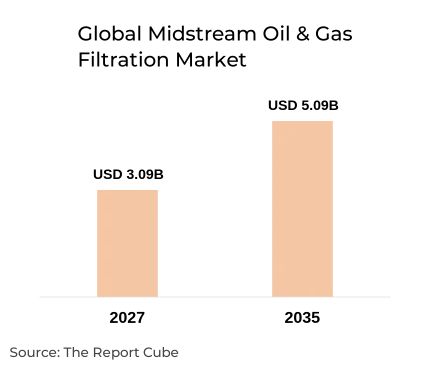
- The Global Midstream Oil & Gas Filtration Market is estimated at USD 3.09 billion in 2027 and is projected to reach USD 5.09 billion by 2035, based on the supplied market estimates.
- The market is projected to expand at a CAGR of approximately 6.43% during 2027–2035, although the supplied rounded market values mathematically imply approximately 6.44%.
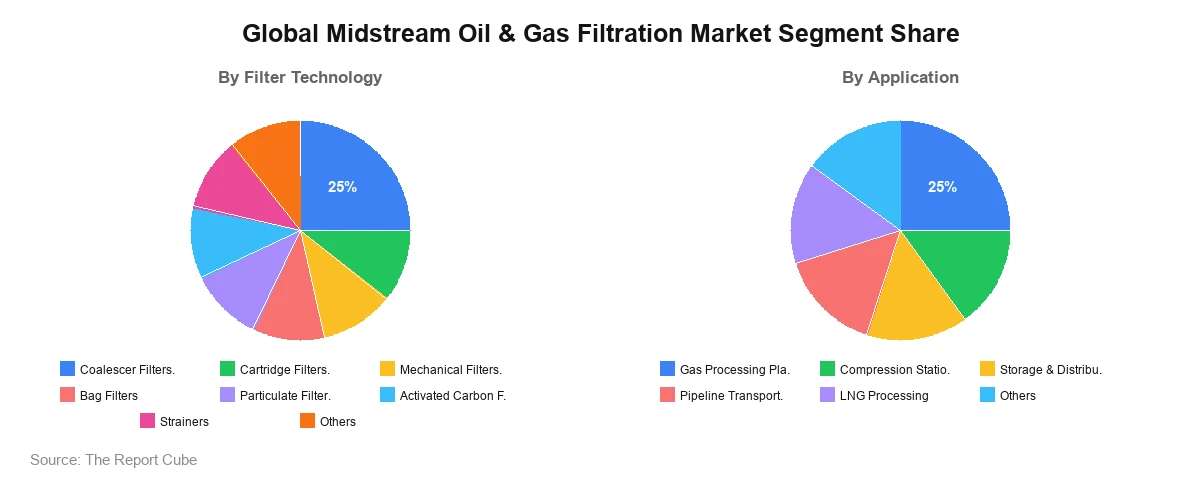
- Coalescer Filters are estimated to lead the filter technology segment with an approximate 25% share in 2026, supported by their role in removing liquid aerosols and contaminants from natural gas streams.
- Gas Processing Plants are estimated to account for approximately 25% of the application segment in 2026, reflecting filtration requirements across gas treatment, dehydration, and contaminant removal operations.
- Oil Filtration and Gas Filtration represent the two major filtration phases across midstream hydrocarbon operations.
- Refineries and the Petrochemical Industry are the identified end-user categories, with filtration requirements associated with hydrocarbon processing, equipment protection, and fluid quality control.
- Global LNG capacity expansion, pipeline infrastructure development, and demand for reliable gas transportation systems are important factors supporting filtration equipment requirements.
- Pall Corporation, Jonell Systems, Parker Hannifin, Eaton, Pentair, Graver Technologies, PRAIMO, Filters Spa, Brother Filtration, and Clark-Reliance form the supplied competitive landscape.
Global Midstream Oil & Gas Filtration Market Outlook
The Global Midstream Oil & Gas Filtration Market is expected to experience steady growth during the forecast period, supported by investments in gas processing, pipeline transportation, compression facilities, storage infrastructure, and LNG projects. Filtration systems play an important role in maintaining the quality of transported hydrocarbons and protecting equipment from contaminants such as water, compressor oil, solid particles, corrosion products, and liquid aerosols. As midstream operators expand and modernize their infrastructure, demand for reliable filtration and separation equipment is expected to increase.
Coalescer filters are expected to remain an important technology because they remove fine liquid droplets and aerosols from gas streams. These systems are used in compressor discharge protection, gas processing, glycol dehydration, amine sweetening, and pipeline transmission applications. Cartridge filters, particulate filters, mechanical separators, bag filters, and strainers provide complementary contaminant-control functions across oil and gas operations. Suppliers offering application-specific filter elements, high-pressure housings, and customized filtration systems may benefit from increasingly demanding operating requirements.
Despite the positive outlook, the industry faces challenges associated with capital expenditure requirements, project execution delays, raw material prices, operating conditions, and maintenance costs. Filtration systems must perform under high-pressure, variable-flow, and contamination-intensive conditions, making product selection and maintenance important for operational reliability. Based on the supplied estimates, the global market is projected to increase from USD 3.09 billion in 2027 to USD 5.09 billion in 2035. These figures are retained as working market estimates and have not been independently validated against a publicly available global market dataset.
Government Regulations
The global midstream oil and gas filtration industry operates under regulatory frameworks covering pipeline safety, gas quality, environmental protection, industrial emissions, equipment integrity, and occupational safety. In the United States, the Pipeline and Hazardous Materials Safety Administration administers federal pipeline safety requirements under 49 CFR Parts 191, 192, and 195, covering natural gas and hazardous liquid pipeline systems. These requirements influence the inspection, operation, maintenance, and integrity management of pipeline infrastructure, although they do not prescribe a single filtration technology for all applications. In Europe, the Industrial Emissions Directive and related environmental requirements establish obligations for covered industrial installations, while pressure equipment and equipment used in potentially explosive atmospheres are subject to applicable European conformity requirements. Filtration vessels and associated equipment may also need to meet relevant pressure-vessel codes, such as ASME Boiler and Pressure Vessel Code requirements, depending on the jurisdiction and application. Operators and equipment manufacturers must assess the applicable national, regional, and industry-specific standards for each installation.
Global Midstream Oil & Gas Filtration Market Dynamics
The Global Midstream Oil & Gas Filtration Market is influenced by the expansion of natural gas processing and transportation infrastructure, growing LNG capacity, and the need to protect critical hydrocarbon equipment from contamination. Filtration technologies support liquid-gas separation, particulate removal, dehydration system protection, compressor performance, and pipeline reliability. At the same time, high equipment costs, variable operating conditions, maintenance requirements, and project execution risks influence purchasing decisions. The following factors summarize the major forces shaping market development.
| Factor | Type | Specific Impact on Market | Magnitude |
|---|---|---|---|
| Expansion of LNG and gas processing infrastructure | Growth Driver | New LNG liquefaction facilities, gas processing plants, and associated transportation infrastructure require filtration systems for gas conditioning, dehydration, liquid removal, and equipment protection. | High |
| Increasing focus on pipeline integrity and equipment protection | Growth Driver | Removal of particulate contaminants, water, compressor oil, and liquid aerosols helps reduce corrosion, fouling, equipment wear, and contamination-related downtime across midstream facilities. | High |
| Advanced coalescing and high-efficiency filtration systems | Market Opportunity | High-efficiency gas coalescers, advanced filter media, and integrated separation systems create opportunities for suppliers serving demanding gas processing, compression, LNG, and pipeline applications. | High |
| Replacement, retrofit, and lifecycle filtration services | Market Opportunity | Aging infrastructure and recurring filter-element replacement requirements create opportunities for aftermarket cartridges, filtration upgrades, vessel refurbishment, and application-specific maintenance services. | Medium to High |
| High capital expenditure and project execution delays | Industry Challenge | Large filtration vessels, high-pressure housings, and integrated separation systems can require substantial upfront investment. Delays in LNG, pipeline, and gas processing projects can postpone equipment procurement and installation. | Medium to High |
| Contamination variability and demanding operating conditions | Industry Challenge | Changes in gas composition, liquid loading, particulate contamination, pressure, temperature, and flow conditions can affect filtration performance and increase maintenance frequency or equipment replacement requirements. | High |
Growth Drivers: Expansion of Global LNG and Gas Processing Infrastructure
Expansion of LNG export capacity and natural gas processing infrastructure is creating demand for filtration and separation systems across the midstream value chain. Gas processing plants require filtration to remove liquids, aerosols, and solid contaminants before downstream treatment and transportation. LNG facilities also require effective contaminant control to protect cryogenic processing equipment and maintain gas quality. The International Energy Agency's Global LNG Capacity Tracker, updated in October 2026, indicates that more than 330 bcm per year of new LNG export capacity is expected to come online between 2025 and 2030 from projects that had reached final investment decision and were under construction as of 2025. This infrastructure expansion creates opportunities for suppliers of gas coalescers, particulate filters, filter separators, and associated filtration vessels.
Need Specific Data, Let’s Customize the Report for You
Request CustomizationMarket Opportunities: Adoption of Advanced Coalescing and High-Efficiency Filtration Systems
Advanced coalescing systems present an important opportunity for filtration manufacturers because gas processing and transportation facilities require effective removal of fine liquid droplets, aerosols, and particulate contaminants. High-efficiency coalescer cartridges are used in compressor discharge protection, gas dehydration, amine sweetening, and pipeline transmission. Manufacturers offering specialized media, multi-stage filtration systems, high-pressure vessels, and application-specific engineering can address increasingly demanding operating conditions. Pall Corporation, Jonell Systems, and Graver Technologies publicly document filtration products designed for gas-liquid separation and contaminant removal across oil and gas applications. Continued development of filtration media and separation configurations may support product differentiation and aftermarket demand.
Industry Challenges: High Capital Expenditure and Project Execution Delays
Advanced filtration systems used in midstream oil and gas facilities can involve substantial equipment and installation costs. High-pressure filtration vessels, large gas coalescers, integrated separation packages, and customized systems require engineering, manufacturing, testing, and commissioning. Large LNG and gas infrastructure projects may also face permitting delays, construction challenges, financing constraints, and changes in investment schedules. When projects are postponed, procurement of filtration equipment and associated components can also be delayed. Smaller operators may face additional financial constraints when upgrading existing filtration infrastructure or adopting advanced separation technologies.
Market Trends: Increasing Use of High-Efficiency Gas Coalescing Technologies
High-efficiency gas coalescing is an important technology trend in the midstream filtration industry. Coalescer filters are designed to capture fine liquid aerosols and combine small droplets into larger droplets that can be separated from gas streams. These systems are used to remove compressor lubricating oil, glycol, amine, condensate, and other liquid contaminants. Their applications include compressor discharge filtration, gas processing, dehydration, pipeline protection, and LNG processing. Manufacturers are developing specialized filter media, multi-stage cartridge designs, and engineered vessels to improve contaminant removal and filtration performance under demanding operating conditions.
Global Midstream Oil & Gas Filtration Market Segment Analysis
The Global Midstream Oil & Gas Filtration Market is segmented by filter technology, application, filtration phase, end user, and region. Filter technology reflects the different mechanisms used to remove liquid and solid contaminants from hydrocarbon streams, while application segmentation covers the infrastructure where filtration systems are installed. Filtration phase distinguishes oil and gas treatment requirements, and end-user segmentation identifies the downstream industrial facilities included in the supplied market scope. Regional analysis evaluates market conditions across North America, Europe, Asia-Pacific, and Rest of World.
By Filter Technology
- Coalescer Filters
- Cartridge Filters
- Mechanical Filters
- Bag Filters
- Particulate Filters
- Activated Carbon Filters
- Strainers
- Others
Coalescer Filters are estimated to lead the Global Midstream Oil & Gas Filtration Market with an approximate 25% share in 2026. These filters are used to remove fine liquid droplets, aerosols, and other contaminants from natural gas and hydrocarbon streams. Their application in gas processing plants, compressor stations, pipeline transportation, and LNG facilities supports their importance in midstream filtration systems. Coalescing technology is particularly relevant for removing compressor oil, glycol, amine, condensate, and other liquid contaminants that may affect downstream equipment. The 25% share is an analyst estimate; exact global technology revenue shares were not publicly disclosed in the sources reviewed.
By Application
- Gas Processing Plants
- Compression Stations
- Storage & Distribution
- Pipeline Transportation
- LNG Processing
- Others
Gas Processing Plants are estimated to lead the application segment with an approximate 25% share in 2026. These facilities require filtration and separation systems to remove solid particles, liquid hydrocarbons, water, aerosols, and other contaminants from incoming and processed gas streams. Filtration is required across inlet separation, acid gas treatment, glycol dehydration, condensate stabilization, and other processing stages. The growing need to protect processing equipment and maintain gas quality supports demand for gas coalescers, particulate filters, and filter separators. The 25% share is an analyst estimate; exact global application revenue shares were not publicly disclosed in the sources reviewed.
Global Midstream Oil & Gas Filtration Market Regional Analysis
Regional demand for midstream filtration systems is influenced by natural gas production, pipeline infrastructure, LNG processing capacity, gas storage facilities, refinery operations, and petrochemical manufacturing. North America benefits from extensive natural gas transportation and LNG export infrastructure, while Europe requires filtration systems for gas processing, storage, and transportation networks. Asia-Pacific is supported by expanding energy demand and infrastructure investment, while Rest of World includes important hydrocarbon-producing and exporting markets across the Middle East, Africa, and Latin America. The following table provides a qualitative assessment of regional growth factors and industry trends without assigning unsupported regional revenue shares.
| Region | Key Growth Factors | Industry Trends |
|---|---|---|
| North America | Extensive natural gas pipeline networks, LNG export capacity, gas processing plants, compressor stations, and established oil and gas production infrastructure. | Demand for high-efficiency gas coalescers, pipeline filtration, compressor protection, and filtration upgrades across existing and new LNG infrastructure. |
| Europe | Gas transportation and storage infrastructure, industrial gas consumption, pipeline interconnections, and modernization of existing energy infrastructure. | Focus on equipment reliability, gas quality, contamination control, filtration system replacement, and operational efficiency across gas infrastructure. |
| Asia-Pacific | Increasing natural gas consumption, LNG import terminal development, pipeline expansion, industrialization, and investment in gas processing infrastructure. | Growing requirement for gas filtration, dehydration protection, compressor filtration, and separation systems across LNG and pipeline projects. |
| Rest of World | Hydrocarbon production, export terminal development, gas processing projects, pipeline infrastructure, and energy investment across Latin America, the Middle East, and Africa. | Demand for customized filtration vessels, gas-liquid separation, pipeline contaminant removal, and filtration systems suited to challenging operating environments. |
Global Midstream Oil & Gas Filtration Market Competitive Landscape
The competitive landscape of the Global Midstream Oil & Gas Filtration Market includes filtration technology manufacturers, separation equipment suppliers, industrial filtration companies, and specialized filter-element producers. Leading participants compete through gas coalescing performance, particulate removal efficiency, filter media design, high-pressure vessel engineering, product customization, and aftermarket support. Pall Corporation, Jonell Systems, Parker Hannifin, and Graver Technologies have publicly documented oil and gas filtration portfolios covering applications such as gas processing, pipeline transmission, compressor protection, and liquid-gas separation. The supplied list also includes companies with broader filtration or industrial equipment portfolios; their precise participation in midstream oil and gas applications should be assessed at the product and project level.
| Company | Competitive Strength | Primary Segment Served |
|---|---|---|
| Pall Corporation | Provides dedicated midstream oil and gas filtration and separation solutions, including liquid-gas separation, gas processing, dehydration, mercury removal, and pipeline filtration technologies. | Gas processing, LNG, pipeline transportation, liquid-gas separation, and contaminant removal. |
| Jonell Systems | Offers engineered filter cartridges, gas coalescers, filter separators, filtration vessels, and customized oil and gas filtration systems. | Gas processing, compression stations, pipeline transmission, dehydration, and hydrocarbon filtration. |
| Parker Hannifin | Provides gas coalescer cartridges, gas filter-coalescers, dry gas filters, liquid particulate cartridges, and filtration products through its filtration businesses. | Natural gas filtration, compressor protection, pipeline systems, and liquid filtration. |
| Eaton | Has a broad industrial filtration and separation portfolio. Its precise product-level participation in the supplied midstream gas filtration scope should be verified against the relevant business and product line. | Industrial filtration and process-fluid filtration; specific midstream application coverage requires product-level verification. |
| Pentair | Provides industrial flow and filtration-related technologies across selected markets. Direct participation in the specific midstream oil and gas filtration categories requires further product-level confirmation. | Industrial filtration and fluid management; specific midstream filtration portfolio requires verification. |
| Graver Technologies | Offers natural gas filtration and purification systems, including compressed gas filters, gas coalescing filters, particulate removal, and oil and gas process filtration products. | Gas processing, natural gas purification, compressor and turbine protection, and oil and gas filtration. |
| PRAIMO | Included in the supplied competitive set; an independently verifiable product portfolio specifically serving midstream oil and gas filtration was not established during this research. | Company-specific midstream filtration participation requires verification. |
| Filters Spa | Included in the supplied competitive set; the precise legal entity, product portfolio, and midstream oil and gas filtration applications require further verification. | Company-specific midstream filtration participation requires verification. |
| Brother Filtration | Manufactures cartridge filters and filter housings and identifies oil and gas facilities among its industrial application markets. | Industrial cartridge filtration, filter housings, and oil and gas facility applications. |
| Clark-Reliance | Provides Anderson filtration and mechanical separation products, including natural gas filter elements, coalescing elements, and particulate removal systems. | Natural gas filtration, mechanical separation, aerosol removal, and industrial process filtration. |
- Pall Corporation: Pall Corporation is a filtration, separation, and purification technology supplier with a dedicated oil and gas midstream portfolio. Its solutions support the separation of oil, gas, and water and the removal of solid contaminants from hydrocarbon streams before pipeline transportation. Its documented applications include liquid-gas separation, acid gas sweetening, glycol dehydration, adsorbent dehydration, mercury removal, condensate stabilization, and pipeline black powder filtration. Pall's portfolio also addresses compressor protection, NGL purification, and LNG operations. Its application-focused filtration and separation systems position the company as an important participant in the global midstream filtration industry.
- Jonell Systems: Jonell Systems is a specialized filtration and separation solutions provider serving oil and gas, refining, chemical, petrochemical, and power industries. Its product portfolio includes gas coalescers, dry gas filters, filter separators, particulate filters, liquid filtration housings, and customized filter cartridges. The company provides solutions for compressor protection, amine sweetening, glycol dehydration, condensate filtration, pipeline transmission, and gas processing. Its engineered vessels and cartridge technologies support applications involving fine aerosols, liquid hydrocarbons, glycol, amine, compressor oil, and solid contaminants. Its combination of filtration elements, housings, engineering, and application support strengthens its competitive position in the midstream filtration market.
Recent Developments and Updates
- October 2026 – International LNG infrastructure outlook: The International Energy Agency updated its Global LNG Capacity Tracker on October 1, 2026. It indicated that more than 330 bcm per year of new LNG export capacity was expected to come online between 2025 and 2030 from projects that had reached final investment decision and were under construction as of 2025. The projected capacity additions highlight the importance of gas processing, dehydration, liquid-gas separation, and filtration equipment across new LNG infrastructure.
- July 2026 – Global LNG trade expansion: The U.S. Energy Information Administration reported on July 14, 2026, that global LNG trade volumes reached a record 56.3 billion cubic feet per day in 2025, increasing by 5.4% year over year. The expansion of LNG trade and export capacity supports the need for reliable gas processing, transportation, and contaminant-control systems.
- 2026 – Gas filtration and separation product development: Filtration manufacturers continue to provide specialized gas coalescers, dry gas filters, high-efficiency particulate filters, and engineered filter vessels for compressor protection, pipeline transmission, and gas processing. Public product portfolios from Pall Corporation, Jonell Systems, and Graver Technologies demonstrate the continuing development of application-specific filtration solutions. These product portfolios are evidence of technology availability, rather than a claim that each company introduced a new product during 2026.
Global Midstream Oil & Gas Filtration Market Future Outlook
The Global Midstream Oil & Gas Filtration Market is expected to maintain a positive growth trajectory through 2035, supported by investments in natural gas processing, LNG infrastructure, pipeline transportation, compression stations, and hydrocarbon storage facilities. Filtration systems are essential for removing liquid aerosols, particulate contaminants, water, and other impurities that can affect gas quality and damage critical equipment. Increasing infrastructure requirements and the need to maintain operational reliability are expected to support demand for coalescer filters, cartridge filters, particulate filtration systems, and integrated separation equipment.
Future market development will also depend on technological improvements, aftermarket replacement demand, equipment reliability, and the ability of manufacturers to address increasingly demanding operating conditions. Suppliers offering customized filtration systems, advanced filter media, high-pressure vessels, and lifecycle maintenance services may strengthen their competitive positions. LNG infrastructure expansion is expected to provide additional opportunities across gas processing and transportation applications, although geopolitical uncertainty, capital expenditure constraints, project delays, and raw material price volatility may affect procurement schedules. Based on the supplied estimates, the market is projected to increase from USD 3.09 billion in 2027 to USD 5.09 billion in 2035. The supplied CAGR of 6.43% is retained, with a calculation difference of approximately 0.01 percentage point against the rounded market values.
Global Midstream Oil & Gas Filtration Market Report Coverage
The Global Midstream Oil & Gas Filtration Market Report provides an assessment of market size, growth outlook, filtration technologies, application areas, filtration phases, end-user industries, regional trends, and competitive positioning. The report examines the role of coalescer filters, cartridge filters, mechanical filters, bag filters, particulate filters, activated carbon filters, and strainers across gas processing, compression, storage, pipeline transportation, and LNG operations. It also evaluates key market drivers, opportunities, industry challenges, filtration technology trends, and the product portfolios of major market participants. Market values and segment shares identified as analyst estimates should be interpreted separately from official infrastructure data and company product disclosures.
| Parameter | Details |
|---|---|
| Market Name | Global Midstream Oil & Gas Filtration Market |
| Market Size (Base Year) | USD 3.09 billion |
| Market Size (Forecast Year) | USD 5.09 billion |
| CAGR | 6.43% |
| Base Year | 2026 |
| Historical Period | 2022–2026 |
| Forecast Period | 2027–2035 |
| Geographic Scope | Global |
| Segmentation | By Filter Technology, By Application, By Filtration Phase, By End User, and By Region |
| Regions Covered | North America, Europe, Asia-Pacific, and Rest of World |
| Key Companies | Pall Corporation, Jonell Systems, Parker Hannifin, Eaton, Pentair, Graver Technologies, PRAIMO, Filters Spa, Brother Filtration, and Clark-Reliance |
| Customization | Yes |
Why Choose This Global Midstream Oil & Gas Filtration Market Report?
- Provides an overview of the global midstream oil and gas filtration industry, including market size estimates, growth outlook, and key demand factors.
- Examines filter technology categories, including coalescer filters, cartridge filters, mechanical filters, bag filters, particulate filters, activated carbon filters, and strainers.
- Evaluates key application areas, including gas processing plants, compression stations, storage and distribution, pipeline transportation, and LNG processing.
- Assesses oil filtration and gas filtration requirements across midstream hydrocarbon operations.
- Reviews the supplied end-user categories, including refineries and the petrochemical industry, and identifies the broader midstream infrastructure scope.
- Provides qualitative regional analysis covering North America, Europe, Asia-Pacific, and Rest of World.
- Identifies major growth drivers, market opportunities, industry challenges, and filtration technology trends influencing the industry.
- Reviews the competitive landscape and distinguishes companies with directly documented midstream filtration products from companies requiring additional product-level verification.
- Includes research on LNG infrastructure development, pipeline protection, gas processing, contamination control, and filtration system performance.
Table of Contents
- Introduction
- Objective of the Study
- Product Definition
- Market Segmentation
- Study Variables
- Research Methodology
- Secondary Data Points
- Companies Interviewed
- Primary Data Points
- Breakdown of Primary Interviews
- Secondary Data Points
- Executive Summary
- Market Dynamics
- Drivers
- Challenges
- Opportunity Assessment
- Recent Trends and Developments
- Policy and Regulatory Landscape
- Global Midstream Oil & Gas Filtration Market Overview and Forecast Analysis (2022-2035)
- Market Size, By Value, By Growth Rate (CAGR/USD Billions)
- Demand – Supply Trends
- Market Share, By Filter Technology
- Coalescer Filters
- Cartridge Filters
- Mechanical Filters
- Bag Filters
- Particulate Filters
- Activated Carbon Filters
- Strainers
- Others
- Market Share, By Application
- Gas Processing Plants
- Compression Stations
- Storage & Distribution
- Pipeline Transportation
- LNG Processing
- Others
- Market Share, By Filtration Phase
- Oil Filtration
- Gas Filtration
- Market Share, By End User
- Refineries
- Petrochemical Industry
- Market Share, By Region
- North America
- Europe
- Asia-Pacific
- Rest of World
- Market Share, By Competitors
- Competition Characteristics
- Revenue Shares
- Coalescer Filters Global Midstream Oil & Gas Filtration Market Overview, 2022-2035F
- By Value (USD Million)
- By Application – Market Size & Forecast 2022-2035, USD Million
- Gas Processing Plants
- Compression Stations
- Storage & Distribution
- Pipeline Transportation
- LNG Processing
- Others
- Cartridge Filters Global Midstream Oil & Gas Filtration Market Overview, 2022-2035F
- By Value (USD Million)
- By Application – Market Size & Forecast 2022-2035, USD Million
- Gas Processing Plants
- Compression Stations
- Storage & Distribution
- Pipeline Transportation
- LNG Processing
- Others
- Mechanical Filters Global Midstream Oil & Gas Filtration Market Overview, 2022-2035F
- By Value (USD Million)
- By Application – Market Size & Forecast 2022-2035, USD Million
- Gas Processing Plants
- Compression Stations
- Storage & Distribution
- Pipeline Transportation
- LNG Processing
- Others
- Bag Filters Global Midstream Oil & Gas Filtration Market Overview, 2022-2035F
- By Value (USD Million)
- By Application – Market Size & Forecast 2022-2035, USD Million
- Gas Processing Plants
- Compression Stations
- Storage & Distribution
- Pipeline Transportation
- LNG Processing
- Others
- Particulate Filters Global Midstream Oil & Gas Filtration Market Overview, 2022-2035F
- By Value (USD Million)
- By Application – Market Size & Forecast 2022-2035, USD Million
- Gas Processing Plants
- Compression Stations
- Storage & Distribution
- Pipeline Transportation
- LNG Processing
- Others
- Activated Carbon Filters Global Midstream Oil & Gas Filtration Market Overview, 2022-2035F
- By Value (USD Million)
- By Application – Market Size & Forecast 2022-2035, USD Million
- Gas Processing Plants
- Compression Stations
- Storage & Distribution
- Pipeline Transportation
- LNG Processing
- Others
- Strainers Global Midstream Oil & Gas Filtration Market Overview, 2022-2035F
- By Value (USD Million)
- By Application – Market Size & Forecast 2022-2035, USD Million
- Gas Processing Plants
- Compression Stations
- Storage & Distribution
- Pipeline Transportation
- LNG Processing
- Others
- Others Global Midstream Oil & Gas Filtration Market Overview, 2022-2035F
- By Value (USD Million)
- By Application – Market Size & Forecast 2022-2035, USD Million
- Gas Processing Plants
- Compression Stations
- Storage & Distribution
- Pipeline Transportation
- LNG Processing
- Others
- Competitive Outlook (Company Profile – Partial List)
- Pall Corporation
- Company Overview
- Business Segments
- Strategic Alliances/Partnerships
- Recent Developments
- Jonell Systems
- Company Overview
- Business Segments
- Strategic Alliances/Partnerships
- Recent Developments
- Parker Hannifin
- Company Overview
- Business Segments
- Strategic Alliances/Partnerships
- Recent Developments
- Eaton
- Company Overview
- Business Segments
- Strategic Alliances/Partnerships
- Recent Developments
- Pentair
- Company Overview
- Business Segments
- Strategic Alliances/Partnerships
- Recent Developments
- Graver Technologies
- Company Overview
- Business Segments
- Strategic Alliances/Partnerships
- Recent Developments
- PRAIMO
- Company Overview
- Business Segments
- Strategic Alliances/Partnerships
- Recent Developments
- Filters Spa
- Company Overview
- Business Segments
- Strategic Alliances/Partnerships
- Recent Developments
- Brother Filtration
- Company Overview
- Business Segments
- Strategic Alliances/Partnerships
- Recent Developments
- Clark-Reliance
- Company Overview
- Business Segments
- Strategic Alliances/Partnerships
- Recent Developments
- Pall Corporation
- Contact Us & Disclaimer
Top Key Players & Market Share Outlook
- Pall Corporation
- Jonell Systems
- Parker Hannifin
- Eaton
- Pentair
- Graver Technologies
- PRAIMO
- Filters Spa
- Brother Filtration
- and Clark-Reliance
Frequently Asked Questions