



Build Your Custom Market Intelligence Report
Customize Your ReportKey Takeaways
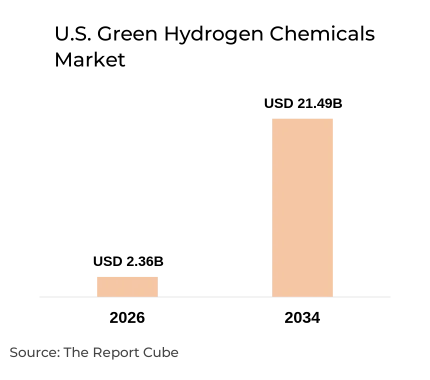
- U.S. Green Hydrogen Chemicals Market valued at USD 2.36 billion in 2026, reflecting accelerating clean energy investment.
- Industry projected to reach USD 21.49 billion by 2034, expanding at a 31.80% CAGR through the forecast period.
- A comprehensive U.S. Green Hydrogen Chemicals Market Analysis reveals Proton Exchange Membrane as the leading electrolyzer technology segment.
- Ammonia and fertilizer production dominates end-use demand, representing the largest industrial off-take category.
- Transportation fuel is the fastest-growing end-use segment, driven by heavy-duty and fuel-cell vehicle deployment.
- Air Products and Chemicals Inc., Linde plc, and Air Liquide lead green hydrogen production and distribution infrastructure.
- Federal clean energy incentives under the Inflation Reduction Act are fundamentally reshaping investment dynamics across the value chain.
- Declining electrolyzer costs and expanding renewable power capacity are accelerating green hydrogen cost competitiveness through 2034.
Market Overview
The U.S. Green Hydrogen Chemicals Market is anticipated to register a 31.80% CAGR during 2026–2034. The market was valued at USD 2.36 billion in 2026 and is projected to reach USD 21.49 billion by 2034. Rapid scaling of renewable energy infrastructure, federal hydrogen production tax credits under the Inflation Reduction Act, and deepening industrial decarbonization commitments from major chemical and refining sector operators are collectively accelerating green hydrogen adoption across the United States. Air Products and Chemicals Inc. and Linde plc have committed multi-billion-dollar capital programs to develop large-scale electrolysis projects aligned with U.S. Department of Energy hydrogen hub strategies.
Growing pressure on petrochemical, fertilizer, and petroleum refining sectors to reduce Scope 1 and Scope 2 emissions is driving structural substitution of grey and blue hydrogen with green hydrogen alternatives. The United States' strategic positioning as a global hydrogen export destination - particularly for Japan, South Korea, and European industrial partners - reinforces long-term domestic production capacity investment. Air Liquide and ENGIE have accelerated U.S. market engagement through renewable power purchase agreements, electrolyzer procurement, and technical partnerships targeting chemical synthesis and power generation off-take segments across multiple regional markets.
Market Size & Forecast
|
Metric |
Details |
|---|---|
|
Market Size (2026) |
USD 2.36 Billion |
|
Market Size (2034) |
USD 21.49 Billion |
|
CAGR (2026–2034) |
31.80% |
|
Base Year |
2026 |
|
Historical Years |
2021–2025 |
|
Forecast Years |
2026–2034 |
The U.S. Green Hydrogen Chemicals Market Size study values the industry at USD 2.36 billion in 2026, projecting expansion to USD 21.49 billion by 2034 at a 31.80% CAGR. This trajectory significantly exceeds the global green hydrogen average growth rate, underpinned by an estimated USD 9.5 billion in federally allocated hydrogen hub investments and the accelerating commercial deployment of proton exchange membrane electrolyzer capacity across the Northeast, Midwest, South, and West regions.
Market Dynamics
The U.S. Green Hydrogen Chemicals Market is advancing through a transformative investment cycle as federal policy incentives, declining electrolyzer capital costs, and industrial decarbonization mandates converge simultaneously. Expanding renewable energy generation, growing ammonia and methanol off-take demand, and bipartisan infrastructure investment frameworks are reinforcing green hydrogen's commercial viability across diverse end-use verticals through 2034.
|
Factor |
Type |
Specific Impact on Market |
Magnitude |
|---|---|---|---|
|
Inflation Reduction Act hydrogen production tax credit (§45V) |
Driver |
Provides USD 3/kg production incentive, accelerating electrolyzer project economics |
High |
|
Expanding U.S. renewable energy generation capacity |
Driver |
Reduces green hydrogen levelized cost by lowering electricity input cost structurally |
High |
|
High electrolyzer capital expenditure |
Restraint |
Increases project payback periods, limiting near-term deployment pace for smaller developers |
Medium |
|
Industrial decarbonization demand from chemicals and refining |
Opportunity |
Creates large-scale, long-term green hydrogen off-take agreements anchoring project finance |
High |
|
Grid integration and renewable intermittency |
Challenge |
Disrupts continuous electrolyzer operation, reducing annual hydrogen output and capacity utilization |
Medium |
- Growth Drivers - Federal Incentive Policy and Renewable Cost Deflation: The U.S. Green Hydrogen Chemicals Market Growth is primarily driven by the §45V clean hydrogen production tax credit, which provides up to USD 3 per kilogram for qualifying green hydrogen production. Simultaneously, U.S. utility-scale solar and wind power prices have declined below USD 30/MWh in multiple regions, directly reducing the largest cost component of green hydrogen production.
- Market Restraints - Electrolyzer Capital Cost and Infrastructure Gaps: Proton exchange membrane and alkaline electrolyzer systems remain capital-intensive at commercial scale, with installed costs still ranging between USD 700 and USD 1,500 per kilowatt in 2026. The absence of a mature hydrogen pipeline and storage network across most U.S. regions requires green hydrogen producers to co-locate production with off-take demand, limiting geographic project flexibility.
- Market Opportunities - Regional Hydrogen Hub Development: The U.S. Department of Energy's seven Regional Clean Hydrogen Hubs program has unlocked USD 7 billion in federal matching grants, catalyzing an estimated USD 40 billion in combined public and private co-investment. These hubs create integrated production, storage, and distribution ecosystems that will anchor long-term green hydrogen supply chains for chemical manufacturing, ammonia production, and heavy transportation.
- Industry Challenges - Green Hydrogen Cost Competitiveness vs. Grey Hydrogen: Despite federal incentives, green hydrogen production costs in 2026 remain approximately two to three times higher than grey hydrogen derived from natural gas steam methane reforming. Industrial buyers - particularly in ammonia and petroleum refining - continue to evaluate price parity timelines before executing large-scale, long-term green hydrogen off-take commitments without subsidy support.
Need Specific Data, Let’s Customize the Report for You
Request CustomizationMarket Trends
- Emerging Trends: Among the most significant U.S. Green Hydrogen Chemicals Market Trends is the rapid emergence of green ammonia as a dual-purpose commodity, serving both fertilizer production and zero-carbon marine fuel applications. Gulf Coast chemical producers are executing large-scale green ammonia projects targeting Japanese and European export markets.
- Technology Trends: Solid oxide electrolysis technology is gaining commercial traction due to its high-temperature efficiency advantages, with Bloom Energy and other developers deploying integrated industrial waste heat configurations. Proton exchange membrane systems continue advancing toward sub-USD 500/kW capital cost targets as manufacturing scale increases through 2034.
- Consumer / Buyer Trends: Industrial chemical and fertilizer producers are increasingly issuing competitive green hydrogen off-take tenders with multi-year contract structures to secure supply at defined price trajectories. Petroleum refinery operators in the Gulf Coast and West Coast regions are integrating green hydrogen procurement into Scope 1 decarbonization roadmaps to meet voluntary emissions reduction commitments.
- Regulatory Trends: The U.S. Treasury's finalized §45V guidance has established strict lifecycle emissions accounting requirements, directly shaping electrolyzer project siting and renewable power matching criteria. California's Low Carbon Fuel Standard continues to create premium credit values for green hydrogen used in transportation, reinforcing state-level demand incentive structures for fuel producers.
U.S. Green Hydrogen Chemicals Market Segment Analysis
The U.S. Green Hydrogen Chemicals Market serves distinct electrolyzer technology categories and end-use industry verticals, each defined by unique capital requirements, efficiency parameters, hydrogen purity specifications, and decarbonization value propositions.
By Electrolyzer Technology
- Proton Exchange Membrane
- Alkaline Water Electrolysis
- Solid Oxide Electrolysis
- Anion Exchange Membrane
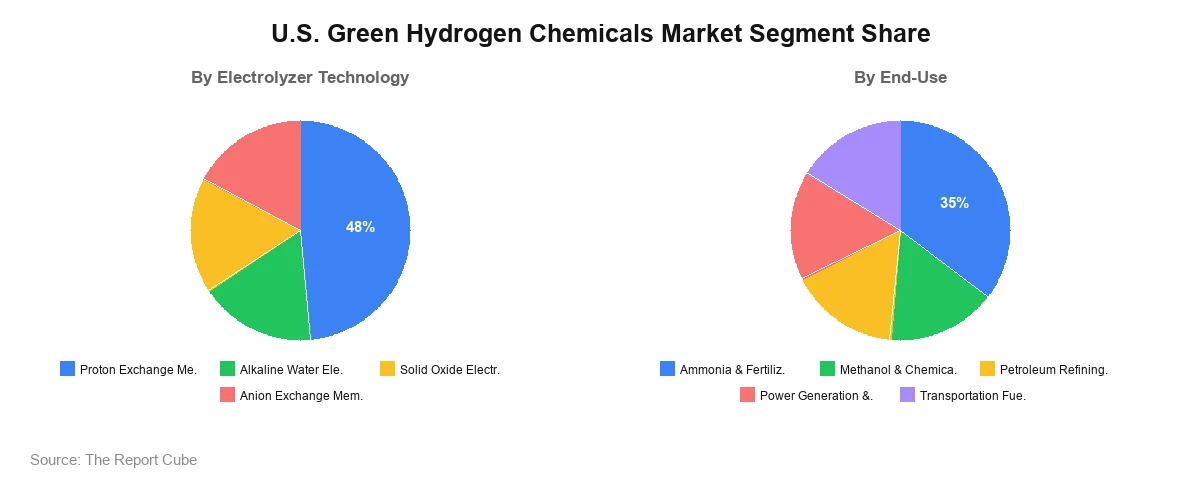
Proton Exchange Membrane (PEM) electrolysis commands an estimated 48% of the U.S. Green Hydrogen Chemicals Market Share in 2026, supported by its operational flexibility, rapid response capability, and compatibility with variable renewable energy inputs. Linde plc and Air Products and Chemicals Inc. are primary technology integrators deploying PEM systems at large-scale U.S. hydrogen production facilities. Alkaline Water Electrolysis accounts for approximately 32% of segment demand, favored for cost efficiency in baseload applications by ENGIE and Nel Hydrogen. Solid Oxide Electrolysis holds around 12%, with Bloom Energy advancing high-temperature industrial deployments, while Anion Exchange Membrane technologies represent the remaining 8%, attracting R&D investment for their lower platinum group metal dependency.
By End-Use
- Ammonia & Fertilizer Production
- Methanol & Chemical Synthesis
- Petroleum Refining
- Power Generation & Grid Storage
- Transportation Fuel
Ammonia and fertilizer production represents the dominant end-use segment at an estimated 35% market share in 2026, driven by domestic agricultural demand and export-oriented green ammonia project development across the Gulf Coast. Air Products and Chemicals Inc. and Air Liquide are key green hydrogen suppliers supporting ammonia synthesis operations. Methanol and chemical synthesis accounts for approximately 22%, with ENGIE partnering with chemical manufacturers on green methanol integration. Petroleum refining holds 18%, reflecting Gulf Coast refinery decarbonization programs. Power generation and grid storage represents 13%, while transportation fuel - at 12% - is the fastest-growing segment, accelerating on the back of California hydrogen fueling network expansion and federal fleet electrification programs.
Regional Analysis
|
Region |
Estimated Market Share |
Key Growth Factors |
Consumer Trends |
|---|---|---|---|
|
West |
38% |
California LCFS incentives, renewable energy abundance, port-adjacent green ammonia export capacity |
High transportation fuel adoption, refinery decarbonization mandates, utility-scale storage demand |
|
South |
29% |
Gulf Coast petrochemical and ammonia production clusters, LNG export hub proximity |
Green ammonia export development, petroleum refining hydrogen substitution, industrial off-take contracts |
|
Northeast |
19% |
Federal hydrogen hub investment, industrial manufacturing density, state-level clean energy standards |
PEM electrolyzer deployment, chemical synthesis applications, grid storage integration |
|
Midwest |
14% |
Agricultural ammonia demand, wind energy resource abundance, fertilizer production infrastructure |
Green fertilizer procurement, bioenergy hydrogen integration, transportation fuel corridor development |
- West - 38% Market Share: The Western United States, led by California, holds the largest regional share of the U.S. Green Hydrogen Chemicals Market. California's Low Carbon Fuel Standard creates premium incentive values for green hydrogen in transportation applications, while abundant solar and wind resources support low-cost renewable electricity input for electrolyzer operations. Air Liquide and Linde plc have positioned California as a flagship green hydrogen mobility and refinery decarbonization market.
- South - 29% Market Share: The Gulf Coast region anchors the South's substantial position through its existing petrochemical, ammonia synthesis, and petroleum refining industrial infrastructure. Air Products and Chemicals Inc. has committed to large-scale green hydrogen and green ammonia projects at Texas Gulf Coast facilities, targeting both domestic chemical sector demand and Japanese export markets via liquefied hydrogen shipping.
- Northeast - 19% Market Share: The Northeast benefits from two of the seven federally designated Regional Clean Hydrogen Hubs, driving concentrated electrolyzer and distribution infrastructure investment. Industrial manufacturing clusters in Pennsylvania, New York, and New Jersey represent significant green hydrogen chemical synthesis off-take markets, with ENGIE and Linde plc active in project development across the corridor.
- Midwest - 14% Market Share: The Midwest's large-scale agricultural economy generates consistent demand for green ammonia as a fertilizer feedstock replacement for conventional grey hydrogen-derived products. Wind energy resource abundance across Iowa, Kansas, and Minnesota provides favorable renewable electricity conditions for cost-competitive green hydrogen production serving regional fertilizer manufacturers and emerging hydrogen transportation corridors.
Market Share & Competitive Landscape
The U.S. Green Hydrogen Chemicals Market's competitive structure features a small number of large-scale industrial gas and energy companies competing across electrolyzer project development, hydrogen production, liquefaction, distribution, and long-term off-take contract management capabilities.
|
Company |
Competitive Strength |
Primary Segment Served |
|---|---|---|
|
Air Products and Chemicals Inc. |
Large-scale hydrogen production, Gulf Coast infrastructure, export-oriented green ammonia |
Ammonia & Fertilizer Production, Petroleum Refining |
|
Linde plc |
Integrated hydrogen liquefaction, distribution network, PEM technology partnerships |
All segments; Petroleum Refining, Transportation Fuel |
|
Air Liquide |
Electrolyzer deployment, renewable power agreements, industrial gas distribution |
Chemical Synthesis, Power Generation, Transportation |
|
ENGIE |
Renewable energy integration, green hydrogen project development, utility partnerships |
Power Generation & Grid Storage, Chemical Synthesis |
Key Companies in the U.S. Green Hydrogen Chemicals Market
Air Products and Chemicals Inc.
Air Products and Chemicals Inc., headquartered in Allentown, Pennsylvania, is one of the world's largest industrial gas companies, with a 30-million-ton annual hydrogen production capacity across multiple technology pathways. In 2025, Air Products advanced its NEOM Green Hydrogen Project and reaffirmed U.S. Gulf Coast green hydrogen and green ammonia development commitments, positioning itself as a structurally critical supplier for domestic fertilizer manufacturers and international export contracts serving the U.S. Green Hydrogen Chemicals Market.
Linde plc
Linde plc, headquartered in Guildford, United Kingdom, with principal U.S. operations managed from Connecticut, is the world's largest industrial gas company by revenue. In 2024 and 2025, Linde scaled electrolyzer equipment partnerships and hydrogen fueling station infrastructure deployments across California and the Northeast, reinforcing its position as a full-value-chain green hydrogen solutions provider in the U.S. Green Hydrogen Chemicals Market serving transportation, chemical synthesis, and petroleum refining customers.
Recent Developments
|
Year |
Company |
Development |
|---|---|---|
|
Jan 2025 |
Air Products and Chemicals Inc. |
Reaffirmed commitment to U.S. Gulf Coast green hydrogen and green ammonia infrastructure projects following strategic portfolio review |
|
2025 |
Linde plc |
Expanded hydrogen fueling station network in California and Northeast U.S. to support commercial fuel-cell vehicle fleets |
Future Outlook
The U.S. Green Hydrogen Chemicals Market Forecast projects the industry reaching USD 21.49 billion by 2034, sustained by a 31.80% CAGR through the forecast period. Continued scaling of Regional Clean Hydrogen Hub infrastructure, growing industrial off-take demand from ammonia, methanol, and petroleum refining sectors, and Air Products, Linde plc, and Air Liquide's deepening U.S. production investments will collectively drive consistent market expansion. Transportation fuel adoption and grid storage applications are expected to emerge as high-growth supplementary demand vectors through 2034.
Technological advancement across proton exchange membrane, solid oxide, and anion exchange membrane electrolyzer platforms will progressively reduce green hydrogen production costs toward grey hydrogen price parity, projected between 2030 and 2034 in high-renewable-penetration regions. Strengthening §45V lifecycle accounting standards and state-level renewable portfolio mandates will reinforce sustainable production requirements, while bipartisan federal infrastructure investment and evolving international hydrogen export agreements will anchor long-term capital commitment across the U.S. green hydrogen chemicals value chain.
U.S. Green Hydrogen Chemicals Market Report Coverage
This U.S. Green Hydrogen Chemicals Market Report covers electrolyzer technology segments, end-use industry verticals, and regional demand dynamics across the full 2026–2034 forecast period with verified market sizing and competitive intelligence.
|
Report Attribute |
Details |
|---|---|
|
Market Name |
U.S. Green Hydrogen Chemicals Market |
|
Market Size (2026) |
USD 2.36 Billion |
|
Market Size (2034) |
USD 21.49 Billion |
|
Forecast Period |
2026–2034 |
|
CAGR |
31.80% |
|
Base Year |
2026 |
|
Historical Years |
2021–2025 |
|
Forecast Years |
2026–2034 |
|
Segments Covered |
By Product Type, By Electrolyzer Technology, By End-Use |
|
Regions Covered |
Northeast, Midwest, South, West |
|
Key Companies |
Air Products and Chemicals Inc., Linde plc, Air Liquide, ENGIE, Others |
|
Report Format |
PDF, Excel, PPT |
|
Customization |
Available as per client requirements |
Why Choose This U.S. Green Hydrogen Chemicals Market Report?
- Comprehensive coverage of the U.S. green hydrogen chemicals industry spanning all electrolyzer technologies and end-use verticals.
- Accurate market sizing from USD 2.36 billion in 2026 through USD 21.49 billion by 2034 forecast.
- Detailed segmentation by electrolyzer technology type and end-use industry category with share estimates.
- Regional insights covering Northeast, Midwest, South, and West with market share and growth factor analysis.
- Competitive profiling of all four leading green hydrogen producers and project developers active in the United States.
- Analysis of federal Inflation Reduction Act §45V incentive impact on green hydrogen project economics and investment timelines.
- Forecast data supporting strategic investment, off-take agreement structuring, and technology procurement planning.
- Research aligned with U.S. Department of Energy National Clean Hydrogen Strategy and Regional Hydrogen Hub program objectives.
Table of Contents
- Introduction
- Objective of the Study
- Product Definition
- Market Segmentation
- Study Variables
- Research Methodology
- Secondary Data Points
- Companies Interviewed
- Primary Data Points
- Breakdown of Primary Interviews
- Secondary Data Points
- Executive Summary
- Market Dynamics
- Drivers
- Challenges
- Opportunity Assessment
- Recent Trends and Developments
- Policy and Regulatory Landscape
- U.S. Green Hydrogen Chemicals Market Overview and Forecast Analysis (2021-2034)
- Market Size, By Value, By Growth Rate (CAGR/USD Billions)
- Demand – Supply Trends
- Market Share, By Product Type
- Electrolytes
- Catalysts
- Membranes
- Water Treatment Chemicals
- Purification Deoxidizers & Desiccants
- Market Share, By Electrolyzer Technology
- Proton Exchange Membrane
- Alkaline Water Electrolysis
- Solid Oxide Electrolysis
- Anion Exchange Membrane
- Market Share, By End-Use
- Ammonia & Fertilizer Production
- Methanol & Chemical Synthesis
- Petroleum Refining
- Power Generation & Grid Storage
- Transportation Fuel
- Market Share, By Region
- Northeast
- Midwest
- South
- West
- Market Share, By Competitors
- Competition Characteristics
- Revenue Shares
- Electrolytes U.S. Green Hydrogen Chemicals Market Overview, 2021-2034F
- By Value (USD Million)
- By Electrolyzer Technology – Market Size & Forecast 2021-2034, USD Million
- Proton Exchange Membrane
- Alkaline Water Electrolysis
- Solid Oxide Electrolysis
- Anion Exchange Membrane
- Catalysts U.S. Green Hydrogen Chemicals Market Overview, 2021-2034F
- By Value (USD Million)
- By Electrolyzer Technology – Market Size & Forecast 2021-2034, USD Million
- Proton Exchange Membrane
- Alkaline Water Electrolysis
- Solid Oxide Electrolysis
- Anion Exchange Membrane
- Membranes U.S. Green Hydrogen Chemicals Market Overview, 2021-2034F
- By Value (USD Million)
- By Electrolyzer Technology – Market Size & Forecast 2021-2034, USD Million
- Proton Exchange Membrane
- Alkaline Water Electrolysis
- Solid Oxide Electrolysis
- Anion Exchange Membrane
- Water Treatment Chemicals U.S. Green Hydrogen Chemicals Market Overview, 2021-2034F
- By Value (USD Million)
- By Electrolyzer Technology – Market Size & Forecast 2021-2034, USD Million
- Proton Exchange Membrane
- Alkaline Water Electrolysis
- Solid Oxide Electrolysis
- Anion Exchange Membrane
- Purification Deoxidizers & Desiccants U.S. Green Hydrogen Chemicals Market Overview, 2021-2034F
- By Value (USD Million)
- By Electrolyzer Technology – Market Size & Forecast 2021-2034, USD Million
- Proton Exchange Membrane
- Alkaline Water Electrolysis
- Solid Oxide Electrolysis
- Anion Exchange Membrane
- Competitive Outlook (Company Profile - Partial List)
- Air Products and Chemicals Inc.
- Company Overview
- Business Segments
- Strategic Alliances/Partnerships
- Recent Developments
- Linde plc
- Company Overview
- Business Segments
- Strategic Alliances/Partnerships
- Recent Developments
- Air Liquide
- Company Overview
- Business Segments
- Strategic Alliances/Partnerships
- Recent Developments
- ENGIE
- Company Overview
- Business Segments
- Strategic Alliances/Partnerships
- Recent Developments
- Other
- Air Products and Chemicals Inc.
- Contact Us & Disclaimer
Top Key Players & Market Share Outlook
- Air Products and Chemicals Inc.
- Linde plc
- Air Liquide
- ENGIE
- Other
Frequently Asked Questions






