


Build Your Custom Market Intelligence Report
Customize Your ReportUAE Halal Food Market Insights & Analysis
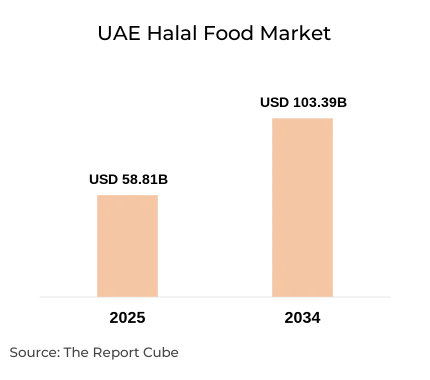
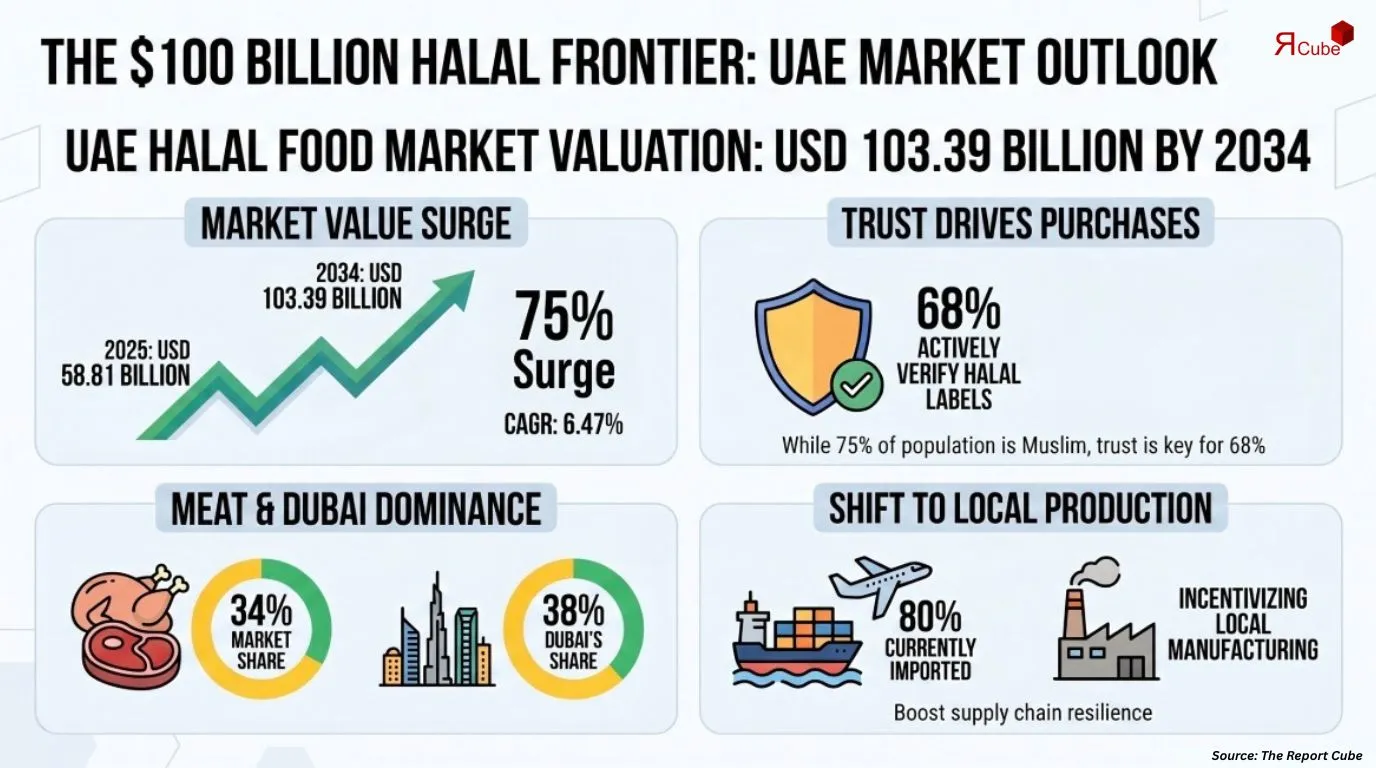
The UAE Halal Food Market is anticipated to register a CAGR of 6.47% during 2026-2034. The market size was valued at USD 58.81 billion in 2025 and is projected to reach USD 103.39 billion by 2034. The UAE represents one of the most mature and globally connected halal food ecosystems, supported by a strong Muslim population base, high per-capita food consumption, and the country’s position as a regional trade and re-export hub. Halal food demand in the UAE extends beyond religious compliance, increasingly reflecting consumer expectations for quality, safety, traceability, and ethical sourcing.
The market benefits from the UAE’s robust food import infrastructure, advanced cold chain logistics, and strong regulatory oversight. Rising tourism, expatriate population growth, and the expansion of foodservice channels such as hotels, restaurants, and catering services are reinforcing demand across multiple halal food categories. At the same time, retail penetration of packaged halal foods continues to rise, driven by modern trade formats, private labels, and growing consumer preference for certified products.
Furthermore, the UAE’s strategic ambition to become a global halal hub has encouraged investments in halal certification frameworks, local food manufacturing, and international trade partnerships. These interconnected factors collectively support sustained growth of the UAE Halal Food Market through 2034.
UAE Halal Food Market Recent Developments
- 2025: Agthia Group expanded its halal-ready meals portfolio targeting retail and foodservice channels across the UAE.
- 2025: Americana Group introduced new halal-certified frozen snack lines to support growing quick-service demand.
Government Initiatives & Policies
- UAE National Halal Strategy: Strengthens halal standards, certification, and global trade leadership.
- UAE Food Security Strategy 2051: Supports sustainable food production and halal supply chain resilience.
UAE Halal Food Market Dynamics
Key Driver: Strong Consumer Demand for Certified and Trusted Halal Products
The primary driver of the UAE Halal Food Market is the consistently high consumer demand for certified and trusted halal food products. With over 75% of the UAE population identifying as Muslim, halal compliance remains a fundamental purchasing criterion. Beyond religious adherence, consumers increasingly associate halal certification with superior hygiene, food safety, and quality assurance. Surveys indicate that nearly 68% of UAE consumers actively check halal certification labels before purchasing packaged foods. This trust-driven behavior is strengthening demand across meat, poultry, dairy, and processed food categories. Additionally, the presence of globally recognized certification bodies in the UAE further reinforces consumer confidence, enabling both domestic and imported halal products to thrive.
Book your FREE 30-minute expert consultation today
Contact UsIndustry Trends: Premiumization and Expansion of Value-Added Halal Foods
Premiumization is a notable trend shaping the UAE halal food landscape. Consumers are increasingly seeking value-added halal products such as organic meats, fortified dairy, ready-to-eat meals, and functional beverages. This shift reflects rising disposable incomes and a growing health-conscious population. Premium halal products are witnessing annual growth rates exceeding 7%, particularly in urban centers such as Dubai and Abu Dhabi. Food manufacturers are responding by investing in innovation, clean-label formulations, and attractive packaging. In parallel, private label halal products offered by major retailers are expanding, combining affordability with certification credibility and strengthening competitive intensity within the market.
Major Challenge: Dependence on Imports and Supply Chain Volatility
Despite strong demand, the UAE Halal Food Market faces challenges related to its heavy dependence on food imports. More than 80% of halal food products consumed in the UAE are imported, exposing the market to global price fluctuations, logistical disruptions, and geopolitical uncertainties. Volatility in raw material prices, particularly for meat and grains, directly impacts cost structures and retail pricing. Additionally, ensuring consistent halal compliance across international suppliers requires stringent audits and monitoring, increasing operational complexity for importers and distributors. These factors collectively pose risks to margin stability and supply continuity.
Opportunity: Growth of Local Halal Manufacturing and Export Potential
The expansion of local halal food manufacturing presents a significant growth opportunity for the UAE market. Government-backed incentives, industrial zones, and food parks are encouraging domestic production of halal meat, processed foods, and packaged staples. Local manufacturing reduces import dependence while enhancing supply chain resilience. Moreover, UAE-based producers are increasingly targeting export markets across the Middle East, Africa, and Asia, leveraging the country’s strong halal certification credibility. This dual focus on domestic supply and exports positions the UAE as both a major consumer and global supplier of halal food products.
UAE Halal Food Market Segment-wise Analysis
By Product Segment:
- Meat & Poultry
- Seafood
- Dairy Products
- Grains & Cereals
Meat and poultry represent the leading product segment, accounting for approximately 34% of the UAE Halal Food Market in 2025. This dominance is driven by high per-capita consumption and the central role of meat in traditional and modern diets. Poultry products, in particular, benefit from affordability and versatility across foodservice and household consumption. Dairy products follow closely, supported by strong demand for halal-certified milk, yogurt, and cheese. The segment continues to expand through flavored, fortified, and low-fat variants, aligning with evolving health preferences.
By Certification Type:
- Domestic Certified
- International Certified
- Private Label Certified
International certified halal products hold the largest share, contributing nearly 46% of total market revenue in 2025. The UAE’s role as a major import hub allows access to globally recognized halal brands from Asia, Europe, and the Americas. Domestic certified products are steadily gaining traction as local manufacturers expand capabilities and brand recognition. Meanwhile, private label certified products are emerging as a fast-growing segment, offering competitive pricing while maintaining halal compliance, particularly within large retail chains.
Regional Projection of UAE Halal Food Industry
- Dubai
- Abu Dhabi
- Sharjah
- Northern Emirates
Dubai leads the UAE Halal Food Market, accounting for approximately 38% of total market share in 2025. The emirate benefits from a large population base, high tourist inflows, and a dense concentration of retail and foodservice outlets. Dubai’s advanced logistics infrastructure and international trade connectivity further support strong halal food availability and diversity. Abu Dhabi follows closely, driven by rising household consumption and government-supported food security initiatives. Sharjah and the Northern Emirates are witnessing steady growth as modern retail penetration increases and consumer purchasing power improves.
Need insights for a specific region within this market?
Request Regional DataWhy Choose This Report?
- Provides a comprehensive overview of the overall market analysis, encompassing key trends, consumer behavior analysis, and risk assessment to support strategic decision-making.
- Provides accurate, up-to-date insights into market size, segmentation, and emerging opportunities, helping to minimize risk & capitalizing on growth.
- Gives deep understanding of target audience preferences, investment habits, and communication channels for enhanced product development & marketing effectiveness.
- Delivers competitive analysis & benchmarking, uncovering the strengths & weaknesses of market competitors to guide strategies.
- Consolidate comprehensive market intelligence, reducing reasoning & streamlining research efforts.
- Facilitates customized market segmentation & risk mitigation strategies, fine-tuned to the business objectives.
- Aids in identifying both market challenges & untapped opportunities within the industry to drive long-term business growth.
- Provides valuable information based on actual customer data & search trends.
Table of Contents
- Introduction
- Objective of the Study
- Product and Category Definition
- Market Segmentation
- Study Variables
- Research Methodology
- Secondary Data Points
- Breakdown of Secondary Sources
- Primary Data Points
- Breakdown of Primary Interviews
- Secondary Data Points
- Executive Summary
- Market Dynamics
- Drivers
- Challenges
- Opportunity Assessment
- Recent Trends and Developments
- Regulatory and Policy Landscape
- UAE Halal Food Market Overview (2020-2034)
- Market Size, By Value (USD Billion)
- Market Share, By Product Segment
- Meat & Poultry
- Seafood
- Dairy Products
- Grains & Cereals
- Fruits & Vegetables
- Snacks & Confectionery
- Beverages
- Others
- Market Share, By Certification Type
- Domestic Certified
- International Certified
- Private Label Certified
- Market Share, By Distribution Channel
- Supermarkets/Hypermarkets
- Specialty Stores
- Traditional Grocers
- Online/E-Commerce
- Foodservice/HoReCa
- Market Share, By Consumer Type
- Resident Muslim
- Resident Non‑Muslim
- Tourist
- Institutional Buyers
- Market Share, By Region
- Dubai
- Abu Dhabi
- Sharjah
- Northern Emirates
- Rest of UAE
- Market Share, By Company
- Revenue Shares
- Competitive Landscape
- Dubai Halal Food Market
- Market Size, By Value (USD Billion)
- Market Share, By Product Segment
- Market Share, By Certification Type
- Market Share, By Distribution Channel
- Market Share, By Consumer Type
- Abu Dhabi Halal Food Market
- Market Size, By Value (USD Billion)
- Market Share, By Product Segment
- Market Share, By Certification Type
- Market Share, By Distribution Channel
- Market Share, By Consumer Type
- Sharjah Halal Food Market
- Market Size, By Value (USD Billion)
- Market Share, By Product Segment
- Market Share, By Certification Type
- Market Share, By Distribution Channel
- Market Share, By Consumer Type
- Northern Emirates Halal Food Market
- Market Size, By Value (USD Billion)
- Market Share, By Product Segment
- Market Share, By Certification Type
- Market Share, By Distribution Channel
- Market Share, By Consumer Type
- Competitive Outlook and Company Profiles
- Al Islami Foods
- Company Overview
- Product Portfolio
- Strategic Alliances/Partnerships
- Recent Developments
- Global Food Industries
- Company Overview
- Product Portfolio
- Strategic Alliances/Partnerships
- Recent Developments
- Emirates Modern Poultry
- Company Overview
- Product Portfolio
- Strategic Alliances/Partnerships
- Recent Developments
- Americana Group
- Company Overview
- Product Portfolio
- Strategic Alliances/Partnerships
- Recent Developments
- Agthia Group
- Company Overview
- Product Portfolio
- Strategic Alliances/Partnerships
- Recent Developments
- Nestlé Middle East
- Company Overview
- Product Portfolio
- Strategic Alliances/Partnerships
- Recent Developments
- BRF Middle East
- Company Overview
- Product Portfolio
- Strategic Alliances/Partnerships
- Recent Developments
- Cargill Inc.
- Company Overview
- Product Portfolio
- Strategic Alliances/Partnerships
- Recent Developments
- Kawan Food Berhad
- Company Overview
- Product Portfolio
- Strategic Alliances/Partnerships
- Recent Developments
- Emirates Halal
- Company Overview
- Product Portfolio
- Strategic Alliances/Partnerships
- Recent Developments
- Others
- Al Islami Foods
- Contact Us and Disclaimer
Top Key Players & Market Share Outlook
- Al Islami Foods
- Global Food Industries
- Emirates Modern Poultry
- Americana Group
- Agthia Group
- Nestlé Middle East
- BRF Middle East
- Cargill Inc.
- Kawan Food Berhad
- Emirates Halal
- Others
Frequently Asked Questions