



Build Your Custom Market Intelligence Report
Customize Your ReportSouth Korea Herbal/Traditional Products Market Key Highlights
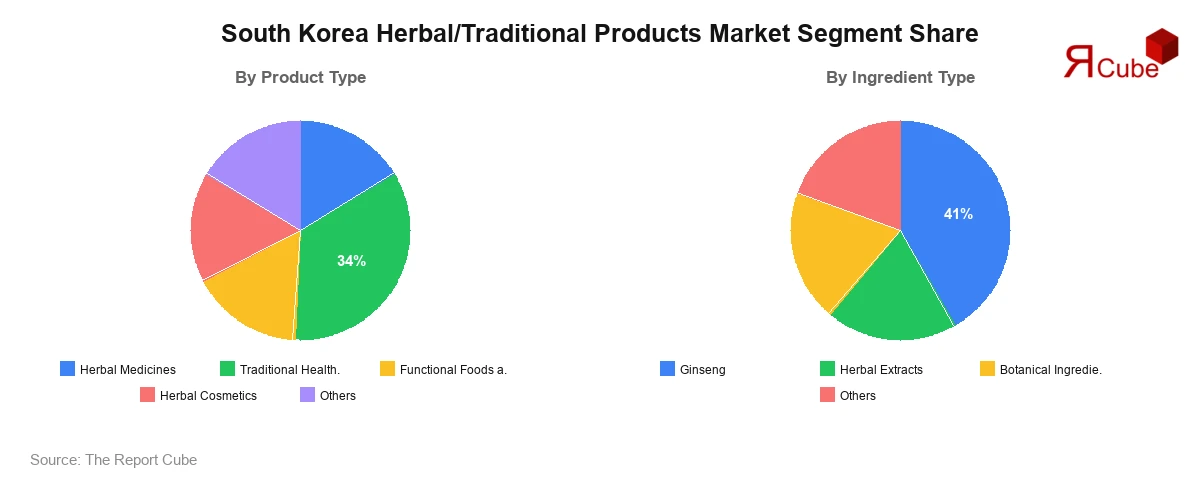
By Product Type:
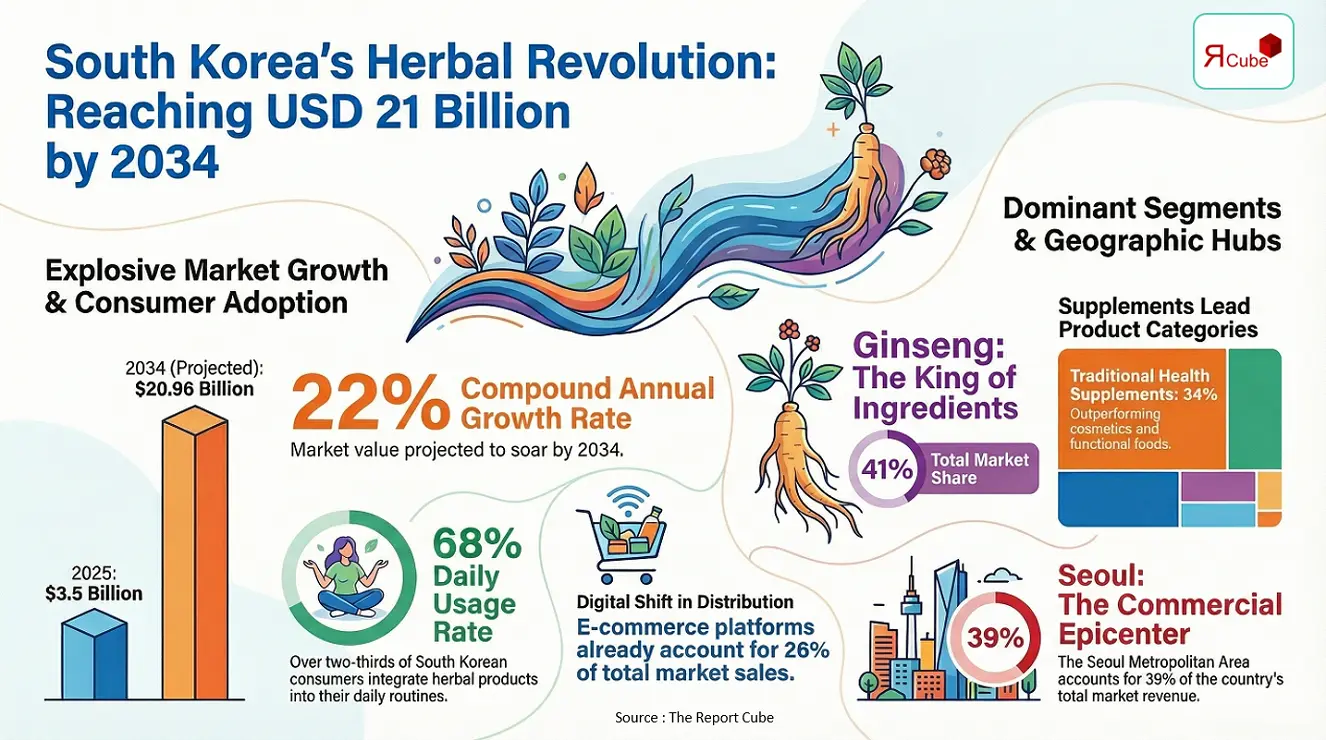
Traditional Health Supplements segment lead the market, with around 34% share.
By Ingredient Type:
Ginseng segment dominate the market, accounting for nearly 41% of total revenue.
Regional Outlook:
Seoul Metropolitan Area region dominates the market, with around 39% share.
Government Initiatives & Policies
- Korean Medicine Development Promotion Act: Supports traditional medicine research and commercialization.
- Health Functional Food Act: Regulates safety and quality of herbal and functional food products.
South Korea Herbal/Traditional Products Market Insights & Analysis
The South Korea Herbal/Traditional Products Market is anticipated to register a 22% during 2026-2034. the market size was valued at USD 3.5 Billion and is projected to reach USD 20.96 Billion by 2034.
The market is experiencing rapid expansion, driven by growing consumer preference for natural and holistic healthcare solutions. South Korea’s aging population and increasing awareness of preventive healthcare are key factors contributing to this growth. Nearly 68% of consumers in the country actively use herbal or traditional products as part of their daily wellness routines, highlighting strong cultural acceptance and trust in traditional medicine practices.
Government support and regulatory frameworks are playing a crucial role in market development. Policies promoting traditional Korean medicine and functional foods have encouraged research and innovation, leading to the commercialization of advanced herbal formulations. Public and private investments in R&D have increased significantly, with funding for herbal medicine research growing by approximately 18% annually. This has enabled the development of scientifically validated products, bridging the gap between traditional practices and modern healthcare systems.
Technological advancements and product innovation are reshaping the market landscape. Companies are introducing convenient formats such as capsules, ready-to-drink herbal beverages, and functional foods enriched with botanical ingredients. Digital platforms and e-commerce channels are further expanding accessibility, accounting for nearly 26% of total sales in 2025. Additionally, personalized wellness solutions and AI-driven product recommendations are gaining traction, enhancing consumer engagement and satisfaction.
South Korea Herbal/Traditional Products Market Dynamics
Key Driver:
- Rising consumer preference for natural and preventive healthcare solutions
- Strong cultural acceptance of traditional medicine practices
- Increasing aging population driving demand for wellness products
Industry Trends:
- Growing demand for functional foods and herbal beverages
- Expansion of premium and personalized herbal wellness products
- Rising adoption of e-commerce and digital health platforms
Book your FREE 30-minute expert consultation today
Contact UsMajor Challenge:
- Regulatory complexities for product approval and standardization
- High competition among domestic and international brands
- Limited awareness in younger demographics compared to modern healthcare
Opportunity:
- Expansion into global markets with increasing export demand
- Innovation in herbal-based cosmetics and nutraceuticals
- Integration of traditional medicine with modern healthcare systems
South Korea Herbal/Traditional Products Market Segment-wise Analysis
By Product Type:
- Herbal Medicines
- Traditional Health Supplements
- Functional Foods and Beverages
- Herbal Cosmetics
- Others
Traditional health supplements dominate the market with approximately 34% share, driven by strong consumer demand for preventive healthcare products. These supplements, including ginseng extracts and herbal formulations, are widely consumed for boosting immunity and enhancing overall well-being. Around 61% of adults in South Korea regularly consume dietary supplements, with herbal-based products accounting for a significant portion. The availability of diverse product formats such as capsules, powders, and liquid extracts has further supported adoption. Additionally, increasing health awareness and rising disposable income levels are contributing to sustained growth in this segment.
By Ingredient Type:
- Ginseng
- Herbal Extracts
- Botanical Ingredients
- Others
Ginseng leads the ingredient segment with nearly 41% market share, owing to its long-standing cultural significance and proven health benefits. South Korea is one of the largest producers and consumers of ginseng, with annual production exceeding 20,000 metric tons. Ginseng-based products are widely used for improving energy levels, cognitive function, and immune support. The increasing global demand for Korean ginseng products has also boosted export revenues. Furthermore, continuous innovation in product formulations, including beverages and functional foods, is expanding the application scope of ginseng across multiple industries.
Regional Projection of South Korea Herbal/Traditional Products Industry
- Seoul Metropolitan Area
- Gyeonggi Province
- Busan
- Daegu
- Others
Seoul Metropolitan Area dominates the market with around 39% share, driven by its high population density and strong purchasing power. The region serves as a major hub for healthcare innovation, retail distribution, and e-commerce platforms. Nearly 45% of total online herbal product sales originate from this region, reflecting high digital adoption. Additionally, the presence of leading companies, research institutions, and wellness centers supports product development and market expansion. Increasing consumer awareness and access to premium products further strengthen the region’s leading position in the market.
South Korea Herbal/Traditional Products Market Recent Developments
- 2025: Korea Ginseng Corporation expanded its premium product line with advanced red ginseng formulations targeting global wellness markets, enhancing export growth and brand positioning.
- 2025: Dong-A Pharmaceutical Co., Ltd. introduced new herbal-based functional supplements focusing on immunity and energy enhancement, catering to increasing health-conscious consumers.
- 2025: Amorepacific Corporation launched herbal-infused skincare products combining traditional ingredients with modern dermatological research, expanding its presence in the premium cosmetics segment.
- 2025: LG Household & Health Care Ltd. invested in sustainable sourcing and eco-friendly packaging for herbal products, aligning with environmental and consumer sustainability trends.
- 2025: Daesang Corporation strengthened its functional food portfolio by incorporating botanical ingredients, targeting the growing demand for natural and health-focused food products.
Build Your Custom Market Intelligence Report
Customized Your ReportWhy Choose This Report?
- Provides a comprehensive overview of the overall market analysis, encompassing key trends, consumer behavior analysis, and risk assessment to support strategic decision-making.
- Provides accurate, up-to-date insights into market size, segmentation, and emerging opportunities, helping to minimize risk & capitalizing on growth.
- Gives deep understanding of target audience preferences, investment habits, and communication channels for enhanced product development & marketing effectiveness.
- Delivers competitive analysis & benchmarking, uncovering the strengths & weaknesses of market competitors to guide strategies.
- Consolidate comprehensive market intelligence, reducing reasoning & streamlining research efforts.
- Facilitates customized market segmentation & risk mitigation strategies, fine-tuned to the business objectives.
- Aids in identifying both market challenges & untapped opportunities within the industry to drive long-term business growth.
- Provides valuable information based on actual customer data & search trends.
Table of Contents
- Introduction
- Objective of the Study
- Product and Category Definition
- Market Segmentation
- Study Variables
- Research Methodology
- Secondary Data Points
- Breakdown of Secondary Sources
- Primary Data Points
- Breakdown of Primary Interviews
- Secondary Data Points
- Executive Summary
- Market Dynamics
- Drivers
- Challenges
- Opportunity Assessment
- Recent Trends and Developments
- Regulatory and Policy Landscape
- South Korea Herbal/Traditional Products Market Overview (2026-2034)
- Market Size, By Value (USD Billion)
- Market Share, By Product Type
- Herbal Medicines
- Traditional Health Supplements
- Functional Foods and Beverages
- Herbal Cosmetics
- Others
- Market Share, By Ingredient Type
- Ginseng
- Herbal Extracts
- Botanical Ingredients
- Others
- Market Share, By Application
- Healthcare and Wellness
- Pharmaceutical Applications
- Personal Care and Cosmetics
- Nutrition and Dietary Supplements
- Market Share, By Distribution Channel
- Pharmacies and Drug Stores
- Specialty Stores
- Supermarkets and Hypermarkets
- Online Retail
- Market Share, By End User
- Individual Consumers
- Hospitals and Clinics
- Wellness Centers
- Market Share, By Price Range
- Economy
- Mid-Range
- Premium
- Market Share, By Region
- Seoul Metropolitan Area
- Gyeonggi Province
- Busan
- Daegu
- Others
- Market Share, By Company
- Revenue Shares and Analysis
- Competitive Landscape
- Seoul Metropolitan Area Herbal/Traditional Products Market
- Market Size, By Value (USD Billion/Million)
- Market Share, By Product Type
- Market Share, By Ingredient Type
- Market Share, By Application
- Market Share, By Distribution Channel
- Gyeonggi Province Herbal/Traditional Products Market
- Market Size, By Value (USD Billion/Million)
- Market Share, By Product Type
- Market Share, By Ingredient Type
- Market Share, By Application
- Market Share, By Distribution Channel
- Busan Herbal/Traditional Products Market
- Market Size, By Value (USD Billion/Million)
- Market Share, By Product Type
- Market Share, By Ingredient Type
- Market Share, By Application
- Market Share, By Distribution Channel
- Daegu Herbal/Traditional Products Market
- Market Size, By Value (USD Billion/Million)
- Market Share, By Product Type
- Market Share, By Ingredient Type
- Market Share, By Application
- Market Share, By Distribution Channel
- Competitive Outlook and Company Profiles
- Korea Ginseng Corporation
- Company Overview
- Product Portfolio
- Strategic Alliances/Partnerships
- Recent Developments
- Dong-A Pharmaceutical Co., Ltd.
- Company Overview
- Product Portfolio
- Strategic Alliances/Partnerships
- Recent Developments
- Hanmi Pharmaceutical Co., Ltd.
- Company Overview
- Product Portfolio
- Strategic Alliances/Partnerships
- Recent Developments
- Amorepacific Corporation
- Company Overview
- Product Portfolio
- Strategic Alliances/Partnerships
- Recent Developments
- LG Household & Health Care Ltd.
- Company Overview
- Product Portfolio
- Strategic Alliances/Partnerships
- Recent Developments
- Daesang Corporation
- Company Overview
- Product Portfolio
- Strategic Alliances/Partnerships
- Recent Developments
- Korea Ginseng Corporation
- Contact Us and Disclaimer
Top Key Players & Market Share Outlook
- Korea Ginseng Corporation
- Dong-A Pharmaceutical Co., Ltd.
- Hanmi Pharmaceutical Co., Ltd.
- Amorepacific Corporation
- LG Household & Health Care Ltd.
- Daesang Corporation &
- Others
Frequently Asked Questions