


Build Your Custom Market Intelligence Report
Customize Your ReportKey Highlights of the India Decarbonization HVAC Market
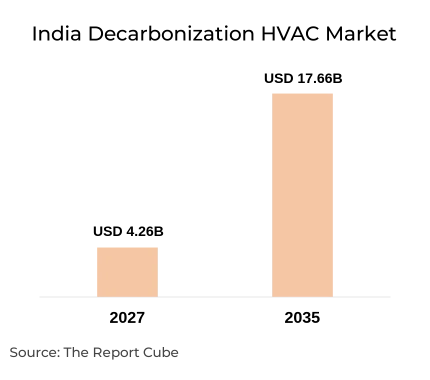
- The India Decarbonization HVAC Market is estimated at USD 4.26 billion in 2027 and is projected to reach USD 17.66 billion by 2035, registering a CAGR of 19.45% during 2027–2035.
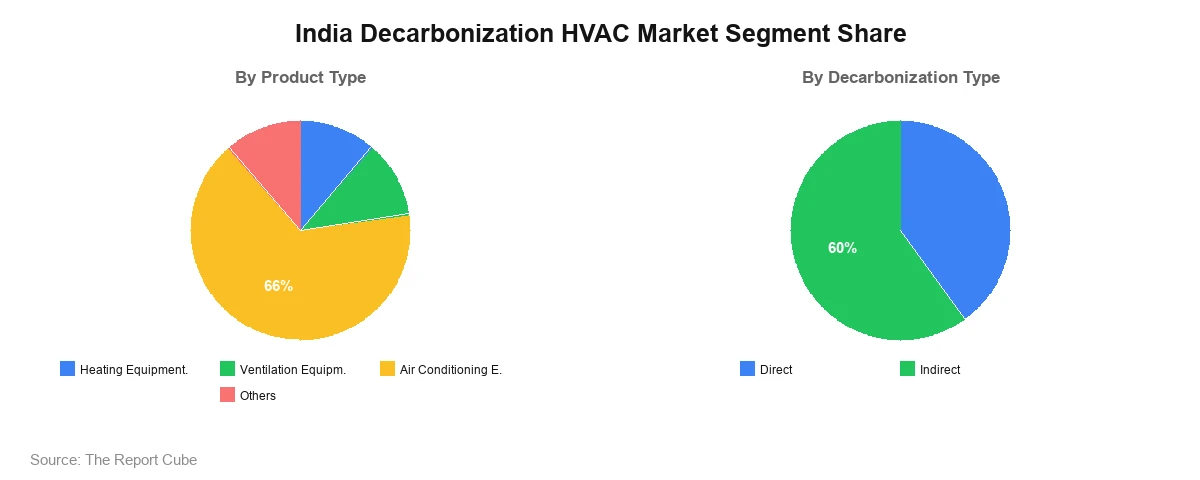
- Air Conditioning Equipment is estimated to account for approximately 66% of the market by product type in 2026, reflecting the importance of energy-efficient cooling systems, chillers, VRF equipment and air-conditioning retrofits.
- Indirect Decarbonization is estimated to hold approximately 60% share in 2026, based on the supplied analyst estimate. This category relates to reducing emissions associated with electricity consumption through higher HVAC efficiency and cleaner energy supply.
- Demand is supported by India's building energy-efficiency regulations, the India Cooling Action Plan and growing interest in energy-efficient HVAC equipment and building management systems.
- Commercial Buildings, Residential Buildings, Industrial Facilities, Healthcare Facilities and Data Centers represent important end-user categories for low-carbon HVAC technologies.
- Variable-speed systems, high-efficiency chillers, heat pumps, advanced building controls, low-global-warming-potential refrigerants and smart cooling technologies are shaping the market's technology landscape.
- India's Energy Conservation and Sustainable Building Code 2024 includes requirements covering mechanical systems and HVAC equipment in qualifying commercial buildings, supporting the adoption of more energy-efficient building infrastructure.
- Carrier, Blue Star, Daikin, Voltas, Johnson Controls, LG Electronics, Danfoss, Panasonic, Trane and Mitsubishi Electric are among the companies participating in India's HVAC equipment and building-efficiency ecosystem.
India Decarbonization HVAC Market Outlook
The India Decarbonization HVAC Market is developing alongside the country's expanding building infrastructure, rising cooling requirements and increasing focus on reducing energy consumption and operational emissions. Heating, ventilation and air-conditioning systems are significant components of building energy use, particularly in commercial buildings, hospitals, hotels, offices, industrial facilities and data centers. Decarbonization initiatives are encouraging building owners and developers to evaluate HVAC equipment based on energy performance, refrigerant characteristics, operating costs and compatibility with cleaner electricity sources. The market therefore includes both new low-carbon HVAC installations and the modernization of existing cooling and ventilation infrastructure.
India's HVAC decarbonization landscape is influenced by government energy-efficiency initiatives, building codes, appliance standards and cooling-related policy objectives. The India Cooling Action Plan, launched by the Ministry of Environment, Forest and Climate Change in March 2019, provides a long-term framework for reducing cooling demand, refrigerant demand and cooling-related energy requirements by 2037–38. The plan identifies energy-efficient cooling, alternative technologies, research and development, and improvements in servicing capabilities as important areas of action.
Air conditioning equipment represents a major product category because cooling systems are widely used across residential and commercial buildings, industrial facilities and digital infrastructure. High-efficiency chillers, variable refrigerant flow systems, inverter air conditioners, heat pumps, energy recovery ventilation and building automation technologies can improve HVAC performance. Decarbonization also involves refrigerant management, system design, equipment replacement, thermal management and the integration of renewable electricity. The commercial opportunity therefore extends beyond equipment sales to include engineering, installation, commissioning, retrofits, controls and ongoing energy optimization services.
Government Regulations
The India Decarbonization HVAC Market is influenced by energy conservation legislation, building energy codes, appliance efficiency standards, refrigerant regulations and environmental requirements. The Bureau of Energy Efficiency (BEE), operating under the Ministry of Power, administers energy-efficiency initiatives including the Standards and Labelling Programme and building energy codes. The Energy Conservation Building Code 2017 establishes energy-performance requirements for qualifying commercial buildings, including building envelopes, mechanical systems and HVAC equipment. The Energy Conservation and Sustainable Building Code 2024 further addresses building energy performance, water conservation, HVAC systems, controls and renewable energy provisions. Its scope includes commercial buildings with a connected load of at least 100 kW or contract demand of at least 120 kVA; residential buildings are not covered by this code.
The BEE Standards and Labelling Programme also covers room air conditioners, including fixed-speed and variable-speed products, through minimum energy-performance requirements and star labels. These standards influence product design, manufacturing and consumer purchasing decisions. The India Cooling Action Plan provides a broader policy direction for sustainable cooling and refrigerant transition, while India's obligations under the Montreal Protocol and Kigali Amendment are relevant to the phase-down of high-global-warming-potential refrigerants. In addition, the Environment Protection Act, groundwater regulations and applicable state-level building and environmental approval processes can affect cooling-system installation and operation. The regulatory framework is therefore distributed across national standards, state-level implementation and project-specific requirements.
India Decarbonization HVAC Market Dynamics
The India Decarbonization HVAC Market is influenced by rising cooling requirements, energy-efficiency regulations, building modernization and the need to reduce electricity-related emissions. High-efficiency air conditioning equipment, advanced controls, heat pumps and improved ventilation systems are supporting the transition toward lower-carbon building operations. However, high initial investment, retrofit complexity, refrigerant transition requirements and differences in building-level implementation create challenges for market adoption. The following table summarizes the key factors shaping market development.
| Factor | Type | Specific Impact on Market | Magnitude |
|---|---|---|---|
| Increasing cooling requirements across buildings | Growth Driver | Rising demand for space cooling in residential, commercial, healthcare and industrial facilities increases the need for efficient air-conditioning systems and cooling infrastructure. | High |
| Building energy-efficiency regulations | Growth Driver | ECBC and ECSBC requirements encourage energy-efficient building design, HVAC system performance improvements and the adoption of more efficient mechanical equipment in qualifying buildings. | High |
| HVAC retrofits and building modernization | Opportunity | Replacement of inefficient chillers, air conditioners, ventilation systems and outdated controls creates opportunities for equipment suppliers, system integrators and energy-service providers. | High |
| Low-carbon cooling and heat pump adoption | Opportunity | Heat pumps, efficient chillers, heat recovery systems and alternative refrigerants create opportunities for technology suppliers serving new construction and industrial applications. | Medium to High |
| High upfront investment and retrofit costs | Challenge | Capital expenditure for high-efficiency equipment, controls, engineering and building modifications can delay adoption, particularly among smaller building owners. | High |
| Refrigerant transition and servicing capabilities | Challenge | Transitioning to lower-GWP refrigerants requires compatible equipment, trained technicians, safe handling procedures and changes in servicing infrastructure. | Medium to High |
| Variable-speed and high-efficiency HVAC systems | Trend | Inverter compressors, variable-speed drives and advanced chiller technologies are improving part-load performance and reducing electricity requirements. | High |
| Smart building controls and advanced cooling technologies | Trend | Building automation, connected monitoring, demand-based ventilation and advanced data-center cooling are improving operational efficiency and resource management. | Medium to High |
Growth Drivers: Rising Cooling Demand and Expansion of Commercial and Residential Infrastructure
Increasing cooling requirements across India are supporting demand for energy-efficient HVAC equipment and low-carbon cooling solutions. Population growth, urbanization, rising household incomes and the expansion of commercial infrastructure are increasing the need for indoor thermal comfort. Residential air conditioning demand is supported by greater penetration of cooling appliances, while commercial facilities such as offices, shopping centres, hotels, hospitals and educational institutions require centralized or distributed cooling systems. As the installed HVAC base expands, energy consumption and operating costs become increasingly important considerations for building owners and developers, encouraging the selection of more efficient systems.
The India Cooling Action Plan provides a policy framework for addressing growing cooling requirements while improving energy efficiency and reducing environmental impact. The plan identifies objectives to reduce cooling demand across sectors by 20–25%, refrigerant demand by 25–30% and cooling energy requirements by 25–40% by 2037–38, relative to the plan's baseline. These are national policy objectives rather than guaranteed market outcomes. Nevertheless, they encourage investment in passive cooling, efficient air conditioning, alternative cooling technologies and better building design. This creates opportunities for manufacturers offering efficient HVAC equipment and for service providers involved in energy audits, system upgrades and cooling optimization.
Need Specific Data, Let’s Customize the Report for You
Request CustomizationMarket Opportunities: HVAC Retrofit and Modernization of Existing Buildings
Modernization of existing buildings represents an important opportunity for the India Decarbonization HVAC Market. A substantial installed base of older air conditioners, chillers, pumps, cooling towers and ventilation equipment provides opportunities for replacement and system optimization. Building owners can upgrade conventional equipment with high-efficiency chillers, variable-speed drives, inverter compressors, advanced controls and energy recovery systems. Retrofitting may also include improving insulation, optimizing chilled-water distribution, balancing air systems and installing building management platforms. These projects can reduce electricity consumption and operating costs, although the achievable savings depend on the original equipment, operating schedules, climate conditions and quality of implementation.
Commercial buildings, hospitals, hotels, educational institutions and industrial facilities are relevant customers for HVAC modernization services because they often operate cooling systems for extended periods. HVAC manufacturers and engineering companies can expand their offerings beyond equipment supply through energy audits, system design, installation, commissioning, predictive maintenance and performance monitoring. Building owners may also consider energy performance contracting or other financing structures to manage the upfront cost of upgrades. This creates a broader service opportunity for manufacturers, engineering contractors and energy-management providers in addition to conventional HVAC equipment sales.
Industry Challenges: High Initial Investment and Complex HVAC Retrofit Requirements
High initial investment is a major challenge for the adoption of decarbonized HVAC systems. High-efficiency chillers, advanced controls, variable-speed equipment, heat pumps and integrated building management systems can involve higher purchase and installation costs than conventional alternatives. The total project cost may also include engineering assessments, electrical upgrades, ductwork modifications, chilled-water system improvements, commissioning and building automation integration. These expenses can create adoption barriers for small and medium-sized commercial buildings, residential property owners and industrial facilities with limited capital budgets.
Retrofit projects can be particularly complex because existing buildings often have different equipment generations, inconsistent system designs and limited documentation. Replacing HVAC equipment without assessing building loads, operating schedules and distribution infrastructure may fail to deliver the expected energy performance. Installation may also require temporary operational shutdowns, coordination with building occupants and specialized contractors. Consequently, the market needs stronger energy-audit capabilities, project financing options and technically qualified system integrators to support wider adoption of low-carbon HVAC technologies.
Market Trends: Adoption of High-Efficiency Chillers, Inverter Systems and Variable-Speed HVAC Equipment
High-efficiency HVAC equipment is becoming increasingly important as building owners seek to manage electricity consumption and improve cooling performance. Variable-speed compressors, variable-frequency drives, magnetic-bearing chillers and advanced part-load control systems can improve performance under changing cooling requirements. These technologies are relevant to commercial buildings, hospitals, hotels, data centers and industrial facilities where cooling loads vary throughout the day. Equipment manufacturers are also incorporating advanced monitoring and controls to improve system operation and maintenance.
Indian manufacturers and international HVAC suppliers are expanding their offerings in high-efficiency cooling systems. Blue Star, for example, offers inverter scroll chillers and other commercial cooling products designed for different load conditions. Carrier provides air-cooled and water-cooled chillers, including products using alternative refrigerants. Trane's India portfolio includes chillers, building controls and retrofit solutions. The wider availability of such products is increasing the range of options for building developers and facility operators seeking to improve HVAC energy performance.
India Decarbonization HVAC Market Segment Analysis
The India Decarbonization HVAC Market is segmented by product type, decarbonization type, capacity, end-user and region. These categories reflect the equipment used to provide heating, ventilation and cooling, the approach adopted to reduce emissions, system capacity requirements and the buildings or facilities deploying low-carbon HVAC solutions. Air conditioning equipment is the leading product category in the supplied estimates, while commercial, residential, industrial and specialized infrastructure applications represent different areas of demand. The following analysis retains the supplied segmentation and available 2026 analyst estimates.
By Product Type
- Heating Equipment
- Ventilation Equipment
- Air Conditioning Equipment
- Others
Air Conditioning Equipment is estimated to lead the product type category with approximately 66% share in 2026. Its leading position reflects the extensive requirement for cooling across residential buildings, commercial offices, retail facilities, hospitals, hotels, industrial facilities and data centers. Relevant equipment includes room air conditioners, variable refrigerant flow systems, packaged units, chillers, precision cooling systems and other cooling equipment. Decarbonization-related demand is increasingly focused on improving cooling efficiency through inverter compressors, high-efficiency heat exchangers, variable-speed drives, optimized refrigerant systems and intelligent controls. Heating Equipment supports applications requiring space heating, hot water and industrial thermal processes, while Ventilation Equipment contributes to indoor air quality, air exchange and energy-efficient air distribution. Others includes additional HVAC-related products and supporting equipment.
By Decarbonization Type
- Direct
- Indirect
Indirect Decarbonization is estimated to lead the category with approximately 60% share in 2026, based on the supplied analyst estimate. In the context of HVAC systems, indirect decarbonization can be interpreted as reducing emissions associated with electricity consumption through energy-efficient equipment, improved system controls, reduced cooling loads and the use of cleaner electricity. Examples include high-efficiency chillers, inverter air conditioners, variable-speed pumps, optimized ventilation and renewable-powered HVAC operations. Direct Decarbonization relates more closely to reducing emissions occurring directly within the building or HVAC system, including refrigerant leakage and emissions from on-site fuel combustion where applicable. Refrigerant management, lower-GWP refrigerants, electrification and equipment redesign can contribute to this category. The direct and indirect classification is not a universally standardized HVAC market taxonomy; the supplied categories and estimated split have therefore been retained without treating the 60% share as independently verified.
India Decarbonization HVAC Market Regional Analysis
Regional demand for decarbonized HVAC technologies in India varies according to climatic conditions, urbanization, industrial concentration, commercial construction and infrastructure development. North, South, East and West India have different cooling and ventilation requirements, which influence equipment selection, system capacity and investment in energy-efficient technologies. Commercial buildings, industrial facilities, healthcare infrastructure and data centers are important sources of demand across multiple regions. The following table summarizes the major regional growth factors and industry trends.
| Region | Key Growth Factors | Industry Trends |
|---|---|---|
| North India | Demand from commercial buildings, government infrastructure, healthcare facilities, industrial facilities and large urban centres. Seasonal temperature variation also creates requirements for both cooling and heating solutions. | Adoption of efficient chillers, inverter air conditioners, building automation and HVAC retrofits in commercial and institutional buildings. Delhi NCR and other major urban centres are relevant demand locations. |
| South India | Strong presence of technology companies, IT parks, industrial facilities, healthcare infrastructure and data centers in cities such as Bengaluru, Chennai and Hyderabad. | Growing focus on high-efficiency cooling, VRF systems, advanced ventilation, data center thermal management and connected building controls. |
| East India | Demand supported by urban development, industrial activity, healthcare facilities, commercial construction and the need for reliable cooling in humid and warm climatic conditions. | Opportunities for energy-efficient commercial air conditioning, equipment modernization, ventilation improvements and cooling infrastructure upgrades. |
| West India | Commercial and industrial concentration in Mumbai, Pune, Ahmedabad and surrounding urban centres, together with demand from offices, hotels, manufacturing and data centers. | Adoption of centralized HVAC systems, high-efficiency chillers, building management systems, industrial cooling and commercial HVAC modernization. |
India Decarbonization HVAC Market Competitive Landscape
The competitive landscape of the India Decarbonization HVAC Market includes domestic HVAC manufacturers, multinational equipment suppliers, building technology companies and component providers. Competition is shaped by equipment efficiency, product range, manufacturing capabilities, service networks, refrigerant technologies, system integration and lifecycle support. Some companies supply complete HVAC equipment and building systems, while others provide controls, compressors, valves and components that support HVAC decarbonization. The companies below are retained from the supplied list and assessed according to their publicly identifiable product portfolios and business activities.
| Company | Competitive Strength | Primary Segment Served |
|---|---|---|
| Carrier | Broad commercial HVAC portfolio covering chillers, heat pumps, air handling units, fan coil units, VRF systems and other cooling equipment, supported by Indian manufacturing and service operations. | Commercial air conditioning, chillers, HVAC systems and building cooling |
| Blue Star Limited | Indian HVAC manufacturer with a portfolio of chillers, VRF systems, ducted and packaged air conditioners, commercial cooling systems, retrofits and maintenance services. | Commercial air conditioning, industrial cooling and HVAC modernization |
| Daikin Airconditioning India Pvt. Ltd. (DAIKIN INDUSTRIES, Ltd.) | Wide air-conditioning portfolio covering residential, commercial and industrial applications, including VRV systems, chillers, heat recovery ventilation and airside equipment. | Residential and commercial air conditioning, VRV and chillers |
| Voltas (Tata Group) | Established Indian cooling solutions provider with commercial air conditioners, VRF systems, packaged units, chillers and retrofit services. | Commercial cooling, residential air conditioning and HVAC services |
| Johnson Controls | HVAC equipment and building automation capabilities, including chillers, air handling, VRF systems, controls and building energy-management solutions. | Commercial HVAC, building automation and energy management |
| LG Electronics | Commercial HVAC portfolio including VRF systems, air-cooled chillers, air handling solutions and inverter-based air-conditioning technologies. | Commercial air conditioning, VRF and chillers |
| Danfoss | Supplier of HVAC components and technologies for chillers, heat pumps, air conditioning, refrigerant systems, compressors, valves and controls. | HVAC components, refrigeration, heat pumps and energy efficiency |
| Panasonic Life Solutions India Pvt. Ltd. (Panasonic Holdings Corporation) | Residential and commercial air-conditioning portfolio, including inverter systems, commercial ACs, VRF integration and connected cooling technologies. | Residential air conditioning, commercial AC and connected HVAC |
| Trane | Commercial HVAC solutions covering chillers, air handling systems, building controls, data center cooling, retrofit services and electrified HVAC solutions. | Commercial HVAC, chillers, building systems and data center cooling |
| Mitsubishi Electric Corporation | Air-conditioning systems for residential, commercial and industrial applications, including VRF, ventilation products, split systems and energy-efficient cooling technologies. | Residential and commercial air conditioning, VRF and ventilation |
- Carrier: Carrier India is a major participant in the Indian commercial HVAC industry, with a history of operations and manufacturing in the country. Its Gurgaon manufacturing facility produces products including air-cooled and water-cooled chillers, cassettes, ducted split systems, packaged units, fan coil units and air handling units. The company has also expanded its Made in India portfolio through locally manufactured air handling units and fan coil units. Carrier's product range and manufacturing capabilities position it as a relevant supplier for commercial building HVAC, industrial cooling and energy-efficiency projects.
- Blue Star Limited: Blue Star is an Indian manufacturer of air-conditioning and commercial refrigeration products with a broad portfolio covering residential air conditioners, commercial air conditioning systems, chillers, VRF systems, ducted and packaged units, and specialized cooling solutions. Its commercial HVAC business includes design, installation, maintenance, retrofitting and system modernization. The company also offers inverter chillers, remote monitoring and products designed for commercial buildings, hospitals, offices, industrial facilities and data centers. These capabilities make Blue Star relevant to India's energy-efficient HVAC equipment and building modernization market.
Recent Developments and Updates
- March 12, 2026 – Panasonic showcases HVAC portfolio at ACREX India 2026: Panasonic Life Solutions India presented its portfolio across residential air conditioners, commercial air conditioning, VRF systems and cold-chain solutions. The showcase included smart residential air conditioners, AI-enabled VRF integration and a commercial cassette AC with occupancy-based energy optimization. The development highlights the growing focus on connected and energy-efficient HVAC products in India.
- March 30, 2026 – LG Electronics India deploys advanced HVAC solutions at Seva Teerth: LG Electronics India announced the deployment of a VRF air-conditioning system with a total capacity of 1,590 horsepower, comprising 113 outdoor units, at the Seva Teerth complex in New Delhi. The company stated that the system was supplied from its Pune manufacturing facility. The project demonstrates the use of large VRF installations in major institutional buildings.
- July 2, 2026 – Trane launches magnetic-bearing chiller for Asia Pacific data centers: Trane announced the HSWE magnetic-bearing centrifugal chiller, developed for the Asia Pacific market and designed to address high-performance cooling requirements, particularly in data centers. The launch reflects increasing demand for high-efficiency thermal management equipment as computing workloads and data center infrastructure expand.
- August 12, 2026 – Government highlights energy and water efficiency measures for data centers: The Ministry of Electronics and Information Technology reported that India's installed data center capacity had reached approximately 1,575 MW, compared with 375 MW in 2020. The government also highlighted the use of advanced cooling technologies, including direct-to-chip liquid cooling, adiabatic cooling, immersion cooling and closed-loop liquid cooling, along with efficiency and water-conservation standards.
- October 14, 2026 – NITI Aayog releases Data Centre Evaluation Framework: NITI Aayog's Frontier Tech Hub released a framework to help state governments evaluate data center investment proposals across power and energy, water and cooling, environmental sustainability, economic value and policy implementation. The framework emphasizes grid readiness, renewable energy, water-stress assessment and sustainable cooling, creating a relevant planning context for India's data center HVAC market.
India Decarbonization HVAC Market Future Outlook
The India Decarbonization HVAC Market is expected to expand as demand for cooling increases and building owners place greater emphasis on energy performance, operating costs and emissions reduction. Commercial building development, residential air-conditioning penetration, industrial modernization and data center expansion are expected to support demand for high-efficiency HVAC equipment. Air conditioning equipment is likely to remain an important product category, while variable-speed systems, high-efficiency chillers, smart controls, heat pumps and lower-GWP refrigerant technologies are expected to influence equipment selection and system design.
Government energy-efficiency codes, the India Cooling Action Plan and investment in sustainable infrastructure are expected to influence the market's long-term direction. Retrofit projects, building automation, advanced cooling systems and integrated energy-management solutions may provide additional opportunities for equipment manufacturers and service providers. However, adoption will depend on upfront investment, lifecycle economics, technical capabilities, refrigerant transition requirements and the implementation of building standards. Based on the supplied estimates, the market is projected to increase from USD 4.26 billion in 2027 to USD 17.66 billion by 2035, representing a CAGR of approximately 19.45% during the forecast period.
India Decarbonization HVAC Market Report Coverage
The India Decarbonization HVAC Market report provides an assessment of market size, growth trends, regulatory developments, market dynamics and competitive positioning across India's low-carbon heating, ventilation and air-conditioning industry. The report examines the market by product type, decarbonization type, capacity, end-user and region, while evaluating the impact of building energy codes, cooling requirements, HVAC modernization, refrigerant transition and advanced cooling technologies.
| Parameter | Details |
|---|---|
| Market Name | India Decarbonization HVAC Market |
| Market Size (2027) | USD 4.26 Billion |
| Market Size (2035) | USD 17.66 Billion |
| CAGR | 19.45% |
| Base Year | 2026 |
| Historical Period | 2022–2026 |
| Forecast Period | 2027–2035 |
| Geographic Scope | India |
| Segmentation | By Product Type, By Decarbonization Type, By Capacity, By End User and By Region |
| Regions Covered | North India, South India, East India and West India |
| Key Companies | Carrier, Blue Star Limited, Daikin Airconditioning India Pvt. Ltd. (DAIKIN INDUSTRIES, Ltd.), Voltas (Tata Group), Johnson Controls, LG Electronics, Danfoss, Panasonic Life Solutions India Pvt. Ltd. (Panasonic Holdings Corporation), Trane and Mitsubishi Electric Corporation |
| Customization | Available as per client requirements |
Why Choose This India Decarbonization HVAC Market Report?
- Provides market size estimates and growth projections for India's decarbonization HVAC industry from 2027 to 2035.
- Examines key growth drivers, market opportunities, industry challenges and technology trends influencing HVAC decarbonization.
- Evaluates the market across product type, decarbonization type, capacity, end-user and regional categories.
- Reviews the influence of India's building energy codes, energy-efficiency standards and India Cooling Action Plan on HVAC technology adoption.
- Analyzes the competitive landscape of domestic and international HVAC manufacturers and technology providers.
- Highlights opportunities in HVAC retrofits, high-efficiency chillers, heat pumps, smart building controls, refrigerant transition and data center cooling.
- Supports strategic planning for HVAC manufacturers, building developers, facility managers, engineering contractors, investors and energy-efficiency service providers.
Table of Contents
- Introduction
- Objective of the Study
- Product Definition
- Market Segmentation
- Study Variables
- Research Methodology
- Secondary Data Points
- Companies Interviewed
- Primary Data Points
- Breakdown of Primary Interviews
- Secondary Data Points
- Executive Summary
- Market Dynamics
- Drivers
- Challenges
- Opportunity Assessment
- Recent Trends and Developments
- Policy and Regulatory Landscape
- India Decarbonization HVAC Market Overview and Forecast Analysis (2022-2035)
- Market Size, By Value, By Growth Rate (CAGR/USD Billions)
- Demand – Supply Trends
- Market Share, By Product Type
- Heating Equipment
- Ventilation Equipment
- Air Conditioning Equipment
- Others
- Market Share, By Decarbonization Type
- Direct
- Indirect
- Market Share, By Capacity
- Up to 5 Tons
- 5–20 Tons
- Above 20 Tons
- Market Share, By End User
- Commercial Buildings
- Residential Buildings
- Industrial Facilities
- Healthcare Facilities
- Data Centers
- Others
- Market Share, By Region
- North India
- South India
- East India
- West India
- Market Share, By Competitors
- Competition Characteristics
- Revenue Shares
- Heating Equipment India Decarbonization HVAC Market Overview, 2022-2035F
- By Value (USD Million)
- By Decarbonization Type – Market Size & Forecast 2022-2035, USD Million
- Direct
- Indirect
- Ventilation Equipment India Decarbonization HVAC Market Overview, 2022-2035F
- By Value (USD Million)
- By Decarbonization Type – Market Size & Forecast 2022-2035, USD Million
- Direct
- Indirect
- Air Conditioning Equipment India Decarbonization HVAC Market Overview, 2022-2035F
- By Value (USD Million)
- By Decarbonization Type – Market Size & Forecast 2022-2035, USD Million
- Direct
- Indirect
- Others India Decarbonization HVAC Market Overview, 2022-2035F
- By Value (USD Million)
- By Decarbonization Type – Market Size & Forecast 2022-2035, USD Million
- Direct
- Indirect
- Competitive Outlook (Company Profile – Partial List)
- Carrier
- Company Overview
- Business Segments
- Strategic Alliances/Partnerships
- Recent Developments
- Blue Star Limited
- Company Overview
- Business Segments
- Strategic Alliances/Partnerships
- Recent Developments
- Daikin Airconditioning India Pvt. Ltd. (DAIKIN INDUSTRIES
- Company Overview
- Business Segments
- Strategic Alliances/Partnerships
- Recent Developments
- Ltd.)
- Company Overview
- Business Segments
- Strategic Alliances/Partnerships
- Recent Developments
- Voltas (Tata Group)
- Company Overview
- Business Segments
- Strategic Alliances/Partnerships
- Recent Developments
- Johnson Controls
- Company Overview
- Business Segments
- Strategic Alliances/Partnerships
- Recent Developments
- LG Electronics
- Company Overview
- Business Segments
- Strategic Alliances/Partnerships
- Recent Developments
- Danfoss
- Company Overview
- Business Segments
- Strategic Alliances/Partnerships
- Recent Developments
- Panasonic Life Solutions India Pvt. Ltd. (Panasonic Holdings Corporation)
- Company Overview
- Business Segments
- Strategic Alliances/Partnerships
- Recent Developments
- Trane
- Company Overview
- Business Segments
- Strategic Alliances/Partnerships
- Recent Developments
- Mitsubishi Electric Corporation
- Company Overview
- Business Segments
- Strategic Alliances/Partnerships
- Recent Developments
- Carrier
- Contact Us & Disclaimer
Top Key Players & Market Share Outlook
- Carrier
- Blue Star Limited
- Daikin Airconditioning India Pvt. Ltd. (DAIKIN INDUSTRIES, Ltd.)
- Voltas (Tata Group)
- Johnson Controls
- LG Electronics
- Danfoss
- Panasonic Life Solutions India Pvt. Ltd. (Panasonic Holdings Corporation)
- Trane
- and Mitsubishi Electric Corporation
Frequently Asked Questions