



Build Your Custom Market Intelligence Report
Customize Your ReportUS Influencer Marketing Market Key Takeaways
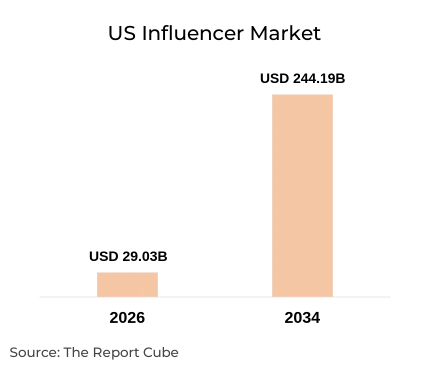
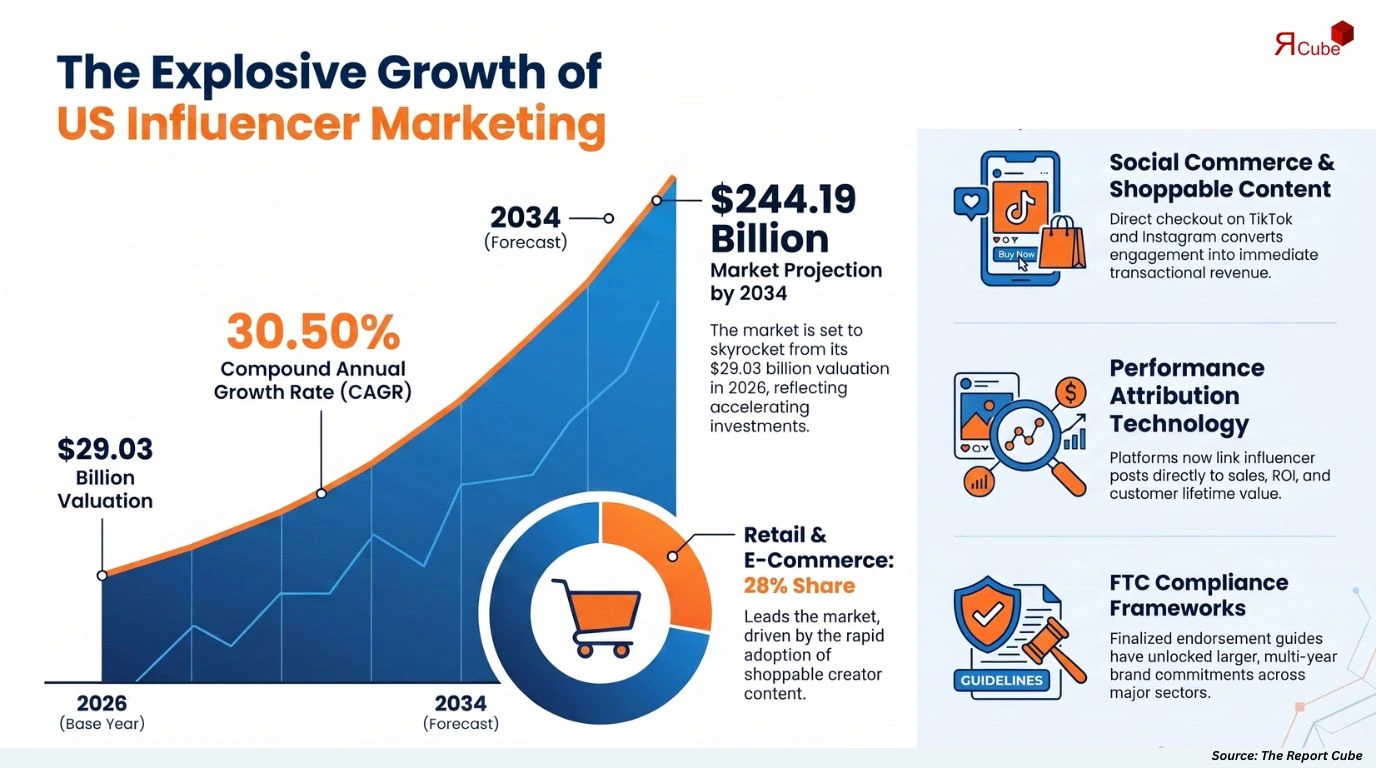
- US Influencer Marketing Market valued at USD 29.03 billion in 2026, reflecting accelerating creator economy investments.
- Industry projected to reach USD 244.19 billion by 2034, expanding at an impressive 30.50% CAGR.
- Retail and e-commerce commands the largest end-user segment share driven by shoppable content adoption.
- Solutions component leads the market as brands prioritize integrated campaign management and analytics platforms.
- The United States maintains dominant regional positioning through high social media penetration and digital ad spending.
- Micro and nano-influencer partnerships are reshaping brand acquisition strategies across all major verticals.
- Leading companies include Influencity, AspireIQ, Upfluence, Traackr, Klear, BuzzSumo, NinjaOutreach, CreatorIQ, and HypeAuditor.
- Rising demand for performance-linked attribution, fraud detection, and FTC-compliant creator programs accelerates platform adoption.
US Influencer Marketing Market Insights & Analysis
The US Influencer Marketing Market is anticipated to register a 30.50% CAGR during 2026–2034. The market size was valued at USD 29.03 billion in 2026 and is projected to reach USD 244.19 billion by 2034. The industry is benefiting from accelerating brand investment in creator-driven acquisition channels, the mainstreaming of short-form video commerce, and measurable reductions in blended customer acquisition costs when advertising budgets shift from paid search to influencer partnerships. Updated Federal Trade Commission Endorsement Guides finalized in 2023 have also provided a compliance framework that unlocked larger, multi-year brand commitments across fashion, retail, and consumer goods sectors.
Platform-level innovations from leading vendors including Upfluence, CreatorIQ, and Traackr are enabling enterprise brands to connect influencer activity directly to conversion outcomes, affiliate revenue, and return on creator spend (ROCS) metrics. Retail and e-commerce brands operating on Shopify, WooCommerce, and Amazon are increasingly embedding creator programs into core acquisition strategies, while beauty, luxury, and food-and-beverage advertisers are expanding nano and micro-influencer rosters to generate authentic, high-engagement content at scale. These structural shifts are expected to sustain accelerated market expansion across the forecast period.
US Influencer Marketing Market Dynamics
Demand across the US Influencer Marketing Market continues intensifying as brands across fashion, retail, travel, food and beverage, and consumer goods sectors recognize creator partnerships as a strategic revenue-generation function rather than a supplementary branding exercise. Expanding social commerce infrastructure on TikTok, Instagram, and YouTube, combined with direct e-commerce integrations from leading platforms, is compressing the gap between content engagement and measurable sales conversion.
|
Factor |
Type |
Specific Impact on Market |
Magnitude |
|---|---|---|---|
|
Social commerce expansion |
Driver |
Accelerates shoppable creator content adoption across retail brands |
Very High |
|
FTC compliance framework |
Driver |
Unlocks larger multi-year brand commitments and platform investment |
High |
|
Micro and nano-influencer adoption |
Opportunity |
Reduces cost-per-acquisition while improving engagement authenticity |
High |
|
Performance attribution technology |
Trend |
Shifts creator spend from branding to measurable revenue channels |
Very High |
|
Influencer fraud and audience quality |
Challenge |
Increases demand for fraud detection and audience verification platforms |
High |
Key Market Driver: Social Commerce and Shoppable Creator Content
Short-form video platforms including TikTok and Instagram Reels have transformed creator content into direct purchase pathways, compelling brands to integrate influencer campaigns with product seeding, affiliate link programs, and real-time checkout capabilities. Retail and e-commerce brands are now allocating dedicated influencer commerce budgets separate from traditional digital advertising, as platforms like Upfluence and CreatorIQ enable direct tracking of influencer-driven revenue through native Shopify and Amazon integrations. Influencer marketing campaigns now deliver an average return on investment approximately 6.5 times higher than traditional advertising methods, reinforcing continued budget migration toward creator channels.
Major Industry Challenge: Influencer Fraud and Audience Authenticity Verification
Despite rapid market growth, follower inflation, engagement manipulation, and inauthentic audience composition remain persistent operational challenges that undermine campaign performance and erode advertiser confidence. Brands running large-scale creator programs increasingly require audience quality scoring, fake follower detection, and demographic verification before committing to influencer partnerships. Platforms including HypeAuditor and Klear have built specialized fraud analytics capabilities to address this need, though the expanding volume of nano and micro-influencer partnerships creates significant ongoing vetting complexity for enterprise marketing teams managing hundreds of simultaneous creator relationships.
Emerging Trend Shaping Outlook: Performance Attribution and Return on Creator Spend
Enterprise brands are accelerating adoption of attribution infrastructure that links every influencer post directly to measurable business outcomes including sales, affiliate revenue, new customer acquisition, and customer lifetime value. CreatorIQ's Impact reporting framework, Traackr's Brand Vitality Score, and Upfluence's Jace AI-powered campaign optimization are enabling marketing teams to present return on creator spend to finance leadership with the same rigor previously reserved for paid search and programmatic advertising. This shift from impressions-based to outcome-based measurement is restructuring how brands evaluate, compensate, and retain creator talent across the forecast period.
Need Specific Data, Let’s Customize the Report for You
Request CustomizationUS Influencer Marketing Market Segment-wise Analysis
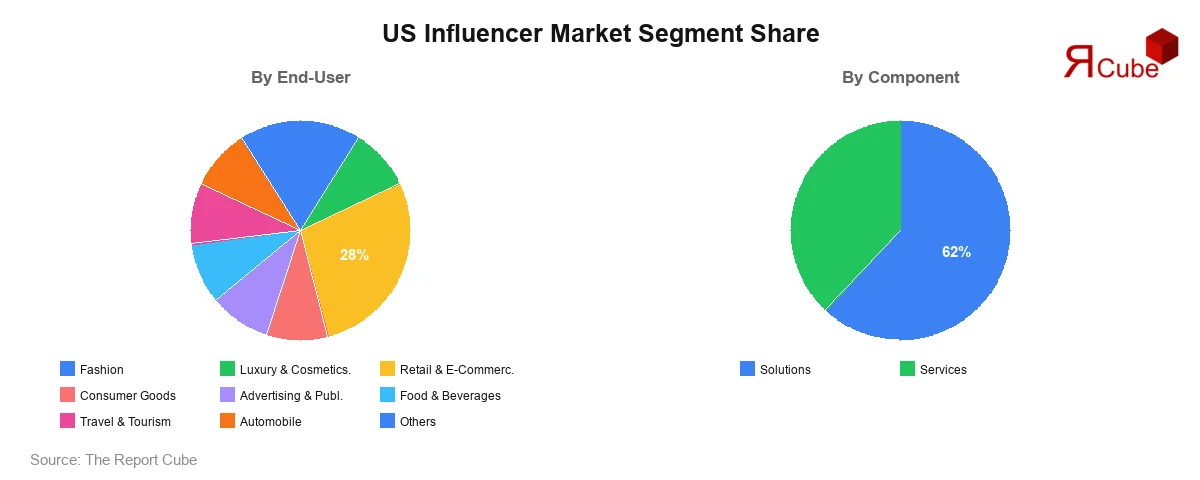
The US Influencer Marketing Market demonstrates strong variation across end-user verticals and component types as brands at different digital maturity levels seek differentiated platform capabilities. Fashion, retail, luxury, and food-and-beverage sectors are collectively driving the highest platform adoption volumes, while solutions-based deployments continue commanding the majority of technology investment.
By End-User
- Fashion
- Luxury & Cosmetics
- Retail & E-Commerce
- Consumer Goods
- Advertising & Public Relations
- Food & Beverages
- Travel & Tourism
- Automobile
- Others
Retail and e-commerce represents the dominant end-user segment, accounting for approximately 28% of total US Influencer Marketing Market revenue in 2026, driven by the direct connection between creator content and platform-native purchase behavior. Brands operating on Shopify, WooCommerce, and Amazon are deploying influencer platforms that automate product seeding, generate affiliate commission tracking, and measure influencer-sourced revenue in real time. The segment's leadership is reinforced by the rapid expansion of TikTok Shop, Instagram Shopping, and YouTube Shopping integrations that convert creator engagement into immediate transactional activity without redirecting consumers to external websites.
Fashion and luxury and cosmetics together represent the second-largest combined vertical, accounting for an estimated 24% of market revenue as brands leverage influencer platforms to generate earned media value at major cultural events including fashion weeks and award ceremonies. At Cannes 2025, luxury and fashion influencers generated a record USD 203 million in earned media value on Instagram, with the fashion category alone contributing USD 77.2 million, demonstrating the commercial scale of strategic creator partnerships in premium brand environments. Food and beverage and travel and tourism are emerging as the fastest-growing end-user verticals as experiential content formats drive strong audience engagement and category purchase intent across YouTube and Instagram channels.
By Component
- Solutions
- Services
The solutions segment leads the US Influencer Marketing Market by component, representing approximately 62% of total market revenue in 2026, as brands and agencies deploy integrated software platforms spanning influencer discovery, campaign management, content approval, affiliate tracking, creator payments, and performance analytics within unified workflows. Enterprise solutions from CreatorIQ, Traackr, and Upfluence enable multinational brands to standardize creator program governance, benchmarking, and return on creator spend reporting across multiple product lines, geographies, and agency partners simultaneously, driving substantial annual contract values across the large enterprise segment.
The services segment is expanding rapidly as brands lacking internal influencer marketing expertise engage managed service providers, strategy consultancies, and full-service agencies to design, execute, and optimize creator programs. Mid-market and small business advertisers in particular are increasingly accessing platform capabilities through agency-managed service tiers, reducing the upfront investment and operational complexity associated with self-serve enterprise deployments. Services adoption is expected to grow at an above-average rate through 2034 as demand from emerging verticals including travel, automobile, and consumer goods accelerates beyond current in-house organizational capabilities.
Regional Projection of US Influencer Marketing Market
The US Influencer Marketing Market exhibits concentrated regional activity shaped by social media penetration rates, e-commerce infrastructure maturity, advertiser digital sophistication, and platform availability across different domestic markets.
|
Region |
Estimated Market Share |
Key Growth Factors |
Consumer Trends |
|---|---|---|---|
|
Northeast |
31.4% |
Dense brand headquarters, agency ecosystem, luxury and fashion advertiser concentration |
High enterprise platform adoption and multi-channel creator programs |
|
West (including California) |
28.7% |
Tech industry investment, creator economy concentration, social media platform proximity |
Strong direct-to-consumer and e-commerce influencer integration |
|
South |
22.1% |
Expanding retail and consumer goods sector, growing mid-market advertiser base |
Rapid micro-influencer adoption across food, beverage, and lifestyle |
|
Midwest |
11.6% |
Manufacturing and consumer goods brand investment, regional creator ecosystems |
Increasing services-led influencer program adoption |
|
Other Regions |
6.2% |
Travel, tourism, and hospitality sector influencer adoption |
Growing nano-influencer program investment |
- Northeast: The Northeast maintains market leadership with approximately 31.4% share, anchored by the concentration of major brand headquarters, advertising holding company offices, and luxury fashion advertisers across New York City that allocate substantial creator marketing budgets to integrated influencer platform deployments.
- West (including California): The West Coast benefits from geographic proximity to major social media platform offices, a dense creator economy, and technology-forward direct-to-consumer brands that invest aggressively in Shopify-integrated influencer affiliate programs and performance-linked creator compensation structures.
- South: The South is the fastest-growing domestic region as expanding retail, food-and-beverage, and consumer goods advertisers increasingly adopt micro and nano-influencer programs to reach highly engaged regional audiences at competitive cost-per-acquisition rates compared to paid digital channels.
- Midwest: The Midwest contributes a stable revenue base driven by large consumer goods and manufacturing brands deploying enterprise influencer platforms to manage regional creator rosters and measure influencer-sourced customer acquisition across multiple product categories.
- Other Regions: Travel, tourism, and hospitality advertisers in emerging domestic markets are driving growing platform adoption as destination brands invest in creator-produced experiential content distributed across YouTube, Instagram, and TikTok channels to reach travel-intent consumer audiences.
US Influencer Marketing Market: Recent Development (2025)
- Upfluence launched Jace AI co-pilot, enabling brands to build and optimize influencer campaigns ten times faster.
- HypeAuditor overhauled its analytics dashboard introducing an Audience Quality Score for improved influencer vetting.
- AspireIQ released a fully customizable influencer CRM and ROI tracking suite for scalable e-commerce brands.
- Captiv8 announced a strategic partnership with Perplexity to integrate AI-powered natural language campaign intelligence tools.
US Influencer Marketing Market Future Outlook (2034)
The US Influencer Marketing Market is projected to expand at a 30.50% CAGR, reaching approximately USD 244.19 billion by 2034, as creator programs become indispensable components of enterprise brand strategy across every major consumer vertical. Continued social commerce expansion on TikTok Shop, YouTube Shopping, and Instagram Checkout will deepen the integration between creator content and real-time purchase conversion, while AI-driven creator selection, automated content briefing, and predictive return on creator spend modeling will reduce campaign cycle times and strengthen performance accountability across the market.
Long-term market expansion will be supported by the proliferation of nano and micro-influencer programs that enable brands to build scalable, authentic creator communities at substantially lower cost-per-acquisition than traditional digital advertising. Autonomous campaign optimization, real-time fraud detection, cross-channel attribution, and creator relationship management capabilities will become standard platform features as leading vendors including Traackr, CreatorIQ, and Influencity invest in AI-powered infrastructure upgrades. Healthcare, financial services, and B2B technology sectors represent emerging growth verticals where FTC-compliant influencer programs are being piloted for the first time, collectively expanding the addressable market well beyond its current consumer-brand concentration.
US Influencer Marketing Market Report Coverage
|
Report Attribute |
Details |
|---|---|
|
Market Name |
US Influencer Marketing Market |
|
Market Size (2026) |
USD 29.03 Billion |
|
Market Size (2034) |
USD 244.19 Billion |
|
Forecast Period |
2026–2034 |
|
CAGR |
30.50% |
|
Base Year |
2026 |
|
Historical Years |
2021–2025 |
|
Forecast Years |
2026–2034 |
|
Segments Covered |
By End-User, By Component, By Organization Size |
|
Regions Covered |
Northeast, West, South, Midwest, Other Regions |
|
Key Companies |
Influencity, AspireIQ, Upfluence, Traackr, Klear, BuzzSumo, NinjaOutreach, CreatorIQ, HypeAuditor |
|
Report Format |
PDF, Excel, PPT |
|
Customization |
Available as per client requirements |
Why Choose This Report?
- Comprehensive analysis covering all major end-user verticals and component segments.
- Accurate market sizing with reliable 30.50% CAGR forecast through 2034.
- Detailed segmentation insights identifying retail, fashion, and luxury revenue leaders.
- Competitive profiling of nine leading influencer marketing platform vendors.
- Strategic analysis of performance attribution, social commerce, and creator economy trends.
- Regional intelligence covering domestic US market concentration and growth dynamics.
- FTC compliance and influencer fraud risk coverage addressing key advertiser concerns.
- Data-driven research aligned with current influencer marketing industry best practices.
Table of Contents
- Introduction
- Objective of the Study
- Product Definition
- Market Segmentation
- Study Variables
- Research Methodology
- Secondary Data Points
- Companies Interviewed
- Primary Data Points
- Breakdown of Primary Interviews
- Secondary Data Points
- Executive Summary
- Market Dynamics
- Drivers
- Challenges
- Opportunity Assessment
- Recent Trends and Developments
- Policy and Regulatory Landscape
- US Influencer Marketing Market Overview and Forecast Analysis (2021-2034)
- Market Size, By Value, By Growth Rate (CAGR/USD Billions)
- Demand – Supply Trends
- Market Share, By End-User
- Fashion
- Luxury & Cosmetics
- Retail & E-Commerce
- Consumer Goods
- Advertising & Public Relations
- Food & Beverages
- Travel & Tourism
- Automobile
- Others
- Market Share, By Component
- Solutions
- Services
- Market Share, By Organization Size
- Small & Medium Enterprise (SME)
- Large Enterpr
- Market Share, By Region
- Northeast
- West
- South
- Midwest
- Other Regions
- Market Share, By Competitors
- Competition Characteristics
- Revenue Shares
- Fashion US Influencer Marketing Market Overview, 2021-2034F
- By Value (USD Million)
- By Component – Market Size & Forecast 2021-2034, USD Million
- Solutions
- Services
- Luxury & Cosmetics US Influencer Marketing Market Overview, 2021-2034F
- By Value (USD Million)
- By Component – Market Size & Forecast 2021-2034, USD Million
- Solutions
- Services
- Retail & E-Commerce US Influencer Marketing Market Overview, 2021-2034F
- By Value (USD Million)
- By Component – Market Size & Forecast 2021-2034, USD Million
- Solutions
- Services
- Consumer Goods US Influencer Marketing Market Overview, 2021-2034F
- By Value (USD Million)
- By Component – Market Size & Forecast 2021-2034, USD Million
- Solutions
- Services
- Advertising & Public Relations US Influencer Marketing Market Overview, 2021-2034F
- By Value (USD Million)
- By Component – Market Size & Forecast 2021-2034, USD Million
- Solutions
- Services
- Food & Beverages US Influencer Marketing Market Overview, 2021-2034F
- By Value (USD Million)
- By Component – Market Size & Forecast 2021-2034, USD Million
- Solutions
- Services
- Travel & Tourism US Influencer Marketing Market Overview, 2021-2034F
- By Value (USD Million)
- By Component – Market Size & Forecast 2021-2034, USD Million
- Solutions
- Services
- Automobile US Influencer Marketing Market Overview, 2021-2034F
- By Value (USD Million)
- By Component – Market Size & Forecast 2021-2034, USD Million
- Solutions
- Services
- Others US Influencer Marketing Market Overview, 2021-2034F
- By Value (USD Million)
- By Component – Market Size & Forecast 2021-2034, USD Million
- Solutions
- Services
- Competitive Outlook (Company Profile – Partial List)
- Influencity
- Company Overview
- Business Segments
- Strategic Alliances/Partnerships
- Recent Developments
- AspireIQ
- Company Overview
- Business Segments
- Strategic Alliances/Partnerships
- Recent Developments
- Upfluence
- Company Overview
- Business Segments
- Strategic Alliances/Partnerships
- Recent Developments
- Traackr
- Company Overview
- Business Segments
- Strategic Alliances/Partnerships
- Recent Developments
- Klear
- Company Overview
- Business Segments
- Strategic Alliances/Partnerships
- Recent Developments
- BuzzSumo
- Company Overview
- Business Segments
- Strategic Alliances/Partnerships
- Recent Developments
- NinjaOutreach
- Company Overview
- Business Segments
- Strategic Alliances/Partnerships
- Recent Developments
- CreatorIQ
- Company Overview
- Business Segments
- Strategic Alliances/Partnerships
- Recent Developments
- HypeAuditor
- Company Overview
- Business Segments
- Strategic Alliances/Partnerships
- Recent Developments
- Others
- Influencity
- Contact Us & Disclaimer
Top Key Players & Market Share Outlook
- Influencity
- AspireIQ
- Upfluence
- Traackr
- Klear
- BuzzSumo
- NinjaOutreach
- CreatorIQ
- HypeAuditor
- Others
Frequently Asked Questions






