



Build Your Custom Market Intelligence Report
Customize Your ReportEurope Instant Delivery FMCG Market Key Highlights
By Service Model:
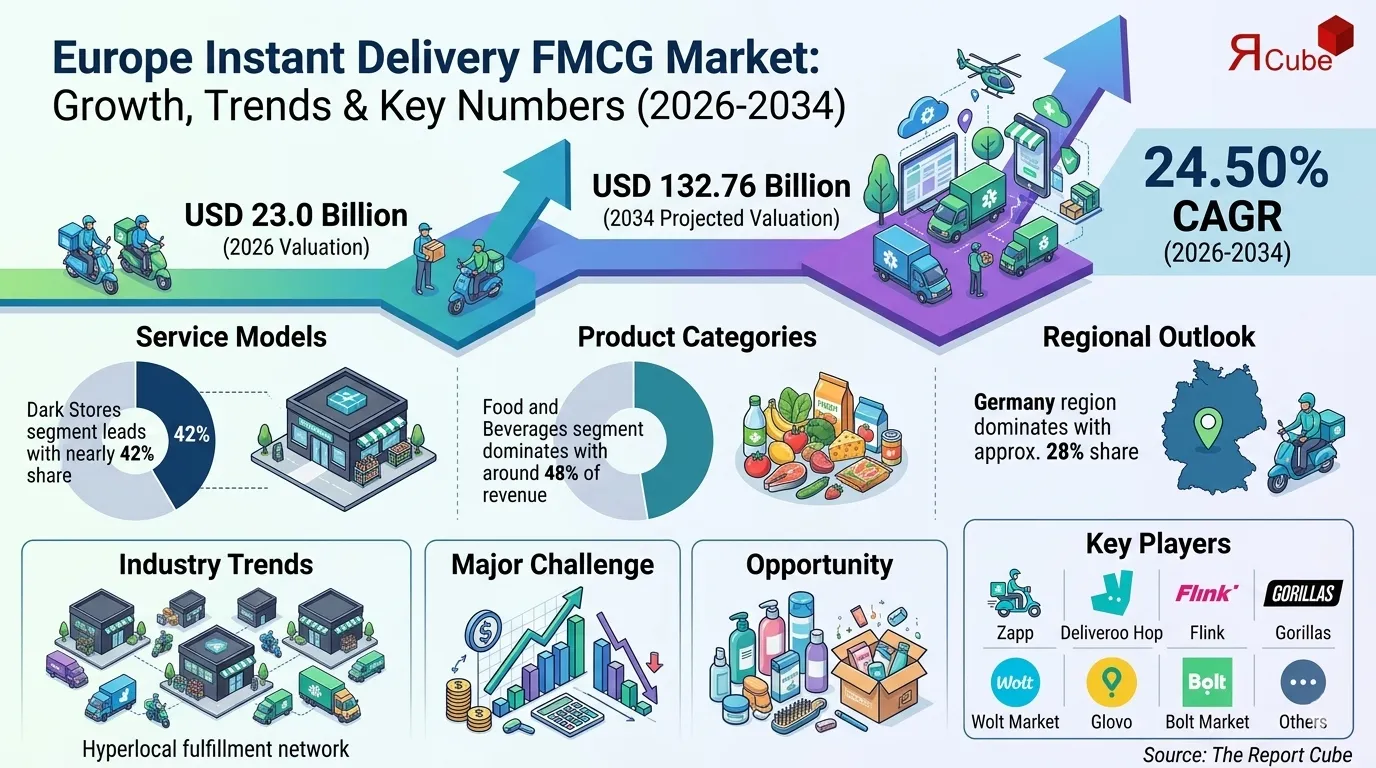
Instant Delivery from Dark Stores segment leads the market with nearly 42% share.
By Product Category:
Food and Beverages segment dominates the market with around 48% of revenue.
Regional Outlook:
Germany region dominates the Europe Instant Delivery FMCG Market with approximately 28% share.
Europe Instant Delivery FMCG Market Insights & Analysis
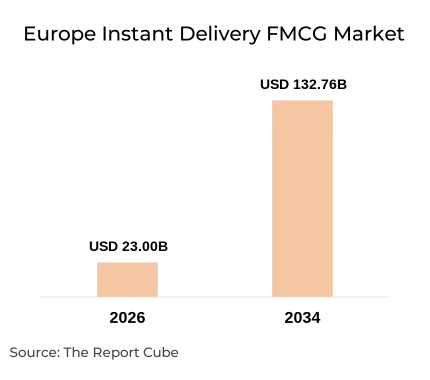
The Europe Instant Delivery FMCG Market is anticipated to register a CAGR of around 24.50% during the forecast period 2026-2034. The market size is valued at USD 23.0 billion in 2026 and is projected to reach USD 132.76 billion by 2034. The rapid expansion of this market is closely tied to changing urban lifestyles, where convenience, speed, and digital accessibility are shaping consumer purchasing behavior. Increasing smartphone penetration across Europe, which exceeded 82% in 2025, has created a strong foundation for app-based commerce, significantly boosting instant delivery FMCG market growth.
Investment activity across the region is also accelerating, with venture capital funding in quick commerce platforms increasing by over 35% between 2024 and 2026. Governments across Europe are supporting digital logistics infrastructure and urban mobility solutions, enabling efficient last-mile delivery networks. Additionally, companies are heavily investing in micro-fulfillment centers and AI-driven demand forecasting systems, which help reduce delivery time and improve inventory management. These innovations are enhancing operational efficiency and contributing to the steady increase in Europe instant delivery FMCG market size and revenue.
Europe Instant Delivery FMCG Market Dynamics
Key Driver: Rising Demand for Ultra-Fast Convenience and Urban Lifestyle Shifts
The growing demand for ultra-fast delivery services is a major driver of the Europe instant delivery FMCG market. Consumers in metropolitan areas increasingly prefer receiving essential goods within minutes rather than planning bulk purchases. Surveys conducted in 2025 indicate that nearly 64% of urban consumers in Europe prioritize delivery speed over price when purchasing daily essentials. This shift reflects evolving lifestyle patterns where time-saving services are becoming essential rather than optional.
Additionally, the rise of dual-income households and busy work schedules has further strengthened reliance on instant delivery platforms. Companies are responding by expanding their dark store networks and optimizing delivery routes. This trend is directly contributing to the expansion of instant delivery FMCG market share and strengthening customer retention through improved service reliability.
Book your FREE 30-minute expert consultation today
Contact UsIndustry Trends: Expansion of Dark Stores and Hyperlocal Fulfillment Networks
The Europe instant delivery FMCG market is witnessing a strong shift toward hyperlocal fulfillment through dark stores. By 2026, more than 15,000 micro-fulfillment centers are expected to be operational across Europe, allowing companies to reduce delivery times significantly. These facilities are strategically located in dense urban areas to ensure rapid dispatch and efficient order handling.
Another key trend is the integration of advanced analytics and real-time inventory tracking. Companies are leveraging predictive algorithms to anticipate demand spikes and optimize stock levels. This not only improves delivery speed but also reduces wastage. As a result, the market is experiencing consistent innovation, shaping new instant delivery FMCG market trends focused on efficiency and scalability.
Major Challenge: High Operational Costs and Profitability Pressure
One of the primary challenges in the Europe instant delivery FMCG market is the high cost associated with maintaining ultra-fast delivery services. Expenses related to warehouse operations, rider fleets, and logistics infrastructure significantly impact profit margins. Reports from 2025 suggest that last-mile delivery accounts for nearly 50% of total logistics costs in quick commerce operations.
Additionally, maintaining inventory accuracy across multiple micro-fulfillment centers requires advanced technology investments. These financial pressures make it difficult for smaller players to compete effectively. As competition intensifies, companies must balance cost efficiency with service quality, which continues to be a critical concern for long-term sustainability.
Opportunity: Expansion into Non-Food FMCG and Subscription-Based Models
The expansion of instant delivery services beyond groceries into non-food FMCG categories presents a significant growth opportunity. Categories such as personal care, pet products, and household essentials are gaining traction, with demand increasing by over 28% annually. This diversification helps companies increase basket value and customer engagement.
Subscription-based models are also emerging as a key opportunity, offering benefits such as free delivery and exclusive discounts. These models enhance customer loyalty and provide predictable revenue streams. As companies continue to innovate, these strategies are expected to further boost instant delivery FMCG market value and long-term growth potential.
Europe Instant Delivery FMCG Market Segment-wise Analysis
By Service Model:
- Instant Delivery from Dark Stores
- Instant Delivery from Partner Retailers
- Hybrid Instant Delivery Models
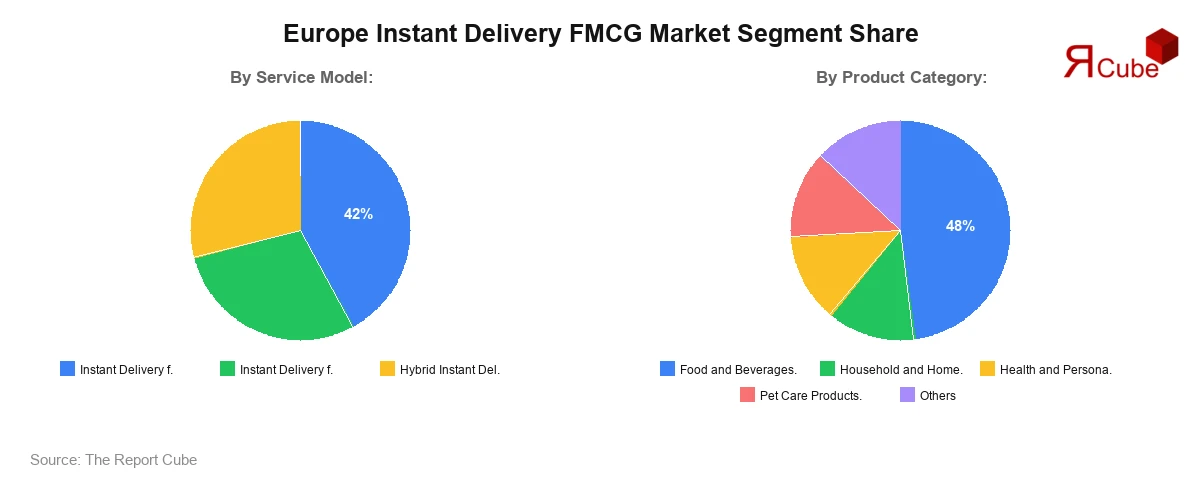
The instant delivery from dark stores segment holds a leading position with approximately 42% market share in 2026. This dominance is attributed to its ability to ensure faster delivery times and better inventory control compared to traditional retail partnerships. Dark stores are designed exclusively for online order fulfillment, allowing companies to streamline operations and reduce delivery time to under 30 minutes in most urban areas.
Furthermore, investments in automation and robotics within dark stores are enhancing operational efficiency. These facilities enable companies to maintain a wide range of SKUs while minimizing picking and packing time. As demand for rapid delivery continues to rise, the segment is expected to maintain its leadership in driving instant delivery FMCG market growth.
By Product Category:
- Food and Beverages
- Household and Home Care
- Health and Personal Care
- Pet Care Products
- Others
The food and beverages segment dominates the market with nearly 48% share, driven by high-frequency purchasing behavior. Consumers rely on instant delivery platforms for daily essentials such as fresh produce, dairy products, and ready-to-eat meals. This consistent demand ensures steady revenue generation for service providers.
In addition, the increasing availability of premium and organic food products through instant delivery platforms is attracting health-conscious consumers. Companies are also collaborating with local suppliers to ensure freshness and quality, further strengthening the segment’s position in the Europe instant delivery FMCG market.
Regional Projection of Europe Instant Delivery FMCG Industry
- The UK
- Germany
- The Netherlands
- France
- Spain
- Italy
- Rest of Europe
Germany leads the Europe instant delivery FMCG market with an estimated 28% share, supported by strong urban infrastructure and high digital adoption. Cities such as Berlin and Munich have become hubs for quick commerce innovation, with dense networks of dark stores and efficient logistics systems. Consumer adoption rates in Germany have surpassed 70% for app-based grocery delivery services, reflecting a mature market landscape.
Additionally, the presence of major market players and continuous investment in technology-driven logistics solutions are strengthening Germany’s position. The country’s focus on sustainable delivery practices, including electric vehicles and optimized routing, is also contributing to long-term growth and operational efficiency.
Need insights for a specific region within this market?
Request Regional DataGovernment Initiatives & Policies
- EU Urban Mobility Framework 2026: Supports sustainable last-mile logistics and encourages low-emission delivery systems.
- Germany Digital Logistics Initiative 2025: Promotes smart logistics infrastructure and digital supply chain innovations.
Europe Instant Delivery FMCG Industry Recent Developments
- 2026: Flink secured US$100 million funding led by Prosus to expand quick commerce hubs across Germany and the Netherlands, focusing on profitable dense urban areas and higher-value baskets.
- 2025: Wolt Market expanded its platform by adding over 3,000 non-food retail stores across Europe, strengthening its position as a comprehensive on-demand FMCG marketplace.
- 2025: Bolt Market partnered with El Corte Inglés to enhance grocery delivery services across Spain and Portugal, significantly improving FMCG availability in Iberian markets.
- 2025: Zapp introduced its Zapp+ subscription model and expanded premium brand partnerships in London, boosting customer retention and increasing average order value.
Why Choose This Report?
- Provides a comprehensive overview of the overall market analysis, encompassing key trends, consumer behavior analysis, and risk assessment to support strategic decision-making.
- Provides accurate, up-to-date insights into market size, segmentation, and emerging opportunities, helping to minimize risk & capitalizing on growth.
- Gives deep understanding of target audience preferences, investment habits, and communication channels for enhanced product development & marketing effectiveness.
- Delivers competitive analysis & benchmarking, uncovering the strengths & weaknesses of market competitors to guide strategies.
- Consolidate comprehensive market intelligence, reducing reasoning & streamlining research efforts.
- Facilitates customized market segmentation & risk mitigation strategies, fine-tuned to the business objectives.
- Aids in identifying both market challenges & untapped opportunities within the industry to drive long-term business growth.
- Provides valuable information based on actual customer data & search trends.
Table of Contents
- Introduction
- Objective of the Study
- Product and Category Definition
- Market Segmentation
- Study Variables
- Research Methodology
- Secondary Data Points
- Breakdown of Secondary Sources
- Primary Data Points
- Breakdown of Primary Interviews
- Secondary Data Points
- Executive Summary
- Market Dynamics
- Drivers
- Challenges
- Opportunity Assessment
- Recent Trends and Developments
- Regulatory and Policy Landscape
- Europe Instant Delivery FMCG Market Overview (2021-2034)
- Market Size, By Value (USD Billion)
- Market Share, By Service Model
- Instant Delivery from Dark Stores
- Instant Delivery from Partner Retailers
- Hybrid Instant Delivery Models
- Market Share, By Product Category
- Food and Beverages
- Household and Home Care
- Health and Personal Care
- Pet Care Products
- Others
- Market Share, By Order Platform
- Mobile Applications
- Web Portals
- Market Share, By Delivery Time Promise
- Under 15 Minutes
- 15-30 Minutes
- 30-60 Minutes
- Market Share, By Customer Type
- Individual Consumers
- Small Offices and Businesses
- Market Share, By Country
- The UK
- Germany
- The Netherlands
- France
- Spain
- Italy
- Rest of Europe
- Market Share, By Company
- Revenue Shares and Analysis
- Competitive Landscape
- The UK Instant Delivery FMCG Market
- Market Size, By Value (USD Billion/Million)
- Market Share, By Service Model
- Market Share, By Product Category
- Market Share, By Order Platform
- Market Share, By Delivery Time Promise
- Market Share, By Customer Type
- Germany Instant Delivery FMCG Market
- Market Size, By Value (USD Billion/Million)
- Market Share, By Service Model
- Market Share, By Product Category
- Market Share, By Order Platform
- Market Share, By Delivery Time Promise
- Market Share, By Customer Type
- The Netherlands Instant Delivery FMCG Market
- Market Size, By Value (USD Billion/Million)
- Market Share, By Service Model
- Market Share, By Product Category
- Market Share, By Order Platform
- Market Share, By Delivery Time Promise
- Market Share, By Customer Type
- France Instant Delivery FMCG Market
- Market Size, By Value (USD Billion/Million)
- Market Share, By Service Model
- Market Share, By Product Category
- Market Share, By Order Platform
- Market Share, By Delivery Time Promise
- Market Share, By Customer Type
- Spain Instant Delivery FMCG Market
- Market Size, By Value (USD Billion/Million)
- Market Share, By Service Model
- Market Share, By Product Category
- Market Share, By Order Platform
- Market Share, By Delivery Time Promise
- Market Share, By Customer Type
- Italy Instant Delivery FMCG Market
- Market Size, By Value (USD Billion/Million)
- Market Share, By Service Model
- Market Share, By Product Category
- Market Share, By Order Platform
- Market Share, By Delivery Time Promise
- Market Share, By Customer Type
- Competitive Outlook and Company Profiles
- Zapp
- Company Overview
- Product Portfolio
- Strategic Alliances/Partnerships
- Recent Developments
- Deliveroo Hop
- Company Overview
- Product Portfolio
- Strategic Alliances/Partnerships
- Recent Developments
- Flink
- Company Overview
- Product Portfolio
- Strategic Alliances/Partnerships
- Recent Developments
- Gorillas
- Company Overview
- Product Portfolio
- Strategic Alliances/Partnerships
- Recent Developments
- Wolt Market
- Company Overview
- Product Portfolio
- Strategic Alliances/Partnerships
- Recent Developments
- Glovo
- Company Overview
- Product Portfolio
- Strategic Alliances/Partnerships
- Recent Developments
- Bolt Market
- Company Overview
- Product Portfolio
- Strategic Alliances/Partnerships
- Recent Developments
- Others
- Zapp
- Contact Us and Disclaimer
Top Key Players & Market Share Outlook
- Zapp
- Deliveroo Hop
- Flink
- Gorillas
- Wolt Market
- Glovo
- Bolt Market
- Others
Frequently Asked Questions






