



Build Your Custom Market Intelligence Report
Customize Your ReportSouth Korea Integrated Telecom Infrastructure Market Key Takeaways
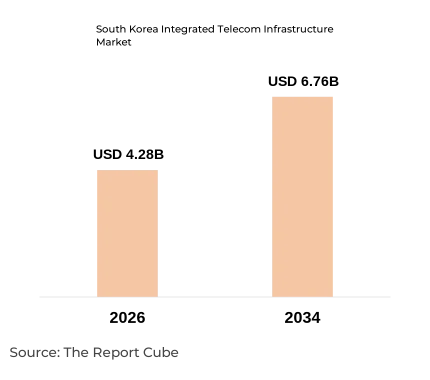
- South Korea Integrated Telecom Infrastructure Market valued USD 4.28 billion during 2026.
- Market projected reaching USD 6.76 billion by 2034 steadily.
- South Korea Integrated Telecom Infrastructure Market anticipated registering 6.00% CAGR through forecast period.
- Telecommunication Service Providers segment dominates revenue contribution across end-user categories.
- Networking Equipment segment maintains strongest market share across component segments.
- Seoul Capital Region leads market expansion supported by advanced digital infrastructure.
- Major companies include Huawei, Nokia, Ericsson, Samsung, and Cisco.
- AI-enabled network optimization increasingly transforms telecom infrastructure management nationwide.
South Korea Integrated Telecom Infrastructure Market Insights & Analysis
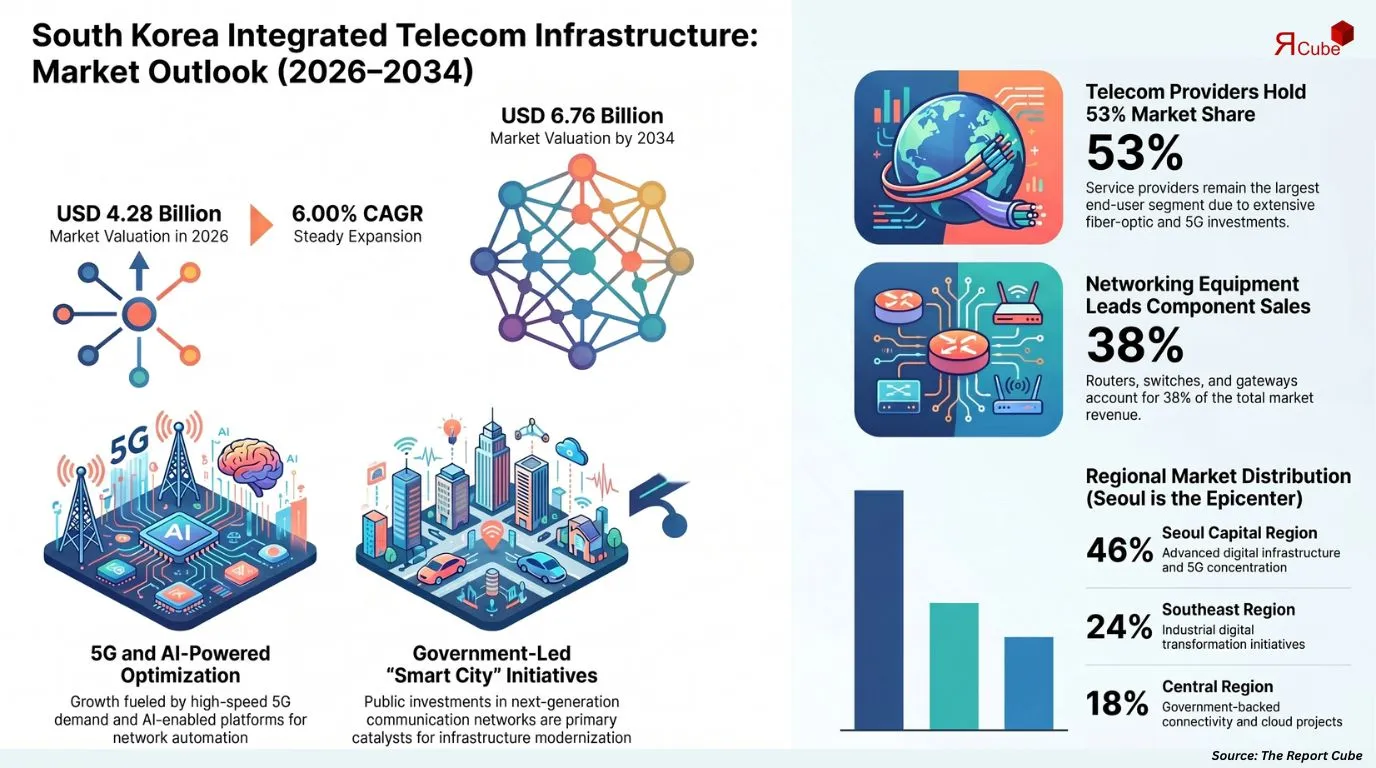
The South Korea Integrated Telecom Infrastructure Market is anticipated to register a 6.00% CAGR during 2026-2034. The market size was valued at USD 4.28 billion in 2026 and is projected to reach USD 6.76 billion by 2034. The increasing deployment of 5G networks, growing demand for high-speed connectivity, and rising adoption of digital transformation initiatives are significantly driving the South Korea Integrated Telecom Infrastructure Market. Government investments in next-generation communication networks, smart city projects, and nationwide digital infrastructure modernization continue supporting the expansion of advanced telecom systems.
Furthermore, increasing investments in cloud computing, edge data centers, and intelligent networking solutions are accelerating market growth. Telecom operators and enterprises are implementing integrated infrastructure platforms to improve network performance, enhance scalability, and support growing data traffic requirements. These developments are expected to contribute significantly to market expansion throughout the forecast period.
South Korea Integrated Telecom Infrastructure Market Dynamics
|
Factor |
Type |
Specific Impact on Market |
Magnitude |
|---|---|---|---|
|
5G network expansion |
Driver |
Increased telecom infrastructure deployment |
High |
|
Smart city development |
Opportunity |
Greater networking equipment demand |
High |
|
Network integration complexity |
Challenge |
Infrastructure deployment delays |
Moderate |
|
AI-powered network management |
Trend |
Improved operational efficiency |
High |
|
Rising data consumption |
Driver |
Higher communication capacity requirements |
High |
Key Market Driver: Accelerating 5G Infrastructure Expansion
The rapid deployment of 5G networks across South Korea is significantly driving demand for integrated telecom infrastructure solutions. Telecom operators are investing heavily in transmission systems, networking equipment, and advanced communication technologies to support higher bandwidth requirements, ultra-low latency services, and increasing data traffic volumes.
Additionally, rising adoption of connected devices and digital services continues strengthening demand for robust communication infrastructure. These developments are expected to support long-term market growth and network modernization initiatives.
Major Industry Challenge: Managing Complex Network Integration
Integrating advanced telecom technologies with existing communication infrastructure remains a major challenge for service providers and enterprises. Organizations must ensure interoperability across diverse networking platforms, equipment standards, and communication protocols while maintaining service reliability and performance.
Furthermore, increasing network complexity requires continuous infrastructure upgrades and technical expertise. Industry participants continue investing in intelligent network management solutions to address integration challenges effectively.
Emerging Trend Shaping Outlook: Intelligent Network Automation Solutions
The integration of artificial intelligence, machine learning, and advanced analytics is transforming telecom infrastructure operations across South Korea. Telecom providers increasingly deploy AI-powered platforms to optimize network performance, automate maintenance activities, and improve service quality through predictive analytics.
The South Korea Integrated Telecom Infrastructure Market is benefiting from investments in software-defined networking, intelligent traffic management systems, and cloud-based telecom platforms. These innovations are expected to create substantial growth opportunities while enhancing network efficiency through 2034.
Need Specific Data, Let’s Customize the Report for You
Request CustomizationSouth Korea Integrated Telecom Infrastructure Market Segment-wise Analysis
The South Korea Integrated Telecom Infrastructure Market is witnessing consistent growth across end-user categories and component segments due to increasing demand for advanced connectivity solutions. Growing investments in digital infrastructure, smart technologies, and communication network expansion continue supporting revenue generation across major market segments.
The market is also benefiting from rising enterprise digitalization, industrial connectivity requirements, and adoption of next-generation communication technologies. Continuous innovation in networking systems is expected to strengthen market penetration throughout the forecast period.
By End Users
- Telecommunication Service Providers
- Government
- Enterprise
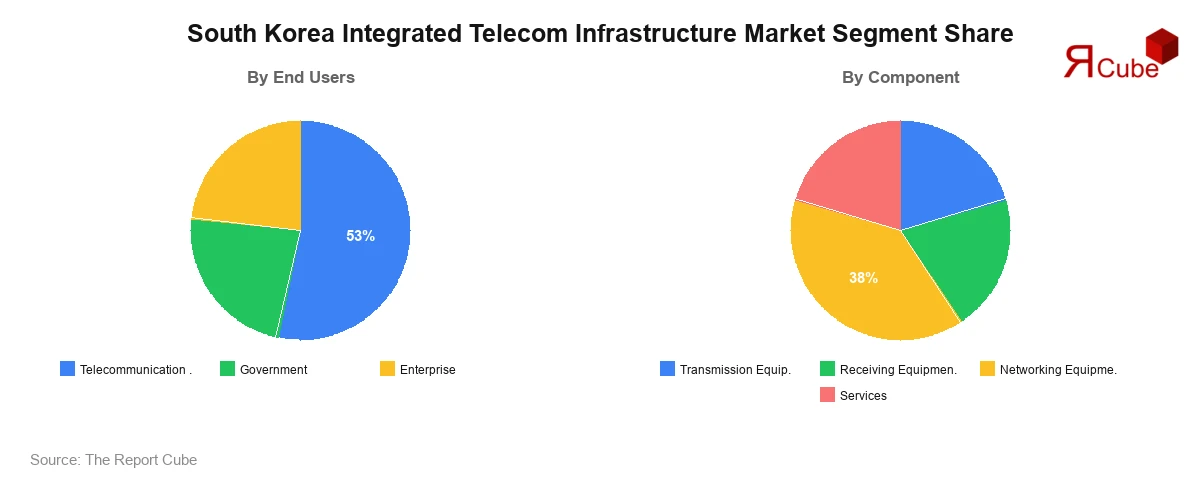
Telecommunication Service Providers dominate the market with approximately 53% market share in 2026 owing to extensive investments in 5G deployment, fiber-optic infrastructure, and network modernization projects. Service providers continue expanding communication capabilities to accommodate rising data consumption and next-generation connectivity requirements across South Korea.
Enterprise accounts for nearly 29% market share during 2026 due to increasing adoption of digital transformation initiatives and cloud-based communication solutions. Government organizations continue witnessing notable growth through smart city projects and digital infrastructure development programs.
By Component
- Transmission Equipment
- Receiving Equipment
- Networking Equipment
- Services
Networking Equipment dominates the market with approximately 38% market share in 2026 owing to growing demand for routers, switches, gateways, and network management solutions supporting advanced communication systems. Telecom operators and enterprises increasingly invest in networking infrastructure to enhance connectivity, reliability, and network scalability.
Transmission Equipment accounts for nearly 27% market share during 2026 due to increasing deployment of high-capacity communication networks. Receiving Equipment and Services continue witnessing strong growth through network expansion and maintenance requirements.
Regional Projection of South Korea Integrated Telecom Infrastructure Market
The regional landscape of the South Korea Integrated Telecom Infrastructure Market reflects varying levels of digital infrastructure development, technology adoption, and communication network investments. Regions with advanced urban infrastructure and strong technology ecosystems continue generating substantial demand for telecom solutions.
Growing investments in smart city initiatives, digital transformation programs, and next-generation communication infrastructure are creating significant opportunities across South Korea. Increasing demand for high-speed connectivity and intelligent networking solutions continues supporting regional market growth throughout the forecast period.
- Seoul Capital Region
- Southeast Region
- Central Region
- Southwest Region
Seoul Capital Region dominates the South Korea Integrated Telecom Infrastructure Market with approximately 46% market share in 2026 due to its concentration of telecom operators, technology companies, and advanced digital infrastructure projects. The region benefits from extensive 5G deployment, smart city development, and strong enterprise technology adoption.
The Southeast Region is witnessing substantial growth supported by industrial digitalization and communication infrastructure investments. The Central Region continues benefiting from government-backed connectivity programs, while the Southwest Region is experiencing steady growth through expanding broadband and networking initiatives.
|
Region |
Estimated Market Share |
Key Growth Factors |
Consumer Trends |
|---|---|---|---|
|
Seoul Capital Region |
46% |
Advanced digital infrastructure |
High-speed connectivity demand |
|
Southeast Region |
24% |
Industrial digital transformation |
Smart networking adoption |
|
Central Region |
18% |
Government infrastructure projects |
Cloud communication utilization |
|
Southwest Region |
12% |
Broadband expansion initiatives |
Connected service adoption |
South Korea Integrated Telecom Infrastructure Market: Recent Development (2025)
- 2025: Samsung expanded next-generation telecom infrastructure solutions by enhancing 5G network capabilities, strengthening intelligent connectivity platforms, and supporting nationwide digital transformation initiatives across South Korea.
- 2025: Ericsson increased investment in advanced network automation technologies through AI-powered management systems, improved telecom efficiency solutions, and expanded partnerships with communication service providers.
- 2025: Nokia strengthened integrated telecom offerings by advancing cloud-native networking platforms, enhancing transmission technologies, and supporting scalable communication infrastructure deployments nationwide.
- 2025: Cisco expanded intelligent networking solutions through advanced infrastructure management platforms, improved cybersecurity integration capabilities, and enhanced support for enterprise digital connectivity requirements.
South Korea Integrated Telecom Infrastructure Market Future Outlook (2034)
The South Korea Integrated Telecom Infrastructure Market is projected to reach USD 6.76 billion by 2034 while registering a CAGR of 6.00% during the forecast period. Increasing demand for high-speed connectivity, expansion of 5G networks, and rising adoption of digital transformation initiatives are expected to drive substantial market growth over the coming years.
Technological advancements in artificial intelligence, software-defined networking, edge computing, cloud-native telecom platforms, and intelligent communication systems are expected to transform the industry landscape. Expansion of smart city projects, industrial IoT networks, advanced broadband infrastructure, and next-generation communication services will likely create significant growth opportunities. Continued investment in telecom innovation is anticipated to strengthen market competitiveness through 2034.
South Korea Integrated Telecom Infrastructure Market Report Coverage
|
Report Attribute |
Details |
|---|---|
|
Market Size Value (2026) |
USD 4.28 billion |
|
Market Size Value (2034) |
USD 6.76 billion |
|
Forecast Period |
2026-2034 |
|
CAGR |
6.00% |
|
Customization |
Available |
|
Segments Covered |
By End Users, By Component, By Technology, By Deployment Type |
|
Regions Covered |
Seoul Capital Region, Southeast Region, Central Region, Southwest Region |
|
Key Companies |
Huawei, Nokia, Ericsson, Cisco, ZTE, Samsung, Alcatel-Lucent, Juniper Networks, Ciena, Others |
|
Report Format |
PDF, Excel, PPT |
Why Choose This Report?
- Comprehensive assessment of South Korea integrated telecom infrastructure market trends and opportunities.
- Detailed analysis of end-user and component segment performance.
- Strategic evaluation of 5G deployment and digital infrastructure developments.
- Regional insights highlighting telecom network expansion and technology adoption trends.
- Competitive profiling of leading telecom infrastructure technology providers and vendors.
- Future-focused forecasts supported by AI-driven networking and communication advancements.
Table of Contents
- Introduction
- Objective of the study
- Product Definition
- Market Segmentation
- Study Variables
- Research Methodology
- Secondary Data Points
- Companies Interviewed
- Primary Data Points
- Breakdown of Primary Interviews
- Secondary Data Points
- Executive Summary
- Market Dynamics
- Drivers
- Challenges
- Opportunity Assessment
- Recent Trends and Developments
- Policy and Regulatory Landscape
- South Korea Integrated Telecom Infrastructure Market Overview and Forecast Analysis (2021-2034)
- Market Size, By Value, By growth rate (CAGR/USD Billions)
- Demand - Supply Trends
- Market Share, By End Users
- Telecommunication Service Providers
- Government
- Enterprise
- Market Share, By Component
- Transmission Equipment
- Receiving Equipment
- Networking Equipment
- Services
- Market Share, By Technology
- Fiber Optic Technology
- Wireless Communication Technology
- Satellite Communication Technology
- Internet Protocol Technology
- Market Share, By Deployment Type
- On-Premises
- Cloud-Based
- Market Share, By Region
- Seoul Capital Region
- Southeast Region
- Central Region
- Southwest Region
- Market Share, By Competitors
- Competition Characteristics
- Revenue Shares
- South Korea Telecommunication Service Providers Integrated Telecom Infrastructure Market Overview, 2021-2034F
- By Value (USD Million)
- By Component - Market Size & Forecast 2021-2034, USD Million
- By Technology - Market Size & Forecast 2021-2034, USD Million
- By Deployment Type- Market Size & Forecast 2021-2034, USD Million
- South Korea Government Integrated Telecom Infrastructure Market Overview, 2021-2034F
- By Value (USD Million)
- By Component - Market Size & Forecast 2021-2034, USD Million
- By Technology - Market Size & Forecast 2021-2034, USD Million
- By Deployment Type- Market Size & Forecast 2021-2034, USD Million
- South Korea Enterprise Integrated Telecom Infrastructure Market Overview, 2021-2034F
- By Value (USD Million)
- By Component - Market Size & Forecast 2021-2034, USD Million
- By Technology - Market Size & Forecast 2021-2034, USD Million
- By Deployment Type- Market Size & Forecast 2021-2034, USD Million
- Competitive Outlook (Company Profile - Partial List)
- Huawei
- Company Overview
- Business Segments
- Strategic Alliances/Partnerships
- Recent Developments
- Nokia
- Company Overview
- Business Segments
- Strategic Alliances/Partnerships
- Recent Developments
- Ericsson
- Company Overview
- Business Segments
- Strategic Alliances/Partnerships
- Recent Developments
- Cisco
- Company Overview
- Business Segments
- Strategic Alliances/Partnerships
- Recent Developments
- ZTE
- Company Overview
- Business Segments
- Strategic Alliances/Partnerships
- Recent Developments
- Samsung
- Company Overview
- Business Segments
- Strategic Alliances/Partnerships
- Recent Developments
- Alcatel-Lucent
- Company Overview
- Business Segments
- Strategic Alliances/Partnerships
- Recent Developments
- Juniper Networks
- Company Overview
- Business Segments
- Strategic Alliances/Partnerships
- Recent Developments
- Ciena
- Company Overview
- Business Segments
- Strategic Alliances/Partnerships
- Recent Developments
- Others
- Huawei
- Contact Us & Disclaimer
Top Key Players & Market Share Outlook
- Huawei
- Nokia
- Ericsson
- Cisco
- ZTE
- Samsung
- Alcatel-Lucent
- Juniper Networks
- Ciena
- Others
Frequently Asked Questions






