



Build Your Custom Market Intelligence Report
Customize Your ReportAsia Pacific Intelligent Building Automation Technologies Market Key Highlights
By Offering:
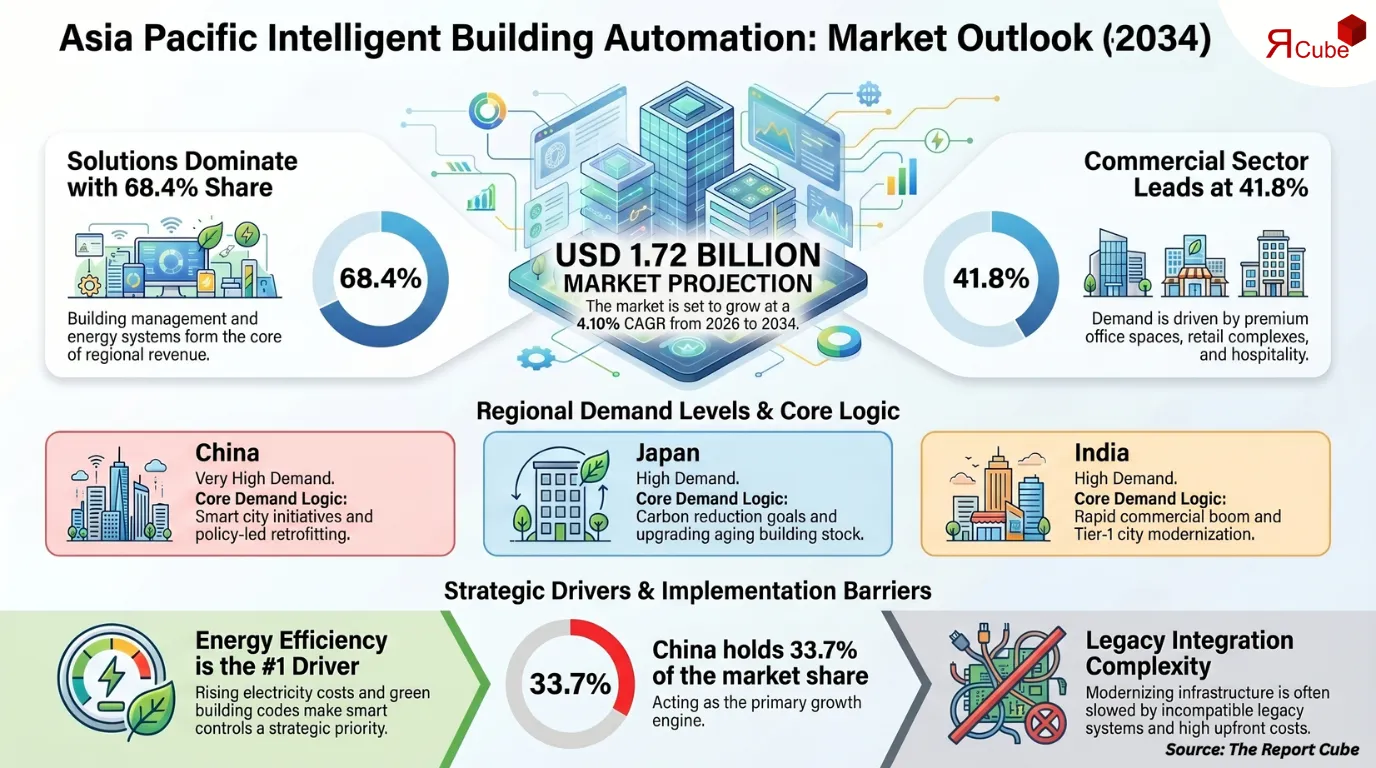
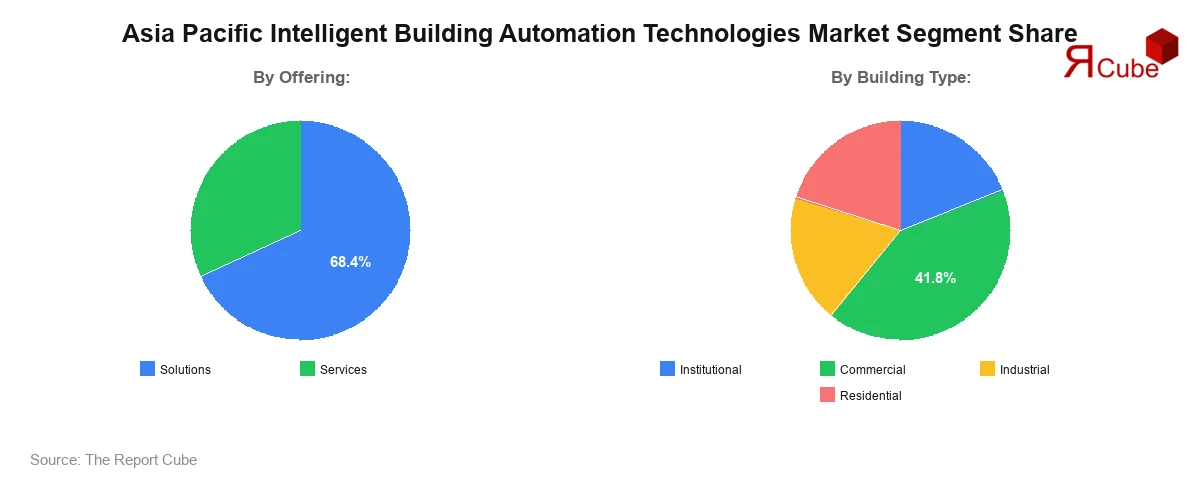
Solutions segment leads the market with approximately 68.4% share.
By Building Type:
Commercial segment dominates the market with nearly 41.8% of revenue.
Regional Outlook:
China dominates the Asia Pacific Intelligent Building Automation Technologies Market with around 33.7% share.
Asia Pacific Intelligent Building Automation Technologies Market Insights & Analysis
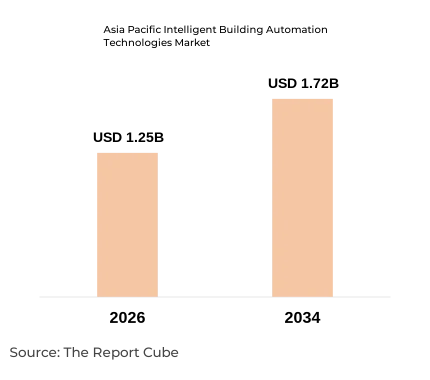
The Asia Pacific Intelligent Building Automation Technologies Market is anticipated to register a CAGR of around 4.10% during the forecast period 2026-2034. The market size is valued at USD 1.25 billion in 2026 and is projected to reach USD 1.72 billion by 2034. Market expansion is being supported by increasing investment in smart commercial infrastructure, digital building operations, and energy-efficient facility management across Asia Pacific. Governments throughout China, Singapore, South Korea, Japan, and India are strengthening building efficiency frameworks and encouraging the deployment of intelligent technologies that help reduce energy consumption and carbon emissions. Building owners are increasingly integrating energy management systems, building management platforms, intelligent lighting controls, and connected HVAC solutions to improve operational performance while meeting sustainability objectives.
Technology providers are continuously enhancing automation platforms through cloud connectivity, IoT-enabled devices, and advanced analytics capabilities. The growing construction of premium office spaces, airports, healthcare facilities, educational campuses, industrial parks, and data centers is creating sustained demand for integrated building automation solutions. Companies such as Siemens, Schneider Electric, Honeywell, Daikin, ABB, and Johnson Controls are expanding their regional presence through scalable software platforms and intelligent control systems. The increasing requirement for real-time monitoring, predictive maintenance, and centralized facility management is encouraging organizations to modernize building infrastructure, supporting long-term market growth across the region.
Asia Pacific Intelligent Building Automation Technologies Market Impact Analysis
| Factor | Type | Specific Impact on Market | Magnitude | Business Implication |
|---|---|---|---|---|
| Energy Efficiency and Sustainability | Market | Green building codes push demand for smart energy controls | High | Vendors gain from solutions that optimize energy usage |
| Rapid Urbanization and Infrastructure | Market | New commercial towers adopt integrated automation platforms | High | Drives large projects for complete building system upgrades |
| Advances in IoT and Cloud | Technological | Connected sensors enable centralized monitoring and analytics | High | Creates demand for scalable cloud based control architectures |
| Regulatory Standards and Compliance | Regulatory | Regional policies require efficient building operations tracking | Medium | Spurs adoption of compliant automation and reporting tools |
| High Initial Deployment Costs | Environmental | Upfront investment slows uptake among smaller properties | Medium | Encourages phased projects and innovative financing models |
| Growing Focus on Occupant Experience | Consumer | Smart environments improve comfort, safety and productivity | Medium | Supports premium pricing for advanced automation features |
| Competitive Entry of Global Players | Competitive | International firms intensify rivalry with local integrators | High | Requires differentiation through services and domain expertise |
Asia Pacific Intelligent Building Automation Technologies Market Dynamics
Key Driver: Rising Demand for Energy-Efficient Building Operations
Energy efficiency has become a strategic priority for building owners and facility operators across Asia Pacific as electricity costs continue to rise and sustainability targets become more stringent. Intelligent building automation technologies enable continuous monitoring and optimization of lighting, HVAC systems, energy consumption, and occupancy levels, helping organizations reduce operational expenditures while maintaining occupant comfort. Commercial property developers are increasingly incorporating automation systems during both new construction and renovation projects to improve long-term building performance.
The shift toward green building certification programs and carbon-reduction commitments is further accelerating technology adoption. Intelligent controls help facilities identify inefficiencies, automate energy-intensive processes, and improve resource utilization. Large enterprises, healthcare institutions, airports, universities, and retail complexes are increasingly investing in integrated building management systems to support environmental goals while achieving measurable cost savings. These factors continue to strengthen demand for intelligent building automation technologies throughout Asia Pacific.
Industry Trends: Expansion of Connected and Cloud-Based Building Platforms
Building automation strategies across Asia Pacific are increasingly shifting from standalone systems toward connected digital ecosystems capable of managing multiple building functions from a unified platform. Cloud-based building management solutions are gaining traction because they provide greater flexibility, remote accessibility, and centralized operational oversight. Facility managers can now monitor energy usage, occupancy patterns, indoor environmental conditions, and equipment performance through a single interface, improving decision-making and operational responsiveness.
Market participants are also integrating predictive maintenance capabilities into automation platforms to improve asset reliability and reduce downtime. IoT sensors deployed across building infrastructure generate continuous operational data that can be analyzed to identify performance deviations before failures occur. This approach is particularly valuable for large commercial properties, healthcare facilities, manufacturing sites, and data centers where uninterrupted operations are critical. The growing adoption of data-driven building management practices is becoming a defining trend across the regional market.
Book your FREE 30-minute expert consultation today
Contact UsMajor Challenge: Integration Complexity Across Existing Building Infrastructure
Although intelligent building automation technologies offer substantial operational benefits, implementation challenges remain significant across many Asia Pacific markets. Existing buildings often contain multiple legacy systems that were installed independently over time and may not support seamless communication with modern automation platforms. Integrating HVAC systems, lighting controls, security infrastructure, fire safety solutions, and energy management software into a unified ecosystem frequently requires extensive technical expertise and additional investment.
Budget constraints also influence purchasing decisions, particularly among small and mid-sized building owners. Initial expenditures associated with software deployment, hardware upgrades, system integration, network modernization, and employee training can extend project timelines and affect return-on-investment expectations. As a result, many organizations adopt building automation technologies in phases, prioritizing high-impact applications before expanding deployment across broader facility operations.
Opportunity: Smart Cities and Digital Infrastructure Development
Large-scale urban modernization programs across Asia Pacific are creating substantial growth opportunities for intelligent building automation technology providers. Governments continue to invest in smart city frameworks that prioritize sustainability, energy efficiency, public safety, and digital connectivity. These initiatives require advanced building management systems capable of supporting intelligent infrastructure through automated monitoring, control, and optimization functions.
Strong growth in regional data center construction is creating an additional avenue for market expansion. Data center operators increasingly require advanced cooling management, energy optimization, environmental monitoring, and predictive maintenance solutions to support high-density computing environments. As digital transformation accelerates across industries, intelligent building automation technologies are becoming essential for maintaining operational efficiency, reliability, and sustainability within next-generation infrastructure projects.
Asia Pacific Intelligent Building Automation Technologies Market Segment-wise Analysis
By Offering:
- Solutions
- Energy Management Systems (EMS)
- Building Management Systems (BMS/BAS)
- Lighting & HVAC Automation Systems
- Security & Access Control Systems
- Fire & Life Safety Systems
- Services
- System Integration & Deployment
- Maintenance & Managed Services
- Consulting & Design
The Solutions segment is expected to maintain its leading position within the Asia Pacific Intelligent Building Automation Technologies Market, accounting for approximately 68.4% of total revenue during the forecast period. Organizations continue to prioritize investments in building management systems, energy management platforms, intelligent HVAC controls, security automation solutions, and fire safety technologies that deliver measurable operational improvements. These systems serve as the foundation of modern smart buildings by enabling centralized visibility across critical facility functions.
Demand remains particularly strong among commercial office developments, healthcare facilities, airports, educational institutions, industrial facilities, and mixed-use infrastructure projects. Organizations increasingly recognize that integrated automation platforms provide long-term value through lower energy consumption, improved asset performance, enhanced occupant comfort, and more efficient facility management. Continued innovation in cloud connectivity and analytics capabilities is expected to further reinforce the segment's market leadership.
By Building Type:
- Institutional
- Commercial
- Industrial
- Residential
The Commercial segment is projected to account for the largest share of the Asia Pacific Intelligent Building Automation Technologies Market, representing nearly 41.8% of total market revenue. Commercial properties face increasing pressure to improve operational efficiency, reduce utility expenses, and meet sustainability requirements while delivering high-quality occupant experiences. Intelligent automation technologies provide building operators with actionable insights that support energy optimization, security management, space utilization, and preventive maintenance initiatives.
Rapid growth in commercial real estate development across major urban centers in China, India, Japan, Singapore, and Southeast Asia continues to support segment expansion. Premium office buildings, retail complexes, hospitality facilities, and mixed-use developments are increasingly integrating automation technologies during the design phase to improve long-term building performance. The growing focus on smart workplaces and sustainable commercial infrastructure is expected to sustain demand throughout the forecast horizon.
Regional Projection of Asia Pacific Intelligent Building Automation Technologies Industry
- China
- Japan
- India
- South Korea
- Malaysia
- Thailand
- Indonesia
- Vietnam
- Philippines
- Rest of Asia-Pacific
China is expected to retain its position as the leading market for intelligent building automation technologies in Asia Pacific, accounting for approximately 33.7% of regional revenue. The country's dominance is supported by extensive urban development projects, strong investment in smart infrastructure, and widespread adoption of digital building technologies across commercial and industrial sectors. National objectives focused on energy efficiency and carbon reduction are encouraging organizations to deploy advanced automation solutions that optimize building performance and reduce resource consumption.
Major metropolitan regions including Beijing, Shanghai, Shenzhen, Guangzhou, and Chengdu continue to witness significant deployment of smart building technologies across office developments, transportation hubs, industrial parks, healthcare facilities, and mixed-use projects. Strong domestic technology capabilities, expanding cloud infrastructure, and ongoing smart city investments further strengthen market growth prospects. As building owners increasingly prioritize operational intelligence and sustainability, China is expected to remain the primary growth engine for the regional market through 2034.
Need insights for a specific region within this market?
Request Regional DataAsia Pacific Intelligent Building Automation Technologies Market - Countries Analysis
The Asia Pacific IBAT market is expanding rapidly, driven by smart cities, energy rules, and post‑pandemic digitalization across key economies in the region.
| Country | Demand Level | Key Areas | System Dominance | Core Demand Logic | Growth Nature |
|---|---|---|---|---|---|
| China | Very High | Tier‑1 cities & new zones | Integrated BAS & IoT | Smart cities and retrofit drives | Scale‑driven, policy‑led |
| Japan | High | Tokyo, Osaka, Nagoya | Energy‑efficient BAS | Carbon goals and aging stock | Upgrades and regulation‑led |
| India | High | Tier‑1 and Tier‑2 cities | Scalable open BAS | Commercial boom and smart cities | Fast, broad‑based adoption |
| South Korea | High | Seoul, Busan, Incheon | AI‑enabled building IoT | Tech‑heavy real estate demand | Innovation‑driven upgrades |
| Malaysia | Medium | Klang Valley, Penang, Johor | Integrated HVAC‑lighting BAS | Green offices and data centers | Steady, project‑linked |
| Thailand | Medium | Bangkok and tourist hubs | Hospitality‑centric BAS | Hotels and malls seek savings | Tourism‑linked expansion |
| Indonesia | Medium | Jakarta, Surabaya, Batam | Modular, cloud BAS | New towers and smart townships | Catch‑up, high upside |
| Vietnam | Medium | Hanoi, Ho Chi Minh City | Cost‑optimized BAS | FDI parks and Grade‑A offices | Manufacturing‑led surge |
| Philippines | Medium | Metro Manila, Cebu, Clark | BPO‑oriented BAS | BPO offices and malls demand | Service‑sector‑driven |
Government Initiatives & Policies
- Singapore Green Mark 2025: Singapore's Building and Construction Authority continues expanding Green Mark certification requirements to improve building energy efficiency, digital building management, and sustainability performance.
- India Smart Cities Mission Progress Program 2025: The Ministry of Housing and Urban Affairs continues supporting technology-enabled urban infrastructure, integrated command centers, and smart building ecosystems across participating cities.
Asia Pacific Intelligent Building Automation Technologies Industry Recent Developments
- 2026: Daikin Industries, Ltd. launched a new range of IoT-enabled inverter rooftop air-conditioning units for overseas commercial markets. The systems provide remote monitoring, centralized control, and seamless integration with building management systems, supporting energy optimization, predictive maintenance, and intelligent facility operations across commercial and industrial buildings.
- 2025: Johnson Controls International plc introduced its Silent-Aire Coolant Distribution Unit platform for Asia-Pacific data centers. The solution delivers scalable thermal management capabilities and can reduce non-IT energy consumption by up to 50%, strengthening intelligent automation adoption within mission-critical facilities.
- 2025: Siemens AG expanded deployment of its Building X platform across ASEAN markets. The cloud-based solution centralizes energy, occupancy, and operational data, enabling predictive maintenance and potentially delivering energy savings of up to 30% while supporting sustainable building operations.
Why Choose This Report?
- Provides a comprehensive overview of the overall market analysis, encompassing key trends, consumer behavior analysis, and risk assessment to support strategic decision-making.
- Provides accurate, up-to-date insights into market size, segmentation, and emerging opportunities, helping to minimize risk & capitalizing on growth.
- Gives deep understanding of target audience preferences, investment habits, and communication channels for enhanced product development & marketing effectiveness.
- Delivers competitive analysis & benchmarking, uncovering the strengths & weaknesses of market competitors to guide strategies.
- Consolidate comprehensive market intelligence, reducing reasoning & streamlining research efforts.
- Facilitates customized market segmentation & risk mitigation strategies, fine-tuned to the business objectives.
- Aids in identifying both market challenges & untapped opportunities within the industry to drive long-term business growth.
- Provides valuable information based on actual customer data & search trends.
Table of Contents
- Introduction
- Objective of the Study
- Product and Category Definition
- Market Segmentation
- Study Variables
- Research Methodology
- Secondary Data Points
- Breakdown of Secondary Sources
- Primary Data Points
- Breakdown of Primary Interviews
- Secondary Data Points
- Executive Summary
- Market Dynamics
- Emerging Opportunities
- Adoption Trends
- Demand Drivers
- Disruption Analysis (Challenges)
- Industry Analysis & Strategic Insights
- Supply/Value Chain Analysis
- Pricing Analysis
- Go-To-Market (GTM) Strategy
- BCG Matrix
- Recent Trends and Developments
- Regulatory and Policy Landscape
- Country-wise Policies
- Government Initiatives
- Asia Pacific Intelligent Building Automation Technologies Market Overview and Forecast Analysis (2021-2034)
- Market Size, By Value, By Growth Rate (CAGR/USD Billion)
- Market Share, By Offering
- Solutions
- Energy Management Systems (EMS)
- Building Management Systems (BMS/BAS)
- Lighting & HVAC Automation Systems
- Security & Access Control Systems
- Fire & Life Safety Systems
- Services
- System Integration & Deployment
- Maintenance & Managed Services
- Consulting & Design
- Solutions
- Market Share, By Application
- Predictive Maintenance
- Energy Optimization
- Facility & Asset Management
- Space & Occupancy Management
- Security & Surveillance
- Indoor Environmental Quality Monitoring
- Life Safety Management
- Others
- Market Share, By Building Type
- Institutional
- Commercial
- Industrial
- Residential
- Market Share, By Deployment Mode
- Hybrid
- On-Premise
- Cloud-Based
- Market Share, By Deployment Type
- Retrofit & Renovation
- New Construction
- Market Share, By Country
- Japan
- Malaysia
- India
- South Korea
- Thailand
- China
- Philippines
- Indonesia
- Vietnam
- Rest of Asia-Pacific
- Market Share, By Company
- Revenue Shares & Analysis
- Competitive Landscape
- Japan Intelligent Building Automation Technologies Market Overview and Forecast Analysis (2021-2034)
- Market Size, By Value, By Growth Rate (CAGR/USD Billion/Million)
- Market Share, By Offering
- Market Share, By Application
- Market Share, By Building Type
- Market Share, By Deployment Mode
- Market Share, By Deployment Type
- Malaysia Intelligent Building Automation Technologies Market Overview and Forecast Analysis (2021-2034)
- Market Size, By Value, By Growth Rate (CAGR/USD Billion/Million)
- Market Share, By Offering
- Market Share, By Application
- Market Share, By Building Type
- Market Share, By Deployment Mode
- Market Share, By Deployment Type
- India Intelligent Building Automation Technologies Market Overview and Forecast Analysis (2021-2034)
- Market Size, By Value, By Growth Rate (CAGR/USD Billion/Million)
- Market Share, By Offering
- Market Share, By Application
- Market Share, By Building Type
- Market Share, By Deployment Mode
- Market Share, By Deployment Type
- South Korea Intelligent Building Automation Technologies Market Overview and Forecast Analysis (2021-2034)
- Market Size, By Value, By Growth Rate (CAGR/USD Billion/Million)
- Market Share, By Offering
- Market Share, By Application
- Market Share, By Building Type
- Market Share, By Deployment Mode
- Market Share, By Deployment Type
- Thailand Intelligent Building Automation Technologies Market Overview and Forecast Analysis (2021-2034)
- Market Size, By Value, By Growth Rate (CAGR/USD Billion/Million)
- Market Share, By Offering
- Market Share, By Application
- Market Share, By Building Type
- Market Share, By Deployment Mode
- Market Share, By Deployment Type
- China Intelligent Building Automation Technologies Market Overview and Forecast Analysis (2021-2034)
- Market Size, By Value, By Growth Rate (CAGR/USD Billion/Million)
- Market Share, By Offering
- Market Share, By Application
- Market Share, By Building Type
- Market Share, By Deployment Mode
- Market Share, By Deployment Type
- Philippines Intelligent Building Automation Technologies Market Overview and Forecast Analysis (2021-2034)
- Market Size, By Value, By Growth Rate (CAGR/USD Billion/Million)
- Market Share, By Offering
- Market Share, By Application
- Market Share, By Building Type
- Market Share, By Deployment Mode
- Market Share, By Deployment Type
- Indonesia Intelligent Building Automation Technologies Market Overview and Forecast Analysis (2021-2034)
- Market Size, By Value, By Growth Rate (CAGR/USD Billion/Million)
- Market Share, By Offering
- Market Share, By Application
- Market Share, By Building Type
- Market Share, By Deployment Mode
- Market Share, By Deployment Type
- Vietnam Intelligent Building Automation Technologies Market Overview and Forecast Analysis (2021-2034)
- Market Size, By Value, By Growth Rate (CAGR/USD Billion/Million)
- Market Share, By Offering
- Market Share, By Application
- Market Share, By Building Type
- Market Share, By Deployment Mode
- Market Share, By Deployment Type
- Competitive Analysis, 2026
- Market Share of Key Players
- Competitive Mapping for Each Segment and Companies Operating Regionally
- Japan Intelligent Building Automation Technologies Providers/Companies Share & Competitive Analysis, 2026
- Malaysia Intelligent Building Automation Technologies Providers/Companies Share & Competitive Analysis, 2026
- India Intelligent Building Automation Technologies Providers/Companies Share & Competitive Analysis, 2026
- South Korea Intelligent Building Automation Technologies Providers/Companies Share & Competitive Analysis, 2026
- Thailand Intelligent Building Automation Technologies Providers/Companies Share & Competitive Analysis, 2026
- China Intelligent Building Automation Technologies Providers/Companies Share & Competitive Analysis, 2026
- Philippines Intelligent Building Automation Technologies Providers/Companies Share & Competitive Analysis, 2026
- Indonesia Intelligent Building Automation Technologies Providers/Companies Share & Competitive Analysis, 2026
- Vietnam Intelligent Building Automation Technologies Providers/Companies Share & Competitive Analysis, 2026
- Company Profile (Partial List)
- Legrand SA
- Company Overview
- Product Portfolio
- Strategic Alliances/Partnerships
- Recent Developments
- ABB Ltd.
- Company Overview
- Product Portfolio
- Strategic Alliances/Partnerships
- Recent Developments
- Mitsubishi Electric Corporation
- Company Overview
- Product Portfolio
- Strategic Alliances/Partnerships
- Recent Developments
- Azbil Corporation
- Company Overview
- Product Portfolio
- Strategic Alliances/Partnerships
- Recent Developments
- Honeywell International Inc.
- Company Overview
- Product Portfolio
- Strategic Alliances/Partnerships
- Recent Developments
- Huawei Technologies Co., Ltd.
- Company Overview
- Product Portfolio
- Strategic Alliances/Partnerships
- Recent Developments
- Daikin Industries, Ltd.
- Company Overview
- Product Portfolio
- Strategic Alliances/Partnerships
- Recent Developments
- Hitachi, Ltd.
- Company Overview
- Product Portfolio
- Strategic Alliances/Partnerships
- Recent Developments
- Johnson Controls International plc
- Company Overview
- Product Portfolio
- Strategic Alliances/Partnerships
- Recent Developments
- Delta Electronics, Inc.
- Company Overview
- Product Portfolio
- Strategic Alliances/Partnerships
- Recent Developments
- Schneider Electric SE
- Company Overview
- Product Portfolio
- Strategic Alliances/Partnerships
- Recent Developments
- Siemens AG
- Company Overview
- Product Portfolio
- Strategic Alliances/Partnerships
- Recent Developments
- Others (Partial List)
- Legrand SA
- Contact Us and Disclaimer
Top Key Players & Market Share Outlook
- Legrand SA
- ABB Ltd.
- Mitsubishi Electric Corporation
- Azbil Corporation
- Honeywell International Inc.
- Huawei Technologies Co., Ltd.
- Daikin Industries, Ltd.
- Hitachi, Ltd.
- Johnson Controls International plc
- Delta Electronics, Inc.
- Schneider Electric SE
- Siemens AG
- Others
Frequently Asked Questions






