



Build Your Custom Market Intelligence Report
Customize Your ReportU.S. Internet of Medical Things Market Statistics and Insights
Market Insight
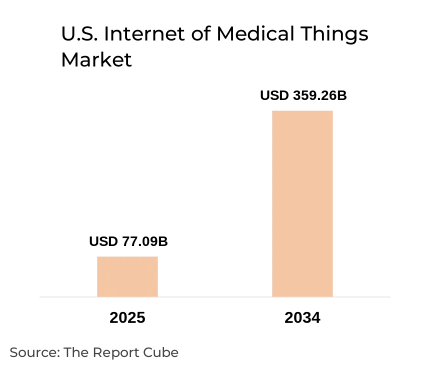
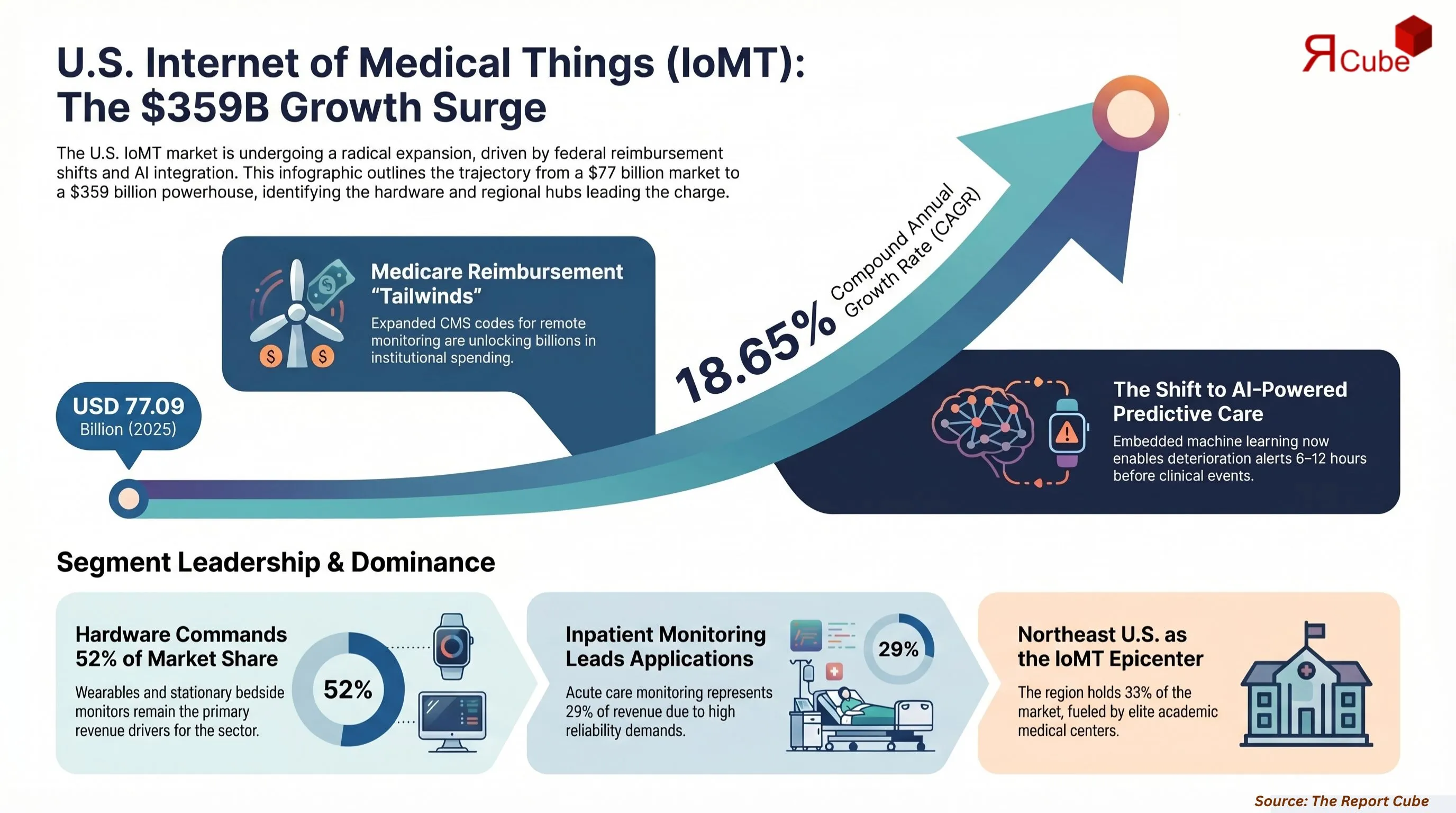
- The U.S. Internet of Medical Things Market was valued at USD 77.09 billion in 2025.
- The market is projected to reach USD 359.26 billion by the year 2034.
- The U.S. Internet of Medical Things Market is set to grow at 18.65% CAGR through 2034.
By Component
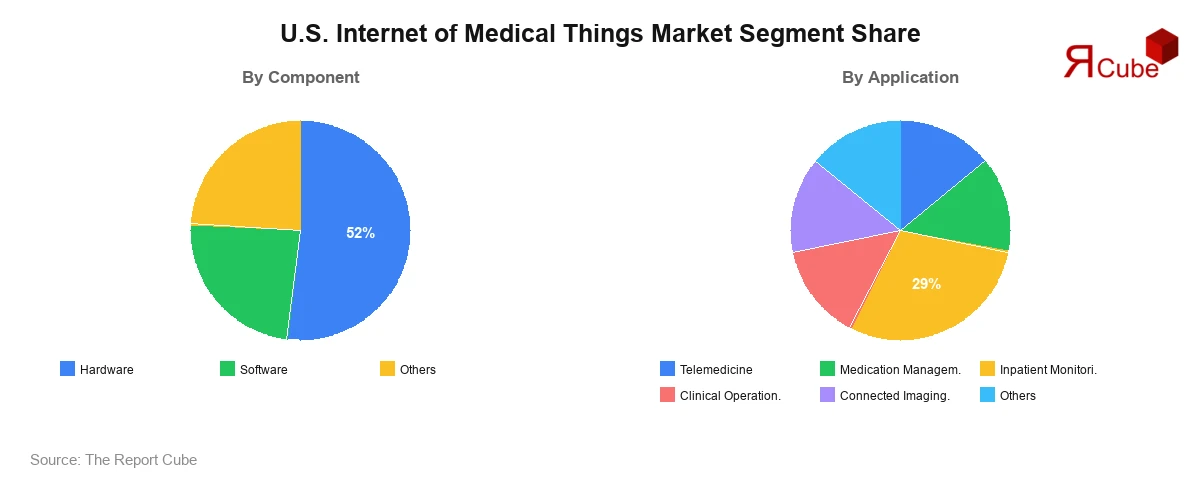
- Hardware leads the Component segment, commanding approximately 52% market share.
Key Player
- More than 10 companies are actively engaged in producing U.S. Internet of Medical Things solutions.
- Top 5 companies acquired around 38% of the market share.
- Cisco Systems Inc, GE Aerospace, Medtronic PLC, Siemens AG, Boston Scientific Corp, and others.
By Application
- Inpatient Monitoring leads the Application segment, holding approximately 29% market share.
U.S. Internet of Medical Things Market Insights & Analysis
The U.S. Internet of Medical Things Market is anticipated to register a 18.65% CAGR during 2026–2034. The market size was valued at USD 77.09 billion in 2025 and is projected to reach USD 359.26 billion by 2034. The accelerating convergence of cloud computing, edge analytics, and connected medical devices is fundamentally reshaping patient care delivery across the United States. Federal investments are playing a catalytic role, the Centers for Medicare & Medicaid Services (CMS) expanded remote patient monitoring (RPM) reimbursement codes in 2024, unlocking billions in institutional spending on IoMT infrastructure.
Concurrently, the National Institutes of Health (NIH) allocated over USD 1.8 billion toward digital health innovation grants in fiscal year 2024–25. Large hospital networks are deploying real-time monitoring ecosystems covering thousands of beds, while ambulatory care providers are integrating wearable and implantable devices to shift chronic disease management from episodic clinic visits to continuous, data-driven interventions. The rising burden of cardiovascular disease, diabetes, and neurological disorders, collectively affecting more than 130 million Americans, is further amplifying demand for persistent, device-enabled monitoring solutions that can flag deterioration events before they escalate.
U.S. Internet of Medical Things Market Dynamics
Key Market Driver: Regulatory Tailwinds Accelerating RPM Reimbursement Nationwide
The expansion of Medicare reimbursement for remote patient monitoring services represents one of the most consequential structural drivers in the U.S. IoMT sector. CMS CPT codes 99453, 99454, 99457, and 99458 now allow providers to bill for device setup, daily data transmission, and interactive management of chronic conditions, generating sustainable revenue streams that incentivize IoMT deployment at scale.
By 2024, over 4.5 million Medicare beneficiaries were enrolled in RPM programs, a figure projected to surpass 10 million by 2028 according to the American Telemedicine Association. This policy architecture effectively de-risks IoMT investment for providers, fueling procurement of connected devices, interoperability platforms, and clinical workflow software across both urban hospital systems and rural critical access facilities.
Major Industry Challenge: Interoperability Gaps Across Fragmented Health Data Ecosystems
Despite widespread adoption of electronic health records, the U.S. healthcare IT landscape remains deeply fragmented, with more than 700 distinct EHR platforms operating across hospitals, specialty clinics, and ambulatory settings. IoMT devices from different manufacturers frequently transmit data using incompatible protocols, ranging from HL7 FHIR to proprietary vendor formats, creating significant integration burdens for clinical IT teams.
The Office of the National Coordinator for Health IT (ONC) has mandated FHIR R4 compliance under the 21st Century Cures Act, but enforcement timelines remain staggered, and legacy infrastructure at community hospitals impedes seamless device-to-EHR data flows. This fragmentation slows clinical adoption, inflates implementation costs, and undermines the real-time decision support value that IoMT platforms are designed to deliver.
Emerging Trend Shaping Outlook: AI-Powered Predictive Analytics Embedded Within IoMT Platforms
A defining frontier in the U.S. IoMT market is the deep integration of machine learning models directly within connected medical device ecosystems. Rather than transmitting raw physiological data to separate analytics platforms, next-generation IoMT solutions embed predictive algorithms at the device or edge-gateway level, enabling sub-minute deterioration alerts without cloud round-trips.
Companies including Philips HealthSuite and GE Aerospace's Edison platform are deploying AI models that analyze continuous cardiac, respiratory, and hemodynamic data streams to predict sepsis, arrhythmia, and hypotensive events 6–12 hours before clinical deterioration. The FDA cleared over 950 AI/ML-enabled medical devices through fiscal year 2024, a 37% year-over-year increase, signaling regulatory readiness to absorb this wave of intelligent IoMT infrastructure across acute and post-acute care settings
Need Specific Data, Let’s Customize the Report for You
Request CustomizationU.S. Internet of Medical Things Market Segment-wise Analysis
The U.S. IoMT landscape is characterized by rich segmentation across both device components and clinical application domains. The interplay between hardware innovation and application-layer software is creating compounding growth dynamics, with each segment reinforcing adoption in adjacent categories. Understanding these segments is essential for stakeholders seeking to identify high-yield investment and commercialization opportunities through 2034.
By Component
- Hardware
- Stationary Devices
- Implantable Devices
- Wearable Devices
- Software
- Others
Hardware commands the largest share within the Component segment, accounting for approximately 52% of total 2025 market revenue. Within hardware, wearable devices, including smartwatches with medical-grade ECG and blood oxygen sensors, continuous glucose monitors (CGMs), and biosensor patches, represent the fastest-growing sub-category, driven by direct-to-consumer adoption and clinical validation for chronic disease management. Stationary devices, encompassing bedside patient monitoring stations, connected infusion pumps, and smart ventilators, dominate inpatient settings and are being upgraded to IP-enabled architectures across major U.S. hospital networks.
Implantable devices, including cardiac rhythm management devices from Medtronic and Boston Scientific, are increasingly equipped with wireless telemetry capabilities enabling remote follow-up, reducing clinic visits by up to 30% according to clinical evidence. The Software segment, holding roughly 28% share, encompasses device management platforms, clinical analytics suites, and interoperability middleware, and is growing rapidly as providers seek to unify disparate device data into actionable clinical intelligence dashboards.
By Application
- Telemedicine
- Medication Management
- Inpatient Monitoring
- Clinical Operations & Workflow Management
- Connected Imaging
- Others
Inpatient Monitoring is the dominant application segment, accounting for approximately 29% of U.S. IoMT revenue in 2025. The acute care environment places the highest demands on real-time data accuracy, alarm management, and system reliability, driving large capital investments in connected monitoring infrastructure. Telemedicine holds the second-largest share at roughly 24%, propelled by post-pandemic normalization of virtual care and CMS RPM reimbursement expansion.
Medication Management, covering smart infusion pumps, connected pill dispensers, and dose verification platforms, represents approximately 17% of application revenue, with adoption surging in long-term care and home health settings seeking to reduce medication errors, which affect an estimated 1.5 million Americans annually. Clinical Operations & Workflow Management, at around 14%, encompasses nurse call systems, asset tracking, and staff workflow automation tools. Connected Imaging, which links diagnostic modalities such as MRI, CT, and ultrasound to cloud-based AI interpretation platforms, is the fastest-growing application category, fueled by radiologist workforce shortages and the FDA's accelerating clearance of AI imaging tools.
Regional Projection of U.S. Internet of Medical Things Market
The U.S. IoMT market exhibits distinct regional dynamics shaped by healthcare infrastructure density, payer mix, and regulatory adoption timelines.
- Northeast
- Southeast
- Midwest
- Southwest
The Northeast holds the leading regional position, capturing approximately 33% of total U.S. IoMT market revenue in 2025. This dominance reflects the region's concentration of major academic medical centers, including Massachusetts General Hospital, NewYork-Presbyterian, and Johns Hopkins Medicine, which serve as early adopters and innovation hubs for connected care technologies. The Northeast also benefits from the highest Medicare Advantage enrollment density in the U.S., creating strong insurer-driven incentives for RPM adoption.
The West, particularly California, represents the second-largest regional market, anchored by Silicon Valley-headquartered IoMT startups, large integrated delivery networks such as Kaiser Permanente, and state-level digital health policy frameworks that have accelerated deployment. The Southeast is the fastest-growing region, driven by rapid population expansion in states like Texas, Florida, and Georgia and a corresponding surge in chronic disease burden requiring continuous monitoring solutions.
U.S. Internet of Medical Things Market: Recent Development (2025)
- Medtronic PLC reported a 14.2% operating margin improvement following expanded rollout of its remote cardiac monitoring platform across 600 U.S. hospital sites.
- Cisco Systems Inc launched an enterprise-grade IoMT network segmentation solution designed specifically to isolate connected medical device traffic from hospital IT infrastructure.
- Boston Scientific Corp announced a USD 1.1 billion investment in its U.S. implantable device manufacturing capacity, targeting wireless-enabled cardiac rhythm management devices.
- Siemens AG achieved a 19.3% gross margin in its U.S. digital health infrastructure division, driven by strong demand for connected imaging and workflow automation platforms.
U.S. Internet of Medical Things Market Future Outlook (2034)
By 2034, the U.S. Internet of Medical Things Market is projected to reach USD 359.26 billion, expanding at an 18.65% CAGR from 2026. The proliferation of 5G infrastructure across U.S. metropolitan and suburban geographies will enable ultra-low-latency device communication, unlocking new use cases in surgical robotics, real-time ICU monitoring, and emergency response. AI-driven predictive analytics will transition from supplementary clinical tools to primary decision-support infrastructure embedded within EMR workflows.
The aging U.S. population, with adults over 65 expected to constitute 22% of the population by 2034, will generate sustained structural demand for home-based IoMT monitoring, implantable devices, and telemedicine platforms. Federal policy frameworks supporting value-based care reimbursement will further incentivize health systems to invest in IoMT infrastructure as a mechanism for reducing preventable hospitalizations and optimizing population health outcomes at scale.
Why Choose This Report?
- Provides a comprehensive overview of the overall market analysis, encompassing key trends, consumer behavior analysis, and risk assessment to support strategic decision-making.
- Provides accurate, up-to-date insights into market size, segmentation, and emerging opportunities, helping to minimize risk & capitalizing on growth.
- Gives deep understanding of target audience preferences, investment habits, and communication channels for enhanced product development & marketing effectiveness.
- Delivers competitive analysis & benchmarking, uncovering the strengths & weaknesses of market competitors to guide strategies.
- Consolidate comprehensive market intelligence, reducing reasoning & streamlining research efforts.
- Facilitates customized market segmentation & risk mitigation strategies, fine-tuned to the business objectives.
- Aids in identifying both market challenges & untapped opportunities within the industry to drive long-term business growth.
- Provides valuable information based on actual customer data & search trends.
Table of Contents
- Introduction
- Objective of the study
- Product Definition
- Market Segmentation
- Study Variables
- Research Methodology
- Secondary Data Points
- Companies Interviewed
- Primary Data Points
- Breakdown of Primary Interviews
- Secondary Data Points
- Executive Summary
- Market Dynamics
- Drivers
- Challenges
- Opportunity Assessment
- Recent Trends and Developments
- Policy and Regulatory Landscape
- U.S Emergency Medical Device Services Market Overview (2021-2034)
- Market Size, By Value (in USD Billions)
- Market Share, By Component
- Hardware
- Stationary Devices
- Implantable Devices
- Wearable Devices
- Software
- Others
- Market Share, By Deployment
- Cloud
- On-premise
- Market Share, By Application
- Telemedicine
- Medication Management
- Inpatient Monitoring
- Clinical Operations & Workflow Management
- Connected Imaging
- Others
- Market Share, By End Users
- Hospitals
- Others
- Homecare
- Clinics
- Research Institutes & Academics
- Market Share, By Region
- Northeast
- Southeast
- Midwest
- Southwest
- Market Share, By Competitors
- Competition Characteristics
- Revenue Shares
- U.S Hardware Emergency Medical Device Services Market Overview, 2021-2034F
- By Value (USD Million)
- By Deployment- Market Size & Forecast 2021-2034, USD Million
- By Application- Market Size & Forecast 2021-2034, USD Million
- By End Users- Market Size & Forecast 2021-2034, USD Million
- U.S Stationary Devices Emergency Medical Device Services Market Overview, 2021-2034F
- By Value (USD Million)
- By Deployment- Market Size & Forecast 2021-2034, USD Million
- By Application- Market Size & Forecast 2021-2034, USD Million
- By End Users- Market Size & Forecast 2021-2034, USD Million
- U.S Implantable Devices Emergency Medical Device Services Market Overview, 2021-2034F
- By Value (USD Million)
- By Deployment- Market Size & Forecast 2021-2034, USD Million
- By Application- Market Size & Forecast 2021-2034, USD Million
- By End Users- Market Size & Forecast 2021-2034, USD Million
- U.S Wearable Devices Emergency Medical Device Services Market Overview, 2021-2034F
- By Value (USD Million)
- By Deployment- Market Size & Forecast 2021-2034, USD Million
- By Application- Market Size & Forecast 2021-2034, USD Million
- By End Users- Market Size & Forecast 2021-2034, USD Million
- U.S Software Emergency Medical Device Services Market Overview, 2021-2034F
- By Value (USD Million)
- By Deployment- Market Size & Forecast 2021-2034, USD Million
- By Application- Market Size & Forecast 2021-2034, USD Million
- By End Users- Market Size & Forecast 2021-2034, USD Million
- U.S Others Emergency Medical Device Services Market Overview, 2021-2034F
- By Value (USD Million)
- By Deployment- Market Size & Forecast 2021-2034, USD Million
- By Application- Market Size & Forecast 2021-2034, USD Million
- By End Users- Market Size & Forecast 2021-2034, USD Million
- Competitive Outlook (Company Profile - Partial List)
- Cisco Systems Inc
- Company Overview
- Business Segments
- Strategic Alliances/Partnerships
- Recent Developments
- NeuroMetrix Inc
- Company Overview
- Business Segments
- Strategic Alliances/Partnerships
- Recent Developments
- Lenovo Group Ltd
- Company Overview
- Business Segments
- Strategic Alliances/Partnerships
- Recent Developments
- Honeywell International Inc
- Company Overview
- Business Segments
- Strategic Alliances/Partnerships
- Recent Developments
- GE Aerospace
- Company Overview
- Business Segments
- Strategic Alliances/Partnerships
- Recent Developments
- Siemens AG
- Company Overview
- Business Segments
- Strategic Alliances/Partnerships
- Recent Developments
- SAP SE ADR
- Company Overview
- Business Segments
- Strategic Alliances/Partnerships
- Recent Developments
- Boston Scientific Corp
- Company Overview
- Business Segments
- Strategic Alliances/Partnerships
- Recent Developments
- Medtronic PLC
- Company Overview
- Business Segments
- Strategic Alliances/Partnerships
- Recent Developments
- Others
- Cisco Systems Inc
- Contact Us & Disclaimer
Top Key Players & Market Share Outlook
- Cisco Systems Inc
- NeuroMetrix Inc
- Lenovo Group Ltd
- Honeywell International Inc
- GE Aerospace
- Siemens AG
- SAP SE ADR
- Boston Scientific Corp
- Medtronic PLC
- Others
Frequently Asked Questions