




Build Your Custom Market Intelligence Report
Customize Your ReportUS Pacemakers Market Key Highlights
By Product Type:
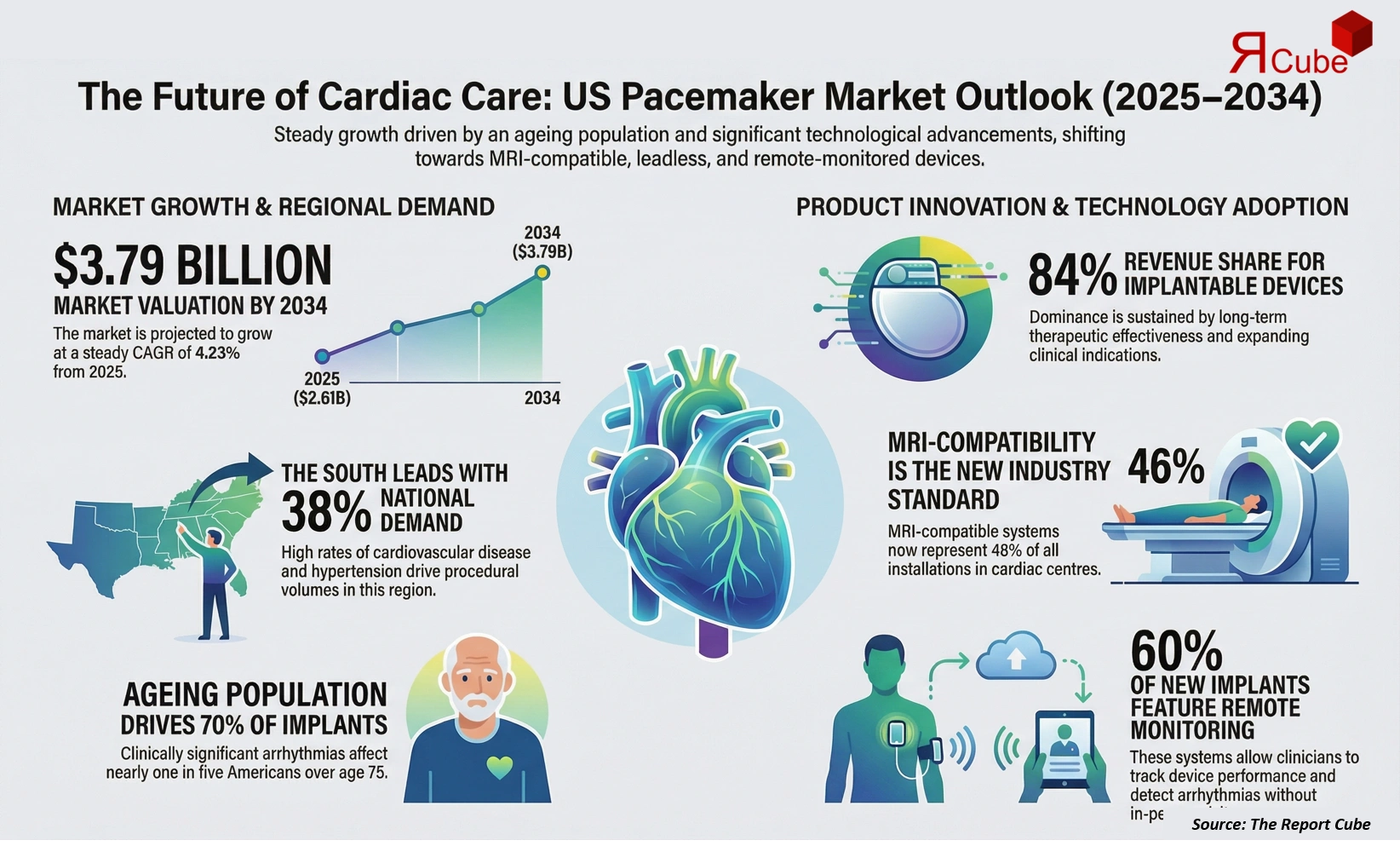
Implantable pacemakers segment lead the market, accounting for nearly 84% of total revenue.
By Technology:
MRI-compatible pacemakers dominate technology adoption, representing close to 46% of total installations across US cardiac care centers.
Regional Outlook:
The South region leads the market, contributing approximately 38% of national demand.
Government Initiatives & Policies
- Centers for Medicare & Medicaid Services (CMS) Cardiac Device Coverage Policy: Supports reimbursement for implantable cardiac rhythm management devices, improving patient access nationwide.
- FDA Breakthrough Devices Program: Accelerates approval pathways for innovative pacemaker technologies addressing unmet cardiac needs.
US Pacemakers Market Insights & Analysis
The US Pacemakers Market is anticipated to register a CAGR of 4.23% during 2026-2034. The market size was valued at USD 2.61 billion in 2025 and is projected to reach USD 3.79 billion by 2034. Pacemakers remain a cornerstone therapy in managing cardiac rhythm disorders across the United States. An aging population, rising incidence of atrioventricular block, and increasing survival rates among cardiac patients continue to sustain procedural volumes. By 2025, more than 3.5 million Americans were estimated to be living with implanted cardiac rhythm devices, underscoring the clinical relevance of pacemaker therapy. The US healthcare ecosystem benefits from advanced electrophysiology infrastructure, favorable reimbursement coverage, and strong physician awareness.
Technological refinement is reshaping the competitive landscape. Miniaturized leadless pacemakers, remote monitoring platforms, and MRI-compatible systems have improved patient outcomes while reducing complication rates. Hospitals and cardiac centers increasingly prioritize devices that support post-implantation monitoring, enabling early detection of arrhythmias and device performance issues. These capabilities align with value-based care models, which reward long-term patient management rather than isolated procedures.
Additionally, outpatient cardiac procedures are gaining traction. Ambulatory surgical centers are increasingly equipped to manage temporary and select implantable pacemaker procedures. This shift improves procedural efficiency and reduces hospitalization costs. As cardiac care delivery models evolve, pacemaker manufacturers are aligning portfolios to address diverse care settings and patient populations.
US Pacemakers Market Dynamics
Key Driver: Growing Burden of Cardiac Rhythm Disorders Across Aging Population
An expanding geriatric population represents the most influential driver of the US pacemakers market. Adults aged 65 years and above account for over 70% of pacemaker implantations nationwide. Age-related degeneration of the cardiac conduction system significantly raises the prevalence of bradycardia and heart block. Clinical data indicates that nearly one in five Americans over the age of 75 experiences clinically significant arrhythmias requiring device intervention. As life expectancy increases, pacemakers are supporting longer, more active lives. The demand is further reinforced by improved diagnostic capabilities, including wearable ECG monitoring and advanced electrophysiology studies. These tools facilitate earlier diagnosis and timely intervention, directly increasing procedural volumes.
Book your FREE 30-minute expert consultation today
Contact UsIndustry Trends: Rapid Adoption of Remote Monitoring and Leadless Pacemaker Technologies
Remote monitoring-enabled pacemakers are transforming post-implant care across the US. By 2025, nearly 60% of newly implanted pacemakers incorporated remote data transmission capabilities. These systems allow clinicians to track device performance, detect arrhythmic events, and adjust therapy without in-person visits. Leadless pacemakers are also gaining momentum, particularly among patients at higher risk of lead-related complications. Their compact design reduces infection risk and eliminates the need for surgical pockets. Manufacturers are investing heavily in expanding indications for leadless systems, including dual-chamber functionality. These trends collectively enhance patient safety and operational efficiency for healthcare providers.
Major Challenge: High Device Costs and Reimbursement Pressure
The high cost of advanced pacemaker systems continues to present challenges for healthcare providers. MRI-compatible and leadless pacemakers command premium pricing, often exceeding conventional device costs by 30-40%. Hospitals face reimbursement pressure under bundled payment models, which emphasize cost containment. While long-term benefits are clear, upfront capital expenditure can strain budgets, particularly for smaller cardiac centers. In addition, device recalls and post-market surveillance requirements add compliance-related costs. These financial considerations influence procurement decisions and may slow adoption of next-generation technologies in certain settings.
Opportunity: Expanding Role of Pacemakers in Heart Failure and Preventive Cardiology
An important growth opportunity lies in the expanding application of pacemakers in managing congestive heart failure. Biventricular and CRT pacemakers are increasingly prescribed to improve cardiac synchronization and patient quality of life. Heart failure affects more than 6 million Americans, creating a substantial addressable patient pool. Preventive cardiology initiatives are also encouraging earlier intervention for rhythm disorders. Combined with advancements in rechargeable and longer-lasting batteries, these developments position pacemakers as long-term therapeutic platforms rather than episodic solutions.
US Pacemakers Market Segment-wise Analysis
By Product Type:
- External Pacemakers
- Implantable Pacemakers
Implantable pacemakers dominate the US pacemakers market, holding nearly 84% market share in 2025. Their dominance stems from long-term therapeutic effectiveness and expanding clinical indications. Dual-chamber pacemakers represent the most widely implanted configuration, offering physiological pacing benefits. Biventricular pacemakers continue to gain adoption for heart failure management. Leadless pacemakers, while currently representing a smaller share, are experiencing double-digit annual growth due to reduced complication rates. Hospitals prioritize implantable systems for their durability, clinical outcomes, and reimbursement alignment.
By Technology:
- Remote Monitoring-Enabled Pacemakers
- Rechargeable Pacemakers
- MRI-Compatible Pacemakers
- Conventional Pacemakers
MRI-compatible pacemakers lead technology adoption with an estimated 46% share. Given that over half of pacemaker patients require MRI scans during their lifetime, compatibility has become a standard requirement. Remote monitoring-enabled devices closely follow, driven by telecardiology expansion. Rechargeable pacemakers are gaining interest for their extended battery life, particularly among younger patients. Technology-driven differentiation remains a central competitive strategy among manufacturers.
Regional Projection of US Pacemakers Industry
- Northeast
- Midwest
- South
- West
The South region leads the US pacemakers market, accounting for approximately 38% of total demand. Higher rates of cardiovascular disease, diabetes, and hypertension contribute to increased procedural volumes. The Midwest follows, supported by strong hospital networks and electrophysiology expertise. The Northeast benefits from academic medical centers and early adoption of advanced technologies. The West region shows steady growth, driven by outpatient cardiac care expansion and technological innovation. Regional healthcare infrastructure and demographic patterns strongly influence implantation rates.
US Pacemakers Market Recent Developments
- 2025: Medtronic expanded its remote monitoring platform for pacemakers, integrating predictive analytics to enhance early arrhythmia detection and improve long-term patient management across US hospitals.
- 2025: Abbott Laboratories introduced upgrades to its MRI-compatible pacemaker portfolio, focusing on reduced device size and improved battery longevity to support broader patient eligibility.
- 2025: Boston Scientific Corporation announced expanded clinical data supporting CRT pacemakers in moderate heart failure patients, strengthening adoption across cardiac centers.
- 2025: BIOTRONIK increased manufacturing capacity in North America to support growing demand for rechargeable and remote monitoring-enabled pacemakers.
Need insights for a specific region within this market?
Request Regional DataWhy Choose This Report?
- Provides a comprehensive overview of the overall market analysis, encompassing key trends, consumer behavior analysis, and risk assessment to support strategic decision-making.
- Provides accurate, up-to-date insights into market size, segmentation, and emerging opportunities, helping to minimize risk & capitalizing on growth.
- Gives deep understanding of target audience preferences, investment habits, and communication channels for enhanced product development & marketing effectiveness.
- Delivers competitive analysis & benchmarking, uncovering the strengths & weaknesses of market competitors to guide strategies.
- Consolidate comprehensive market intelligence, reducing reasoning & streamlining research efforts.
- Facilitates customized market segmentation & risk mitigation strategies, fine-tuned to the business objectives.
- Aids in identifying both market challenges & untapped opportunities within the industry to drive long-term business growth.
- Provides valuable information based on actual customer data & search trends.
Table of Contents
- Introduction
- Objective of the Study
- Product and Category Definition
- Market Segmentation
- Study Variables
- Research Methodology
- Secondary Data Points
- Breakdown of Secondary Sources
- Primary Data Points
- Breakdown of Primary Interviews
- Secondary Data Points
- Executive Summary
- Market Dynamics
- Drivers
- Challenges
- Opportunity Assessment
- Recent Trends and Developments
- Regulatory and Policy Landscape
- US Pacemakers Market Overview (2021-2034)
- Market Size, By Value (USD Million)
- Market Share, By Product Type
- External Pacemakers
- Transcutaneous Pacemakers
- Temporary Pacemakers
- Implantable Pacemakers
- Leadless Pacemakers
- Biventricular/CRT Pacemakers
- Dual-Chamber Pacemakers
- Single-Chamber Pacemakers
- External Pacemakers
- Market Share, By Technology
- Remote Monitoring-Enabled Pacemakers
- Rechargeable Pacemakers
- MRI-Compatible Pacemakers
- Conventional Pacemakers
- Market Share, By Patient Demographics
- Pediatric Population (<18 years)
- Adult Population (18–64 years)
- Geriatric Population (65+ years)
- Market Share, By Application
- Bradycardia
- Heart Block
- Arrhythmias
- Tachycardia
- Congestive Heart Failure
- Others
- Market Share, By End User
- Cardiac Centers
- Ambulatory Surgical Centers
- Hospitals
- Others
- Market Share, By Region
- Northeast
- Midwest
- South
- West
- Market Share, By Company
- Revenue Shares & Analysis
- Competitive Landscape
- Northeast US Pacemakers Market
- Market Size, By Value (USD Million)
- Market Share, By Product Type
- Market Share, By Technology
- Market Share, By Patient Demographics
- Market Share, By Application
- Market Share, By End User
- Midwest US Pacemakers Market
- Market Size, By Value (USD Million)
- Market Share, By Product Type
- Market Share, By Technology
- Market Share, By Patient Demographics
- Market Share, By Application
- Market Share, By End User
- South US Pacemakers Market
- Market Size, By Value (USD Million)
- Market Share, By Product Type
- Market Share, By Technology
- Market Share, By Patient Demographics
- Market Share, By Application
- Market Share, By End User
- West US Pacemakers Market
- Market Size, By Value (USD Million)
- Market Share, By Product Type
- Market Share, By Technology
- Market Share, By Patient Demographics
- Market Share, By Application
- Market Share, By End User
- Competitive Outlook and Company Profiles
- Medtronic
- Company Overview
- Product Portfolio
- Strategic Alliances/Partnerships
- Recent Developments
- Abbott Laboratories
- Company Overview
- Product Portfolio
- Strategic Alliances/Partnerships
- Recent Developments
- Boston Scientific Corporation
- Company Overview
- Product Portfolio
- Strategic Alliances/Partnerships
- Recent Developments
- BIOTRONIK
- Company Overview
- Product Portfolio
- Strategic Alliances/Partnerships
- Recent Developments
- MicroPort Scientific Corporation
- Company Overview
- Product Portfolio
- Strategic Alliances/Partnerships
- Recent Developments
- ZOLL Medical Corporation
- Company Overview
- Product Portfolio
- Strategic Alliances/Partnerships
- Recent Developments
- Integer Holdings Corporation
- Company Overview
- Product Portfolio
- Strategic Alliances/Partnerships
- Recent Developments
- LivaNova, Inc.
- Company Overview
- Product Portfolio
- Strategic Alliances/Partnerships
- Recent Developments
- OSCOR Inc
- Company Overview
- Product Portfolio
- Strategic Alliances/Partnerships
- Recent Developments
- Medico International Inc
- Company Overview
- Product Portfolio
- Strategic Alliances/Partnerships
- Recent Developments
- Others
- Medtronic
- Contact Us and Disclaimer
Top Key Players & Market Share Outlook
- LivaNova, Inc.
- OSCOR Inc
- Medico International Inc
- Medtronic
- Abbott Laboratories
- Boston Scientific Corporation
- BIOTRONIK
- MicroPort Scientific Corporation
- ZOLL Medical Corporation
- Integer Holdings Corporation
Frequently Asked Questions






