



Build Your Custom Market Intelligence Report
Customize Your ReportUS Cardiovascular Devices Market Insights & Analysis
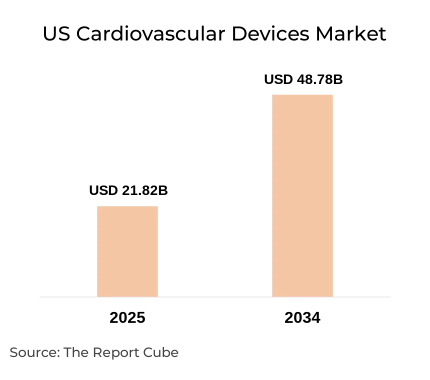
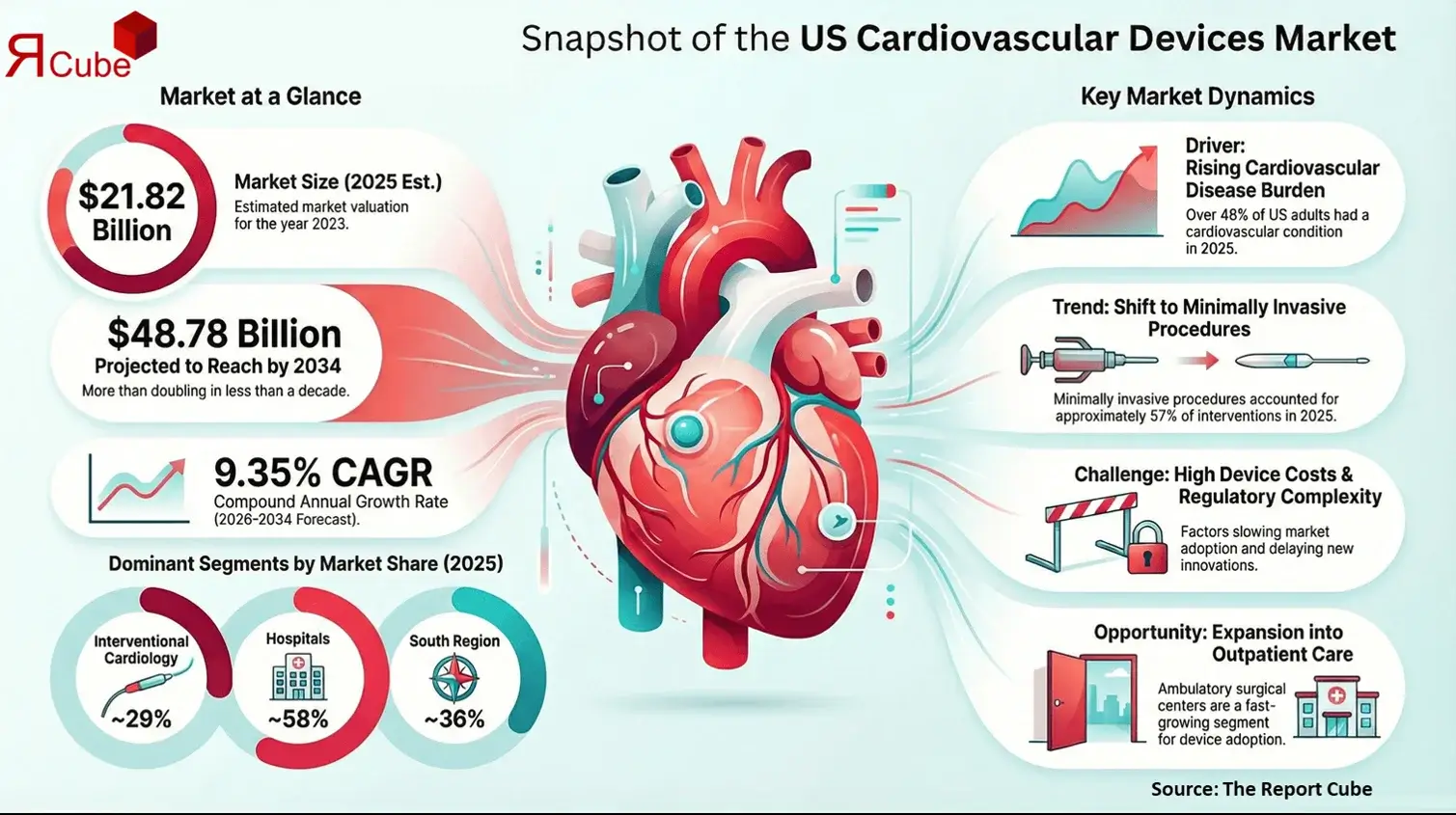
The US Cardiovascular Devices Market is anticipated to register a CAGR of 9.35% during 2026-2034. The market size was valued at USD 21.82 Billion in 2025 and is projected to reach USD 48.78 Billion by 2034. the market represents one of the largest and most technologically advanced segments within the global medical device industry, driven by the high prevalence of cardiovascular diseases, advanced healthcare infrastructure, and continuous innovation in diagnostic and therapeutic technologies. Cardiovascular disease remains the leading cause of mortality in the United States, accounting for nearly one in every five deaths annually, which creates sustained demand for effective diagnosis, treatment, and long-term disease management solutions. In 2025, more than 48% of adults in the US were estimated to have some form of cardiovascular condition, including hypertension, coronary artery disease, and arrhythmias. This significant disease burden fuels consistent adoption of cardiovascular devices across hospitals, cardiac centers, and outpatient facilities. Strong reimbursement frameworks, early adoption of minimally invasive procedures, and widespread physician awareness further support robust market expansion.
US Cardiovascular Devices Market Recent Developments
- 2025: Medtronic expanded its transcatheter aortic valve replacement portfolio for high-risk patients.
- 2025: Abbott launched next-generation cardiac monitoring devices with enhanced remote capabilities.
Government Initiatives & Policies
- US National Heart, Lung, and Blood Institute (NHLBI) Programs: Federal initiatives supporting cardiovascular research and innovation.
- CMS Value-Based Care Programs: Policies promoting improved cardiovascular outcomes and cost-effective care delivery.
Market growth is also supported by rapid technological advancements and a strong shift toward minimally invasive and catheter-based interventions. Devices such as drug-eluting stents, transcatheter heart valves, implantable defibrillators, and advanced imaging systems are increasingly preferred due to shorter hospital stays and improved patient outcomes. In 2025, interventional and rhythm management devices together accounted for nearly 44% of total market revenue, highlighting the growing emphasis on advanced procedural care. Additionally, the integration of digital health, remote monitoring, and data-driven diagnostics is enhancing long-term patient management and follow-up care. These factors collectively position the US cardiovascular devices market for strong, sustained growth throughout the forecast period.
US Cardiovascular Devices Market Dynamics
Key Driver: Rising Cardiovascular Disease Burden and Aging Population
The primary driver of the US cardiovascular devices market is the rising prevalence of cardiovascular diseases combined with an aging population. As the US population ages, the incidence of heart failure, arrhythmias, and vascular disorders continues to increase, directly boosting demand for diagnostic, interventional, and implantable devices. In 2025, individuals aged 65 and above accounted for over 40% of total cardiovascular device utilization. Additionally, lifestyle-related risk factors such as obesity, diabetes, and sedentary behavior further contribute to disease incidence. These demographic and epidemiological trends ensure sustained demand for cardiovascular technologies across acute and chronic care settings.
Major Challenge: High Device Costs and Regulatory Complexity
A major challenge facing the US cardiovascular devices market is the high cost of advanced devices and the complexity of regulatory approval processes. Cutting-edge technologies such as transcatheter valves and implantable rhythm management devices involve significant research, development, and clinical validation expenses, resulting in premium pricing. While reimbursement coverage is generally strong, cost containment pressures from healthcare providers and payers can slow adoption in certain settings. Additionally, navigating the US regulatory landscape requires extensive clinical evidence, increasing time-to-market for new innovations. These factors can create barriers for smaller manufacturers and delay commercialization timelines.
Industry Trends: Minimally Invasive Procedures and Remote Monitoring
An important industry trend is the growing preference for minimally invasive cardiovascular procedures and remote patient monitoring solutions. Catheter-based interventions are increasingly replacing open-heart surgeries due to reduced recovery time and lower complication rates. In 2025, minimally invasive procedures accounted for approximately 57% of cardiovascular interventions performed in the US. At the same time, wearable and implantable monitoring devices are gaining traction for continuous rhythm tracking and early detection of cardiac events. These trends are reshaping clinical workflows and driving demand for advanced device solutions.
Opportunity Ahead: Technological Innovation and Outpatient Expansion
Future opportunities lie in continued technological innovation and the expansion of cardiovascular care into outpatient and ambulatory settings. Advances in imaging, robotics, and device miniaturization are enabling complex procedures to be performed safely outside traditional hospital environments. Ambulatory surgical centers are increasingly adopting cardiovascular devices to reduce costs and improve patient convenience. Manufacturers that develop cost-effective, easy-to-use devices tailored for these settings can unlock significant growth opportunities across the US healthcare landscape.
US Cardiovascular Devices Market Segment-wise Analysis
By Device Type:
- Diagnostic & Monitoring Devices
- Therapeutic & Surgical Devices
- Interventional Cardiology Devices
- Cardiac Rhythm Management Devices
- Peripheral Vascular Devices
- Others
Interventional cardiology devices represent the leading segment, accounting for approximately 29% of total market revenue in 2025. This dominance is driven by high procedure volumes for coronary artery disease and structural heart interventions. Cardiac rhythm management devices follow closely, supported by rising arrhythmia prevalence and increased use of implantable defibrillators and pacemakers. Diagnostic and monitoring devices continue to grow steadily with expanded adoption of imaging and wearable technologies.
By End User:
- Hospitals
- Cardiac Centers
- Ambulatory Surgical Centers
- Others
Hospitals remain the dominant end user, contributing nearly 58% of total market demand in 2025 due to their role in complex cardiovascular procedures and acute care management. Cardiac centers follow, benefiting from specialization and high patient volumes. Ambulatory surgical centers represent a fast-growing segment as minimally invasive procedures shift toward outpatient care models.
Regional Projection of US Cardiovascular Devices Industry
- Northeast
- Midwest
- South
- West
The South leads the US cardiovascular devices market with approximately 36% share in 2025, driven by higher cardiovascular disease prevalence, large population size, and extensive hospital networks. The Midwest and Northeast follow, supported by advanced healthcare infrastructure and strong adoption of innovative technologies. The West contributes steadily, driven by technological innovation, outpatient care expansion, and high healthcare spending.
Why Choose This Report?
- Provides a comprehensive overview of the overall market analysis, encompassing key trends, consumer behavior analysis, and risk assessment to support strategic decision-making.
- Provides accurate, up-to-date insights into market size, segmentation, and emerging opportunities, helping to minimize risk & capitalizing on growth.
- Gives deep understanding of target audience preferences, investment habits, and communication channels for enhanced product development & marketing effectiveness.
- Delivers competitive analysis & benchmarking, uncovering the strengths & weaknesses of market competitors to guide strategies.
- Consolidate comprehensive market intelligence, reducing reasoning & streamlining research efforts.
- Facilitates customized market segmentation & risk mitigation strategies, fine-tuned to the business objectives.
- Aids in identifying both market challenges & untapped opportunities within the industry to drive long-term business growth.
- Provides valuable information based on actual customer data & search trends.
Table of Contents
- Introduction
- Objective of the Study
- Product/Category Definition
- Market Segmentation
- Study Variables
- Research Methodology
- Secondary Data Points
- Breakdown of Secondary Sources
- Primary Data Points
- Breakdown of Primary Interviews
- Secondary Data Points
- Executive Summary
- Market Dynamics
- Drivers
- Challenges
- Opportunity Assessment
- Recent Trends and Developments
- Policy and Regulatory Landscape
- US Cardiovascular Devices Market Overview (2020-2034)
- Market Size, By Value (USD Million)
- Market Share, By Device Type
- Diagnostic & Monitoring Devices
- Therapeutic & Surgical Devices
- Interventional Cardiology Devices
- Cardiac Rhythm Management Devices
- Peripheral Vascular Devices
- Others
- Market Share, By End User
- Hospitals
- Cardiac Centers
- Ambulatory Surgical Centers
- Others
- Market Share, By Application
- Coronary Artery Disease
- Heart Failure
- Arrhythmia
- Stroke
- Others
- Market Share, By Region
- Northeast
- Midwest
- South
- West
- Market Share, By Company
- Revenue Shares
- Competitive Landscape
- Segment-wise & Application-wise Market Forecast (2026-2034)
- By Device Type
- By End User
- By Application
- By Region
- Northeast US Cardiovascular Devices Market
- Market Size, By Value (USD Million)
- Market Share, By Device Type
- Market Share, By End User
- Market Share, By Application
- Market Share, By Key States
- Midwest US Cardiovascular Devices Market
- Market Size, By Value (USD Million)
- Market Share, By Device Type
- Market Share, By End User
- Market Share, By Application
- Market Share, By Key States
- South US Cardiovascular Devices Market
- Market Size, By Value (USD Million)
- Market Share, By Device Type
- Market Share, By End User
- Market Share, By Application
- Market Share, By Key States
- West US Cardiovascular Devices Market
- Market Size, By Value (USD Million)
- Market Share, By Device Type
- Market Share, By End User
- Market Share, By Application
- Market Share, By Key States
- Competitive Outlook & Company Profiles
- Medtronic
- Company Overview
- Product Portfolio
- Strategic Alliances/Partnerships
- Recent Developments
- Abbott
- Company Overview
- Product Portfolio
- Strategic Alliances/Partnerships
- Recent Developments
- Boston Scientific
- Company Overview
- Product Portfolio
- Strategic Alliances/Partnerships
- Recent Developments
- Edwards Lifesciences
- Company Overview
- Product Portfolio
- Strategic Alliances/Partnerships
- Recent Developments
- Johnson & Johnson
- Company Overview
- Product Portfolio
- Strategic Alliances/Partnerships
- Recent Developments
- GE HealthCare
- Company Overview
- Product Portfolio
- Strategic Alliances/Partnerships
- Recent Developments
- Siemens Healthineers
- Company Overview
- Product Portfolio
- Strategic Alliances/Partnerships
- Recent Developments
- Philips
- Company Overview
- Product Portfolio
- Strategic Alliances/Partnerships
- Recent Developments
- Terumo
- Company Overview
- Product Portfolio
- Strategic Alliances/Partnerships
- Recent Developments
- Others
- Medtronic
- Contact Us / Disclaimer
Top Key Players & Market Share Outlook
- Medtronic
- Abbott
- Boston Scientific
- Edwards Lifesciences
- Johnson & Johnson
- GE HealthCare
- Siemens Healthineers
- Philips
- Terumo
- Others
Frequently Asked Questions






