



Build Your Custom Market Intelligence Report
Customize Your ReportMalaysia Islamic Banking Market Key Highlights
By Banking Type:
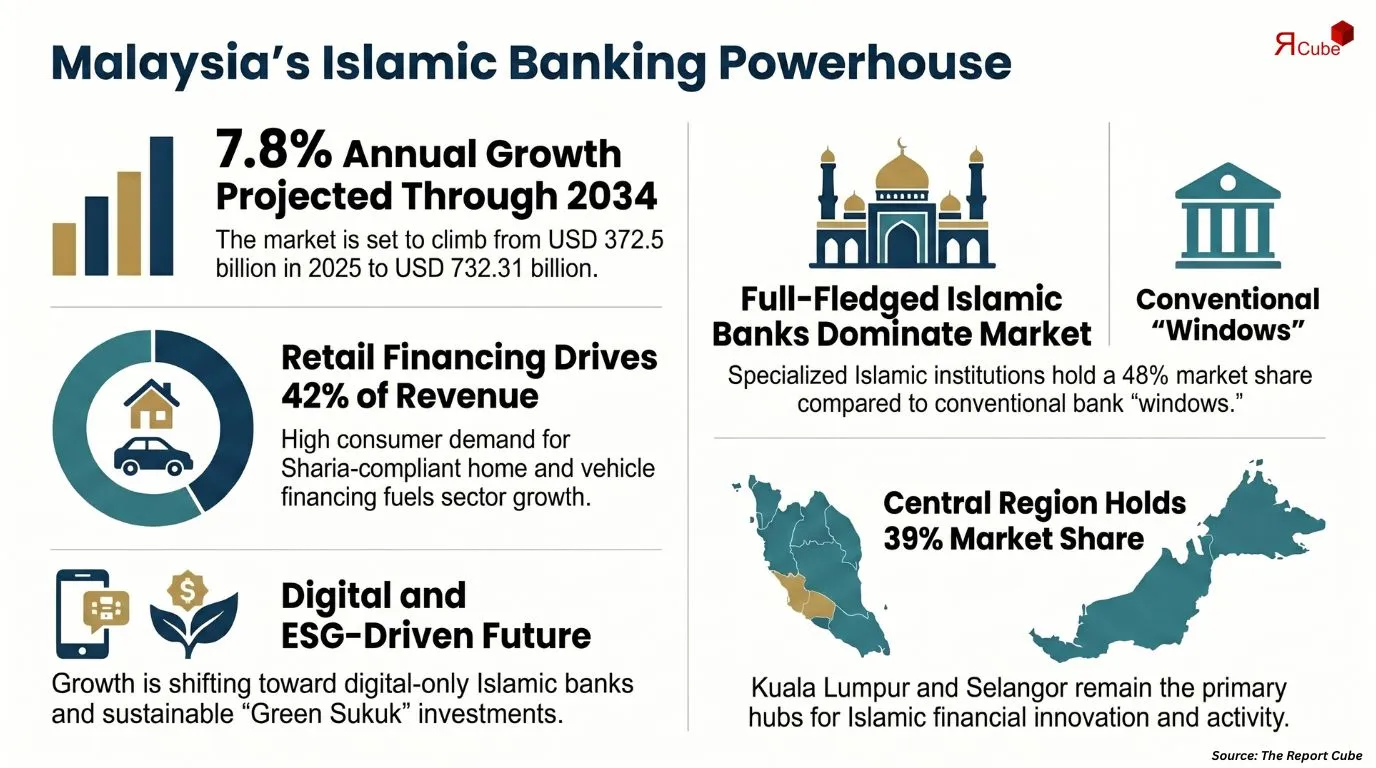
Full-Fledged Islamic Banks segment leads the market, with around 48% market share.
By Product:
Retail Financing segment dominates the market, accounting for nearly 42% of total revenue.
Regional Outlook:
Central region dominates the Malaysia islamic banking market, with around 39% market share.
Government Initiatives & Policies
- Financial Sector Blueprint 2022–2026 by Bank Negara Malaysia: A national framework accelerating Malaysia’s position as a global Islamic finance hub through digital innovation, Shariah governance improvements, and sustainable Islamic finance initiatives.
- Malaysia International Islamic Financial Centre (MIFC) Initiative: A government-supported platform promoting Malaysia as a global Islamic finance marketplace by attracting international investors and strengthening sukuk and Sharia-compliant banking services.
Malaysia Islamic Banking Market Insights & Analysis
The Malaysia Islamic Banking Market is anticipated to register a CAGR of 7.8% during 2026-2034. the market size was valued at USD 372.5 billion in 2025 and is projected to reach USD 732.31 billion by 2034. Malaysia has developed one of the world’s most advanced Islamic finance ecosystems, supported by a robust regulatory environment, sophisticated financial infrastructure, and strong consumer confidence in Sharia-compliant financial services.
Islamic banking in Malaysia has transformed from a niche banking alternative into a core pillar of the national financial system. By 2025, Islamic banking assets represented more than 40% of the country’s total banking system assets, reflecting deep adoption among retail and corporate clients. Growth in this sector is closely connected to the rising demand for ethical finance, increasing Muslim population participation in formal banking, and continuous innovation in Sharia-compliant financial instruments such as sukuk, Islamic funds, and asset-backed financing solutions.
Government policy has played a significant role in building Malaysia’s leadership in Islamic finance. Initiatives from Bank Negara Malaysia and the Securities Commission Malaysia have strengthened governance frameworks and encouraged product innovation. Programs promoting green sukuk, Islamic fintech, and Sharia-compliant digital banking platforms are also helping expand the market reach to younger consumers and underserved segments. Malaysia’s proactive regulatory environment allows financial institutions to develop new Sharia-based contracts and hybrid products, enabling banks to serve diverse financing needs ranging from retail home financing to complex infrastructure projects.
Another important factor shaping market expansion is the integration of digital technologies within Islamic financial institutions. Major Islamic banks are investing heavily in digital platforms, artificial intelligence driven financial advisory tools, and mobile banking services to improve accessibility and customer engagement. The growing fintech ecosystem in Malaysia is enabling Islamic banks to automate compliance checks, enhance transaction security, and provide real-time financial services to consumers and businesses. As digital adoption increases and cross-border Islamic finance expands across ASEAN, Malaysia is expected to remain one of the leading hubs for global Islamic banking innovation and investment.
Malaysia Islamic Banking Market Dynamics
Key Driver: Expanding Demand for Sharia-Compliant Financial Solutions
The increasing demand for ethical and Sharia-compliant financial services is a primary factor driving the growth of Malaysia’s Islamic banking market. Malaysia has one of the most developed Islamic finance infrastructures globally, supported by a Muslim population representing over 60% of the national demographic. Consumers and businesses increasingly prefer financial products aligned with Islamic principles such as profit-sharing, asset-backed financing, and prohibition of interest-based lending. As awareness of Islamic financial principles grows, more customers are shifting from conventional banking services toward Sharia-compliant alternatives.
Retail financing has been a key growth engine in this transition. Islamic home financing, vehicle financing, and personal financing products have witnessed significant adoption across Malaysia due to competitive profit rates and transparent contract structures. Islamic banks are also offering innovative financing models such as diminishing Musharakah home financing and Tawarruq-based personal financing that meet both regulatory and consumer requirements. These products provide risk-sharing mechanisms that appeal to consumers seeking financial stability and ethical financial practices.
Corporate clients are also expanding their participation in Islamic banking services. Businesses are increasingly utilizing Sharia-compliant working capital financing, trade finance solutions, and project financing structures for infrastructure development. Islamic banks in Malaysia have financed major construction, renewable energy, and transportation projects through sukuk and asset-based financing frameworks. With the government promoting sustainable finance and infrastructure expansion, Islamic banks are expected to play a central role in funding large-scale economic development initiatives.
Book your FREE 30-minute expert consultation today
Contact UsIndustry Trends: Digital Transformation and Islamic Fintech Integration
Digital transformation is rapidly reshaping the Malaysia Islamic banking market as financial institutions adopt advanced technologies to improve customer experience and operational efficiency. Islamic banks are increasingly investing in digital platforms, cloud computing infrastructure, and AI-driven analytics to support real-time banking services and personalized financial offerings. Mobile banking applications now allow customers to perform transactions, manage investment accounts, and apply for Sharia-compliant financing products without visiting physical bank branches.
The emergence of Islamic fintech startups is also strengthening the digital ecosystem. Fintech companies are developing innovative solutions such as peer-to-peer Islamic financing platforms, automated zakat payment systems, and Sharia-compliant investment advisory tools. These technologies help reduce operational costs for banks while improving financial inclusion for consumers who previously lacked access to traditional banking services. Digital identity verification and blockchain-based transaction tracking are further improving security and transparency across Islamic financial operations.
Another major industry trend is the expansion of digital-only Islamic banks. Malaysia’s regulatory environment allows new entrants to launch fully digital Sharia-compliant banking platforms that operate with minimal physical infrastructure. These digital banks provide faster onboarding processes, lower transaction costs, and personalized financial products tailored to modern consumers. As digital banking adoption accelerates across Southeast Asia, Islamic financial institutions are positioning themselves to capture new growth opportunities through technology-driven services.
Major Challenge: Complex Sharia Governance and Product Structuring
While Malaysia’s Islamic banking sector continues to expand, the complexity of Sharia governance and financial product structuring presents an ongoing challenge for market participants. Islamic banking products must comply with strict religious principles, requiring detailed oversight from Sharia advisory boards, regulatory authorities, and financial institutions. Each financing product must undergo rigorous review processes to ensure it meets both financial and religious compliance requirements.
The complexity of structuring Sharia-compliant financial contracts also increases operational costs for banks. Products such as Murabahah financing, Ijarah leasing, and Musharakah partnerships require detailed legal frameworks and transaction documentation. Financial institutions must maintain specialized compliance teams, Sharia scholars, and legal advisors to ensure ongoing adherence to regulatory standards. These requirements increase the time needed to develop and launch new Islamic banking products compared to conventional financial services.
Cross-border operations can also present challenges because Sharia interpretations may vary across jurisdictions. Islamic financial products approved in one country may require additional regulatory adjustments when introduced in another market. Banks expanding into regional markets must adapt their product structures to align with local Sharia guidelines and financial regulations. Addressing these complexities will require continued collaboration between regulators, scholars, and financial institutions to maintain consistency while supporting innovation in Islamic finance.
Opportunity: Growth of Sustainable and Green Islamic Finance
The integration of sustainability principles into Islamic finance represents one of the most promising opportunities for Malaysia’s Islamic banking market. Environmental, social, and governance aligned financial instruments are increasingly compatible with Islamic finance principles that emphasize ethical investment and responsible economic development. Malaysia has emerged as a global leader in green sukuk issuance, providing financing for renewable energy projects, sustainable infrastructure, and climate-focused initiatives.
Islamic banks are expanding their sustainable financing portfolios by offering Sharia-compliant funding for solar energy installations, sustainable transportation systems, and environmentally responsible construction projects. These initiatives align with Malaysia’s broader sustainability goals and global climate commitments. Investors are also showing strong interest in ESG-aligned Islamic financial instruments, which combine ethical investment strategies with stable long-term returns.
Financial institutions are also integrating ESG metrics into their internal risk assessment and investment strategies. Islamic banks are developing specialized funds and wealth management solutions that prioritize sustainable companies and environmentally responsible investments. As global investors seek ethical financial opportunities, Malaysia’s leadership in Islamic sustainable finance positions the country to attract substantial international capital flows in the coming years.
Malaysia Islamic Banking Market Segment-wise Analysis
By Banking Type:
- Full-Fledged Islamic Banks
- Islamic Windows of Conventional Banks
- Development Financial Institutions (Islamic)
- Islamic Digital Banks
The Full-Fledged Islamic Banks segment accounts for approximately 48% of Malaysia’s Islamic banking market, making it the leading banking structure within the industry. These institutions operate entirely under Sharia principles, providing comprehensive financial services including financing, investment products, deposits, and wealth management solutions. Unlike conventional banks with Islamic windows, full-fledged Islamic banks design all operations, governance structures, and financial products in accordance with Sharia guidelines.
Leading institutions such as Maybank Islamic, Bank Islam Malaysia, and CIMB Islamic have built extensive branch networks and digital banking platforms to serve millions of customers nationwide. Their strong brand recognition and established customer trust have enabled them to dominate both retail and corporate financing segments. These banks also maintain dedicated Sharia advisory boards and advanced compliance frameworks, ensuring all financial products adhere to Islamic legal principles.
Another advantage of full-fledged Islamic banks is their ability to innovate specialized financial products tailored specifically for Islamic markets. They frequently introduce new financing contracts, investment products, and digital banking solutions designed to address evolving consumer demands. As the Malaysian financial sector continues to expand, full-fledged Islamic banks are expected to maintain their dominant position by offering integrated financial services and leveraging advanced digital infrastructure.
By Product:
- Retail Financing
- Corporate and Commercial Financing
- Deposits and Investment Accounts
- Treasury and Capital Market Services
- Wealth Management and Takaful Referral
- Digital and Transaction Banking
The Retail Financing segment holds nearly 42% of the Malaysia Islamic banking market due to the strong demand for Sharia-compliant financial solutions among households and individual customers. Retail financing includes products such as home financing, personal financing, vehicle financing, credit cards, and education financing, all structured using Sharia-approved contracts like Murabahah and Musharakah.
Home financing represents the largest portion of retail financing portfolios as Malaysian households increasingly prefer Islamic mortgage structures that offer transparent pricing and profit-sharing mechanisms. Islamic banks frequently structure home financing through diminishing Musharakah contracts where customers gradually acquire full ownership of the property. This structure provides flexibility while ensuring compliance with Islamic financial principles.
Personal financing and vehicle financing products have also experienced strong growth due to the increasing middle-income population and rising consumer purchasing power. Islamic banks are continuously expanding their retail portfolios by offering competitive financing rates, digital loan applications, and personalized financial services through mobile banking platforms. As consumer awareness of Islamic finance continues to rise, retail financing is expected to remain a key driver of market growth.
Regional Projection of Malaysia Islamic Banking Industry
- Northern
- Central
- Southern
- East
- Others
The Central region dominates Malaysia’s Islamic banking market with an estimated 39% market share, largely due to the concentration of financial institutions, corporate headquarters, and major commercial activities in areas such as Kuala Lumpur and Selangor. These urban centers serve as Malaysia’s primary economic hubs, hosting large populations of high-income households, multinational corporations, and government institutions.
Financial institutions in the Central region benefit from advanced banking infrastructure, strong digital connectivity, and proximity to regulatory bodies such as Bank Negara Malaysia and the Securities Commission. This environment allows banks to launch innovative financial products, establish partnerships with fintech companies, and rapidly scale digital banking services.
The region also attracts significant investment from both domestic and international financial institutions seeking to expand their Islamic finance operations. Corporate financing, wealth management services, and capital market activities are particularly concentrated in the Central region due to the presence of large corporations and government-linked investment entities. As Malaysia continues to position itself as a global Islamic finance hub, the Central region will remain the focal point for Islamic banking innovation and market expansion.
Malaysia Islamic Banking Market Recent Developments
- 2025: Maybank Islamic Berhad announced a strategic partnership with audax Financial Technology and Amazon Web Services to accelerate digital transformation across ASEAN markets. The initiative focuses on launching Sharia-compliant digital banking products and strengthening regional customer acquisition through advanced cloud-based infrastructure.
- 2025: CIMB Islamic Bank Berhad formed a strategic partnership with ASCARO to launch the CIMB Padel Open and deliver exclusive lifestyle privileges to customers. The initiative supports the bank’s affluent customer strategy while strengthening engagement opportunities linked to Islamic banking products.
- 2025: RHB Islamic Bank Berhad completed Malaysia’s first sustainable sale and buy-back agreement transaction valued at RM120 million with HSBC Amanah and Standard Chartered Saadiq, introducing a new Sharia-compliant liquidity management instrument supporting sustainable Islamic finance growth.
- 2025: Bank Islam Malaysia Berhad earned recognition on the UN Global Compact Network Malaysia & Brunei ESG Select List 2025 after expanding its Shariah-ESG assets and committing to grow its sustainable finance portfolio to RM28 billion.
Need insights for a specific region within this market?
Request Regional DataWhy Choose This Report?
- Provides a comprehensive overview of the overall market analysis, encompassing key trends, consumer behavior analysis, and risk assessment to support strategic decision-making.
- Provides accurate, up-to-date insights into market size, segmentation, and emerging opportunities, helping to minimize risk & capitalizing on growth.
- Gives deep understanding of target audience preferences, investment habits, and communication channels for enhanced product development & marketing effectiveness.
- Delivers competitive analysis & benchmarking, uncovering the strengths & weaknesses of market competitors to guide strategies.
- Consolidate comprehensive market intelligence, reducing reasoning & streamlining research efforts.
- Facilitates customized market segmentation & risk mitigation strategies, fine-tuned to the business objectives.
- Aids in identifying both market challenges & untapped opportunities within the industry to drive long-term business growth.
- Provides valuable information based on actual customer data & search trends.
Table of Contents
- Introduction
- Objective of the Study
- Product and Category Definition
- Market Segmentation
- Study Variables
- Research Methodology
- Secondary Data Points
- Breakdown of Secondary Sources
- Primary Data Points
- Breakdown of Primary Interviews
- Secondary Data Points
- Executive Summary
- Market Dynamics
- Drivers
- Challenges
- Opportunity Assessment
- Recent Trends and Developments
- Regulatory and Policy Landscape
- Malaysia Islamic Banking Market Overview (2021-2034)
- Market Size, By Value (USD Billion)
- Market Share, By Banking Type
- Full-Fledged Islamic Banks
- Islamic Windows of Conventional Banks
- Development Financial Institutions (Islamic)
- Islamic Digital Banks
- Market Share, By Sharia Contract
- Murabahah Financing
- Ijarah Financing
- Musharakah Financing
- Muḍarabah Financing
- Istisna Financing
- Wakalah-Based Financing
- Tawarruq-Based Financing
- Others
- Market Share, By Product
- Retail Financing
- Home Financing
- Vehicle Financing
- Personal Financing
- Credit Cards
- Education Financing
- Corporate and Commercial Financing
- Working Capital Financing
- Trade Finance
- Project and Infrastructure Financing
- SME Financing
- Deposits and Investment Accounts
- Current Accounts
- Savings Accounts
- Term Investment Accounts
- Cash Management Accounts
- Treasury and Capital Market Services
- Sukuk Investment
- Money Market Instruments
- Foreign Exchange Services
- Wealth Management and Takaful Referral
- Wealth and Investment Products
- Private Banking Services
- Takaful Referral and Bancatakaful
- Digital and Transaction Banking
- Internet and Mobile Banking
- Digital Payment Services
- Digital-Only Islamic Banking
- Retail Financing
- Market Share, By Customer
- Retail Customers
- Small and Medium Enterprises
- Large Corporates
- Government and Public Sector
- Non-Profit and Religious Institutions
- Market Share, By Region
- Northern
- Central
- Southern
- East
- Others
- Market Share, By Company
- Asset Shares and Analysis
- Financing and Deposit Shares
- Competitive Landscape
- Northern Malaysia Islamic Banking Market
- Market Size, By Value (USD Billion/Million)
- Market Share, By Banking Type
- Market Share, By Sharia Contract
- Market Share, By Product
- Market Share, By Customer
- Central Malaysia Islamic Banking Market
- Market Size, By Value (USD Billion/Million)
- Market Share, By Banking Type
- Market Share, By Sharia Contract
- Market Share, By Product
- Market Share, By Customer
- Southern Malaysia Islamic Banking Market
- Market Size, By Value (USD Billion/Million)
- Market Share, By Banking Type
- Market Share, By Sharia Contract
- Market Share, By Product
- Market Share, By Customer
- East Malaysia Islamic Banking Market
- Market Size, By Value (USD Billion/Million)
- Market Share, By Banking Type
- Market Share, By Sharia Contract
- Market Share, By Product
- Market Share, By Customer
- Competitive Outlook and Company Profiles
- Maybank Islamic Berhad
- Company Overview
- Product Portfolio
- Strategic Alliances/Partnerships
- Recent Developments
- CIMB Islamic Bank Berhad
- Company Overview
- Product Portfolio
- Strategic Alliances/Partnerships
- Recent Developments
- Bank Islam Malaysia Berhad
- Company Overview
- Product Portfolio
- Strategic Alliances/Partnerships
- Recent Developments
- Public Islamic Bank Berhad
- Company Overview
- Product Portfolio
- Strategic Alliances/Partnerships
- Recent Developments
- RHB Islamic Bank Berhad
- Company Overview
- Product Portfolio
- Strategic Alliances/Partnerships
- Recent Developments
- AmBank Islamic Berhad
- Company Overview
- Product Portfolio
- Strategic Alliances/Partnerships
- Recent Developments
- Bank Muamalat Malaysia Berhad
- Company Overview
- Product Portfolio
- Strategic Alliances/Partnerships
- Recent Developments
- Hong Leong Islamic Bank Berhad
- Company Overview
- Product Portfolio
- Strategic Alliances/Partnerships
- Recent Developments
- Affin Islamic Bank Berhad
- Company Overview
- Product Portfolio
- Strategic Alliances/Partnerships
- Recent Developments
- Alliance Islamic Bank Berhad
- Company Overview
- Product Portfolio
- Strategic Alliances/Partnerships
- Recent Developments
- MBSB Bank Berhad
- Company Overview
- Product Portfolio
- Strategic Alliances/Partnerships
- Recent Developments
- HSBC Amanah Malaysia Berhad
- Company Overview
- Product Portfolio
- Strategic Alliances/Partnerships
- Recent Developments
- Standard Chartered Saadiq Berhad
- Company Overview
- Product Portfolio
- Strategic Alliances/Partnerships
- Recent Developments
- Al Rajhi Banking & Investment Corp.
- Company Overview
- Product Portfolio
- Strategic Alliances/Partnerships
- Recent Developments
- OCBC Al-Amin Bank Berhad
- Company Overview
- Product Portfolio
- Strategic Alliances/Partnerships
- Recent Developments
- Kuwait Finance House
- Company Overview
- Product Portfolio
- Strategic Alliances/Partnerships
- Recent Developments
- AEON Bank (M) Berhad
- Company Overview
- Product Portfolio
- Strategic Alliances/Partnerships
- Recent Developments
- Others
- Maybank Islamic Berhad
- Contact Us and Disclaimer
Top Key Players & Market Share Outlook
- Maybank Islamic Berhad
- CIMB Islamic Bank Berhad
- Bank Islam Malaysia Berhad
- Public Islamic Bank Berhad
- RHB Islamic Bank Berhad
- AmBank Islamic Berhad
- Bank Muamalat Malaysia Berhad
- Hong Leong Islamic Bank Berhad
- Affin Islamic Bank Berhad
- Alliance Islamic Bank Berhad
- MBSB Bank Berhad
- HSBC Amanah Malaysia Berhad
- Standard Chartered Saadiq Berhad
- Al Rajhi Banking & Investment Corp.
- OCBC Al-Amin Bank Berhad
- Kuwait Finance House (Malaysia)
- AEON Bank (M) Berhad
Frequently Asked Questions