



Build Your Custom Market Intelligence Report
Customize Your ReportGlobal Koi Market Research Report 2026-2034
Executive Summary
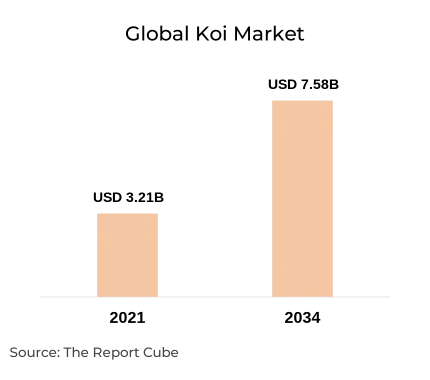
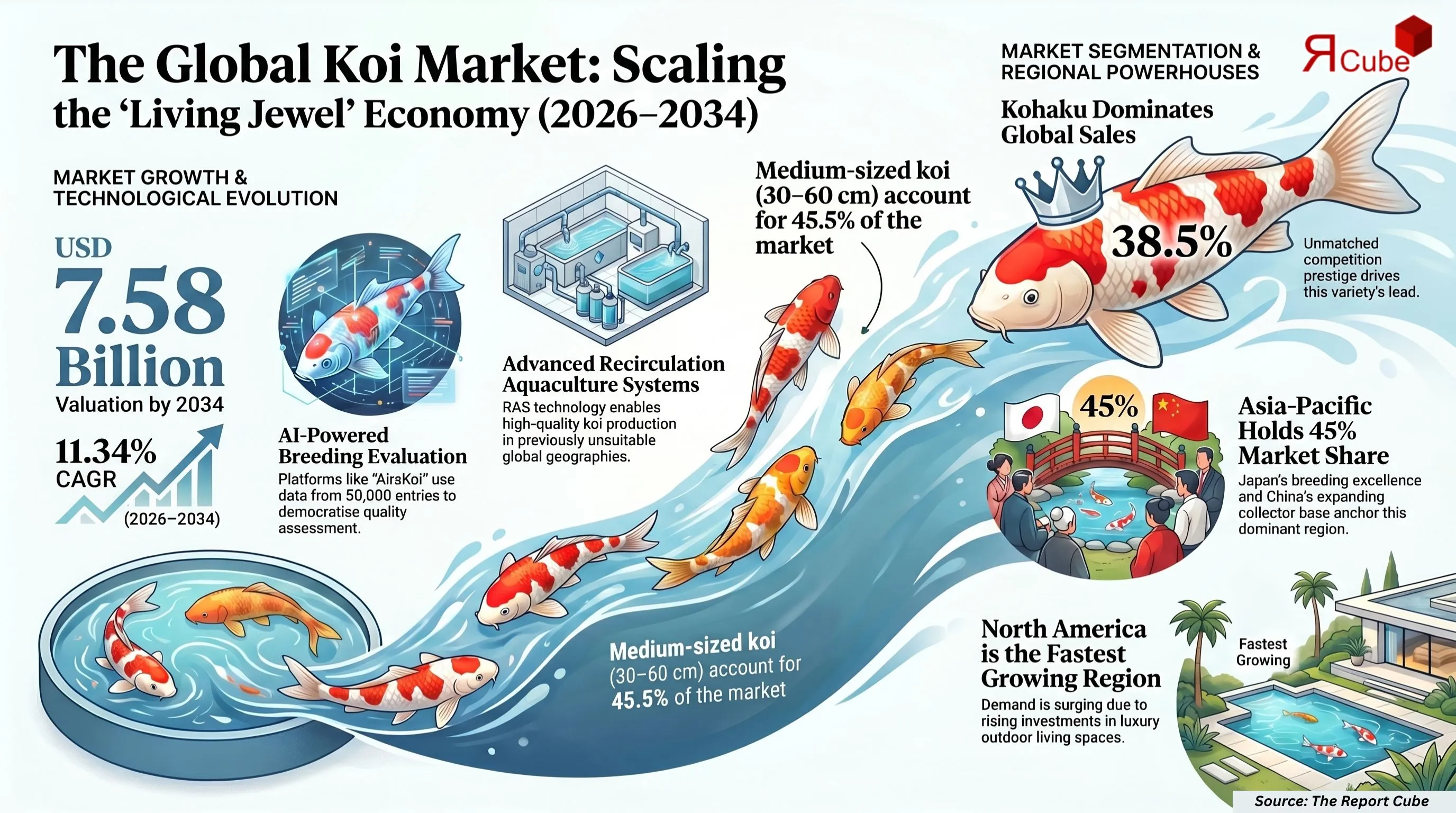
The Global Koi Market is entering a period of sustained and accelerating growth, underpinned by cultural reverence, rising affluence, and a maturing ecosystem of digital sales infrastructure. Valued at USD 3.21 billion in 2026, the market is projected to reach USD 7.58 billion by 2034, expanding at a compound annual growth rate (CAGR) of 11.34% over the forecast period. Koi fish, colorful ornamental freshwater varieties of the Amur carp (Cyprinus rubrofuscus), are no longer confined to Japanese temple gardens or Asian hobbyist circles. They have emerged as a globally recognized symbol of prestige, wellness, and aesthetic landscaping, attracting investment from individual collectors, commercial hospitality developers, and wellness retreat operators worldwide.
Several structural forces are reshaping the competitive and geographic boundaries of this market. The resumption of Japanese koi imports into China in October 2024 reopened one of the most commercially significant trade corridors in the ornamental fish industry, while the 55th All Japan Nishikigoi Show in January 2025, where a Showa Sanshoku claimed the world's best designation, reaffirmed competitive breeding culture as a demand accelerator. Meanwhile, innovations in recirculation aquaculture systems (RAS) and AI-assisted breeding evaluation tools are lifting production efficiency and premiumization simultaneously. This report provides a rigorous, data-backed analysis of the Global Koi Market segmented by type and size, covering regional projections, market dynamics, competitive intelligence, and a forward outlook through 2034.
Key Takeaways
- The Global Koi Market is valued at USD 3.21 billion in 2026 and is anticipated to reach USD 7.58 billion by 2034 at a CAGR of 11.34%.
- Kohaku remains the dominant type segment, commanding the largest market share due to deep cultural symbolism and show-competition prestige.
- Asia-Pacific holds approximately 45% of the global market share, led by Japan, China, and South Korea, with China representing the most dynamic growth corridor.
- The resumption of Japanese koi exports to China in October 2024 materially altered the bilateral trade flow for premium-grade Nishikigoi, benefiting farms such as Dainichi Koi Farm, Sakai Fish Farm, and Isa Koi Farm.
- Medium-size koi command the largest share of the By Size segment, balancing accessibility with collector value.
- AI-assisted evaluation platforms, including the "AirsKoi" system trained on over 50,000 competition entries, are transforming quality assessment and virtual show participation.
- Recirculation aquaculture systems (RAS) and molecular breeding techniques are improving disease resistance and color vibrancy, raising average selling prices for premium varieties.
- North America is the fastest-growing import region, driven by rising interest in luxury landscaping and garden water features.
Global Koi Market Overview
Koi fish have been selectively bred in Japan since the early 19th century in the Niigata Prefecture, where the combination of mineral-rich snowmelt water and centuries of accumulated breeding knowledge produced what collectors now call Nishikigoi, "living jewels." This cultural and aesthetic foundation has proved remarkably durable as a commercial force, enabling the Global Koi Market to sustain double-digit growth rates even through global supply chain disruptions and trade policy volatility.
The market encompasses the breeding, trade, and care of ornamental koi across multiple commercial layers: primary production at breeding farms, wholesale and export channels, retail and e-commerce distribution, and an expanding ecosystem of related products including premium koi food, filtration systems, health and biosecurity products, and pond construction services. While the ornamental fish sector broadly is supported by growing pet ownership trends, koi occupy a distinct premium tier. A champion-quality Kohaku from Sakai Fish Farm has fetched prices exceeding USD 1.8 million at auction, underscoring a market dynamic where biological aesthetics and cultural provenance converge to create extraordinary value density.
Global aquaculture production surpassed 185 million tonnes in 2023, according to the Food and Agriculture Organization, and the ornamental subset, though numerically small, commands disproportionate economic value per unit. The U.S. ornamental fish industry alone contributed over USD 1.5 billion to the domestic economy as of 2020, with koi representing an outsized share of that premium segment. The expansion of international koi trade, certified disease-free biosecurity frameworks, and digital sales platforms are collectively enabling the ornamental fishkeeping market to absorb new geographic demand centers in Europe, Southeast Asia, the Middle East, and Latin America.
Global Koi Market Dynamics
Key Market Driver: Aquaculture Sector Expansion Elevating Koi Production Capacity Globally
The single most consequential structural driver in this market is the accelerating professionalization of koi aquaculture. Recirculation aquaculture systems, closed-loop water management infrastructure that recycles up to 98% of water while maintaining precise temperature, oxygen, and pH parameters, are enabling farms in China, the Netherlands, and the United States to produce high-quality koi at scale and in geographies previously unsuitable for traditional pond rearing. Jiahe Tianyuan's announced capacity expansion in January 2023 was explicitly targeted at satisfying rising international demand, reflecting a strategic recognition that supply infrastructure had become the binding constraint on revenue growth. In Australia, the government-linked ABARES agency projected aquaculture production to reach AUS 2.21 billion by 2028-29, accounting for 64% of total national seafood production value, a policy signal that commercial aquaculture is receiving institutional backing that benefits the broader ornamental segment.
Major Industry Challenge: Disease Susceptibility and Biosecurity Cost Burden Constraining Market Accessibility
Koi's biological vulnerability to pathogens, including Koi Herpesvirus (KHV), Columnaris disease, and parasitic infections, represents the most persistent structural restraint on market expansion. Disease outbreaks can devastate entire pond populations in days, and the regulatory infrastructure for certified disease-free exports is both costly and time-consuming. The November 2023 suspension of Chinese import permits for Japanese koi farms, driven by biosecurity concerns, cost Japanese exporters a critical trading season and forced a difficult repricing of premium inventory. For smaller farms in emerging markets, investment in water quality monitoring systems, veterinary protocols, and international certification adds a substantial fixed-cost burden that restricts entry and limits supply diversity. This challenge is particularly acute in the Large-size koi segment, where extended grow-out periods amplify biosecurity exposure windows.
Need Specific Data, Let’s Customize the Report for You
Request CustomizationEmerging Trend Shaping Outlook: AI-Powered Breeding Evaluation and Virtual Competition Infrastructure Reshaping Demand
The integration of artificial intelligence into koi evaluation and show participation is a genuinely disruptive development with few parallels in any companion-animal market. The "AirsKoi" platform, trained on over 50,000 Nishikigoi competition entries from the All Japan Nishikigoi Show archive, can evaluate a fish's competition potential from uploaded images and video. The 55th All Japan Nishikigoi Show in January 2025, which crowned a Showa Sanshoku as world champion, simultaneously featured AI-assisted judging tools alongside traditional expert panels.
This convergence is significant because it democratizes quality assessment for collectors in geographies without access to certified ZNA (Zen Nippon Airinkai) judges, potentially unlocking demand from Southeast Asia, Eastern Europe, and the Middle East where hobbyist communities are growing rapidly but institutional expertise is thin. Virtual koi shows and online auction platforms further reduce geographic friction, enabling Chinese collectors to bid on Japanese championship lineage fish without physical inspection, a direct contributor to the bilateral trade resumption of October 2024.
Global Koi Market Segmentation Analysis
By Type
|
Sub-Segment |
Market Share (%) |
Key Driver |
Competitive Intensity |
|---|---|---|---|
|
Kohaku |
38.5% |
Championship show dominance and oldest cultural pedigree driving collector premium |
High |
|
Taisho Sanke |
22.0% |
Tri-color red-white-black pattern favored in commercial hospitality pond installations |
High |
|
Showa Sanke |
21.5% |
2025 All Japan champion title elevating global auction demand for Showa bloodlines |
High |
|
Others (Yamabuki Ogon, Asagi, Shusui, Tancho) |
18.0% |
Growing collector diversification into rare metallic and single-color ornamental varieties |
Medium |
The Kohaku segment's leadership position is structurally entrenched rather than merely fashionable. As the oldest formalized koi variety, selectively bred in Niigata since the 1880s, Kohaku carries the deepest institutional validation in show competition culture, commanding the most consistent premium across all transaction tiers from hobbyist retail to championship auction. The 55th All Japan Nishikigoi Show in January 2025 saw Showa Sanshoku claim the overall champion designation, and this competitive outcome has measurably accelerated Showa Sanke demand among collectors seeking the next cycle's winning bloodlines, a pattern that typically lifts prices for Showa-lineage fish from farms like Dainichi Koi Farm and Sakai Fish Farm in the 12–18 months following a major championship. The Others segment, covering metallic Ogon varieties, Asagi, and Shusui, is the fastest-growing sub-segment as collector portfolios mature beyond the three canonical varieties, with Yamabuki Ogon and Platinum Ogon generating outsized interest among interior water feature designers in the Middle East and Southeast Asia.
By Size
|
Sub-Segment |
Market Share (%) |
Key Driver |
Competitive Intensity |
|---|---|---|---|
|
Small (under 30 cm) |
29.0% |
Entry-level retail demand from first-time hobbyists and indoor koi pond adopters |
Medium |
|
Medium (30–60 cm) |
45.5% |
Balanced collector value proposition combining visual impact with manageable pond requirements |
High |
|
Large (over 60 cm) |
25.5% |
High-net-worth collector and commercial hospitality procurement driving Jumbo Koi premium |
Medium |
The Medium-size segment dominates by capturing the broadest cross-section of demand: experienced hobbyists upgrading from starter fish, gift purchasers, and commercial pond operators who need visual impact without the biosecurity complexity of multi-year Large grow-outs. Medium koi typically represent the peak of the price-to-size curve, where pattern maturity and color depth have developed sufficiently to command collector premiums while remaining within shipping logistics parameters for international trade. The Large segment, encompassing "Jumbo" koi over 80 cm that have become trophy assets for luxury resort developers in the UAE, Thailand, and Singapore, is growing at the strongest rate among size sub-segments, driven by an expansion of high-end hospitality investment that favors statement water features. This Large-size demand creates a commercially distinct pipeline for championship farms willing to invest in the 3–5 year grow-out cycles that Jumbo production requires.
Regional Projection of Global Koi Market
- Asia-Pacific leads the global market, accounting for approximately 45% of total revenue in 2024, anchored by Japan's unmatched breeding excellence, China's vast and fast-growing collector base, South Korea's expanding hobbyist community, and Taiwan's emerging export-capable breeding infrastructure. Japan's Niigata Prefecture alone accounts for the majority of globally recognized championship-grade koi production. China's partial resumption of Japanese aquatic product imports in June 2025, covering prefectures outside the Fukushima-affected zone, has further reinforced Asia-Pacific's structural dominance.
- North America holds approximately 25% of global market share and registers the fastest CAGR among developed-market regions, driven by accelerating investment in luxury outdoor living spaces, growth of koi hobbyist associations, and the expansion of domestic breeding farms in the United States and Canada.
- Europe maintains a significant and stable share, with the United Kingdom, Germany, and the Netherlands as the leading markets. European demand skews toward premium Japanese-imported varieties, and the Netherlands has developed a domestic koi breeding industry that supplies mid-range hobbyist demand across the continent.
- Middle East and Africa, Latin America remain smaller markets but are growing from a low base, with UAE hotel and resort developers emerging as notable Large-size koi procurement drivers.
Global Koi Market: Recent Development (2025)
- In January 2025, the 55th All Japan Nishikigoi Show crowned a Showa Sanshoku bred by Dainichi Koi Farm as the world champion, triggering a documented surge in international inquiries for Dainichi-lineage Showa fish and reinforcing the farm's position as the benchmark competitor in the tri-color category. Dainichi's online auction platform, launched in 2023, facilitated direct sales to Chinese and Southeast Asian buyers following the championship.
- Sakai Fish Farm, which produced the world's most expensive koi sold at auction (a Kohaku valued at USD 1.8 million), expanded its digital auction infrastructure in early 2025 to accommodate buyers from restored China trade channels, with international sales revenues estimated to have grown by double digits year-over-year following the October 2024 bilateral trade resumption.
- China's General Administration of Customs issued GACC Announcement No. 140 in June 2025, conditionally resuming aquatic product imports from approved Japanese prefectures. While Niigata, home to the majority of Japan's premium koi farms, was initially excluded from the June 2025 partial resumption, the October 2024 koi-specific framework had already reopened six certified farms in Niigata, Fukuoka, and Hiroshima, establishing a compliance certification pathway that other farms are actively pursuing.
- Jiahe Tianyuan completed its second phase of breeding facility expansion in Guangdong Province in 2025, adding approximately 40,000 square meters of recirculation aquaculture tank capacity to its existing outdoor pond operations, targeting both domestic Chinese demand and Southeast Asian export markets.
Global Koi Market Future Outlook (2034)
The Global Koi Market is on course to reach USD 7.58 billion by 2034, sustaining an 11.34% CAGR through a combination of structural demand growth and supply-side premiumization. Three forces are likely to define the market's long-term trajectory. First, AI-driven breeding evaluation, including the commercialization of genomic selection tools that predict color expression and disease resistance before fish reach marketable size, will compress development timelines and improve return on breeding investment for professional farms.
Second, sustainable aquaculture certification frameworks, already emerging through the British Koi Keepers Society and international aquaculture standards bodies, will increasingly function as market access credentials for premium-tier exports, rewarding early-mover farms with regulatory and reputational advantages. Third, the expansion of koi therapy and wellness applications, where ornamental ponds are integrated into healthcare and hospitality settings, opens an entirely new institutional demand category that no competitor report has yet quantified. By 2034, the market's geographic center of gravity will shift marginally westward as North America, Europe, and the Middle East absorb a growing share of premium trade flows while Asia-Pacific retains production leadership.
Global Koi Market Report Coverage
|
Report Features |
Details |
|---|---|
|
Market Size (2026) |
USD 3.21 Billion |
|
Market Size (2034) |
USD 7.58 Billion |
|
CAGR (2026-2034) |
11.34% |
|
Base Year |
2026 |
|
Forecast Period |
2026–2034 |
|
Historical Data |
2021–2025 |
|
Segments Covered |
By Type; By Size; By Application; By Distribution Channel |
|
Regions Covered |
Asia-Pacific, North America, Europe, Middle East & Africa, Latin America |
|
Key Players |
Liuji, Jiahe Tianyuan, Wanjin, Chongqing Shanghua, Guangzhou Zhengda Aquatic, Marusei Koi Farm, Dainichi Koi Farm, Sakai Fish Farm, Ogata Koi Farm, Isa Koi Farm, Matsue Koi Farm, Omosako Koi Farm, Konishi Koi Farm, Hiroi Koi Farm, Others |
|
Delivery Format |
PDF, PPT & Excel |
|
Customization |
Available |
Why Choose This Report?
- Provides a comprehensive overview of the overall market analysis, encompassing key trends, consumer behavior analysis, and risk assessment to support strategic decision-making.
- Provides accurate, up-to-date insights into market size, segmentation, and emerging opportunities, helping to minimize risk & capitalizing on growth.
- Gives deep understanding of target audience preferences, investment habits, and communication channels for enhanced product development & marketing effectiveness.
- Delivers competitive analysis & benchmarking, uncovering the strengths & weaknesses of market competitors to guide strategies.
- Consolidate comprehensive market intelligence, reducing reasoning & streamlining research efforts.
- Facilitates customized market segmentation & risk mitigation strategies, fine-tuned to the business objectives.
- Aids in identifying both market challenges & untapped opportunities within the industry to drive long-term business growth.
- Provides valuable information based on actual customer data & search trends.
Table of Contents
- Introduction
- Objective of the study
- Product Definition
- Market Segmentation
- Study Variables
- Research Methodology
- Secondary Data Points
- Companies Interviewed
- Primary Data Points
- Breakdown of Primary Interviews
- Secondary Data Points
- Executive Summary
- Market Dynamics
- Drivers
- Challenges
- Opportunity Assessment
- Recent Trends and Developments
- Policy and Regulatory Landscape
- Global Koi Market Overview and Forecast Analysis (2021-2034)
- Market Size, By Value, By growth rate (CAGR/USD Billions)
- Demand - Supply Trends
- Market Share, By Type
- Kohaku
- Taisho Sanke
- Showa Sanke
- Others
- Market Share, By Size
- Small
- Medium
- Large
- Market Share, By Application
- Residential
- Commercial
- Retail
- Market Share, By Region
- Asia-Pacific
- North America
- Europe
- Middle East and Africa
- Latin America
- Market Share, By Company
- Revenue Shares
- Competition Characteristics
- North America Koi Market Overview (2021-2034)
- Market Size, By Value (in USD Billions)
- Market Share, By Type
- Market Share, By Size
- Market Share, By Application
- Market Share, By Distribution Channel
- By Country
- The US
- Canada
- Mexico
- The US Koi Market Overview (2021-2034)
- Market Share, By Type
- Market Share, By Size
- Market Share, By Application
- Market Share, By Distribution Channel
- Canada Koi Market Overview (2021-2034)
- Market Share, By Type
- Market Share, By Size
- Market Share, By Application
- Market Share, By Distribution Channel
- Mexico Koi Market Overview (2021-2034)
- Market Share, By Type
- Market Share, By Size
- Market Share, By Application
- Market Share, By Distribution Channel
- South America Koi Market Overview (2021-2034)
- Market Size, By Value (in USD Billions)
- Market Share, By Type
- Market Share, By Size
- Market Share, By Application
- Market Share, By Distribution Channel
- By Country
- Brazil
- Argentina
- Rest of South America
- Brazil Koi Market Overview (2021-2034)
- Market Share, By Type
- Market Share, By Size
- Market Share, By Application
- Market Share, By Distribution Channel
- Argentina Koi Market Overview (2021-2034)
- Market Share, By Type
- Market Share, By Size
- Market Share, By Application
- Market Share, By Distribution Channel
- Europe Koi Market Overview (2021-2034)
- Market Size, By Value (in USD Billions)
- By Type
- By Size
- By Application
- By Distribution Channel
- By Country
- Germany
- The UK
- France
- Spain
- Italy
- Rest of Europe
- Germany Koi Market Overview (2021-2034)
- Market Share, By Type
- Market Share, By Size
- Market Share, By Application
- Market Share, By Distribution Channel
- France Koi Market Overview (2021-2034)
- Market Share, By Type
- Market Share, By Size
- Market Share, By Application
- Market Share, By Distribution Channel
- The UK Koi Market Overview (2021-2034)
- Market Share, By Type
- Market Share, By Size
- Market Share, By Application
- Market Share, By Distribution Channel
- Spain Koi Market Overview (2021-2034)
- Market Share, By Type
- Market Share, By Size
- Market Share, By Application
- Market Share, By Distribution Channel
- Italy Koi Market Overview (2021-2034)
- Market Share, By Type
- Market Share, By Size
- Market Share, By Application
- Market Share, By Distribution Channel
- The Middle East & Africa Koi Market Overview (2021-2034)
- Market Size, By Value (in USD Billions)
- By Type
- By Size
- By Application
- By Distribution Channel
- By Country
- The UAE
- Saudi Arabia
- South Africa
- Rest of the Middle East & Africa
- The UAE Koi Market Overview (2021-2034)
- Market Share, By Type
- Market Share, By Size
- Market Share, By Application
- Market Share, By Distribution Channel
- Saudi Arabia Koi Market Overview (2021-2034)
- Market Share, By Type
- Market Share, By Size
- Market Share, By Application
- Market Share, By Distribution Channel
- South Africa Koi Market Overview (2021-2034)
- Market Share, By Type
- Market Share, By Size
- Market Share, By Application
- Market Share, By Distribution Channel
- Asia-Pacific Koi Market Overview (2021-2034)
- Market Size, By Value (in USD Billions)
- By Type
- By Size
- By Application
- By Distribution Channel
- By Country
- China
- India
- Japan
- South Korea
- Australia
- Rest of Asia-Pacific
- China Koi Market Overview (2021-2034)
- Market Share, By Type
- Market Share, By Size
- Market Share, By Application
- Market Share, By Distribution Channel
- India Koi Market Overview (2021-2034)
- Market Share, By Type
- Market Share, By Size
- Market Share, By Application
- Market Share, By Distribution Channel
- Japan Koi Market Overview (2021-2034)
- Market Share, By Type
- Market Share, By Size
- Market Share, By Application
- Market Share, By Distribution Channel
- South Korea Koi Market Overview (2021-2034)
- Market Share, By Type
- Market Share, By Size
- Market Share, By Application
- Market Share, By Distribution Channel
- Austraila Koi Market Overview (2021-2034)
- Market Share, By Type
- Market Share, By Size
- Market Share, By Application
- Market Share, By Distribution Channel
- Competitive Outlook (Company Profile - Partial List)
- Liuji
- Company Overview
- Business Segments
- Strategic Alliances/Partnerships
- Recent Developments
- Jiahe Tianyuan
- Company Overview
- Business Segments
- Strategic Alliances/Partnerships
- Recent Developments
- Wanjin
- Company Overview
- Business Segments
- Strategic Alliances/Partnerships
- Recent Developments
- Chongqing Shanghua
- Company Overview
- Business Segments
- Strategic Alliances/Partnerships
- Recent Developments
- Guangzhou Zhengda Aquatic
- Company Overview
- Business Segments
- Strategic Alliances/Partnerships
- Recent Developments
- Marusei Koi Farm
- Company Overview
- Business Segments
- Strategic Alliances/Partnerships
- Recent Developments
- Dainichi Koi Farm
- Company Overview
- Business Segments
- Strategic Alliances/Partnerships
- Recent Developments
- Sakai Fish Farm
- Company Overview
- Business Segments
- Strategic Alliances/Partnerships
- Recent Developments
- Ogata Koi Farm
- Company Overview
- Business Segments
- Strategic Alliances/Partnerships
- Recent Developments
- Isa Koi Farm
- Company Overview
- Business Segments
- Strategic Alliances/Partnerships
- Recent Developments
- Matsue Koi Farm
- Company Overview
- Business Segments
- Strategic Alliances/Partnerships
- Recent Developments
- Omosako Koi Far
- Company Overview
- Business Segments
- Strategic Alliances/Partnerships
- Recent Developments
- Konishi Koi Farm
- Company Overview
- Business Segments
- Strategic Alliances/Partnerships
- Recent Developments
- Hiroi Koi Farm
- Company Overview
- Business Segments
- Strategic Alliances/Partnerships
- Recent Developments
- Others
- Liuji
- Disclaimer
Top Key Players & Market Share Outlook
- Liuji
- Jiahe Tianyuan
- Wanjin
- Chongqing Shanghua
- Guangzhou Zhengda Aquatic
- Marusei Koi Farm
- Dainichi Koi Farm
- Sakai Fish Farm
- Ogata Koi Farm
- Isa Koi Farm
- Matsue Koi Farm
- Omosako Koi Far
- Konishi Koi Farm
- Hiroi Koi Farm
- Others
Frequently Asked Questions






