



Build Your Custom Market Intelligence Report
Customize Your ReportKey Highlights
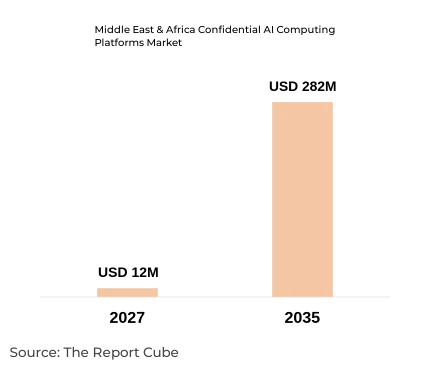
- The Middle East & Africa Confidential AI Computing Platforms Market is assessed using the supplied 2027 value of USD 12.00 Million; the input forecast gives USD 282.00 Million for 2035.
- The supplied CAGR for the Middle East & Africa Confidential AI Computing Platforms Market is 48.38% during 2027–2035.
- The market addresses protection of data while it is processed through hardware-backed trusted execution environments.
- Commercial offerings in the input are Platform Software, Managed Confidential AI Runtime, and Integration and Security Services.
- Deployment options in the input include Public Cloud, Dedicated Private or On-Premises, Sovereign Dedicated Cloud, and Edge and Distributed Sites.
- Demand is linked to sensitive AI workloads, regulated-data collaboration, cloud security and verifiable workload integrity.
- Segment percentages supplied with asterisks lack source, year and measurement basis and are not treated as verified shares.
Market Outlook
Confidential computing protects data in use by executing workloads inside hardware-backed trusted execution environments (TEEs). The Middle East & Africa Confidential AI Computing Platforms Market covers platform software, managed runtime capabilities and services that help customers deploy, attest and operate protected workloads. Its relevance rises when organizations need to use sensitive data without granting broad access to cloud operators, infrastructure administrators or collaborating parties.
Commercial deployment spans public cloud services, dedicated private or on-premises infrastructure, sovereign cloud environments and distributed edge sites. Customers assess the security boundary, processor support, attestation workflow, key-release controls, application compatibility and service availability before moving workloads. Confidential computing is therefore both a hardware capability and a software-and-services market.
The supplied estimates place the Middle East & Africa Confidential AI Computing Platforms Market at USD 12.00 Million in 2027 and USD 282.00 Million in 2035, with a stated CAGR of 48.38% over 2027–2035. These are supplied market inputs, not independently validated public statistics. The growth case is associated with confidential AI, multi-party analytics, cloud modernization and demand for stronger controls over data in use.
The competitive environment includes hyperscale cloud providers, specialist confidential-computing vendors, semiconductor suppliers and enterprise software companies. Adoption remains constrained by heterogeneous hardware, attestation complexity, workload performance, skills requirements and the need to align technical controls with regulatory and customer assurance requirements.
Government Regulations
Confidential AI computing platforms are influenced by cybersecurity, privacy, cloud assurance and sector-specific data-protection requirements rather than one universal product licence. NIST's May 2026 initial public draft on confidential computing describes hardware-enabled protection and remote attestation for cloud workloads. In Europe, GDPR and applicable cybersecurity and sector rules shape processing, access control, transfer and accountability obligations; confidential computing can support technical safeguards but does not itself establish legal compliance. Cloud assurance frameworks such as Germany's BSI C5:2026 describe controls for confidential computing and remote attestation. Buyers should verify processor support, attestation evidence, key management, vulnerability handling, auditability and provider-region availability against their own regulatory obligations.
Middle East & Africa Confidential AI Computing Platforms Market Dynamics
Demand is shaped by sensitive AI adoption, cloud migration, data-sharing requirements, threat models, hardware availability and the ability to prove that workloads are running in an approved environment. These forces influence both platform selection and the level of integration and managed services required.
|
Factor |
Type |
Specific Impact on Market |
Magnitude |
|---|---|---|---|
|
Sensitive AI and analytics workloads |
Driver |
Enables processing of protected data and models inside hardware-backed isolation boundaries |
High |
|
Privacy-preserving data collaboration |
Driver |
Supports multi-party analytics where datasets cannot be freely pooled |
High |
|
Remote and continuous attestation |
Opportunity |
Creates demand for policy, verification and evidence-management capabilities |
Medium-High |
|
Sovereign and dedicated deployment |
Opportunity |
Addresses residency, control and jurisdiction-specific requirements |
Medium-High |
|
Hardware and software fragmentation |
Challenge |
Different TEEs, GPUs, firmware and attestation stacks complicate interoperability |
High |
|
Performance and operating complexity |
Challenge |
Workload tuning, key lifecycle and skills requirements can slow adoption |
Medium-High |
Growth Drivers: Confidential AI, Sensitive Data and Workload Integrity
The NIST IR 8320E initial public draft (May 2026) describes remote attestation as a means to verify that a confidential VM is running in an expected hardware and software configuration. This capability matters for AI and analytics because data protection depends not only on encryption at rest and in transit, but also on the integrity of the environment processing the data. As organizations move sensitive inference, model training and multi-party analytics to cloud infrastructure, the ability to validate workload state and control secret release supports demand for confidential-computing platforms.
Need Specific Data, Let’s Customize the Report for You
Request CustomizationMarket Opportunities: Managed Confidential AI and Continuous Attestation
A key opportunity lies in moving from isolated confidential VMs toward managed confidential AI runtimes, GPU-enabled confidential environments and multi-party data collaboration. Microsoft's Azure portfolio lists confidential VMs, containers, GPU VMs, AI and data services, while Google Cloud documents Confidential Space for collaboration on sensitive datasets. Providers and specialist vendors can differentiate through developer tooling, policy automation, remote attestation, key release and integration with identity and data-governance systems. Adoption still depends on service-region coverage, supported hardware and workload economics.
Industry Challenges: Interoperability, Performance and Security Operations
Confidential computing does not remove all security risks. Applications, guest operating systems, input/output paths, software supply chains and misconfigured access policies remain relevant attack surfaces. TEE technologies also differ across CPU and GPU platforms, creating portability and lifecycle-management challenges. Buyers must evaluate side-channel exposure, firmware updates, attestation roots, incident response and the limits of the provider's trust model instead of treating a confidential-computing label as a complete security guarantee.
Market Trends: Confidential AI, GPU TEEs and Continuous Verification
The market is moving toward confidential AI and accelerated computing, with confidential GPU environments complementing CPU-based confidential VMs. Another trend is continuous rather than one-time attestation: MITRE's July 2026 framework work addresses the need to verify trust throughout workload operation. Cloud providers are also packaging confidential capabilities into databases, analytics, containers and managed services, which can reduce integration effort while making feature availability and configuration differences more important.
Middle East & Africa Confidential AI Computing Platforms Market Segment Analysis
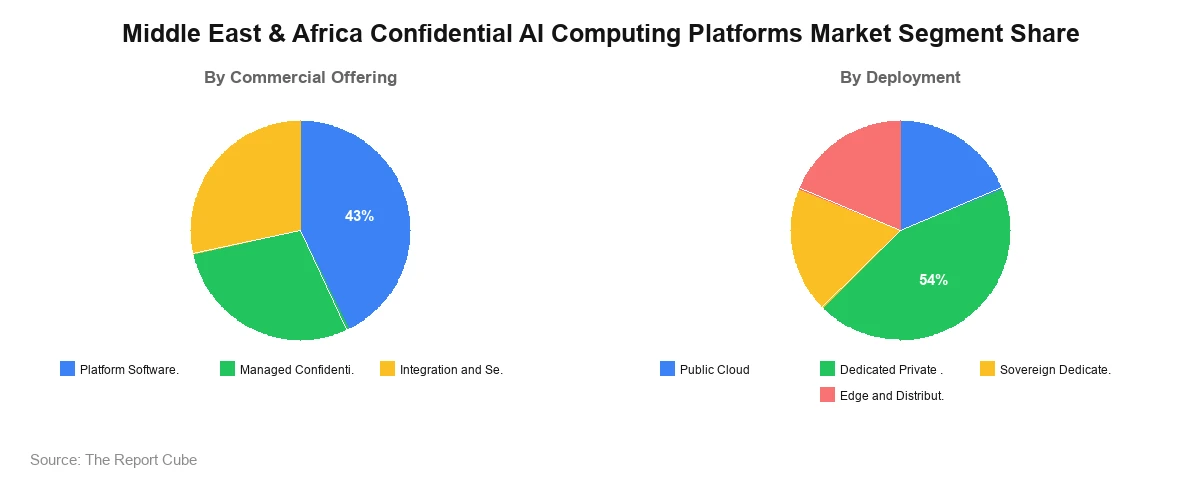
The Middle East & Africa Confidential AI Computing Platforms Market is segmented by commercial offering and deployment. Each category reflects a different demand dimension, from the technology or input used to the route through which the ingredient or service reaches customers.
By Commercial Offering
- Platform Software
- Managed Confidential AI Runtime
- Integration and Security Services
The supplied input identifies Platform Software, Managed Confidential AI Runtime and Integration and Security Services as the commercial-offering segments. Platform Software is assigned an input-only 43% figure, but the source, reference year and measurement basis were not supplied. That percentage is therefore not treated as a verified market share. Demand across the category depends on the degree of control customers need over deployment, attestation, policy management and integration with existing cloud and AI environments.
By Deployment
- Public Cloud
- Dedicated Private or On-Premises
- Sovereign Dedicated Cloud
- Edge and Distributed Sites
The deployment category includes Public Cloud, Dedicated Private or On-Premises, Sovereign Dedicated Cloud and Edge and Distributed Sites. Dedicated Private or On-Premises carries an input-only 54% figure without a cited source, year or denominator, so it is not presented as a validated share. Deployment choice is shaped by data residency, workload sensitivity, latency, infrastructure control and the availability of hardware-backed trusted execution environments.
Competitive Landscape
The Middle East & Africa Confidential AI Computing Platforms Market includes the supplied key players listed below. The table describes broad participation and does not imply market ranking or market share. Company capabilities are based on official product or company information where available; the presence of a company in the supplied list is not, by itself, proof of a leading position in every geography.
|
Company |
Competitive Strength / Capability |
Primary Segment / Focus |
|---|---|---|
|
Microsoft Azure |
Cloud infrastructure and confidential-computing services documented by the provider |
Public cloud, confidential VMs and protected workloads |
|
Google Cloud |
Cloud infrastructure and confidential-computing services documented by the provider |
Public cloud, confidential VMs and protected workloads |
|
Amazon Web Services |
Cloud infrastructure and confidential-computing services documented by the provider |
Public cloud, confidential VMs and protected workloads |
|
Fortanix |
Supplied participant; current product-level scope should be checked against official company documentation |
Platform software, runtime or integration services |
|
Anjuna |
Supplied participant; current product-level scope should be checked against official company documentation |
Platform software, runtime or integration services |
|
Edgeless Systems |
Supplied participant; current product-level scope should be checked against official company documentation |
Platform software, runtime or integration services |
|
Decentriq |
Supplied participant; current product-level scope should be checked against official company documentation |
Platform software, runtime or integration services |
|
IBM |
Supplied participant; current product-level scope should be checked against official company documentation |
Platform software, runtime or integration services |
|
NVIDIA |
GPU and accelerated-computing ecosystem supporting confidential workloads |
Confidential AI and GPU infrastructure |
|
Red Hat |
Supplied participant; current product-level scope should be checked against official company documentation |
Platform software, runtime or integration services |
- Microsoft Azure: Microsoft documents confidential VMs based on AMD SEV-SNP and Intel TDX, confidential containers, GPU-enabled confidential VMs, data services and selected AI services. Its Azure Attestation service supports remote verification of trusted execution environments. This breadth positions Azure across infrastructure, platform and integration layers; availability varies by service and region.
- Google Cloud: Google Cloud offers Confidential VMs, Confidential GKE, Confidential Dataflow, Confidential Dataproc and Confidential Space. Its documentation describes encryption of data in use and attestation for verifying confidential environments. The portfolio supports infrastructure and collaborative analytics use cases, with product and machine-type availability varying by service.
Recent Developments and Updates
- 16 July 2026: MITRE published its Framework for Continuous Remote Attestation, describing an implementation-neutral approach to continuously verifiable trust for cloud and AI workloads. The work reflects a shift beyond boot-time checks toward runtime verification.
- May 2026: NIST released the initial public draft of IR 8320E on hardware-enabled confidential computing of data in cloud workloads, including remote attestation and verification concepts.
- 2026 product documentation: Microsoft's Azure confidential-computing product documentation lists confidential VMs, containers, GPU VMs and confidential data and AI services, showing the expansion of the offer beyond isolated enclave infrastructure.
Middle East & Africa Confidential AI Computing Platforms Market Future Outlook
The market is likely to develop around confidential AI, GPU-enabled TEEs, managed runtimes and continuous attestation. Public cloud may remain important for scale and service integration, while dedicated, sovereign and edge deployments will matter where control, latency or jurisdictional constraints dominate. The commercial winners will need broad hardware support, reliable attestation, developer usability and transparent security boundaries. Growth will be moderated by cost, performance overhead, fragmented implementations and the need to secure the full application stack.
Middle East & Africa Confidential AI Computing Platforms Market Report Coverage
This Middle East & Africa Confidential AI Computing Platforms Market report summarizes the supplied market valuation and forecast, segmentation, geographic framework, regulatory context and competitive ecosystem for the stated study period.
|
Parameter |
Details |
|---|---|
|
Market Name |
Middle East & Africa Confidential AI Computing Platforms Market |
|
2027 Market Value |
USD 12.00 Million |
|
2035 Market Value |
USD 282.00 Million |
|
CAGR |
48.38% |
|
Base Year |
2026 |
|
Historical Period |
2022-2026 |
|
Forecast Period |
2027-2034 |
|
Geographic Scope |
Middle East & Africa Confidential AI Computing Platforms |
|
Key Companies |
Microsoft Azure, Google Cloud, Amazon Web Services, Fortanix, Anjuna, Edgeless Systems, Decentriq, IBM, NVIDIA, Red Hat |
Why Choose This Middle East & Africa Confidential AI Computing Platforms Market Report?
- Sets out the supplied 2027 value, 2035 forecast and 48.38% CAGR for the Middle East & Africa Confidential AI Computing Platforms Market.
- Retains both supplied segmentation categories and every listed subsegment for the Middle East & Africa Confidential AI Computing Platforms Market.
- Explains the drivers, opportunities, challenges and trends shaping the Middle East & Africa Confidential AI Computing Platforms Market.
- Provides geographic context for Middle East & Africa Confidential AI Computing Platforms and identifies where comparable regional share data are unavailable.
- Reviews the supplied company list without inventing market rankings or revenue shares.
- Summarizes relevant regulatory and technical considerations for the Middle East & Africa Confidential AI Computing Platforms Market.
- Separates supplied estimates, official-source evidence and data gaps to support more transparent decisions.
Table of Contents
- Introduction
- Objective of the Study
- Product Definition
- Market Segmentation
- Study Variables
- Research Methodology
- Secondary Data Points
- Companies Interviewed
- Primary Data Points
- Breakdown of Primary Interviews
- Secondary Data Points
- Executive Summary
- Market Dynamics
- Drivers
- Challenges
- Opportunity Assessment
- Recent Trends and Developments
- Policy and Regulatory Landscape
- Middle East & Africa Confidential AI Computing Platforms Market Overview and Forecast Analysis (2022-2035)
- Market Size, By Value, By Growth Rate (CAGR/USD Millions)
- Demand – Supply Trends
- Market Share, By Commercial Offering
- Platform Software
- Managed Confidential AI Runtime
- Integration and Security Services (Attestation, onboarding, integration and support)
- Market Share, By Primary AI Workload
- Protected Model Training (Pretraining, fine-tuning)
- Confidential AI Inference (Private inference, model serving)
- Protected Retrieval and Analytics (RAG, data querying and analytics)
- Secure Multi-Party AI
- Market Share, By Trusted Execution Design
- CPU-Based TEE
- GPU-Based TEE
- End-to-End CPU and GPU TEE
- Market Share, By Deployment
- Public Cloud
- Dedicated Private or On-Premises
- Sovereign Dedicated Cloud
- Edge and Distributed Sites
- Market Share, By End-Use Sector
- BFSI (Banking, insurance, capital markets)
- Healthcare and Life Sciences (Healthcare, pharmaceuticals, research)
- Government and Defence (Public-sector agencies, defense)
- Industrial and Technology (Manufacturing, technology, telecom)
- Other Enterprises (Retail, legal, professional services, others)
- Market Share, By Competitors
- Competition Characteristics
- Revenue Shares
- Platform Software Middle East & Africa Confidential AI Computing Platforms Market Overview, 2022-2035F
- By Value (USD Million)
- By Primary AI Workload – Market Size & Forecast 2022-2035, USD Million
- Protected Model Training (Pretraining, fine-tuning)
- Confidential AI Inference (Private inference, model serving)
- Protected Retrieval and Analytics (RAG, data querying and analytics)
- Secure Multi-Party AI
- Managed Confidential AI Runtime Middle East & Africa Confidential AI Computing Platforms Market Overview, 2022-2035F
- By Value (USD Million)
- By Primary AI Workload – Market Size & Forecast 2022-2035, USD Million
- Protected Model Training (Pretraining, fine-tuning)
- Confidential AI Inference (Private inference, model serving)
- Protected Retrieval and Analytics (RAG, data querying and analytics)
- Secure Multi-Party AI
- Integration and Security Services Middle East & Africa Confidential AI Computing Platforms Market Overview, 2022-2035F
- By Value (USD Million)
- By Primary AI Workload – Market Size & Forecast 2022-2035, USD Million
- Protected Model Training (Pretraining, fine-tuning)
- Confidential AI Inference (Private inference, model serving)
- Protected Retrieval and Analytics (RAG, data querying and analytics)
- Secure Multi-Party AI
- Competitive Outlook (Company Profile – Partial List)
- Microsoft Azure
- Company Overview
- Business Segments
- Strategic Alliances/Partnerships
- Recent Developments
- Google Cloud
- Company Overview
- Business Segments
- Strategic Alliances/Partnerships
- Recent Developments
- Amazon Web Services
- Company Overview
- Business Segments
- Strategic Alliances/Partnerships
- Recent Developments
- Fortanix
- Company Overview
- Business Segments
- Strategic Alliances/Partnerships
- Recent Developments
- Anjuna
- Company Overview
- Business Segments
- Strategic Alliances/Partnerships
- Recent Developments
- Edgeless Systems
- Company Overview
- Business Segments
- Strategic Alliances/Partnerships
- Recent Developments
- Decentriq
- Company Overview
- Business Segments
- Strategic Alliances/Partnerships
- Recent Developments
- IBM
- Company Overview
- Business Segments
- Strategic Alliances/Partnerships
- Recent Developments
- NVIDIA
- Company Overview
- Business Segments
- Strategic Alliances/Partnerships
- Recent Developments
- Red Hat
- Company Overview
- Business Segments
- Strategic Alliances/Partnerships
- Recent Developments
- Microsoft Azure
- Contact Us & Disclaimer
Top Key Players & Market Share Outlook
- Microsoft Azure
- Google Cloud
- Amazon Web Services
- Fortanix
- Anjuna
- Edgeless Systems
- Decentriq
- IBM
- NVIDIA
- Red Hat
Frequently Asked Questions