



Build Your Custom Market Intelligence Report
Customize Your ReportGCC Municipal Solid Waste Management Market Key Highlights
By Waste Type:
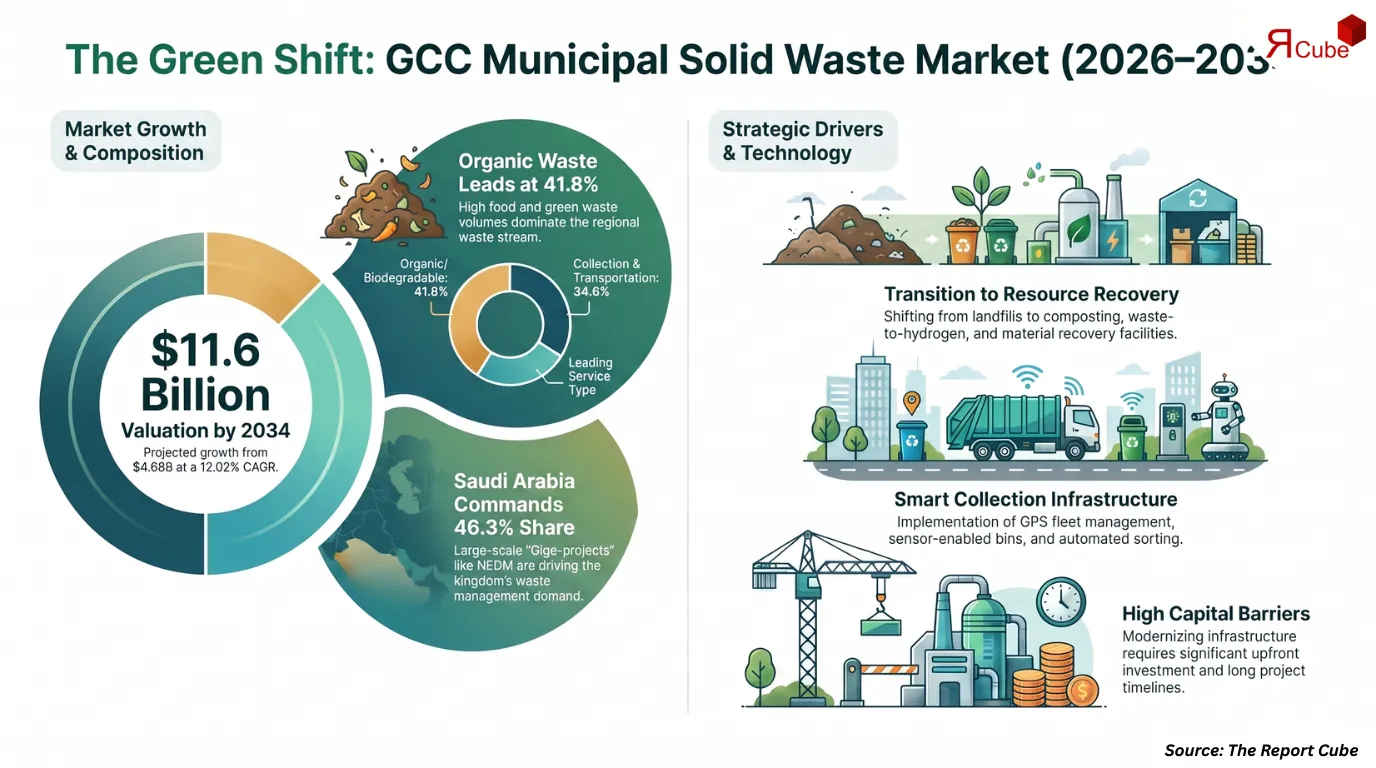
Organic/Biodegradable Waste segment leads the market with approximately 41.8% share.
By Service Type:
Collection & Transportation dominates the market with nearly 34.6% of total revenue.
Regional Outlook:
Saudi Arabia dominates the GCC Municipal Solid Waste Management Market with around 46.3% share.
GCC Municipal Solid Waste Management Market Insights & Analysis
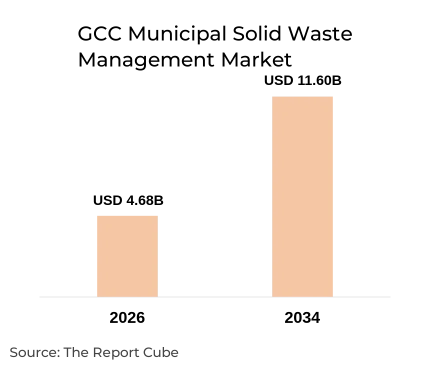
The GCC Municipal Solid Waste Management Market is projected to register a CAGR of around 12.02% during the forecast period of 2026-2034. The market size is valued at USD 4.68 billion in 2026 and is forecast to reach USD 11.60 billion by 2034. Strong population growth, rising urbanization, and expanding economic diversification programs are significantly increasing municipal solid waste generation throughout the Gulf Cooperation Council. Residential communities, commercial centers, industrial zones, and tourism destinations continue to produce larger volumes of municipal waste, creating sustained demand for efficient collection, transportation, recycling, treatment, and disposal services. Governments across the region are shifting from conventional landfill-based practices toward integrated solid waste management systems that prioritize resource recovery, landfill diversion, and environmental sustainability. This transition is encouraging municipalities to modernize waste infrastructure through automated sorting facilities, engineered landfills, biological treatment plants, and advanced recycling technologies capable of improving operational efficiency while reducing environmental impacts.
Long-term national development strategies are strengthening investment across the market. Saudi Arabia's Vision 2030, the UAE Circular Economy Policy, and similar sustainability frameworks in Qatar, Oman, Bahrain, and Kuwait continue to encourage public and private sector collaboration for developing modern municipal waste infrastructure. Governments are increasingly awarding long-term concession agreements covering municipal waste collection, material recovery, recycling, composting, refuse-derived fuel production, and waste-to-energy facilities. At the same time, digital technologies, including GPS-enabled fleet management, smart waste bins, automated material recovery systems, and real-time operational monitoring, are improving collection efficiency and reducing operating costs. Growing investment in circular economy projects is also expanding the commercial value of recyclable materials and recovered resources, supporting sustainable growth across the regional municipal waste management industry.
GCC Municipal Solid Waste Management Market Impact Analysis
| Factor | Type | Specific Impact on Market | Magnitude | Business Implication |
|---|---|---|---|---|
| High Urbanization and Waste Volumes | Market | Large urban population generates rising municipal solid waste | High | Ensures strong demand for collection and treatment services |
| Government Sustainability Initiatives | Regulatory | National agendas promote recycling and landfill diversion goals | High | Creates incentives for advanced recycling and recovery projects |
| Growing Plastic and Packaging Waste | Environmental | High plastic share increases need for sorting and recycling | High | Drives investment in material recovery and reuse facilities |
| Dominance of Collection and Transport | Market | Core services hold majority share of sector revenue streams | Medium | Supports long term municipal service contracts and scale |
| Capital Intensive Waste to Energy | Technological | High setup costs slow deployment of new WtE facilities | Medium | Requires blended finance and partnerships to be viable |
| Fragmented Competitive Landscape | Competitive | Many local and regional players share project opportunities | Medium | Enables consolidation and alliances to win larger contracts |
| Smart Systems and Digital Routing | Technological | Use of data improves routing, cost efficiency and reliability | Medium | Offers edge to operators investing in digital fleet solutions |
GCC Municipal Solid Waste Management Market Dynamics
Key Driver: National Sustainability Programs and Urban Infrastructure Expansion Increase Demand for Integrated Waste Management
Rapid urban growth remains a primary factor supporting the expansion of the GCC Municipal Solid Waste Management Market. Cities across Saudi Arabia, the United Arab Emirates, Qatar, Kuwait, Oman, and Bahrain continue to experience rising population density, large residential developments, expanding commercial districts, and significant tourism activity. These developments are generating higher volumes of municipal solid waste each year, increasing the need for reliable municipal waste collection, recycling, treatment, and disposal services. Food waste, plastic packaging, paper products, glass containers, and mixed household waste account for a substantial share of municipal waste streams, requiring continuous improvements in waste handling capacity and collection efficiency.
Government investment is accelerating the transition toward integrated solid waste management across the region. Authorities are prioritizing infrastructure that combines waste collection, segregation, recycling, biological treatment, engineered landfill management, and energy recovery within a unified operational framework. Public-private partnership models are attracting experienced international operators while encouraging technology transfer and operational best practices. These initiatives are improving service quality, supporting landfill diversion targets, and creating a more resilient municipal waste management ecosystem capable of meeting the region's long-term environmental and economic objectives.
Industry Trend: Resource Recovery and Circular Economy Practices Continue to Reshape Municipal Waste Management
Municipal authorities throughout the GCC are placing greater emphasis on maximizing resource recovery rather than relying primarily on landfill disposal. Investments in advanced material recovery facilities, composting plants, refuse-derived fuel production, and waste-to-energy projects are increasing as governments seek to improve recycling rates and reduce greenhouse gas emissions. Organic waste is increasingly being processed into compost and bio-methane, while plastics, metals, paper, and glass are recovered through automated sorting systems capable of producing higher-quality recyclable materials. These developments support national sustainability goals while creating additional revenue opportunities from recovered resources.
Technology adoption is becoming an important differentiator across municipal waste operations. Smart collection systems equipped with sensor-enabled waste bins, GPS-monitored collection vehicles, route optimization software, and digital performance dashboards are helping municipalities improve operational efficiency and reduce fuel consumption. Growing investment in electric waste collection fleets and automated transfer stations further reflects the region's commitment to lower-emission municipal services. As integrated solid waste management becomes a central component of urban planning, demand for modern recycling and resource recovery infrastructure is expected to strengthen throughout the forecast period.
Book your FREE 30-minute expert consultation today
Contact UsMajor Challenge: Infrastructure Gaps and High Capital Requirements Continue to Affect Market Development
Although investment activity across the GCC Municipal Solid Waste Management Market continues to increase, establishing advanced waste management infrastructure requires substantial financial commitments. Material recovery facilities, composting plants, waste-to-energy projects, engineered landfills, transfer stations, and specialized collection fleets involve considerable upfront capital expenditure along with long project development timelines. Smaller municipalities may encounter budget limitations that delay infrastructure upgrades or restrict the adoption of advanced waste treatment technologies. Maintaining operational efficiency while meeting increasingly stringent environmental standards also places additional financial pressure on service providers.
Operational challenges extend beyond infrastructure investment. Source segregation practices remain inconsistent across several municipalities, resulting in mixed waste streams that reduce recycling efficiency and increase processing costs. Recyclable material prices also fluctuate according to international commodity markets, influencing the commercial viability of recycling operations. Addressing these challenges will require stronger public participation, harmonized waste management regulations, expanded recycling infrastructure, and continued investment in public awareness initiatives that encourage waste segregation at the household and commercial levels.
Opportunity: Advanced Waste Processing Technologies Create New Revenue Opportunities Across the GCC
The transition toward resource-efficient municipal waste management is creating significant opportunities for technology providers, infrastructure developers, and waste management companies operating across the GCC. Governments are supporting projects that convert municipal solid waste into electricity, hydrogen, compost, refuse-derived fuel, recycled construction materials, and other value-added products. These initiatives reduce landfill dependence while improving resource utilization and strengthening the financial sustainability of municipal waste operations. Growing industrial demand for alternative fuels and recycled raw materials is expected to further support investment in advanced waste processing facilities.
Large-scale urban developments, smart cities, industrial clusters, tourism destinations, and mixed-use communities increasingly require integrated municipal waste solutions that combine collection, recycling, treatment, and environmental monitoring under a single operating model. Institutional investors and private infrastructure funds are also demonstrating greater interest in long-term waste management concessions due to their stable revenue potential and alignment with environmental sustainability objectives. Continued policy support, expanding private sector participation, and sustained infrastructure investment are expected to create favorable growth prospects for the GCC Municipal Solid Waste Management Market over the coming decade.
GCC Municipal Solid Waste Management Market Segment-wise Analysis
By Waste Type:
- Glass Waste
- Metal Waste
- Organic/Biodegradable Waste
- Paper & Paperboard
- Plastic Waste
- Others
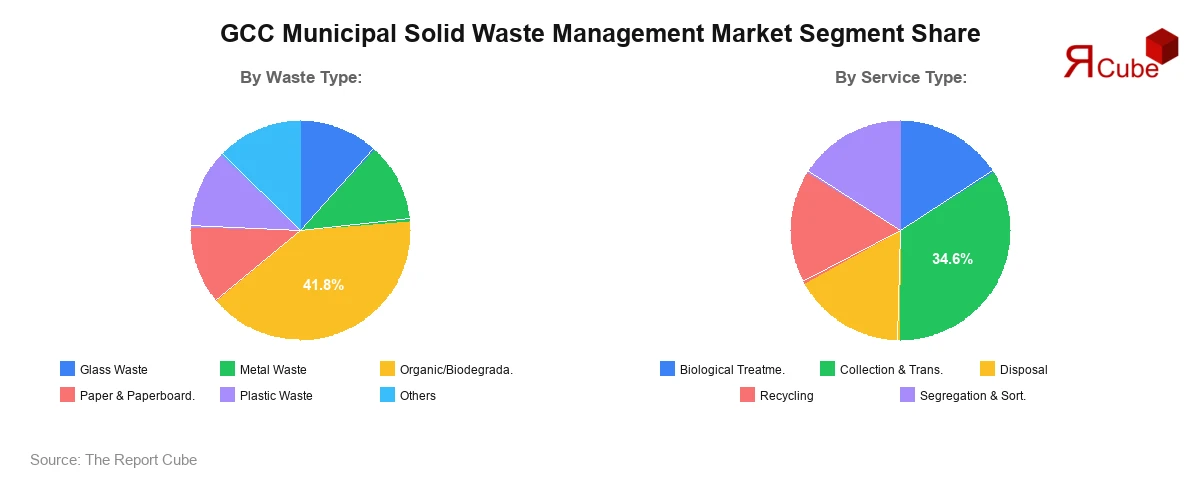
Among all waste categories, the Organic/Biodegradable Waste accounted for the largest share of nearly 41.8% of the GCC Municipal Solid Waste Management Market in 2026, making it the leading waste category across the region. The dominance of this segment reflects the high volume of food and green waste generated by households, restaurants, hotels, supermarkets, catering businesses, and food processing facilities. Rapid urbanization, population growth, and expanding tourism activities across Saudi Arabia, the United Arab Emirates, and Qatar continue to increase organic waste generation. Religious tourism and hospitality-driven developments further contribute to substantial quantities of biodegradable waste requiring organized collection and treatment throughout the year.
Governments across the GCC are strengthening investments in composting plants, bio-methanation facilities, and source-segregation programs to divert organic waste from landfills and recover valuable resources. Municipal authorities are also integrating biological treatment technologies into newly developed integrated solid waste management facilities to reduce methane emissions and improve landfill sustainability. Growing adoption of circular economy policies is encouraging the conversion of food waste into compost and renewable biogas for agricultural and industrial applications. As municipalities continue expanding sustainable municipal waste treatment infrastructure, the Organic/Biodegradable Waste segment is expected to retain its leading position while supporting higher recycling rates and long-term environmental objectives across the GCC.
By Service Type:
- Biological Treatment (Composting & Bio-methanation)
- Collection & Transportation
- Disposal
- Recycling
- Segregation & Sorting
Collection & Transportation represented the largest service segment, contributing approximately 34.6% of the GCC Municipal Solid Waste Management Market revenue in 2026. Efficient collection networks remain the foundation of municipal waste management, ensuring the timely movement of residential, commercial, and institutional waste to transfer stations, recycling facilities, and treatment plants. Rapid expansion of urban communities, commercial districts, industrial zones, and mixed-use developments has increased the demand for organized waste collection services across the GCC. Municipalities are increasingly outsourcing these operations through long-term service contracts to improve operational efficiency and service quality.
Continuous investment in smart fleet management, GPS-enabled collection vehicles, automated route optimization, and sensor-based waste monitoring systems is improving collection efficiency while lowering operating costs. Several cities are also introducing electric and low-emission waste collection vehicles to support national decarbonization goals and sustainable urban development strategies. The expansion of integrated waste management facilities has further strengthened demand for reliable transportation services capable of handling larger waste volumes and segregated waste streams. Ongoing modernization of municipal infrastructure and increasing public-private partnerships are expected to reinforce the leadership of the Collection & Transportation segment throughout the forecast period.
Regional Projection of GCC Municipal Solid Waste Management Industry
- Saudi Arabia
- United Arab Emirates
- Kuwait
- Oman
- Qatar
- Bahrain
Saudi Arabia dominates the GCC Municipal Solid Waste Management Market, accounting for approximately 46.3% of the regional market revenue in 2026. The country's leadership is supported by its large population, rapid urbanization, expanding industrial base, and ambitious infrastructure developments under Vision 2030. Mega projects such as NEOM, The Red Sea Project, Qiddiya, Diriyah Gate, and ROSHN communities are significantly increasing municipal solid waste generation while creating substantial demand for integrated municipal waste collection, recycling, treatment, and disposal services. Rising consumption levels, expanding retail activities, and strong residential construction continue to generate higher volumes of organic waste, plastic waste, paper waste, and construction-related municipal refuse throughout major cities including Riyadh, Jeddah, Dammam, and Makkah.
The Saudi government continues to accelerate investments in circular economy infrastructure through the Saudi Investment Recycling Company (SIRC), National Center for Waste Management (MWAN), and partnerships with international waste management companies. Large-scale material recovery facilities, refuse-derived fuel plants, engineered landfills, and waste-to-energy projects are gradually replacing conventional landfill disposal methods. Municipal authorities are increasingly awarding long-term public-private partnership contracts to improve operational efficiency while attracting private investment into waste infrastructure. Advanced waste collection systems, digital monitoring technologies, and automated segregation facilities are also expanding across urban centers. These initiatives, together with stricter landfill diversion targets and growing environmental awareness, are expected to reinforce Saudi Arabia's leadership in the GCC Municipal Solid Waste Management Market throughout the forecast period.
Need insights for a specific region within this market?
Request Regional DataGCC Municipal Solid Waste Management Market – Country Analysis
The GCC municipal solid waste market is expanding as urban growth, high per‑capita waste, and 2026 regulatory pushes drive advanced treatment, recycling, and waste‑to‑energy capacity across member countries.
| Country | Demand Level | Key Areas | System Dominance | Core Demand Logic | Growth Nature |
|---|---|---|---|---|---|
| Saudi Arabia | Very High | Riyadh, Jeddah, NEOM | Landfill, WtE, MRFs | Vision 2030 diversion push | Regulation‑led expansion |
| United Arab Emirates | Very High | Dubai, Abu Dhabi, Sharjah | WtE, recycling hubs | High per‑capita waste volumes | PPP‑driven capacity build |
| Kuwait | High | Kuwait City, Shagaya | Engineered landfills | Legacy dumpsite replacement | Pipeline‑project growth |
| Oman | Medium | Muscat, Sohar, Salalah | Central landfills & WtE | Dumpsite closure program | Steady infra build‑out |
| Qatar | Medium | Doha, Ras Laffan | Integrated WtE complex | Post‑event urban waste | Optimization‑focused |
| Bahrain | Medium | Manama, Hidd | Single site, new WtE | Landfill pressure relief | Catch‑up modernization |
Government Initiatives & Policies
- Saudi Arabia National Center for Waste Management (MWAN) Strategy (2025): MWAN continues implementing national waste sector reforms focused on increasing recycling rates, expanding private sector participation, improving landfill diversion, and developing integrated municipal solid waste infrastructure under Saudi Vision 2030.
- UAE Circular Economy Policy Implementation (2025): The United Arab Emirates continues expanding its Circular Economy Policy through initiatives supporting municipal waste recycling, resource recovery, sustainable waste treatment technologies, and reduced landfill dependence across all emirates.
GCC Municipal Solid Waste Management Industry Recent Developments
- 2026: Averda International Limited secured a contract with SEPCOIII to establish an Integrated Waste Management Facility for The Red Sea Project in Saudi Arabia. The project includes an automated Materials Recovery Facility, advanced incineration plant, composting system, and a solar-powered electric vehicle fleet operating across land and sea. Residual ash generated through energy recovery will be reused in brick manufacturing, supporting the project's objective of achieving zero waste to landfill during full-scale operations.
- 2025: BEEAH Group PJSC announced the Middle East's first commercial-scale waste-to-hydrogen facility in Sharjah in partnership with the UAE Ministry of Energy and Infrastructure, Chinook Hydrogen, and Air Water Inc. The facility will process municipal solid waste and difficult-to-recycle organic materials using advanced gasification and pyrolysis technology to produce approximately seven tonnes of fuel-cell-grade hydrogen per day while preventing nearly 30,000 tonnes of greenhouse gas emissions annually during its initial phase.
- 2025: Saudi Investment Recycling Company (SIRC) signed a USD 625 million Memorandum of Understanding with EIG Management Company to co-finance two strategic waste infrastructure projects in Riyadh. The agreement includes a USD 375 million refuse-derived fuel facility converting municipal waste into alternative fuel for cement production and a USD 250 million tire recycling plant producing pyrolysis oil and recycled carbon black, significantly strengthening Saudi Arabia's circular economy infrastructure and private investment landscape.
Why Choose This Report?
- Provides a comprehensive overview of the overall market analysis, encompassing key trends, consumer behavior analysis, and risk assessment to support strategic decision-making.
- Provides accurate, up-to-date insights into market size, segmentation, and emerging opportunities, helping to minimize risk while capitalizing on growth.
- Gives deep understanding of target audience preferences, investment habits, and communication channels for enhanced product development and marketing effectiveness.
- Delivers competitive analysis and benchmarking, uncovering the strengths and weaknesses of market competitors to guide strategic business decisions.
- Consolidates comprehensive market intelligence, reducing research efforts and streamlining business planning.
- Facilitates customized market segmentation and risk mitigation strategies, fine-tuned to specific business objectives.
- Aids in identifying both market challenges and untapped opportunities within the industry to drive long-term business growth.
- Provides valuable information based on actual customer data, industry developments, and evolving search trends.
Table of Contents
- Introduction
- Objective of the Study
- Product and Category Definition
- Market Segmentation
- Study Variables
- Research Methodology
- Secondary Data Points
- Breakdown of Secondary Sources
- Primary Data Points
- Breakdown of Primary Interviews
- Secondary Data Points
- Executive Summary
- Market Dynamics
- Emerging Opportunities
- Adoption Trends
- Demand Drivers
- Disruption Analysis (Challenges)
- Industry Analysis & Strategic Insights
- Supply/Value Chain Analysis
- Pricing Analysis
- Go-To-Market (GTM) Strategy
- BCG Matrix
- Recent Trends and Developments
- Import and Export Analysis
- Regulatory and Policy Landscape
- Country-wise policies
- Government Initiatives
- GCC Municipal Solid Waste Management Market Overview and Forecast Analysis (2021-2034)
- Market Size, By Value, By Growth Rate (CAGR/USD Billion)
- Market Share, By Waste Type
- Glass Waste
- Metal Waste
- Organic/Biodegradable Waste
- Paper & Paperboard
- Plastic Waste
- Others
- Market Share, By Service Type
- Biological Treatment (Composting & Bio-methanation)
- Collection & Transportation
- Disposal
- Recycling
- Segregation & Sorting
- Market Share, By End User
- Commercial
- Industrial
- Residential
- Market Share, By Country
- Saudi Arabia
- United Arab Emirates
- Kuwait
- Oman
- Qatar
- Bahrain
- Market Share, By Company
- Revenue Shares & Analysis
- Competitive Landscape
- Saudi Arabia Municipal Solid Waste Management Market Overview and Forecast Analysis (2021-2034)
- Market Size, By Value, By Growth Rate (CAGR/USD Billion/Million)
- Market Share, By Waste Type
- Market Share, By Service Type
- Market Share, By End User
- United Arab Emirates Municipal Solid Waste Management Market Overview and Forecast Analysis (2021-2034)
- Market Size, By Value, By Growth Rate (CAGR/USD Billion/Million)
- Market Share, By Waste Type
- Market Share, By Service Type
- Market Share, By End User
- Kuwait Municipal Solid Waste Management Market Overview and Forecast Analysis (2021-2034)
- Market Size, By Value, By Growth Rate (CAGR/USD Billion/Million)
- Market Share, By Waste Type
- Market Share, By Service Type
- Market Share, By End User
- Oman Municipal Solid Waste Management Market Overview and Forecast Analysis (2021-2034)
- Market Size, By Value, By Growth Rate (CAGR/USD Billion/Million)
- Market Share, By Waste Type
- Market Share, By Service Type
- Market Share, By End User
- Qatar Municipal Solid Waste Management Market Overview and Forecast Analysis (2021-2034)
- Market Size, By Value, By Growth Rate (CAGR/USD Billion/Million)
- Market Share, By Waste Type
- Market Share, By Service Type
- Market Share, By End User
- Bahrain Municipal Solid Waste Management Market Overview and Forecast Analysis (2021-2034)
- Market Size, By Value, By Growth Rate (CAGR/USD Billion/Million)
- Market Share, By Waste Type
- Market Share, By Service Type
- Market Share, By End User
- Competitive Analysis, 2026
- Market Share of Key Players
- Competitive Mapping for Each Segment and Companies Operating Countryally
- Saudi Arabia Municipal Solid Waste Management Companies Share & Competitive Analysis, 2026
- United Arab Emirates Municipal Solid Waste Management Companies Share & Competitive Analysis, 2026
- Kuwait Municipal Solid Waste Management Companies Share & Competitive Analysis, 2026
- Oman Municipal Solid Waste Management Companies Share & Competitive Analysis, 2026
- Qatar Municipal Solid Waste Management Companies Share & Competitive Analysis, 2026
- Company Profile (Partial List)
- EnviroServe Services LLC
- Company Overview
- Product Portfolio
- Strategic Alliances/Partnerships
- Recent Developments
- Veolia Middle East FZE
- Company Overview
- Product Portfolio
- Strategic Alliances/Partnerships
- Recent Developments
- Imdaad LLC
- Company Overview
- Product Portfolio
- Strategic Alliances/Partnerships
- Recent Developments
- BEEAH Group PJSC
- Company Overview
- Product Portfolio
- Strategic Alliances/Partnerships
- Recent Developments
- SEPCO Environment LLC
- Company Overview
- Product Portfolio
- Strategic Alliances/Partnerships
- Recent Developments
- Al Haya Enviro W.L.L.
- Company Overview
- Product Portfolio
- Strategic Alliances/Partnerships
- Recent Developments
- Averda International Limited
- Company Overview
- Product Portfolio
- Strategic Alliances/Partnerships
- Recent Developments
- SUEZ Middle East Recycling LLC
- Company Overview
- Product Portfolio
- Strategic Alliances/Partnerships
- Recent Developments
- Oman Environmental Services Holding Company
- Company Overview
- Product Portfolio
- Strategic Alliances/Partnerships
- Recent Developments
- Tadweer Group PJSC
- Company Overview
- Product Portfolio
- Strategic Alliances/Partnerships
- Recent Developments
- Dulsco Waste Management Services LLC
- Company Overview
- Product Portfolio
- Strategic Alliances/Partnerships
- Recent Developments
- Envac Middle East FZ-LLC
- Company Overview
- Product Portfolio
- Strategic Alliances/Partnerships
- Recent Developments
- Others (Partial List)
- EnviroServe Services LLC
- Contact Us and Disclaimer
Top Key Players & Market Share Outlook
- EnviroServe Services LLC
- Veolia Middle East FZE
- Imdaad LLC
- BEEAH Group PJSC
- SEPCO Environment LLC
- Al Haya Enviro W.L.L.
- Averda International Limited
- SUEZ Middle East Recycling LLC
- Oman Environmental Services Holding Company
- Tadweer Group PJSC
- Dulsco Waste Management Services LLC
- Envac Middle East FZ-LLC
- Others
Frequently Asked Questions






