


Build Your Custom Market Intelligence Report
Customize Your ReportSouth Korea Online Accounting Software Market Key Highlights
By Deployment Model:
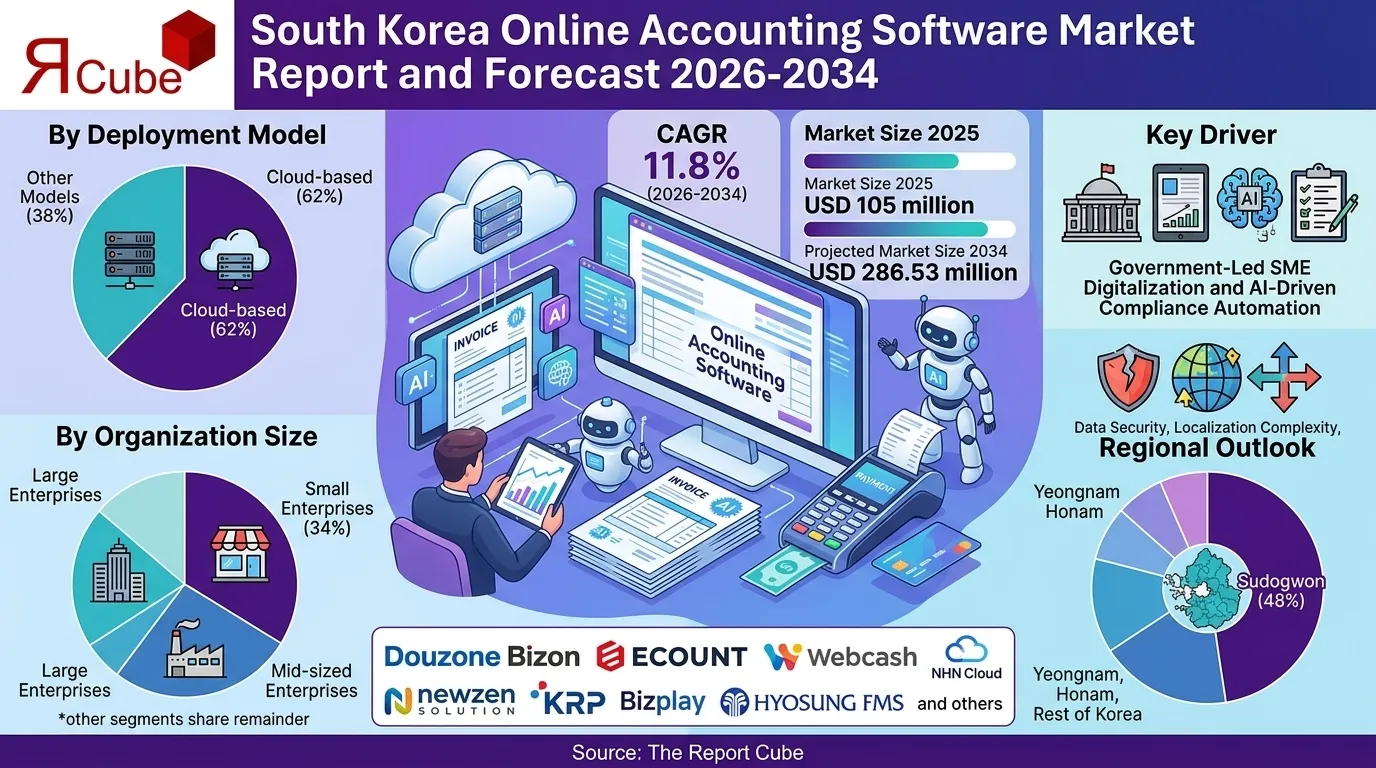
Cloud-based segment leads the market, with around 62% market share.
By Organization Size:
Small Enterprises segment dominates the market, accounting for nearly 34% of total revenue.
Regional Outlook:
Sudogwon region dominates the South Korea online accounting software market, with around 48% market share.
Government Initiatives & Policies
- Korean New Deal – Digital New Deal 2.0 (Ministry of Economy and Finance): Expanded post-2025 to accelerate SME digital transformation, cloud adoption, and AI-based financial management systems.
- National Tax Service (NTS) Digital Tax Filing Enhancement Program 2026: Initiative to upgrade e-tax invoicing, real-time VAT reporting, and AI-assisted compliance systems to support SMEs and freelancers.
South Korea Online Accounting Software Market Insights & Analysis
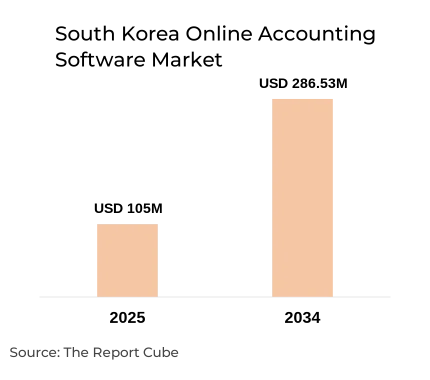
The South Korea Online Accounting Software Market is anticipated to register a CAGR of 11.8% during 2026-2034. The market size was valued at USD 105 million in 2025 and is projected to reach USD 286.53 million by 2034. South Korea’s strong digital infrastructure, near-universal broadband penetration exceeding 97%, and high SME density are shaping rapid demand for cloud-native accounting solutions. The shift toward real-time compliance, automated VAT reporting, and AI-driven bookkeeping is accelerating software upgrades across micro and small enterprises.
Investment activity has intensified since 2025, particularly in AI-powered financial automation. Domestic fintech firms are embedding AI-based reconciliation, invoice matching, and predictive cash-flow analytics into standard accounting modules. The expansion of electronic tax invoice mandates and stricter corporate reporting standards are pushing businesses away from spreadsheet-based accounting toward integrated platforms. Public cloud spending in South Korea crossed USD 6 billion in 2025, with finance and enterprise management software among the fastest-growing segments. The rise of startup ecosystems in Seoul and Pangyo Techno Valley is further increasing demand for scalable SaaS accounting tools. Additionally, ERP vendors are localizing platforms to meet Korea’s tax codes and e-filing regulations, creating competitive differentiation through compliance automation and AI-enabled audit trails.
South Korea Online Accounting Software Market Dynamics
Key Driver: Government-Led SME Digitalization and AI-Driven Compliance Automation
South Korea’s SME sector accounts for over 99% of total enterprises, creating a substantial base for accounting software adoption. Government-backed digital transformation subsidies introduced under Digital New Deal 2.0 have lowered entry barriers for micro and small businesses to adopt cloud accounting systems. At the same time, National Tax Service upgrades to electronic tax invoice systems require accurate, real-time submissions. This regulatory structure encourages automation. AI-based features such as automated expense categorization and real-time VAT estimation are reducing manual workload by up to 40% in small enterprises. Companies increasingly seek integrated payroll, invoicing, and tax filing modules to avoid compliance penalties. As labor costs rise and financial transparency expectations strengthen, businesses are shifting toward subscription-based cloud accounting models that offer scalability and regulatory updates without additional infrastructure investment.
Book your FREE 30-minute expert consultation today
Contact UsIndustry Trends: AI CFO Systems, ERP Convergence, and Embedded Finance Integration
The market is evolving beyond bookkeeping into AI-enabled financial management ecosystems. AI CFO modules now generate predictive budgeting, automated financial insights, and anomaly detection alerts. ERP-integrated accounting solutions are growing as businesses seek unified dashboards linking procurement, payroll, and financial reporting. Embedded finance is another accelerating trend, allowing direct banking integration, payment reconciliation, and automated loan eligibility checks within accounting platforms. Over 55% of mid-sized enterprises in Sudogwon adopted ERP-linked accounting modules in 2025. Mobile-first accounting dashboards are also gaining traction among freelancers and startup founders who require real-time performance tracking. Vendors are focusing on subscription flexibility and API integration capabilities, enabling compatibility with e-commerce platforms and payment gateways widely used in South Korea’s digital economy.
Major Challenge: Data Security, Localization Complexity, and High Switching Costs
Although adoption is accelerating, concerns around financial data security remain a barrier, especially for enterprises handling sensitive payroll and tax information. Korea’s strict Personal Information Protection Act (PIPA) requires enhanced encryption and local data hosting compliance, increasing vendor compliance costs. On-premises users face high switching costs when migrating legacy accounting data to cloud platforms. Customization to meet Korea’s evolving tax codes and industry-specific accounting standards also increases development complexity. Medium-sized enterprises report transition periods of three to six months during ERP-accounting integration, temporarily affecting reporting workflows. Moreover, resistance from traditional accounting firms accustomed to desktop systems slows full digital migration. Vendors must therefore invest heavily in cybersecurity certification, localized support, and migration assistance programs to maintain customer trust and reduce churn rates.
Opportunity: Expansion Among Micro Enterprises and Freelancers Through SaaS Subscription Models
The rise of gig workers and digital entrepreneurs presents strong untapped growth potential. South Korea has more than 8 million self-employed professionals, many seeking affordable, mobile-accessible accounting solutions. Cloud-based subscription pricing models below USD 20 per month are increasing penetration among micro enterprises. Integration with online marketplaces, payment gateways, and digital banking services allows automated revenue tracking for freelancers. Startups in tech and e-commerce increasingly prefer API-based systems that integrate seamlessly with CRM and inventory tools. AI-driven automation reduces the need for external bookkeeping services, enabling cost savings of up to 30% annually for small firms. As digital tax reporting requirements expand, demand from early-stage businesses and freelancers is expected to grow at a faster rate than large enterprise adoption through 2034.
South Korea Online Accounting Software Market Segment-wise Analysis
By Deployment Model:
- Cloud-based
- On-premises
- Hybrid
Cloud-based solutions hold approximately 62% of the market share in 2025, driven by scalability, subscription affordability, and regulatory update automation. SMEs prefer cloud deployment due to minimal upfront infrastructure investment and automatic compliance updates aligned with National Tax Service guidelines. Adoption among startups and tech companies grew by nearly 18% year-over-year in 2025. Cloud systems enable remote access, critical for hybrid work models prevalent across Sudogwon and Yeongnam regions. Vendors offer tiered SaaS pricing and bundled payroll-tax modules, increasing recurring revenue streams. On-premises solutions remain relevant among large enterprises requiring custom configurations, yet migration toward hybrid and cloud environments is accelerating as cybersecurity certifications strengthen confidence in cloud security frameworks.
By Organization Size:
- Micro Enterprises
- Small Enterprises
- Medium Enterprises
- Large Enterprises
Small enterprises dominate with nearly 34% revenue share, reflecting South Korea’s dense SME ecosystem. These firms require cost-efficient systems capable of handling payroll, VAT filing, and expense tracking without dedicated finance departments. Subscription-based pricing and government subsidies have increased adoption among firms with fewer than 50 employees. Automation features reduce bookkeeping time by nearly 35%, improving productivity. Medium enterprises increasingly integrate ERP-linked accounting to consolidate multi-branch financial data. Large enterprises adopt hybrid models with customized analytics dashboards, while micro enterprises are rapidly transitioning from manual bookkeeping to entry-level cloud platforms. The segment’s steady digitalization ensures sustained revenue expansion through 2034.
Regional Projection of South Korea Online Accounting Software Industry
- Sudogwon
- Yeongnam
- Honam
- Hoseo
- Gwandong
Sudogwon leads with around 48% market share, supported by Seoul’s concentration of SMEs, fintech startups, and corporate headquarters. The region benefits from advanced digital infrastructure and strong venture capital investment. Pangyo Techno Valley continues to drive SaaS innovation and ERP integration adoption. Yeongnam follows due to industrial and manufacturing clusters requiring integrated accounting and ERP systems. Honam and Hoseo are witnessing gradual adoption supported by regional SME support programs. Gwandong, though smaller in market size, shows increasing demand from tourism and service-based businesses adopting cloud-based billing and payroll systems. Regional digital readiness and enterprise density remain key determinants of adoption rates across provinces.
South Korea Online Accounting Software Market Recent Developments
- 2025: Webcash announced a full transformation into a financial AI agent company, embedding its proprietary “AI CFO” across all B2B fintech products and upgrading enterprise accounting platforms with AI-driven automation and predictive financial insights.
- 2025: Younglimwon Soft Lab launched the AI-powered ERP platform “K-System Ace I&I,” enhancing automation speed, localized tax management, and expanding globally with multi-million-dollar international contracts.
- 2025: Bizplay reported strong growth in its B2E Pay-based expense management services, stating its corporate travel module reduces accounting closing time by 70% and lowers operational expense handling costs by 72%.
Need insights for a specific region within this market?
Request Regional DataWhy Choose This Report?
- Provides a comprehensive overview of the overall market analysis, encompassing key trends, consumer behavior analysis, and risk assessment to support strategic decision-making.
- Provides accurate, up-to-date insights into market size, segmentation, and emerging opportunities, helping to minimize risk & capitalizing on growth.
- Gives deep understanding of target audience preferences, investment habits, and communication channels for enhanced product development & marketing effectiveness.
- Delivers competitive analysis & benchmarking, uncovering the strengths & weaknesses of market competitors to guide strategies.
- Consolidate comprehensive market intelligence, reducing reasoning & streamlining research efforts.
- Facilitates customized market segmentation & risk mitigation strategies, fine-tuned to the business objectives.
- Aids in identifying both market challenges & untapped opportunities within the industry to drive long-term business growth.
- Provides valuable information based on actual customer data & search trends.
Table of Contents
- Introduction
- Objective of the Study
- Product and Category Definition
- Market Segmentation
- Study Variables
- Research Methodology
- Secondary Data Points
- Breakdown of Secondary Sources
- Primary Data Points
- Breakdown of Primary Interviews
- Secondary Data Points
- Executive Summary
- Market Dynamics
- Drivers
- Challenges
- Opportunity Assessment
- Recent Trends and Developments
- Regulatory and Policy Landscape
- South Korea Online Accounting Software Market Overview (2021-2034)
- Market Size, By Value (USD Million)
- Market Share, By Deployment Model
- Cloud-based
- On-premises
- Hybrid
- Market Share, By Organization Size
- Micro Enterprises
- Small Enterprises
- Medium Enterprises
- Large Enterprises
- Market Share, By End User
- Corporate Businesses
- Accounting Firms
- Self-employed and Freelancers
- Startups and Tech Companies
- Public Sector and Government-related Entities
- Others
- Market Share, By Application
- General Accounting
- Invoicing and Billing
- Payroll Management
- Tax Compliance and Filing
- Financial Reporting and Analytics
- Expense Management
- Accounts Receivable and Payable
- Market Share, By Integration Type
- Standalone Solutions
- ERP-integrated Solutions
- Banking-integrated Solutions
- Payment Gateway-integrated Solutions
- Market Share, By Region
- Sudogwon
- Yeongnam
- Honam
- Hoseo
- Gwandong
- Market Share, By Company
- Revenue Shares and Analysis
- Competitive Landscape
- Sudogwon South Korea Online Accounting Software Market
- Market Size, By Value (USD Million)
- Market Share, By Deployment Model
- Market Share, By Organization Size
- Market Share, By End User
- Market Share, By Application
- Market Share, By Integration Type
- Yeongnam South Korea Online Accounting Software Market
- Market Size, By Value (USD Million)
- Market Share, By Deployment Model
- Market Share, By Organization Size
- Market Share, By End User
- Market Share, By Application
- Market Share, By Integration Type
- Honam South Korea Online Accounting Software Market
- Market Size, By Value (USD Million)
- Market Share, By Deployment Model
- Market Share, By Organization Size
- Market Share, By End User
- Market Share, By Application
- Market Share, By Integration Type
- Hoseo South Korea Online Accounting Software Market
- Market Size, By Value (USD Million)
- Market Share, By Deployment Model
- Market Share, By Organization Size
- Market Share, By End User
- Market Share, By Application
- Market Share, By Integration Type
- Gwandong South Korea Online Accounting Software Market
- Market Size, By Value (USD Million)
- Market Share, By Deployment Model
- Market Share, By Organization Size
- Market Share, By End User
- Market Share, By Application
- Market Share, By Integration Type
- Competitive Outlook and Company Profiles
- Douzone Bizon
- Company Overview
- Product Portfolio
- Strategic Alliances/Partnerships
- Recent Developments
- ECOUNT
- Company Overview
- Product Portfolio
- Strategic Alliances/Partnerships
- Recent Developments
- Webcash
- Company Overview
- Product Portfolio
- Strategic Alliances/Partnerships
- Recent Developments
- Younglimwon Soft Lab
- Company Overview
- Product Portfolio
- Strategic Alliances/Partnerships
- Recent Developments
- Newzen Solution
- Company Overview
- Product Portfolio
- Strategic Alliances/Partnerships
- Recent Developments
- KRP (Korea Recording)
- Company Overview
- Product Portfolio
- Strategic Alliances/Partnerships
- Recent Developments
- Bizplay
- Company Overview
- Product Portfolio
- Strategic Alliances/Partnerships
- Recent Developments
- Hyosung FMS
- Company Overview
- Product Portfolio
- Strategic Alliances/Partnerships
- Recent Developments
- NHN Cloud
- Company Overview
- Product Portfolio
- Strategic Alliances/Partnerships
- Recent Developments
- SAP Korea
- Company Overview
- Product Portfolio
- Strategic Alliances/Partnerships
- Recent Developments
- Oracle Korea
- Company Overview
- Product Portfolio
- Strategic Alliances/Partnerships
- Recent Developments
- D-Bridge
- Company Overview
- Product Portfolio
- Strategic Alliances/Partnerships
- Recent Developments
- SoftOne
- Company Overview
- Product Portfolio
- Strategic Alliances/Partnerships
- Recent Developments
- Taxway (Sbliss)
- Company Overview
- Product Portfolio
- Strategic Alliances/Partnerships
- Recent Developments
- Fin2B
- Company Overview
- Product Portfolio
- Strategic Alliances/Partnerships
- Recent Developments
- Tiger Company
- Company Overview
- Product Portfolio
- Strategic Alliances/Partnerships
- Recent Developments
- Jobis & Villains
- Company Overview
- Product Portfolio
- Strategic Alliances/Partnerships
- Recent Developments
- Others
- Douzone Bizon
- Contact Us and Disclaimer
Top Key Players & Market Share Outlook
- Douzone Bizon
- ECOUNT
- Webcash
- Younglimwon Soft Lab
- Newzen Solution
- KRP (Korea Recording)
- Bizplay
- Hyosung FMS
- NHN Cloud
- SAP Korea
- Oracle Korea
- D-Bridge
- SoftOne
- Taxway (Sbliss)
- Fin2B
- Tiger Company
- Jobis & Villains
Frequently Asked Questions