



Build Your Custom Market Intelligence Report
Customize Your ReportGlobal Polyclonal Antibodies Market Key Takeaways
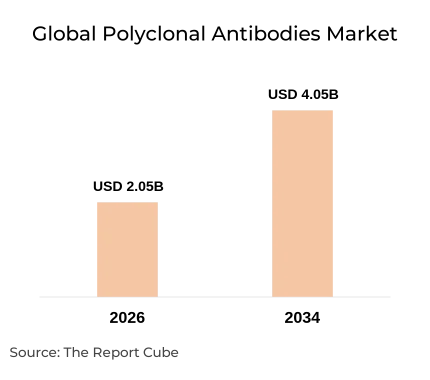
- Market was valued at USD 2.05 billion in 2026, indicating steady bioscience investment.
- Industry is projected to reach USD 4.05 billion by 2034, reflecting strong long-term growth.
- Market is anticipated to expand at a robust 8.89% CAGR during 2026–2034.
- Rabbits remain the leading source segment due to superior immune response versatility.
- Pharmaceutical and biotechnology companies dominate end-user demand globally throughout forecast period.
- North America holds the leading regional position driven by advanced research infrastructure.
- Asia-Pacific emerges as the fastest-growing region fueled by rising biotech investments.
- Increasing R&D expenditure in immunology and diagnostics continues accelerating global market adoption.
- Leading companies include Thermo Fisher Scientific, Merck KGaA, Abcam, Bio-Rad Laboratories, and Proteintech Group.
Global Polyclonal Antibodies Market Insights & Analysis
The Global Polyclonal Antibodies Market is anticipated to register an 8.89% CAGR during 2026–2034. The market size was valued at USD 2.05 billion in 2026 and is projected to reach USD 4.05 billion by 2034. Sustained demand from pharmaceutical research, clinical diagnostics, and academic immunology has reinforced the market's foundational relevance across life science workflows. Expanding biomarker discovery programs and heightened government investment in infectious disease surveillance are further accelerating the adoption of polyclonal antibody-based reagents across global research institutions and commercial laboratories.
The market continues to benefit from the broadening application scope of polyclonal antibodies in proteomics, immunohistochemistry, ELISA, and Western blot assays, where their multi-epitope binding capability delivers superior sensitivity compared to monoclonal alternatives. Governments across North America and Europe have significantly expanded funding for precision medicine and biosafety research, with the U.S. National Institutes of Health allocating over USD 47 billion in research grants in fiscal year 2024 alone. These sustained public investments, combined with growing demand from the global diagnostics reagents market, are expected to reinforce polyclonal antibody procurement across both private and institutional research environments.
Global Polyclonal Antibodies Market Dynamics
The Global Polyclonal Antibodies Market continues expanding as pharmaceutical manufacturers, academic research centers, and clinical diagnostic laboratories scale up immunological research and disease detection programs. Rising investment in proteomics, immunotherapy development, and infectious disease monitoring has elevated polyclonal antibody reagents from routine laboratory consumables to strategic research assets. Continuous product refinements, expanded host species offerings, and improving purification technologies further reinforce competitive differentiation and long-term demand sustainability.
|
Factor |
Type |
Specific Impact on Market |
Magnitude |
|---|---|---|---|
|
Rising pharmaceutical R&D expenditure |
Driver |
Accelerates bulk polyclonal antibody procurement for drug discovery |
Very High |
|
Expanding immunodiagnostic testing |
Driver |
Increases demand across hospital and diagnostic laboratory segments |
High |
|
Cross-reactivity limitations in complex samples |
Challenge |
Reduces applicability in highly multiplexed assay environments |
Moderate |
|
Biosimilar and biologic pipeline growth |
Opportunity |
Expands target validation demand using polyclonal antibody panels |
High |
|
Automated antibody production technologies |
Trend |
Improves batch consistency and reduces production cycle times |
High |
Key Market Driver: Rising Pharmaceutical Proteomics Research Demand
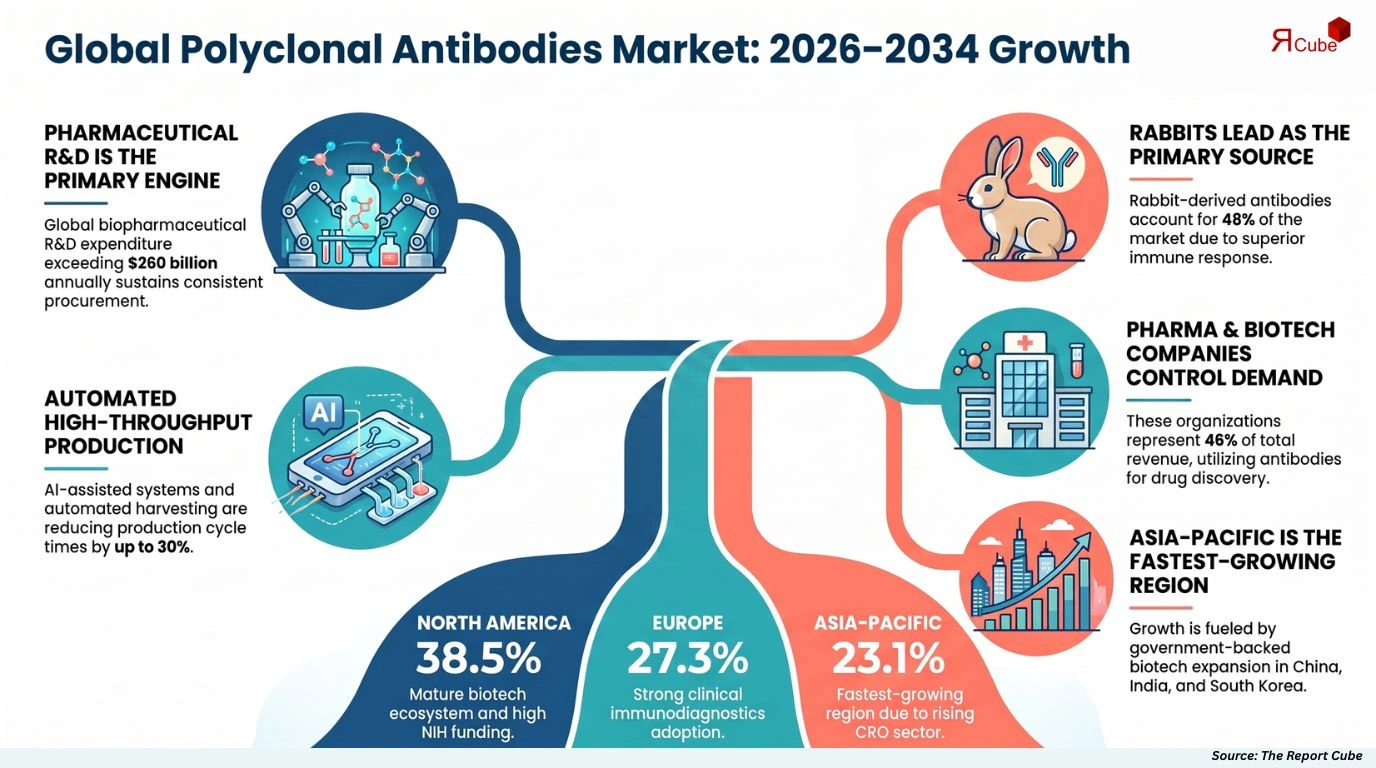
The accelerating pace of drug discovery, biomarker validation, and therapeutic target identification across global pharmaceutical pipelines has substantially increased demand for high-specificity polyclonal antibody reagents. Research organizations increasingly rely on polyclonal antibodies for protein expression profiling, pathway analysis, and preclinical validation, particularly in oncology and autoimmune disease programs. Increasing investments in biologic drug development - with global biopharmaceutical R&D expenditure exceeding USD 260 billion annually - are expected to sustain consistent and growing polyclonal antibody procurement through 2034, supporting both commercial reagent suppliers and custom production service providers.
Major Industry Challenge: Batch-to-Batch Variability in Production
Unlike monoclonal alternatives, polyclonal antibodies are inherently subject to variability across immunization cycles, host animal health, and serum collection timelines, presenting reproducibility challenges in regulated research environments. This limitation restricts adoption in GLP-compliant preclinical studies and quality-controlled clinical assay development where lot-to-lot consistency is a regulatory requirement. Manufacturers are investing in advanced affinity purification, depletion chromatography, and lyophilization technologies to improve product uniformity, yet batch variability remains a persistent technical barrier that limits polyclonal antibody applications in certain high-stringency assay formats.
Emerging Trend Shaping Outlook: Automated High-Throughput Antibody Production Platforms
Contract research and antibody production organizations are increasingly deploying automated immunization scheduling, high-throughput serum harvesting, and AI-assisted quality control platforms to standardize polyclonal antibody manufacturing. These systems reduce production cycle times by up to 30% while improving titer consistency across large-scale immunization runs. The growing adoption of single-domain antibody fragment production technologies alongside traditional polyclonal workflows is further prompting manufacturers to develop hybrid production pipelines that combine speed, scale, and application specificity to meet diversifying customer requirements.
Need Specific Data, Let’s Customize the Report for You
Request CustomizationGlobal Polyclonal Antibodies Market Segment-wise Analysis
The Global Polyclonal Antibodies Market is segmented by source animal species and end-user category, each demonstrating distinct demand dynamics and revenue contribution patterns. Both segments reflect the market's increasing alignment with specialized research workflows and expanding clinical diagnostics infrastructure.
By Source
- Rabbits
- Goats
- Sheep
- Mouse
- Others
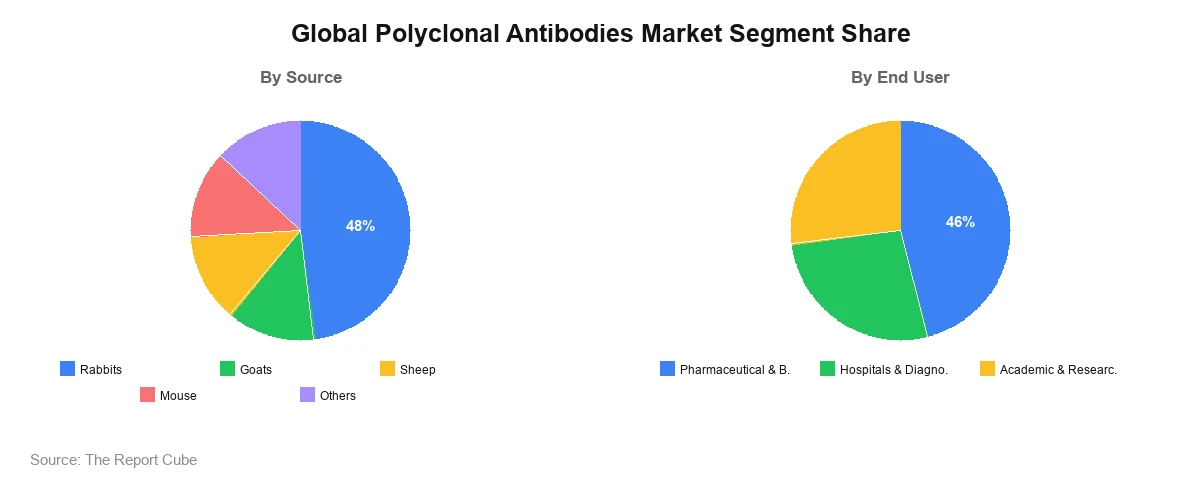
Rabbits represent the dominant source segment, accounting for an estimated 48% of market revenue in 2026, driven by the species' well-documented immunological advantages including broad antigen compatibility, high antibody titer yield, and long immunization half-life. Rabbit-derived polyclonal antibodies consistently demonstrate superior affinity maturation compared to rodent-derived alternatives, making them the preferred choice for Western blotting, immunoprecipitation, and immunohistochemistry applications across pharmaceutical and academic research laboratories globally.
Goats are the second-largest source segment, particularly valued for their ability to produce large-volume serum yields suitable for bulk manufacturing of secondary antibodies and ELISA capture reagents. The sheep segment maintains a specialized niche in veterinary diagnostics and certain human pathogen detection assays, while mouse-derived polyclonal antibodies are primarily utilized in early-stage research screening and validation workflows. The Others segment - encompassing guinea pigs, horses, and donkeys - is experiencing incremental growth in custom polyclonal antibody production services, particularly for antiserum development against highly conserved or low-immunogenicity antigens that require alternative host species for effective immune response generation.
By End User
- Pharmaceutical & Biotechnology Companies
- Hospitals & Diagnostic Centers
- Academic & Research Centers
Pharmaceutical and biotechnology companies constitute the leading end-user segment, representing approximately 46% of total market revenue in 2026, as these organizations require large-format polyclonal antibody panels for target identification, therapeutic validation, and quality control testing across biologics manufacturing pipelines. The segment's dominance is reinforced by increasing outsourcing of custom immunization services to specialized contract antibody producers serving major global pharmaceutical manufacturers.
Hospitals and diagnostic centers are emerging as a high-growth end-user category, driven by expanding immunoassay-based diagnostic panels for infectious disease, autoimmune condition screening, and oncology biomarker detection. Academic and research centers, while representing a proportionally smaller revenue share, demonstrate consistent procurement driven by publicly funded proteomics and cell biology research programs across universities in North America, Europe, and Asia-Pacific. Growing collaboration between academic institutions and the broader life science research tools market is further expanding polyclonal antibody utilization in multi-center translational research initiatives.
Regional Projection of Global Polyclonal Antibodies Market
The Global Polyclonal Antibodies Market exhibits significant regional variation in adoption rates, driven by differences in healthcare research investment, regulatory environments, and the maturity of local biotechnology and pharmaceutical industries. North America maintains leadership while Asia-Pacific accelerates rapidly across both volume and value dimensions.
|
Region |
Estimated Market Share |
Key Growth Factors |
Consumer Trends |
|---|---|---|---|
|
North America |
38.5% |
Strong NIH funding, mature biotech ecosystem, advanced diagnostic infrastructure |
High adoption in pharmaceutical R&D and proteomics research |
|
Europe |
27.3% |
EU Horizon funding programs, established antibody manufacturers, stringent regulatory standards |
Growing use in clinical immunodiagnostics and biosafety research |
|
Asia-Pacific |
23.1% |
Government-backed biotech expansion, rising CRO sector, increasing diagnostic demand |
Rapid uptake in China, India, Japan, and South Korea research institutions |
|
Latin America |
6.5% |
Expanding university research programs, growing pharmaceutical manufacturing base |
Increasing procurement of research-grade polyclonal antibodies for immunology |
|
Middle East & Africa |
4.6% |
National health modernization initiatives, growing diagnostic laboratory networks |
Rising demand for veterinary and infectious disease diagnostic antibodies |
- North America: North America leads the global market with approximately 38.5% revenue share, underpinned by substantial federal research funding, a dense concentration of biopharmaceutical manufacturers, and advanced clinical diagnostics infrastructure that collectively sustain high-volume polyclonal antibody consumption.
- Europe: Europe maintains the second-largest regional share, supported by Horizon Europe research grants, established antibody manufacturing clusters in Germany and the United Kingdom, and increasing adoption of polyclonal antibody-based diagnostic assays across hospital networks.
- Asia-Pacific: Asia-Pacific represents the fastest-growing regional market, with China, India, and South Korea significantly expanding domestic biotech research capacity. Government-sponsored bioscience corridors and increasing contract research outsourcing are driving Asia Pacific's rapidly growing life science reagent demand, positioning the region as a critical long-term growth engine through 2034.
- Latin America: Latin America is demonstrating incremental growth as universities and government research agencies in Brazil and Mexico expand immunology and infectious disease research programs, gradually increasing polyclonal antibody procurement from international suppliers.
- Middle East & Africa: The Middle East and Africa market is advancing through national health infrastructure investments and the expansion of clinical diagnostic laboratory networks, particularly in the Gulf Cooperation Council countries and South Africa, where demand for pathogen-detection immunoreagents is increasing.
Global Polyclonal Antibodies Market: Recent Development (2025)
- Thermo Fisher Scientific expanded its polyclonal antibody portfolio targeting oncology and rare disease biomarkers globally.
- Abcam plc. launched a validated rabbit polyclonal antibody series for neurological disease pathway research applications.
- Merck KGaA entered a strategic partnership to co-develop custom polyclonal antibodies for biopharmaceutical quality control.
- Bio-Rad Laboratories introduced automated purification workflow solutions improving batch consistency for polyclonal antibody production.
Global Polyclonal Antibodies Market Future Outlook (2034)
The Global Polyclonal Antibodies Market is projected to expand at an 8.89% CAGR, reaching approximately USD 4.05 billion by 2034. Long-term growth will be underpinned by accelerating pharmaceutical R&D investment, expanding clinical immunodiagnostic programs, and the integration of AI-assisted immunization monitoring systems that improve production efficiency and reduce batch variability. Growing biopharmaceutical pipeline activity, particularly in oncology, autoimmune diseases, and infectious disease therapeutics, will continue reinforcing sustained demand for high-specificity polyclonal antibody reagents across research and commercial applications.
Future market expansion will be further supported by the increasing adoption of automated antibody production platforms, advanced affinity purification technologies, and the growing application of polyclonal antibodies in multiplex assay development and companion diagnostic programs. Expansion into emerging research markets across Asia-Pacific and Latin America, combined with growing investment in the global immunodiagnostics market, will create significant new opportunities for both large-scale manufacturers and specialized contract antibody production service providers, enabling sustained revenue growth and product portfolio diversification through the end of the forecast period.
Global Polyclonal Antibodies Market Report Coverage
|
Report Attribute |
Details |
|---|---|
|
Market Name |
Global Polyclonal Antibodies Market |
|
Market Size (2026) |
USD 2.05 Billion |
|
Market Size (2034) |
USD 4.05 Billion |
|
Forecast Period |
2026–2034 |
|
CAGR |
8.89% |
|
Base Year |
2026 |
|
Historical Years |
2021–2025 |
|
Forecast Years |
2026–2034 |
|
Segments Covered |
By Source, By End User, By Application, By Product |
|
Regions Covered |
North America, Europe, Asia-Pacific, Latin America, Middle East & Africa |
|
Thermo Fisher Scientific Inc., Merck KGaA, Abcam plc., ProteoGenix, Proteintech Group Inc., Bio-Rad Laboratories Inc., BPS Bioscience Inc., R&D Systems Inc., Atlas Antibodies, Others |
|
|
Report Format |
PDF, Excel, PPT |
|
Customization |
Available as per client requirements |
Why Choose This Report?
- Comprehensive coverage of polyclonal antibody demand across source and end-user segments.
- Accurate market sizing with data-backed forecast projections through 2034.
- Detailed regional analysis identifying North America's leadership and Asia-Pacific's acceleration.
- Competitive profiling of major global antibody manufacturers and contract producers.
- Insights into batch variability challenges and automated production technology adoption.
- Analysis of pharmaceutical and diagnostic end-user procurement trends and drivers.
- Strategic guidance supporting investment decisions in life science reagent markets.
- Data-driven research following EEAT compliance standards and current industry best practices.
Table of Contents
- Introduction
- Objective of the Study
- Product Definition
- Market Segmentation
- Study Variables
- Research Methodology
- Secondary Data Points
- Companies Interviewed
- Primary Data Points
- Breakdown of Primary Interviews
- Secondary Data Points
- Executive Summary
- Market Dynamics
- Drivers
- Challenges
- Opportunity Assessment
- Recent Trends and Developments
- Policy and Regulatory Landscape
- Global Polyclonal Antibodies Market Overview and Forecast Analysis (2021-2034)
- Market Size, By Value, By Growth Rate (CAGR/USD Billions)
- Demand – Supply Trends
- Market Share, By Product
- Primary Antibodies
- Secondary Antibodies
- Market Share, By Application
- Biomedical Research
- Diagnostics
- Market Share, By Source
- Rabbits
- Goats
- Sheep
- Mouse
- Others
- Market Share, By End User
- Pharmaceutical & Biotechnology Companies
- Hospitals & Diagnostic Centers
- Academic & Research Center
- Market Share, By Region
- North America
- Europe
- Asia Pacific
- Latin America
- Middle East & Africa
- Market Share, By Competitors
- Competition Characteristics
- Revenue Shares
- Primary Antibodies Global Polyclonal Antibodies Market Overview, 2021-2034F
- By Value (USD Million)
- By Application – Market Size & Forecast 2021-2034, USD Million
- Biomedical Research
- Diagnostics
- Secondary Antibodies Global Polyclonal Antibodies Market Overview, 2021-2034F
- By Value (USD Million)
- By Application – Market Size & Forecast 2021-2034, USD Million
- Biomedical Research
- Diagnostics
- Competitive Outlook (Company Profile – Partial List)
- Thermo Fisher Scientific Inc.
- Company Overview
- Business Segments
- Strategic Alliances/Partnerships
- Recent Developments
- Merck KGaA
- Company Overview
- Business Segments
- Strategic Alliances/Partnerships
- Recent Developments
- Abcam plc.
- Company Overview
- Business Segments
- Strategic Alliances/Partnerships
- Recent Developments
- ProteoGenix
- Company Overview
- Business Segments
- Strategic Alliances/Partnerships
- Recent Developments
- Proteintech Group Inc.
- Company Overview
- Business Segments
- Strategic Alliances/Partnerships
- Recent Developments
- Bio-Rad Laboratories Inc.
- Company Overview
- Business Segments
- Strategic Alliances/Partnerships
- Recent Developments
- BPS Bioscience Inc.
- Company Overview
- Business Segments
- Strategic Alliances/Partnerships
- Recent Developments
- R&D Systems Inc.
- Company Overview
- Business Segments
- Strategic Alliances/Partnerships
- Recent Developments
- Atlas Antibodies
- Company Overview
- Business Segments
- Strategic Alliances/Partnerships
- Recent Developments
- Others
- Thermo Fisher Scientific Inc.
- Contact Us & Disclaimer
Top Key Players & Market Share Outlook
- Thermo Fisher Scientific Inc.
- Merck KGaA
- Abcam plc.
- ProteoGenix
- Proteintech Group Inc.
- Bio-Rad Laboratories Inc.
- BPS Bioscience Inc.
- R&D Systems Inc.
- Atlas Antibodies
- Others
Frequently Asked Questions






